
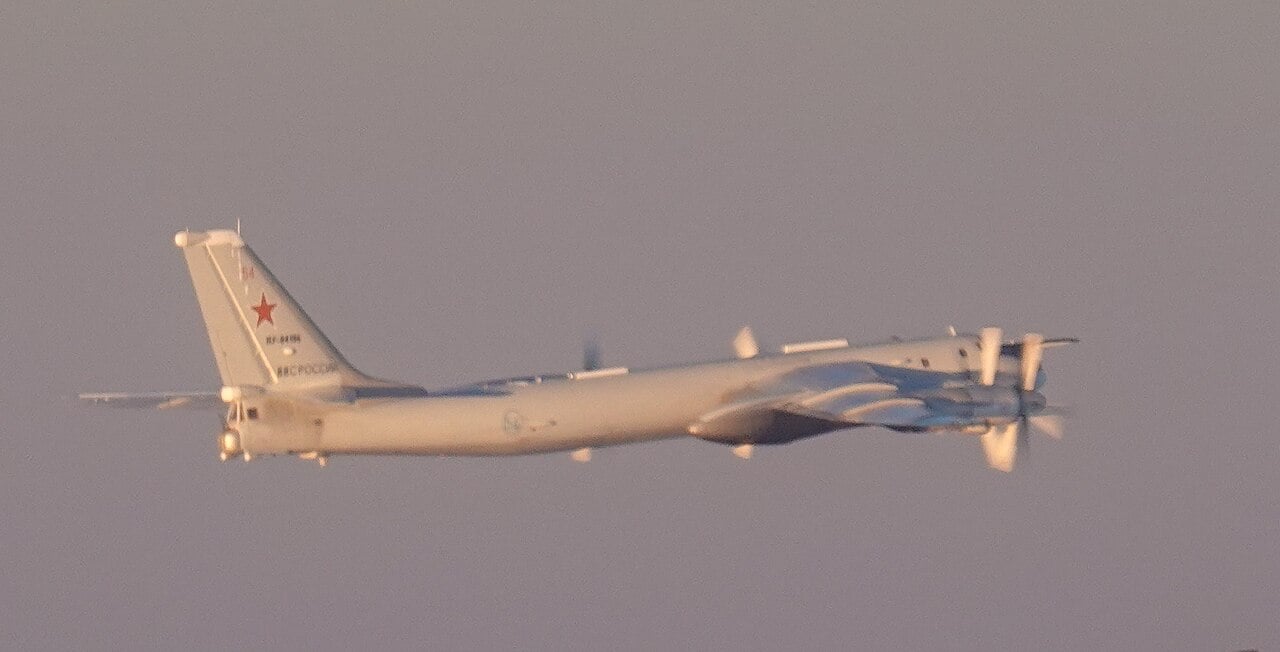
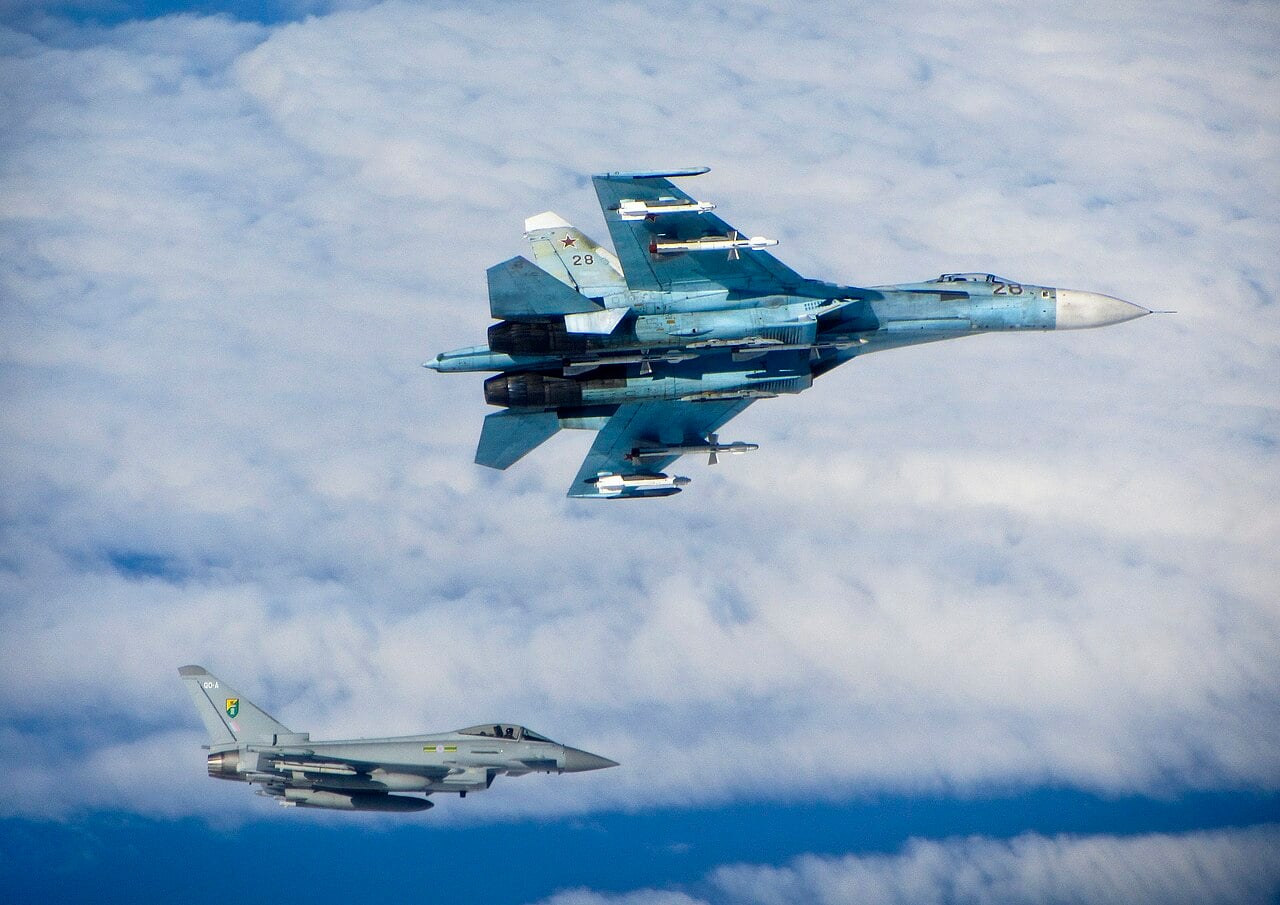
On 17 June 2014, RAF Typhoons from 3 (Fighter) Squadron were scrambled to intercept four separate groups of Russian aircraft over the Baltic. The RAF’s own account of what they found reads like this: a Tu-22 Backfire bomber, four Su-27 Flankers, an A-50 Mainstay early warning aircraft, and an An-26 Curl transport.
Backfire. Flanker. Mainstay. Curl. Those are NATO reporting names, and not one of them is a Russian word, and not one of them was chosen by the people who built the aircraft. They exist because at some point a fighter controller has to say, over a radio, in a hurry, exactly what is out there — and “Sukhoi Su-27” and “Sukhoi Su-24” sound far too much alike when the transmission is poor and the closure rate is not.
Datos rápidos
| What they are | Short code names for Soviet, Russian, Chinese and other non-Western military aircraft and missiles |
| Who assigns them | The Five Eyes Air Force Interoperability Council, based in Washington DC — formerly the ASCC, then ASIC. Not NATO itself. |
| Members | Australia, Canada, New Zealand, the United Kingdom and the United States |
| Introduced | The 1950s, replacing a numbered “Type” system used from 1947 |
| First letter | B bomber, C cargo, F fighter, H helicopter, M miscellaneous |
| Syllables | One syllable means propeller or turboprop; two or more means jet. Helicopters are exempt. |
| Variants | Suffix letters, as in Bear-A, Fulcrum-A2 or Flanker-E variant 1 |
| Why odd words | Deliberately uncommon or invented words, so they cannot be confused with ordinary speech |
| Missiles | A air-to-air, K air-to-surface (from the Russian Kh), G ground-to-air, S surface-to-surface |
The System Is Not Actually NATO’s
Everyone calls them NATO reporting names, including NATO, and the label is not quite right. The names are chosen by the Five Eyes Air Force Interoperability Council, a body based in Washington whose members are Australia, Canada, New Zealand, the United Kingdom and the United States. Three of those are NATO members and two are not. Over its life the organisation has been the Air Standardization Coordinating Committee, then the Air and Space Interoperability Council, and now AFIC; the names it hands out get forwarded to NATO in a single list, which is how NATO ended up with the credit.
Missile names come from elsewhere again, and the numbered designations you see alongside them — AA-2, SA-6, SS-1 — are American, allocated by the US Department of Defense, not by NATO.
The Rules Hidden in the Words
NATO reporting names are far more disciplined than they look from outside, and once you know the two rules you can read almost any reporting name cold.
The first letter gives the job. B is a bomber, so Tu-16 Badger, Tu-160 Blackjack, and the Tu-95 Bear. C is cargo, so An-124 Condor and Il-76 Candid. F is a fighter — MiG-29 Fulcrum, Su-27 Flanker, MiG-25 Foxbat, MiG-31 Foxhound — and later also ground attack aircraft, which is why the Su-25 Frogfoot is an F. H is every kind of helicopter, so Mi-24 Hind and Ka-50 Hokum. M is everything else: trainers, reconnaissance, maritime patrol, tankers, radar aircraft. That is why the A-50 the RAF met over the Baltic is Mainstay and the Il-78 tanker is Midas.
The number of syllables gives the engine. One syllable means a piston or turboprop aircraft. Two or more means a jet. Bear is one syllable and the Tu-95 turns propellers. Badger is two and the Tu-16 is a jet. Fulcrum, Flanker, Foxbat, Frogfoot, Blackjack, Backfire, Candid, Condor — all jets, all multi-syllable. Helicopters are exempt from the rule, which is why Hind and Havoc sit side by side with no contradiction.
Armor Cast on how Russian aircraft and missiles get their Western names.
Before the Names, There Were Numbers
The first Western attempt at this was cruder. From 1947 the US simply numbered new Soviet types in the order it found them: Type 1 for the MiG-9, Type 14 for the MiG-15, Type 27 for the Il-28, Type 39 for the Tu-16, Type 40 for the Tu-95. Strict numerical sequence, no information carried in the label, and no way of saying one out loud that did not sound like an altitude or a heading. The system was abandoned in 1955 as obviously impractical, and the reporting names took over.
There is a third layer that outsiders rarely see. When a new aircraft is spotted but not yet identified — typically by satellite over a test airfield — it gets a temporary code built from the place it was seen plus a letter. Ramenskoye, the flight test centre outside Moscow, supplied a long run of them. RAM-J turned out to be the Su-25. RAM-K became the Su-27 Flanker. RAM-L became the MiG-29 Fulcrum. RAM-P became the Tu-160 Blackjack. VLAD-A, seen at Vladimirovka, became the MiG-25 Foxbat.
For a few years in the late 1970s, Western analysts were writing intelligence assessments about “Ram-K” and “Ram-L” without knowing what either aircraft was called, what it was for, or quite how good it was going to be.
Nobody Asked the Russians
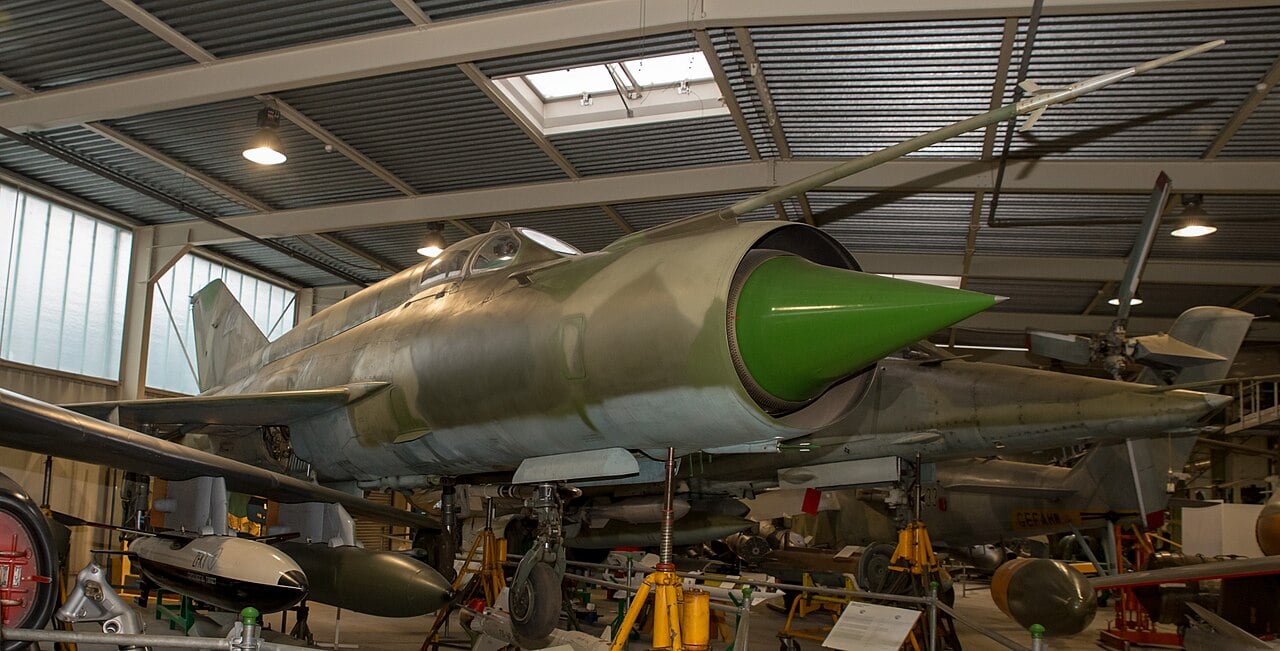
The words used for NATO reporting names are chosen to be uncommon or invented, precisely so they cannot turn up by accident in ordinary speech. That is also why so many of them sound faintly insulting. Fishbed. Frogfoot. Crusty for the Tu-134. Mule, Maiden, Mongol, Madge. Soviet crews largely ignored them and used their own nicknames instead, which is the normal fate of a name assigned to you by somebody who is planning to shoot at you.
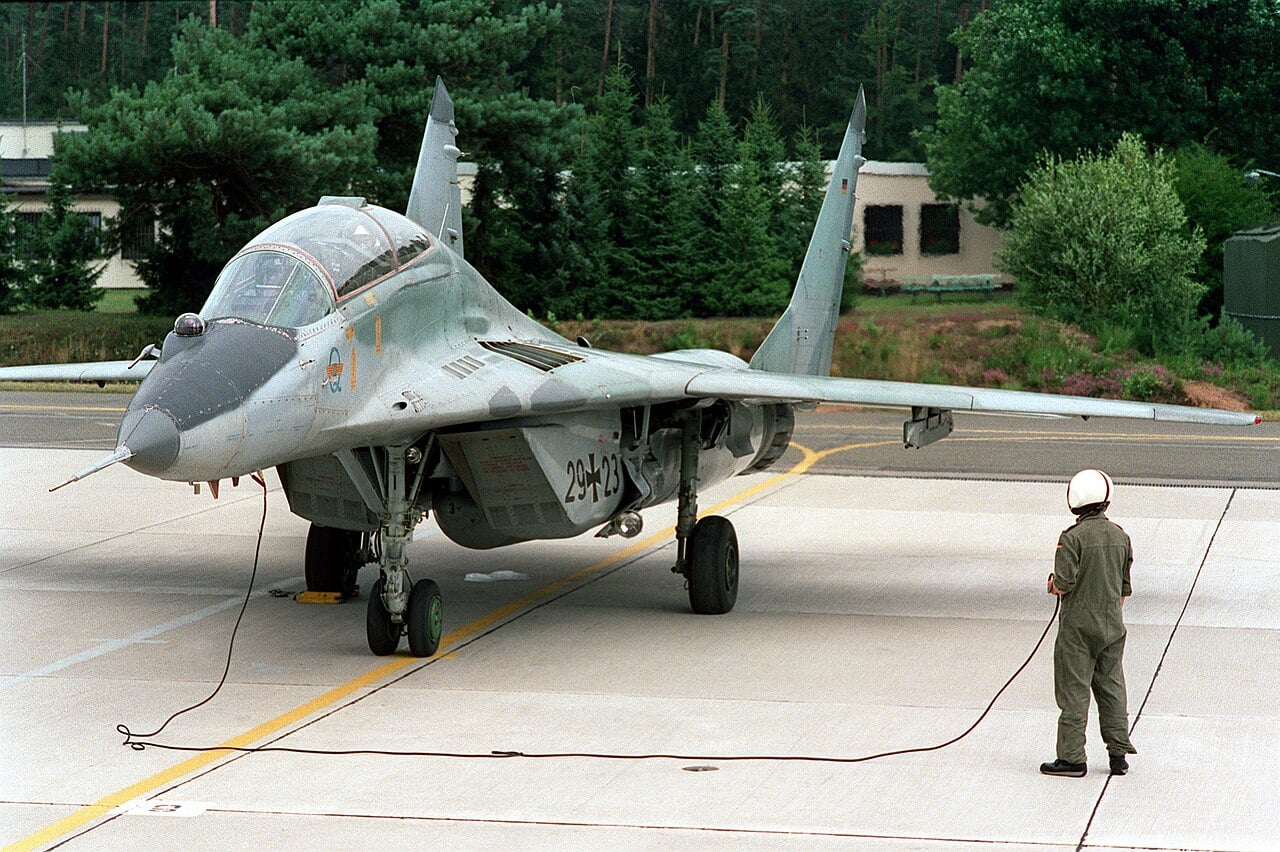
A few landed well anyway. Fulcrum is a good word for an aircraft, and it is the one exception that has genuinely stuck: when Germany reunified in 1990, the Luftwaffe inherited East Germany’s MiG-29s and flew them for years — a NATO air force operating an aircraft whose NATO name had been invented to identify it as a threat.
The system also produces the occasional ghost. Names have been allocated to aircraft that turned out not to exist, or to prototypes that never entered service, because the name was assigned when a shape was first seen rather than when a programme was confirmed. And there is no official public list of any of it: reporting names have been revealed and confirmed over decades, mostly for equipment long out of service, while names for the newest types are frequently just the defence press’s best guess.
A second walk through the code letters, the syllable rule and the variant suffixes.
Which is the quiet joke at the centre of the whole thing. The best known names in Russian military aviation — the ones that appear in headlines, in books, in flight simulators and on model boxes — were made up in Washington, by a committee, to be shouted over a radio.
Sources: Wikipedia entry for NATO reporting names; Andreas Parsch, Western Designations of Soviet/Russian and Chinese Military Aircraft and Missiles, designation-systems.net, including the Type number and temporary identification code tables; UK Ministry of Defence release on the RAF Typhoon intercept of 17 June 2014.
0 Comments