
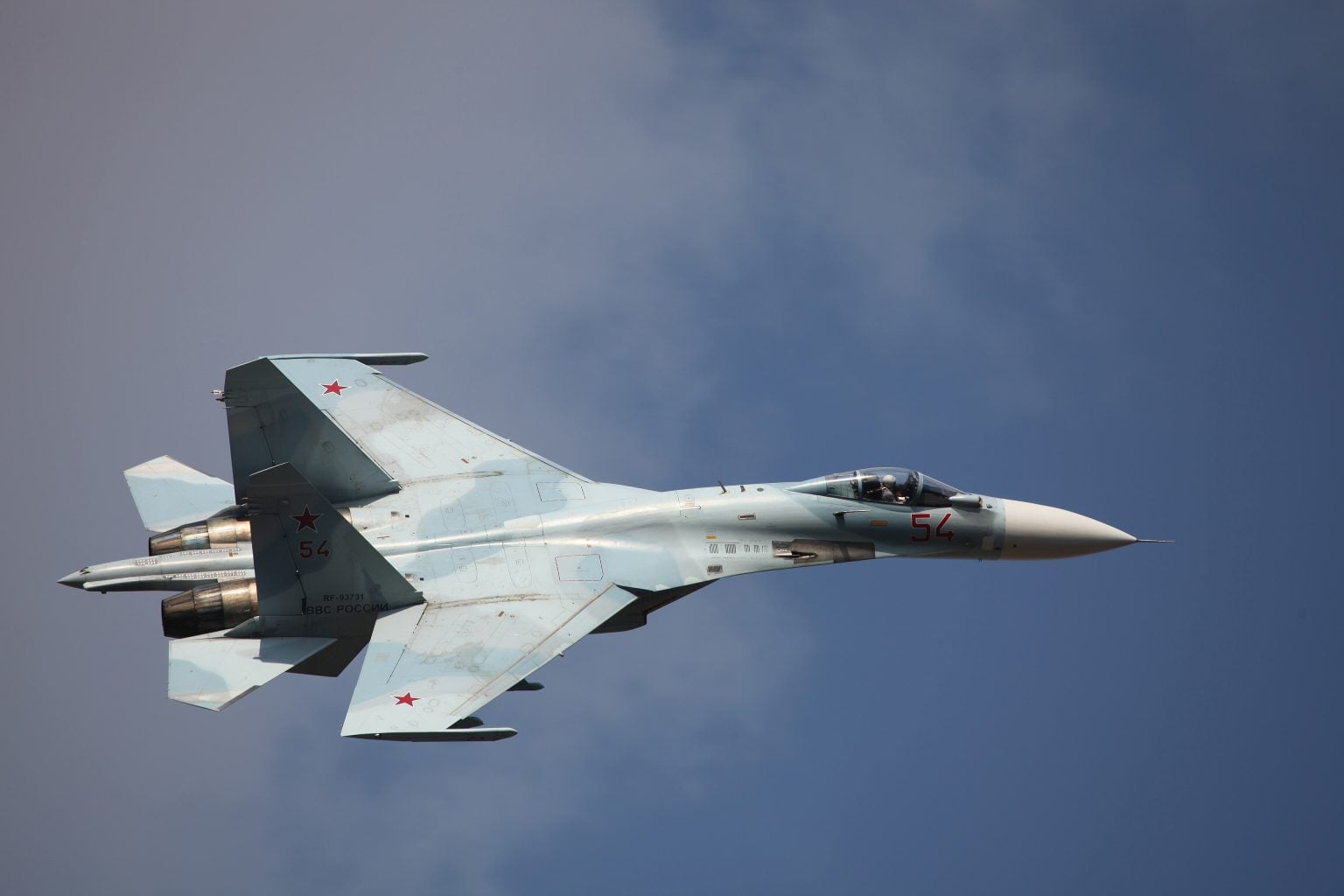
Sukhoi Su-27
“Flanker”
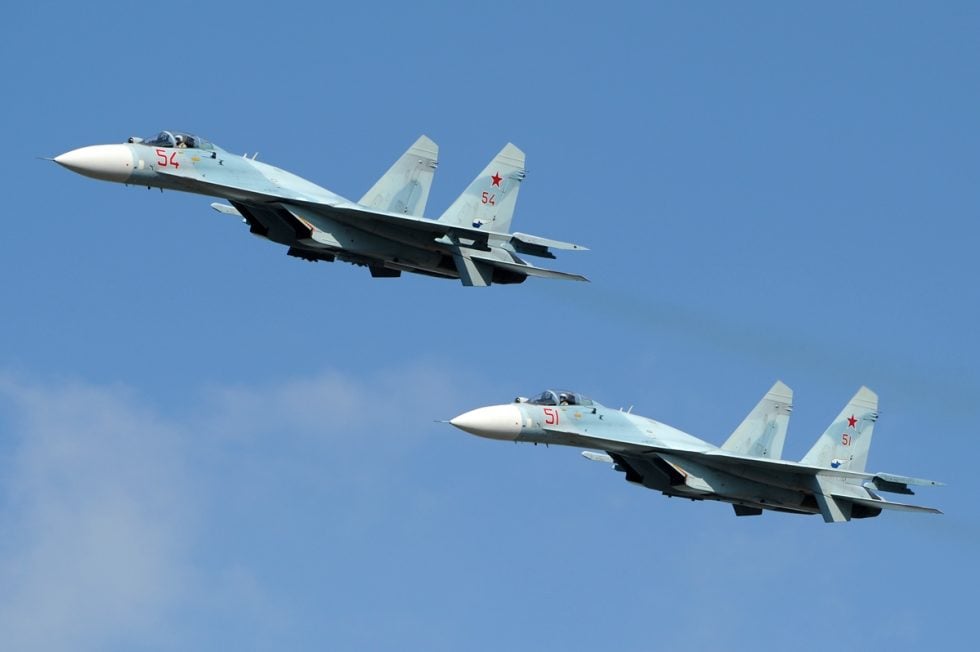
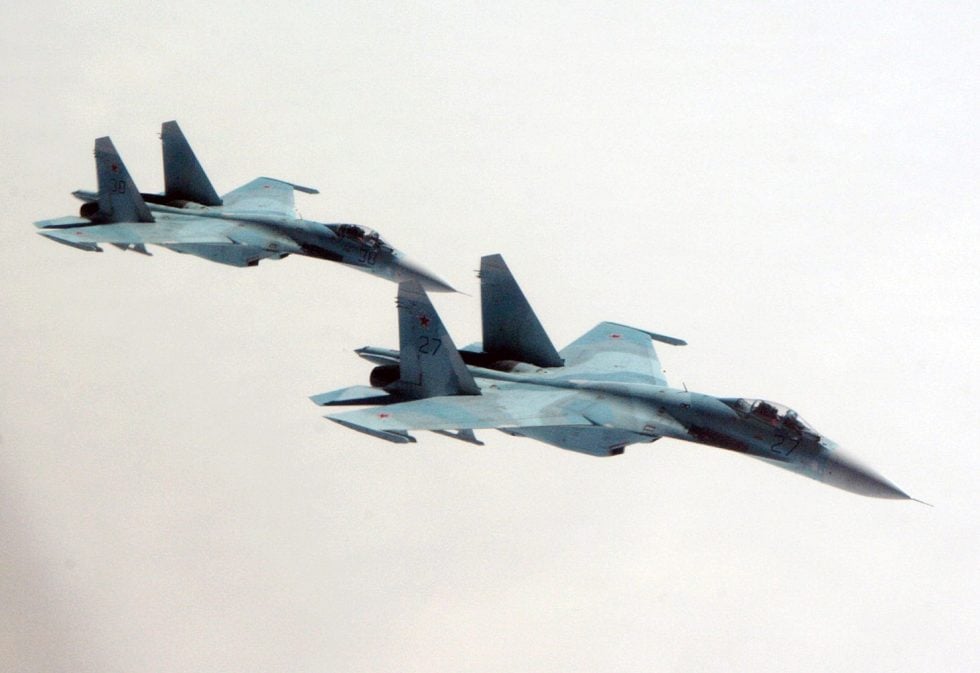
The Soviet answer to the F-15 — a big, long-legged air-superiority fighter so agile it could stop in mid-air. Its “Cobra” stunned the West at Paris in 1989, and its descendants still anchor Russian and Chinese air power today.
The fighter that stopped in mid-air
The Su-27 was born from the Soviet PFI program of the early 1970s — the USSR’s direct answer to the American “FX” that produced the F-15 Eagle. As costs grew, PFI split into two aircraft: a heavy long-range fighter that became the Su-27, and a lighter one that became the MiG-29. The Flanker was the heavy half — built to sweep and hold airspace across the vast Soviet frontier.
The first prototype, the T-10-1, flew on 20 May 1977, but flight testing exposed serious aerodynamic and structural flaws, and a prototype was lost in a fatal crash in 1978. Rather than patch it, Sukhoi effectively started over: the heavily redesigned T-10S flew in 1981 with the definitive blended airframe, canted twin tails and squared wingtips. The type entered service in 1985.
At the 1989 Paris Air Show, test pilot Viktor Pugachev reared the jet nose-up past vertical, hung it tail-low at roughly 110° angle of attack, then flew away level. “Pugachev’s Cobra” rebranded the Flanker overnight from a Cold War silhouette into the most agile heavy fighter on Earth — and seeded one of the largest fighter families in history: the Su-30, Su-33, Su-34, Su-35 and the Su-57.
01The Su-27’s origin: how the Soviet answer to the F-15 nearly failed, then started over
The Su-27 exists because of the F-15. When the U.S. launched its “FX” heavy-fighter program, the USSR responded with PFI, later split into the heavy Su-27 and the light MiG-29 — a high/low mix mirroring the American F-15/F-16 pairing. But the first T-10 prototype was aerodynamically flawed and cost a test pilot his life in 1978.
Sukhoi made a bold call: instead of refining the T-10, they rebuilt it almost wholesale into the T-10S (1981), with a new wing, outward-canted twin tails and a refined blended lifting body. That gamble produced one of the finest airframes of its era — and the template for a dynasty of Flanker derivatives that Russia and China still build today.
What makes the Su-27 special
A wing that is the whole airplane
The Su-27’s fuselage and wing blend into a single lifting body, and large leading-edge root extensions (LERX) shed powerful vortices at high angle of attack. The result is extreme agility — the Cobra is a byproduct — plus enormous internal volume for a very large fuel load, giving intercontinental-class range without external tanks.
Twin AL-31F turbofans
Two widely-spaced Saturn/Lyulka AL-31F afterburning turbofans (~122 kN each in reheat) give a thrust-to-weight ratio near or above 1:1 at combat weight, plus redundancy and survivability. The wide spacing also keeps the intakes in clean air at high alpha — part of why the Flanker stays controllable where other fighters depart.
IRST, helmet sight and the R-73
A nose-offset infrared search-and-track sensor lets the Flanker hunt passively without radar emissions, while a helmet-mounted sight slaves the highly agile R-73 (AA-11 Archer) short-range missile to the pilot’s line of sight for off-boresight shots. The medium-range R-27 (AA-10 Alamo) handles beyond-visual-range work.
02The Su-27’s Cobra: what ~110° angle of attack actually proves
In Pugachev’s Cobra the Su-27 pitches nose-up past vertical to roughly 110–120° angle of attack — momentarily flying tail-first, nose to the sky — then drops back to level flight without losing control or much altitude. It has no direct combat use anyone can reliably name, but it screams control authority and low-speed stability: proof the Soviets had built a genuinely world-class dogfighter. The maneuver became the Flanker’s calling card overnight.
03The Su-27’s eyes without emissions: hunting with IRST
Radar makes a fighter visible the moment it switches on. The Su-27’s infrared search-and-track sensor sidesteps that: it detects the heat of a target and cues a shot without the Flanker ever radiating. Paired with a helmet-mounted sight that lets the pilot cue the off-boresight R-73 wherever he looks, the Su-27 could fight passively and lethally — a combination the early F-15 lacked, and one that made the Flanker dangerous well inside visual range.
Full specifications
Baseline: the single-seat Su-27S — the T-10S production standard as the Soviet Air Forces actually fielded it from 1985, because that is the aeroplane the Flanker reputation was built on. Deltas for the export Su-27SK, the modernised Su-27SM, the two-seat Su-27UB and the naval Su-33 are given in grey. The Su-30 and Su-35 are substantially different aircraft and are covered on their own pages.
Dimensions & weights
- Crew
- 1 (Su-27UB: 2 in tandem)
- Length
- 21.94 m (72 ft 0 in)
- Wingspan
- 14.70 m (48 ft 3 in) — Su-33 folded 7.40 m (24 ft 3 in)
- Height
- 5.93 m (19 ft 5 in) — Su-27UB 6.36 m (20 ft 10 in)
- Wing area
- 62.0 m² (667 sq ft)
- Empty weight
- 16,380 kg (36,110 lb)
- Normal take-off weight
- 23,430 kg (51,650 lb)
- Maximum take-off weight
- 30,450 kg (67,130 lb) — Su-27SK/SM 33,000 kg (72,750 lb)
- Internal fuel, normal load
- 5,270 kg (11,620 lb)
- Internal fuel, maximum
- ~9,400 kg (~20,720 lb) — rarely carried; the aircraft is usually flown well below it
- External stores
- ~4,430 kg (~9,770 lb)
- Hardpoints
- 10 — no drop tanks of any kind; all fuel is internal
- Wing loading
- 377 kg/m² (77 lb/sq ft) at 56% fuel
Performance
- Maximum speed, altitude
- 2,500 km/h (1,553 mph, Mach 2.35)
- Maximum speed, sea level
- 1,400 km/h (870 mph, Mach 1.14)
- Rate of climb
- 300 m/s (59,000 ft/min)
- Service ceiling
- 18,500 m (60,700 ft)
- Ferry range, internal fuel
- 3,530 km (2,190 miles) at cruising altitude
- Combat radius
- ~1,340 km (~830 miles) on an air-defence profile
- Take-off run
- 650 m (2,130 ft) at normal weight
- Landing roll
- 620 m (2,030 ft) with brake chute
- Load factor
- +9 g
- Angle-of-attack limit
- 26° in the normal control law — the Cobra deliberately exceeds it
- Thrust-to-weight
- 1.07 at normal take-off weight (0.82 at maximum)
Propulsion & systems
- Engines
- 2 × Saturn (Lyulka) AL-31F afterburning turbofans
- Thrust, dry
- 74.5 kN (16,750 lbf) each
- Thrust, afterburning
- 122.6 kN (27,560 lbf) each
- Radar
- Phazotron N001 Myech pulse-Doppler with a 1.075 m twist-Cassegrain antenna; roughly 100 km (62 miles) against a fighter head-on but only about 40 km (25 miles) tail-on; ten targets tracked, one engaged — Su-27SM: N001VE, two engaged, R-77 and ground-mapping modes
- Sights
- OEPS-27 suite: OLS-27 infrared search and track with integrated laser rangefinder, slaved to a Shchel-3UM helmet-mounted sight
- Self-defence
- SPO-15 Beryoza radar warning receiver; APP-50 chaff and flare dispensers in the tail boom; optional Sorbtsiya-S wingtip jamming pods
- Flight controls
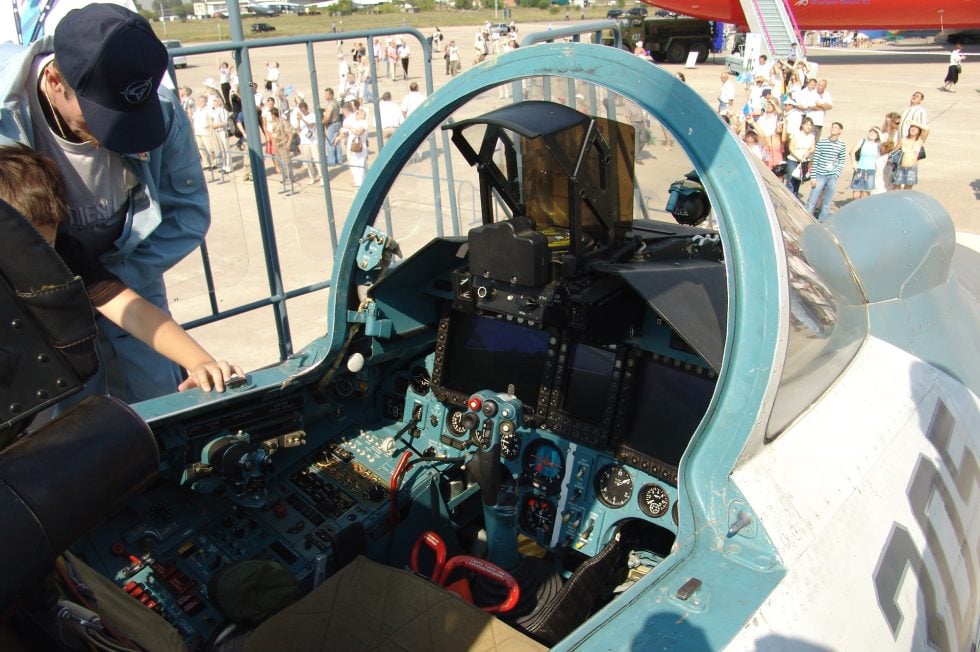
- SDU-10 quadruplex analogue fly-by-wire in pitch — the Soviet Union's first operational fly-by-wire fighter, and the reason the airframe can be flown relaxed-stability
- Fuel system
- Five integral tanks in the fuselage, centre section and wings; a maximum internal load of ~9,400 kg gives a fuel fraction near 0.37, among the highest of any fighter ever built. No refuelling probe and no drop tanks on the baseline aircraft — squadrons routinely fly a reduced 5,270 kg load to keep the aircraft agile
- Ejection seat
- Zvezda K-36DM, zero-zero
- First flight
- 20 May 1977 (T-10-1); 20 April 1981 (the redesigned T-10S)
- Service entry
- June 1985 with the first VVS regiment; formal state acceptance August 1990
- Number built
- ~809 of the basic Su-27 and Su-27UB family (totals differ sharply by source depending on whether prototypes, naval aircraft and Chinese licence-built airframes are counted)
04The Su-27’s numbers: why the specs come with asterisks
Firm figures for the Su-27 are slippery. Sources give maximum takeoff weight anywhere from ~28 to ~30 tonnes depending on how “normal” versus “maximum” loadout is counted; combat radius is variously quoted from ~1,300 to ~1,500 km depending on altitude and profile; and unit cost (~US$30 million) is an approximation with no single authoritative figure, varying by variant, year and export deal. Production totals depend on whether you count only baseline Su-27s (~680+) or fold in two-seat and export subvariants (~800). Treat the round numbers here as good working figures, not settled fact.
Armament & payload
The Su-27S carried ten missiles and could not drop a single guided bomb
The Su-27S was built to do one thing supremely well — find another fighter at long range, kill it with a big missile, and if that failed, out-turn whatever survived. Ten hardpoints, a magazine of semi-active and infrared R-27s for the intercept and R-73s for the merge, and a 30 mm cannon in the starboard wing root gave it the deepest air-to-air load of any fighter of its generation. What it could not do was hit anything on the ground with precision: the baseline aircraft had no designator, no targeting pod and no interface for guided stores, only iron bombs and rocket pods aimed through the gunsight. That gap was deliberate, it lasted until the Su-27SM rebuilds of the 2000s, and it is the single most honest thing anyone can say about the type. Fits vary sharply by mark and operator — Su-27SM, Su-27SKM and Chinese J-11B aircraft all carry weapons the original could not.
Gun
- 1 × 30 mm Gryazev-Shipunov GSh-30-1, single-barrel and gas-operated, buried in the starboard wing-root leading-edge extension
- 150 rounds at roughly 1,500–1,800 rounds per minute — about five seconds of continuous fire
- Muzzle velocity around 860 m/s (2,820 ft/s), with ranging supplied by the OEPS-27 laser rather than the radar
- The same gun arms almost every modern Russian fighter, from the MiG-29 to the Su-57
Air-to-air
- R-27R and R-27ER (AA-10 Alamo-A and Alamo-C) — semi-active radar homing, the long-burn ER being the primary beyond-visual-range weapon
- R-27T and R-27ET (AA-10 Alamo-B and Alamo-D) — infrared-homing versions of the same missile, cued by the IRST and launched with no radar warning to the target
- R-73 (AA-11 Archer) — high off-boresight dogfight missile, slaved to the Shchel-3UM helmet sight; in the late 1980s the best short-range missile in the world by a clear margin
- R-60M (AA-8 Aphid) on early aircraft, quickly displaced by the R-73
- R-77 (AA-12 Adder) active-radar missile only from the Su-27SM onwards — the baseline N001 could not guide it
Air-to-surface guided
- None. The Su-27S as delivered had no guided air-to-ground capability whatsoever, and this is not a footnote — it defined the type for twenty years
- No laser designator, no television or thermal targeting pod, no data interface for guided stores, no anti-radiation capability
- The Su-27SM rebuild added Kh-29L and Kh-29T (AS-14 Kedge), Kh-31A and Kh-31P (AS-17 Krypton) and KAB-500Kr and KAB-500L guided bombs
- Precision strike in the Flanker family was handed to the two-seat Su-30 and Su-34 instead, which is why those aircraft exist
Bombs
- FAB-250 and FAB-500 general-purpose bombs, up to eight of the 500 kg class on multiple ejector racks
- RBK-250 and RBK-500 cluster dispensers
- ZB-500 incendiary tanks
- All unguided, aimed by a computed ballistic solution through the head-up display — accuracy was, politely, approximate
- Practical load capped by the ~4,430 kg (~9,770 lb) stores limit, well below what ten pylons suggest
Rockets
- S-8 80 mm rockets in B-8M1 pods, 20 rounds per pod
- S-13 122 mm rockets in B-13L pods, five rounds per pod
- S-25 heavy 266 mm rockets on single-round O-25 launch tubes
- Normally four pods on the wing pylons, leaving the fuselage tunnel stations free for self-defence missiles
Pods & other stores
- Sorbtsiya-S active jamming pods on the wingtip rails, fitted in place of the outboard missile launchers — jamming and two missiles are mutually exclusive
- APP-50 chaff and flare dispensers built into the tail boom between the engines
- No external fuel tanks of any type; the Su-27 was designed around its internal tankage instead, which is why the wing is clean and the fuel fraction so high
- No reconnaissance or targeting pods on the baseline aircraft. In-flight refuelling probes appear only on the Su-33, the Su-27SM3 and the Su-30 family
Three typical loadouts
- Air superiority, standard
- 2 × R-27ER and 2 × R-27ET under the fuselage tunnel and inner wings, 4 × R-73 on the outer pylons and wingtip rails, 150 rounds of 30 mm, roughly 60% internal fuel
- Long-range combat air patrol
- 6 × R-27 in a mixed radar and infrared fit, 2 × R-73 on the tips, ~9,400 kg of internal fuel — heavy, sluggish below 5,000 m and able to hold a barrier patrol for hours
- Unguided ground attack, as built
- 4 × B-8M1 rocket pods and 2 × FAB-500M-62 on the wing pylons, 2 × R-73 on the wingtips for self-defence, gun loaded
Soviet and Russian stores lists are assembled from manufacturer brochures, export catalogues and observed loadouts rather than published tables, and they drift between marks. Treat any single maximum-ordnance figure as indicative: 4,430 kg is the usual quoted limit for the Su-27S, while Su-27SM documentation cites up to 8,000 kg.
Variants
The Su-27 family begins with a prototype that failed its own requirement
The T-10 that first flew on 20 May 1977 looked like a Flanker and was not one. Flight testing, combined with better Soviet intelligence on what the F-15 could actually do, showed the aircraft would fall short on almost every count that mattered: it was overweight, its structure was inefficient, its fuel fraction disappointing, its radar and fire control years behind schedule, and its aerodynamics compromised by a curved-tip wing and fins mounted on the engine nacelle centrelines. Sukhoi took the decision that almost no Western programme of the period would have survived — it started again.
The T-10S that flew on 20 April 1981 shared the general configuration and very little else. The wing became a straight-tapered planform with square tips carrying missile rails, the fins moved outboard onto tailbooms, the nose was reshaped around a larger radar, the airbrake moved to the spine, and the undercarriage, fuel system and primary structure were redesigned around the integral layout in which the fuselage itself is a lifting body blended into the wing. It cost lives: test pilot Yevgeny Solovyov was killed when T-10-2 broke up in flight in 1978, and the first T-10S was lost soon after its maiden flight. The programme continued, and what reached squadrons in 1985 was the redesign, not the original.
What followed was the most prolific fighter lineage of the late Cold War. The list below covers the Su-27 proper and its direct descendants; the Su-30 and Su-35 are separately reworked aircraft with their own pages.
- T-10 (1977–1981, around nine flying aircraft)
- The original configuration: curved wingtips, centreline-mounted fins, incomplete avionics. Judged unable to meet the requirement and abandoned in favour of a clean-sheet rework.
- T-10S (first flight 20 April 1981)
- The redesign. New wing planform, relocated fins and undercarriage, reshaped nose, spine airbrake, revised internal structure. Effectively a new aeroplane wearing the same programme number.
- Su-27S / Flanker-B (1984 onwards, the bulk of production)
- Production single-seater with N001 Myech radar, OEPS-27 sight, GSh-30-1 gun and ten hardpoints. The baseline for everything on this page.
- Su-27P (1980s, PVO air-defence units)
- Interceptor sub-variant delivered without the wiring and cockpit controls for air-to-ground stores — a pure air-defence aircraft even by Su-27 standards.
- Su-27UB / Flanker-C (1985 onwards, roughly 120)
- Two-seat tandem trainer with a raised rear cockpit and taller fins. Fully combat-capable, at the cost of some internal fuel and a little more drag.
- Su-27SK / Su-27UBK (1991 onwards)
- Export single- and two-seaters with a higher maximum take-off weight, sold to China, Vietnam, Ethiopia, Indonesia and others.
- Su-27SM / Su-27SM3 (2004–2016, around 55 rebuilt plus 12 new-build SM3)
- Russian mid-life upgrade: multifunction displays, N001VE radar, R-77 compatibility and guided air-to-ground weapons. Twenty years late, the Flanker became multirole.
- Su-27K / Su-33 Flanker-D (1989–1999, 24 production aircraft)
- Carrier fighter for Admiral Kuznetsov: canard foreplanes, folding wings and tailplanes, arrestor hook, strengthened undercarriage and a retractable refuelling probe.
- Shenyang J-11 / J-11A / J-11B (1998 onwards, several hundred)
- Chinese licence assembly of the Su-27SK that became an indigenous programme with Chinese radar, engines and weapons, and in turn produced the J-15 and J-16.
- Su-27PU and Su-27M (1988 onwards, prototypes)
- The two-seat long-range and the multirole demonstrator lines that became the Su-30 and Su-35 respectively. Both are separate aircraft and are covered elsewhere.
Flanker designations are genuinely confusing: the same basic aircraft can appear as Su-27S, Su-27SK or J-11 depending on the customer, and Russian sources often use "Su-27" loosely for the entire family. Production totals differ between authorities according to whether prototypes, two-seaters, naval aircraft and Chinese licence-built airframes are included.
The Su-27 through the decades
PFI requirement
The Soviet PFI program is issued as an answer to the U.S. F-15; it splits into the heavy TPFI (Su-27) and light LPFI (MiG-29).
First flight
The T-10-1 prototype flies with test pilot Vladimir Ilyushin at the controls.
Fatal crash, rethink
A prototype is lost and design shortfalls force Sukhoi to redesign the aircraft almost wholesale.
The definitive T-10S
The redesigned T-10S flies, introducing the blended body, canted twin tails and squared wingtips of the production Flanker.
Enters service
The Su-27 (Flanker-B) enters Soviet service as a long-range heavy air-superiority fighter.
The Barents Sea bump
A Soviet Su-27 collides with a Norwegian P-3B Orion over the Barents Sea; both aircraft land safely.
Pugachev’s Cobra
Viktor Pugachev debuts the Cobra maneuver at the Paris Air Show, stunning Western observers.
Flanker vs Fulcrum
Ethiopian Su-27s defeat Eritrean MiG-29s — the only confirmed Su-27-vs-MiG-29 duel in history.
Fighting itself
The Su-27 flies on both sides of the Russo-Ukrainian War; Flankers are lost by both air forces.
From the flight line: twelve Flanker stories
The Cobra that shocked the West
Paris, 1989: a fighter that stopped in mid-air.
Read the full story
Start over: T-10 to T-10S
How failure built a legend.
Read the full story
Flanker vs Fulcrum over Africa
The only time Russia’s two great fighters fought each other.
Read the full story
The Barents Sea bump
A Flanker sliced a NATO patrol plane’s propeller — with its tail.
Read the full story
The biggest fighter dynasty
One airframe, an entire air force.
Read the full story
China’s Flanker: the J-11 story
A licence that outgrew its contract.
Read the full story
The jet that fights itself
Ukraine 2022: Su-27 vs Su-27.
Read the full story
A wing that is the whole airplane
Why the Flanker turns like nothing its size.
Read the full story
The long-range hunter
Built to own airspace no one else could reach.
Read the full story
Eyes without emissions
The Flanker can hunt in silence.
Read the full story
The Russian Knights
Flankers as national showpiece.
Read the full story
Still frontline at 40+
A Cold War design that never left.
Read the full story
The Flanker in pictures
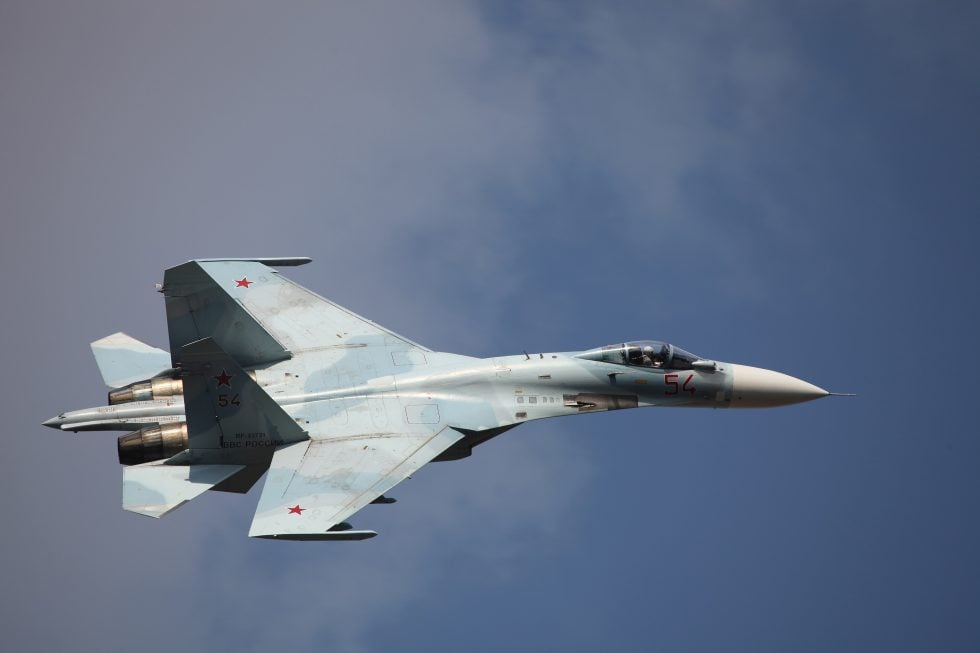
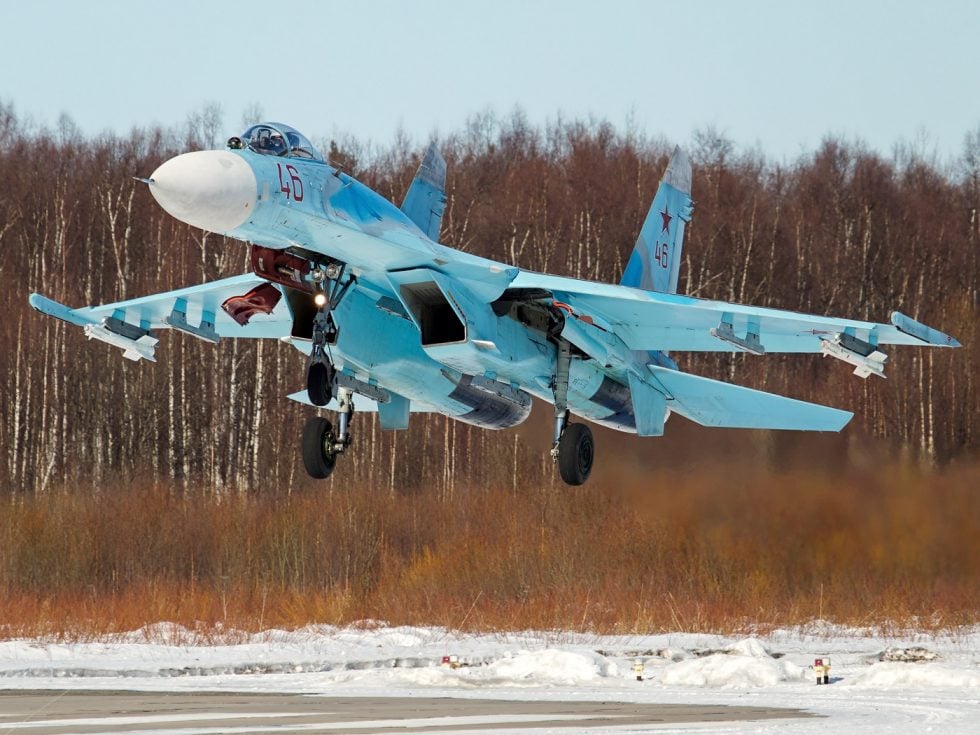
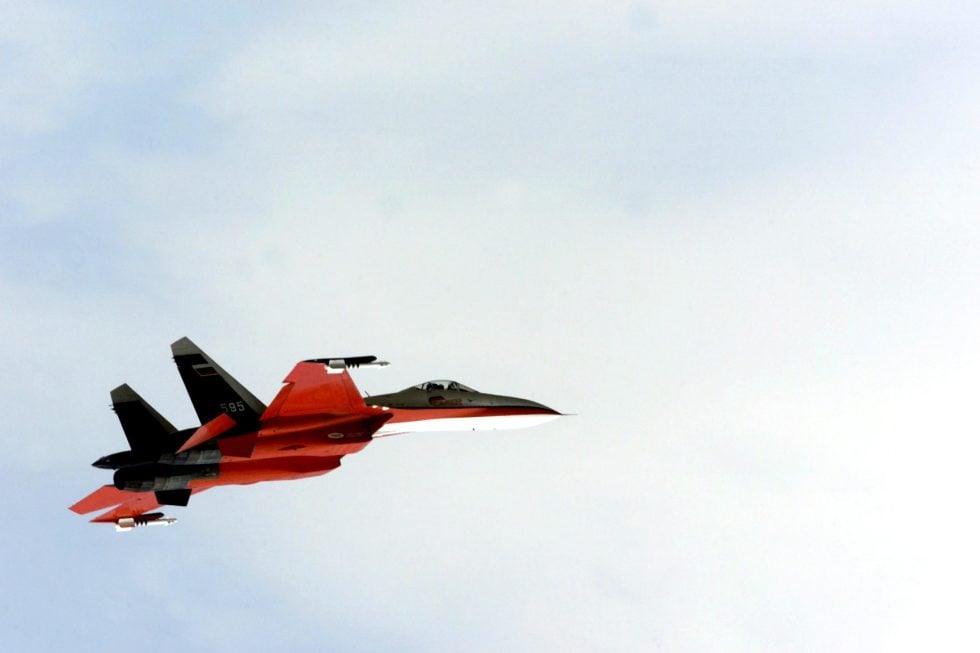
The Su-27 Flanker in motion
A verified video is coming soon. The classic 1989 Paris Air Show clip that shows Pugachev’s Cobra is still being source-checked — channel, view count and embed rights — before we place it here.
The Su-27 Flanker in motion
Megaprojects — one of the most-watched Su-27 Flanker films on YouTube.
Where the Flanker flies
Operators today
Su-27 fleets are shrinking everywhere except China
Counting Flankers is harder than it looks, and this chart deserves its caveats up front. Russia is steadily absorbing its remaining Su-27S and Su-27SM airframes into a force dominated by the newer Su-30SM and Su-35S, and it has lost aircraft in combat since 2022. Ukraine has flown its Su-27s continuously since the first morning of the full-scale invasion; its true remaining strength is a closely held secret, for obvious reasons, and every published figure is an outside guess. Both wartime numbers below should be read as the least reliable on the chart. China depends entirely on a counting policy: here we count the Su-27SK and Su-27UBK bought from Russia together with the licence-assembled J-11 and J-11A, but not the J-11B and later marks, which are re-engineered Chinese aircraft with domestic radar, engines and weapons. Counting those would roughly triple the Chinese bar. Su-30 and Su-35 operators are excluded throughout.
These are estimates. Many airframes counted on paper are stored, in deep overhaul, or not operational. Belarus retired its Su-27P and Su-27UBM1 fleet in 2012 and Eritrea's handful of ex-Ukrainian aircraft could not be corroborated as operational, so neither appears here. Sources: IISS The Military Balance and FlightGlobal World Air Forces; entries that could not be corroborated are omitted.
Flanker vs Fulcrum, and a war against itself
The Su-27’s combat record is thinner than its fame — and unusually contested. Its signature episode is the 1999–2000 Ethiopia–Eritrea War, and its strangest is the Russo-Ukrainian War, where the same fighter flies on both sides. Treat all kill and loss figures below as claims, not settled scores.
The Ethiopia–Eritrea kill totals and pilot identities are disputed, and wartime Ukrainian and Russian loss counts are contested and shifting. Compare the combat record of every military aircraft. Figures as of July 2026.
Everything people ask about the Su-27
Can I fly in a Su-27?
Is the Su-27 fast?
What is Pugachev’s Cobra?
Is the Su-27 still in service?
How does it compare to the F-15?
What is the Flanker family?
How many Su-27s were built?
Can a civilian fly the Su-27?
You can’t fly the Su-27.
These, you can.
Some legends only live in museums — others are fuelled and waiting. MiGFlug has put civilians in real military jet cockpits since 2004.
 Fly the L-39 AlbatrosThe world’s most-flown jet trainer — aerobatics included
 Fly the F-104 Starfighter“The missile with a man in it”
 Fly the MiG-21The Cold War’s most-produced jet
 Fly the T-33 Shooting StarAmerica’s first jet trainer
 Fly the DH VampireA piece of early jet history
 Fly the S.211Agile Italian jet trainer
 Fly the MB-326The classic Aermacchi jet
 Fly the MiG-15The Soviet legend of the Korean War
Continue the tour
Every fact, checked
- MILAVIA — Su-27 specifications & operatorsEngineering, performance and operator data.
- GlobalSecurity.org — Su-27 specsIndependent specification cross-check.
- MilitaryFactory — Su-27 development & productionDevelopment history, variants and production figures.
- We Are The Mighty — Flankers vs Fulcrums over AfricaThe 1999–2000 Ethiopia–Eritrea air war.
- The Aviation Geek Club — Barents Sea collision (1987)The Su-27 / P-3 Orion intercept incident.
- Military Watch Magazine — Su-27 losses in UkraineRusso-Ukrainian War loss reporting (contested).
- EurasianTimes — the Cobra at Paris 1989Pugachev’s Cobra maneuver and its reception.
- Smithsonian Magazine — the jet that fights both sidesThe Su-27 on both sides of the Russo-Ukrainian War.