
NATO has run a lot of joint procurement competitions. Almost all of them ended with every country buying something different anyway.
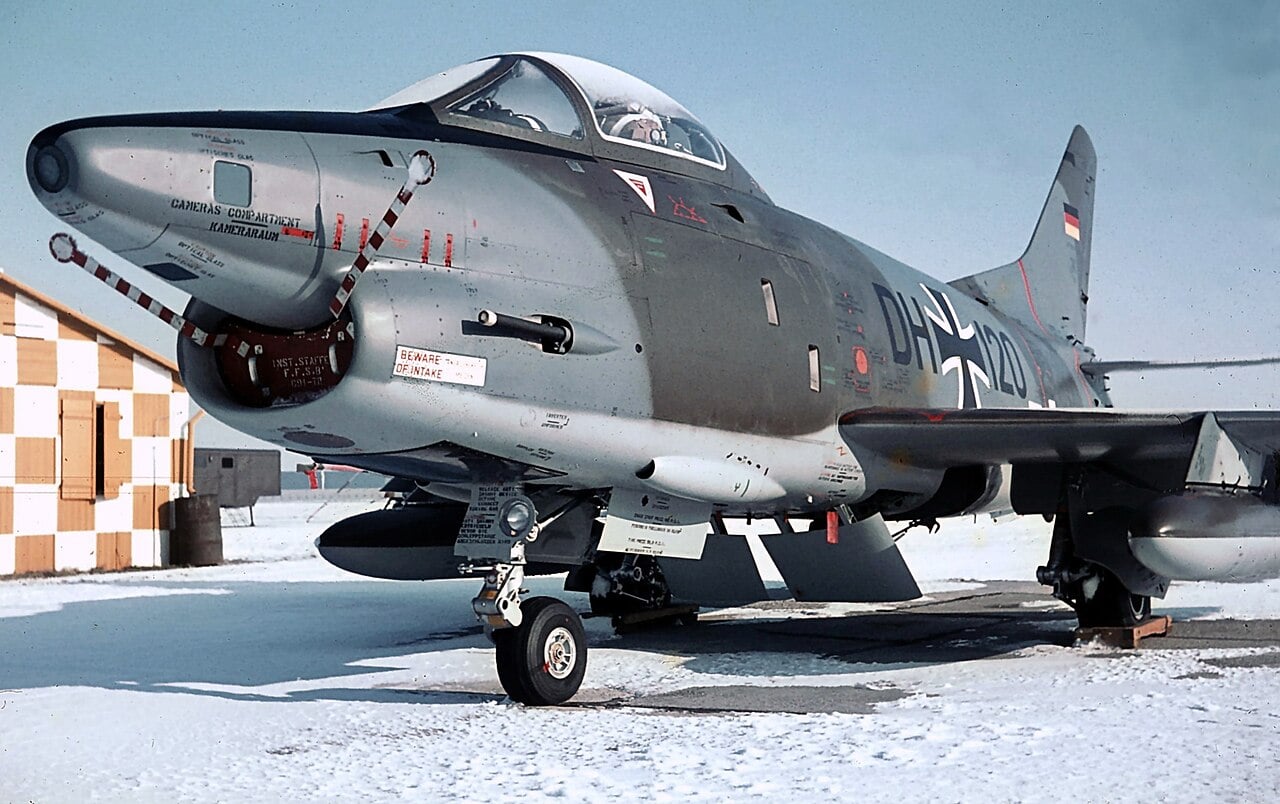
Exactly one produced an aircraft that three air forces actually flew, in numbers, for decades. It was small, it was Italian, it had a nose full of cameras and a reputation for being able to operate off a strip of grass, and everybody called it the Gina.
Datos rápidos
Tipo: Light strike and reconnaissance fighter
Fabricante: Fiat, later Aeritalia
Competencia: NATO Light Weight Strike Fighter, issued December 1953
Selected: 3 June 1955
Primer vuelo: 9 August 1956, Caselle, Turin
Motor: Bristol Siddeley Orpheus 803, 22.2 kN
Armas: Four 12.7 mm Brownings, or two 30 mm DEFA cannon
Construido: 756, between 1956 and 1977
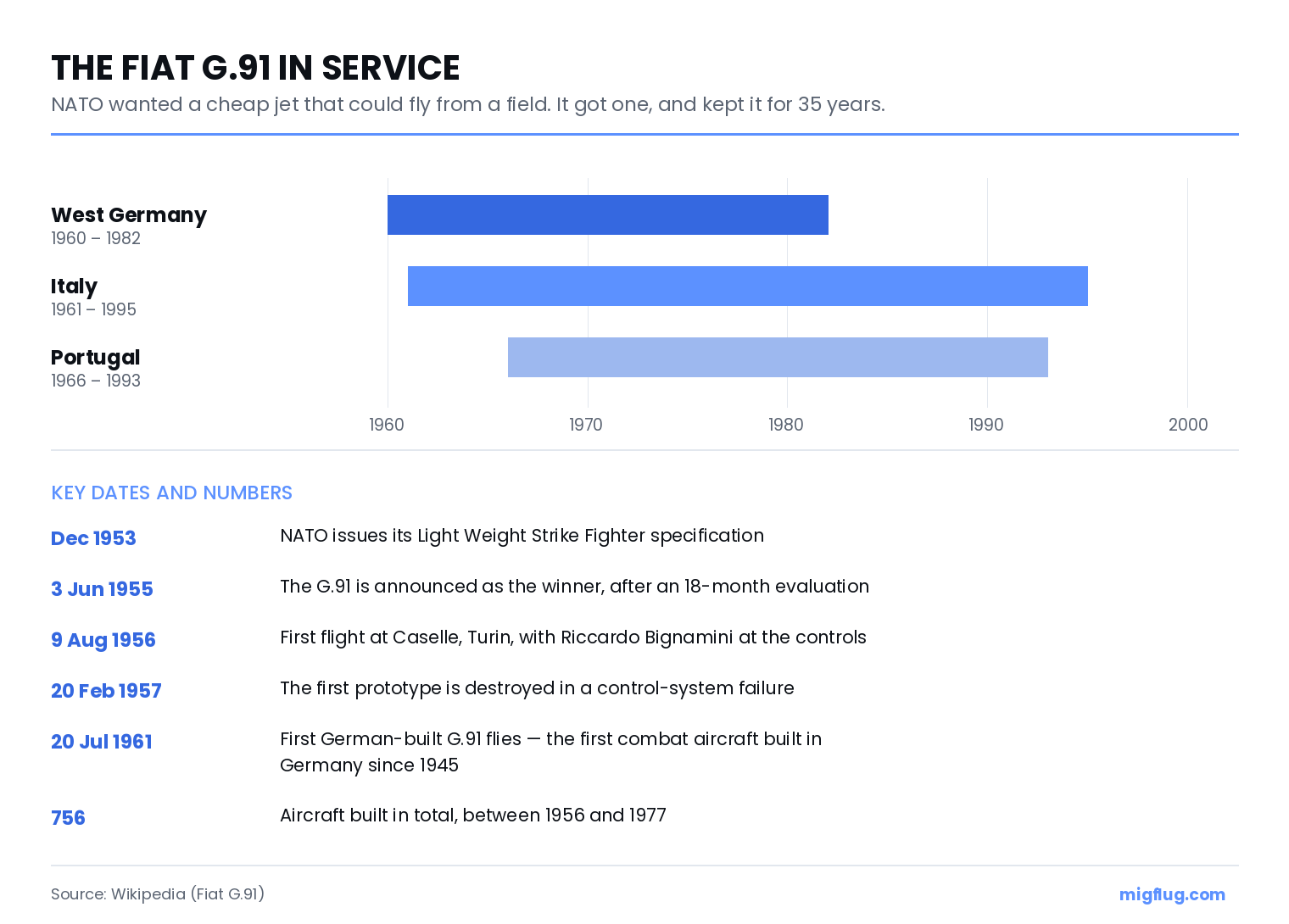
Flown by: Italy, West Germany and Portugal
What NATO Actually Asked For
The requirement came out of Korea. Jets had turned out to be expensive, fuel-hungry and dependent on long concrete runways, none of which is much use in a European war where the runways are the first thing to be cratered.
So in December 1953 NATO asked for a Light Weight Strike Fighter: cheap, small, able to carry ordnance, and able to work from a rough field. Nine designs arrived within the two-month deadline, from Fiat, Dassault, Sud-Est, Aerfer and Breguet among others.
That single line explains a great deal about how the competition actually worked. Almost every entrant was built around the same British Bristol Orpheus turbojet, which meant the contest was not really about performance. It was about who could wrap the least aeroplane around a fixed engine and still deliver something useful.
An AGARD committee chaired by Theodore von Kármán spent eighteen months deciding. On 3 June 1955 the Fiat G.91 was declared the winner, and Fiat got an order for three prototypes and twenty-seven pre-production aircraft.
A Very Bad Start
The prototype flew on 9 August 1956 from Caselle, outside Turin, with chief test pilot Riccardo Bignamini at the controls.
Six months later it was gone. On 20 February 1957, during high-speed envelope expansion, the first prototype was destroyed after a problem in the horizontal control system led to structural failure. The second aircraft was rebuilt with a larger tail, a canopy six centimetres higher and a ventral fin, and the programme carried on.
Germany Built Its Own
The largest operator was not Italy. West Germany ordered 294 aircraft, and rather than simply buy them, arranged licence production through Flugzeug-Union Süd, a consortium of Messerschmitt, Heinkel and Dornier. The first German-built G.91 flew from Oberpfaffenhofen on 20 July 1961.
The Luftwaffe version, the G.91 R/3, carried two 30 mm DEFA cannon instead of the Italian machine guns. By 1 January 1970 the service had 310 R/3s and 40 two-seat trainers. It also had a safety record that is worth noting: by 1976, only twenty of those 310 aircraft had been lost to accidents, which for a single-engined low-level strike aircraft of that era is remarkable.
Portugal Took It to War
The G.91 is the only one of the three operators’ aircraft to have seen sustained combat, and it did so in Africa.
Portugal received forty G.91 R/4s in 1966 and sent them to Portuguese Guinea and Mozambique for reconnaissance and close support, flying rockets, bombs and napalm against PAIGC and FRELIMO forces. For seven years the losses were negligible: two aircraft between 1966 and 1973.
Then the shoulder-launched missile arrived. When PAIGC received Soviet Strela 2 systems in early 1973, four G.91s were shot down in March alone, with more later that year and a final loss on 31 January 1974. It is one of the cleanest illustrations anywhere of what man-portable air defence did to low-level air power, and it happened in the space of a few weeks.
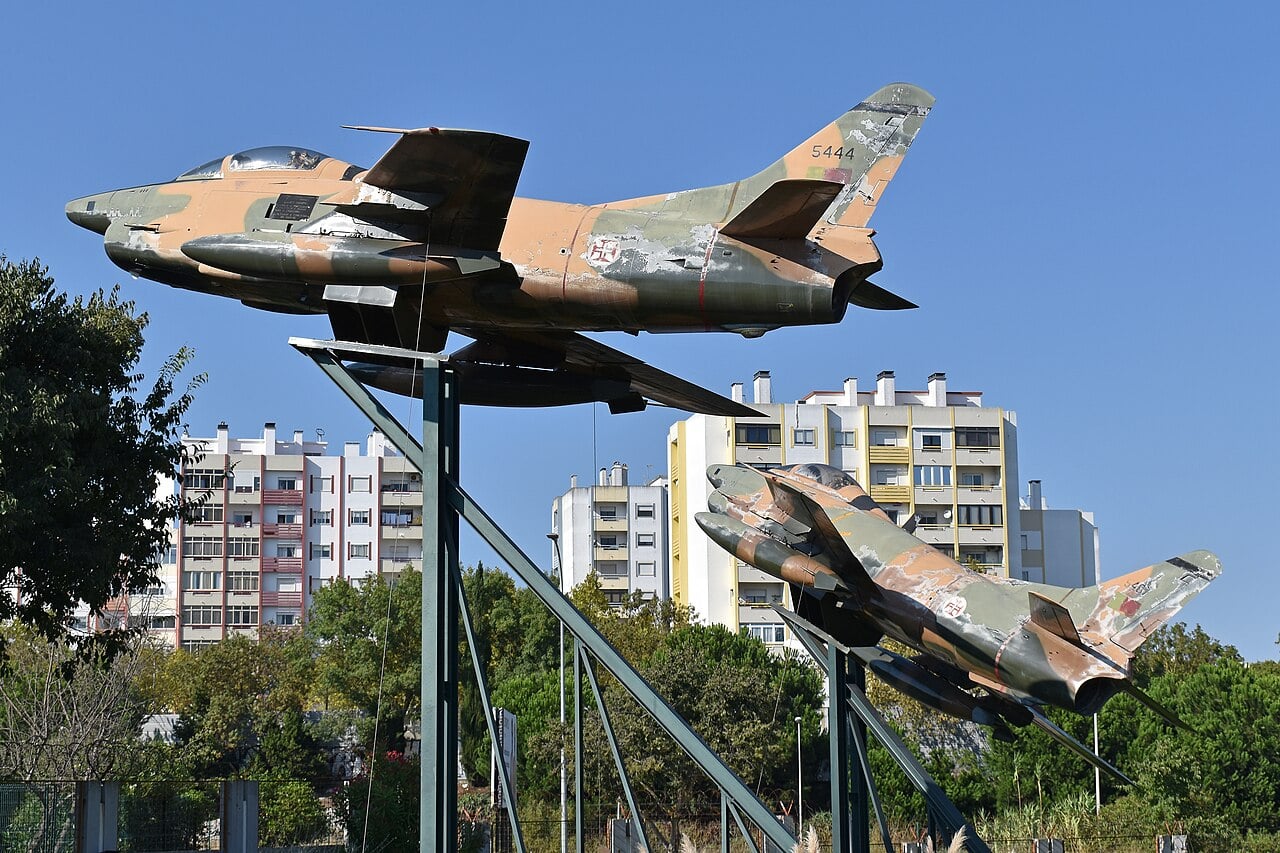
Portugal kept buying them second-hand from Germany long after everyone else had moved on — fourteen R/3s and seven T/3s in 1976, and dozens more between 1980 and 1982. The last Portuguese G.91 flew in 1993.
The Frecce Tricolori Years
In 1964, sixteen pre-production aircraft were stripped of their armament, fitted with smoke tanks and handed to the Italian national aerobatic team as the G.91 PAN.
Fifteen hundred hours a year with better than ninety per cent availability is display-team flying at an industrial rate, and it is the reason a generation of Italians associates this aircraft with smoke trails rather than with NATO doctrine. The Frecce Tricolori flew it until 1981.
Why Gina?
Here the honest answer is that nobody writes it down. The nickname is universal in Italian service and it appears everywhere from squadron records to modern airshow commentary, but the standard references do not explain where it came from.
The explanation you will hear most often is that it is simply what G.91 sounds like out loud in Italian. That is plausible and it may well be right, but it is folklore rather than documented history, and it is worth saying so rather than repeating it as fact.
The Aircraft That Lost
There is a footnote worth having. Among the designs associated with that NATO requirement was Northrop’s N-156, a small twin-engined fighter built to the same philosophy of cheap, light and exportable.
Accounts differ on whether Northrop formally entered the NATO competition or merely designed to its logic — the G.91 literature lists the N-156 among the entries, while Northrop’s own history describes the NATO requirement as an influence. Either way, it did not win.
The N-156T became the T-38 Talon. The N-156F became the F-5 Freedom Fighter. Together they ran to more than 3,800 aircraft and are still flying today.
The G.91 won NATO’s competition and sold 756. The design that lost it sold five times as many. Winning the contest was never the same thing as winning the argument — but for thirty-five years, in three air forces and on two continents, the little Italian jet did the job it was asked to do.
Sources: Wikipedia (Fiat G.91; Northrop F-5).
Preguntas frecuentes
What was the Fiat G.91?
Why is the G.91 called the Gina?
Which countries flew the Fiat G.91?
Was the G.91 built in Germany?
Did the Fiat G.91 see combat?
Did the Frecce Tricolori fly the G.91?
What engine did the G.91 use?
Can civilians fly in a fighter jet today?
Publicaciones relacionadas

0 Comments