
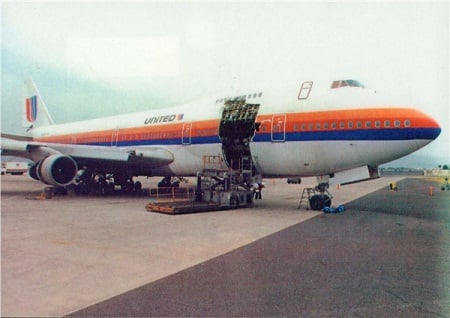
United Airlines Flight 811 left Honolulu for Auckland and Sydney at 01:52 local time on 24 February 1989, a Boeing 747-100 carrying 337 passengers and 18 crew. About seventeen minutes later, climbing between 22,000 and 23,000 feet, the jet was rocked by an explosion. The forward cargo door on the right side had burst open, and the explosive decompression ripped away a section of the fuselage above it.
A post on Instagram tells the story. It is largely accurate, with a few details worth correcting.
Datos rápidos
- Fecha: 24 February 1989
- Aeronave: Boeing 747-122, N4713U
- Ruta: Honolulu to Auckland and Sydney
- A bordo: 337 passengers, 18 crew
- Failure: Forward cargo door opened at about 23,000 ft, roughly 17 minutes after take-off
- Lost: 9 passengers, ejected with their seats
- Multitud: Captain David Cronin, First Officer Gregory Slader, Flight Engineer Randal Thomas
- Final cause: Electrical fault and latch design deficiencies (NTSB, March 1992)
A Hole in the Side of the Cabin
When the door went, the pressure difference blew out the floor and wall above it. Ten seats in rows 8 to 12, seats G and H, were torn out of the business-class cabin, and nine passengers were lost over the Pacific. Flight attendant Mae Sapolu was nearly pulled out through the hole and held on until colleagues dragged her back; purser Laura Brentlinger was also pulled to safety.
In the cockpit, the crew assumed a bomb. Lockerbie had happened just two months earlier. They began an emergency descent and a turn back towards Honolulu, only to find that the oxygen system had been damaged and was not working. Debris sucked out of the hole had also been ingested by the two engines on the right wing: number 3 was shut down after it caught fire, and number 4 soon afterwards.
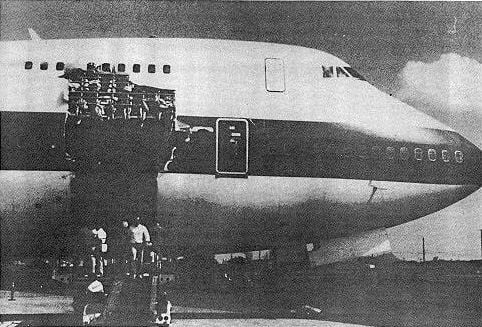
Landing on Two Engines
The crew declared an emergency and dumped fuel to lighten the aircraft. With the leading-edge flaps on the right wing damaged, they could not count on full flaps, so they flew the approach fast: the landing speed was about 190 to 200 knots, far above normal for a 747. They touched down in Honolulu about fourteen minutes after declaring the emergency. The evacuation took less than 45 seconds; every flight attendant was injured. All 346 people still on board survived.
Captain David Cronin, 59, had about 28,000 flying hours and was close to the mandatory retirement age; it was one of his last trips. He, First Officer Gregory “Al” Slader and Flight Engineer Randal Thomas later received the Secretary of Transportation’s Award for Heroism.
The Wrong Answer, Then the Right One
The cargo door lay on the ocean floor, so the NTSB’s first report, published in April 1990, had to work without it. It concluded that the door had not been properly latched, probably because of damage to its locking mechanism, and pointed to the ground handling.
Kevin and Susan Campbell, whose son Lee was among the nine lost, did not accept that. They investigated the door’s design and history themselves and pressed for it to be recovered. The US Navy brought it up from the seabed in two sections in 1990, from a depth of about 14,000 feet. Then in 1991, the cargo door of another United 747 began to open on its own on the ground in New York. Examining the recovered door and that incident, the NTSB issued a superseding report in March 1992. The probable cause was now an electrical fault: a faulty switch or damaged wiring had caused the latches to turn to the open position during flight, and the latching design did not prevent it. The FAA required new locks on 747 cargo doors.
This is one of several accidents in which a single structural failure tested a crew to the limit. Four years earlier, a faulty bulkhead repair had brought down Japan Air Lines Flight 123.
What the Viral Post Gets Right
The essentials are right: the cargo door failure over the Pacific, the nine passengers lost, the crew’s return to Honolulu on two engines, the first report blaming handling, and the Campbells’ part in proving the real cause. Three refinements. The door failed about 17 minutes after take-off, not 16. The very high landing speed was largely a result of the damaged flaps, not simply of the crew’s choice. And the lines attributed to Captain Cronin in the post could not be verified in the NTSB record, so we have not repeated them.
Ver esta publicación en Instagram
Sources: NTSB Aircraft Accident Report AAR-92/02 (March 1992, superseding AAR-90/01); Wikipedia, United Airlines Flight 811; NASA Technical Reports Server image archive.


0 Comments