
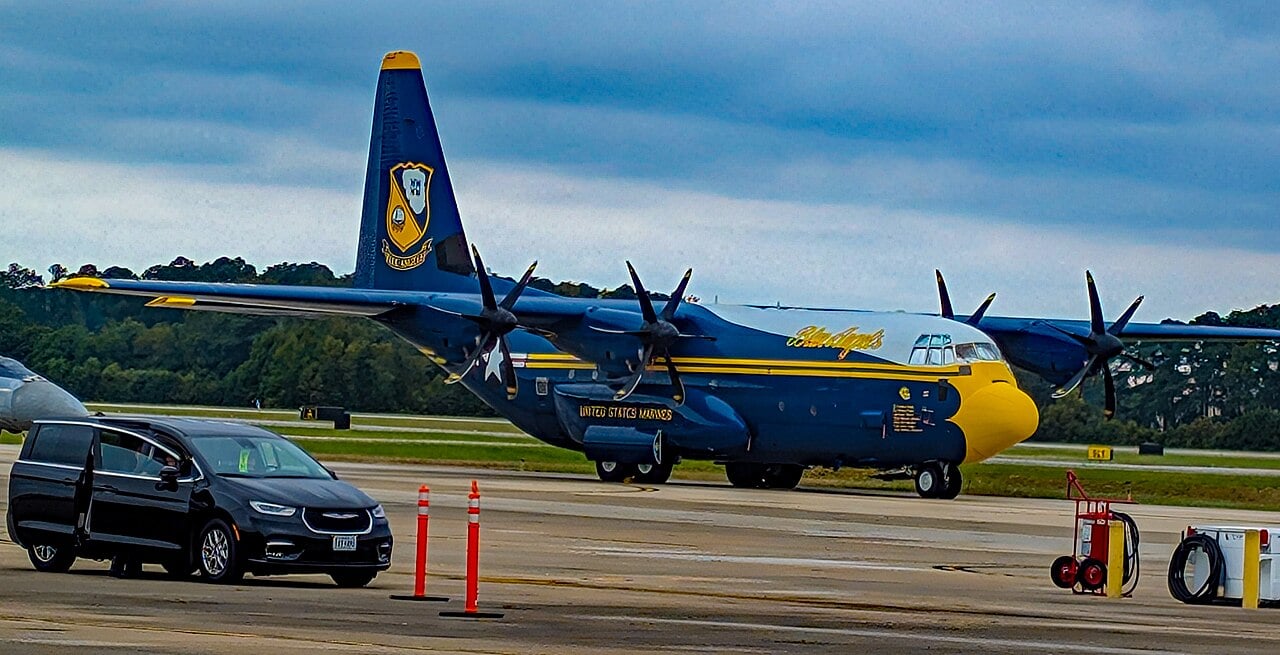
Six blue-and-gold jets get the screams. But before any of them roll down the runway, somebody has to haul the spare parts, the tool chests and about 40 people to the show. For more than half a century, that somebody has been a big, blue, propeller-driven C-130 Hércules with a cartoon nickname: Fat Albert.
This weekend the Ángeles Azules and the Air Force Thunderbirds share the bill at the NAS Jacksonville Air Show, which a separate Afterburner news report covers. Ahead of it, the Florida Times-Union ran a piece arguing Fat Albert is cooler than you think. It has a point. The team's transport has done rocket-boosted takeoffs, lived a former life in the Royal Air Force, and in 2026 it is sitting out the season in an English hangar having what its engineers call the equivalent of spinal surgery.
Here is the story of the hardest-working member of the Blue Angels.
Datos rápidos
- Aeronave: Lockheed Martin C-130J Super Hercules, US Navy BuNo 170000
- Previous life: Royal Air Force ZH885, flown by 24 Squadron from 2001 to 2017
- Price: $29.7 million, bought from the UK Ministry of Defence in 2019
- Multitud: All-Marine, with three Marine Corps C-130 pilots
- Trabajo: Hauling about 40 people and gear to every show, plus a short opening demo
- JATO: Rocket-assisted takeoffs from 1975 until the last one in 2009
- 2026 status: In Cambridge, UK, for a centre wing box replacement; due back for 2027
From Skytrain to Hercules
The Blue Angels have always needed a truck with wings. Wikipedia's history of the team records that it acquired a Douglas R4D Skytrain for logistics in 1949. A C-54 Skymaster came later, replaced in 1968 by a Lockheed VC-121J Constellation, and in 1969, the year the team moved to the F-4J Phantom II, by a C-121 Super Constellation.
In 1970 the team received its first US Marine Corps KC-130F Hercules, manned by an all-Marine crew, and it has never looked back. The Navy says the C-130 has supported the Blue Angels since 1970 and began flying short demonstrations before the jet shows in 1975. The nickname came from the Fat Albert cartoon character, a nod to the aircraft's size and shape.
Over the decades, Fat Albert has been several different airframes. The longest-serving recent one was a C-130T, BuNo 164763, which spent 17 years with the team, flew more than 30,000 hours and retired in May 2019. It now serves as a ground training aircraft in Fort Worth, Texas.
The Rocket Years
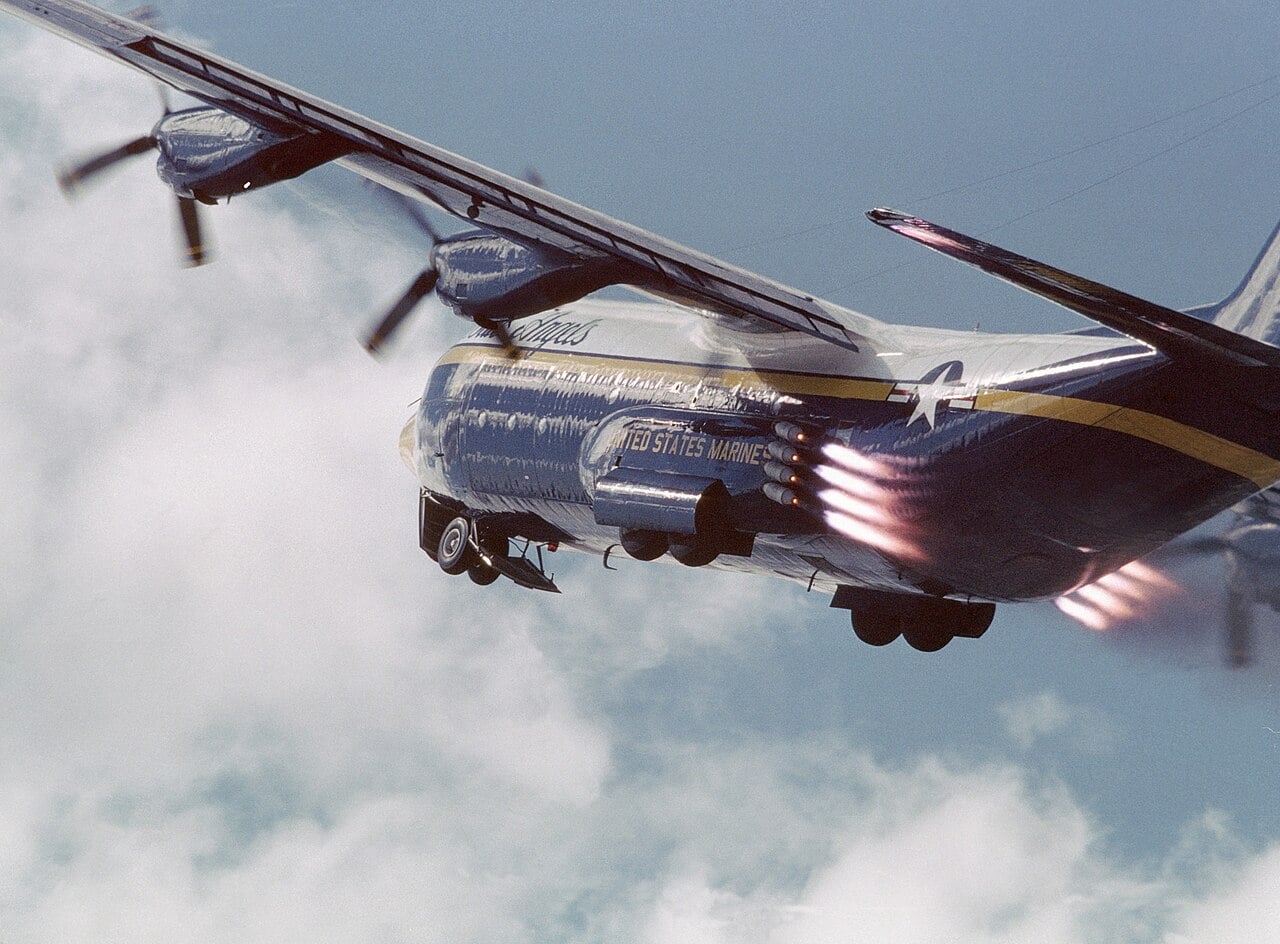
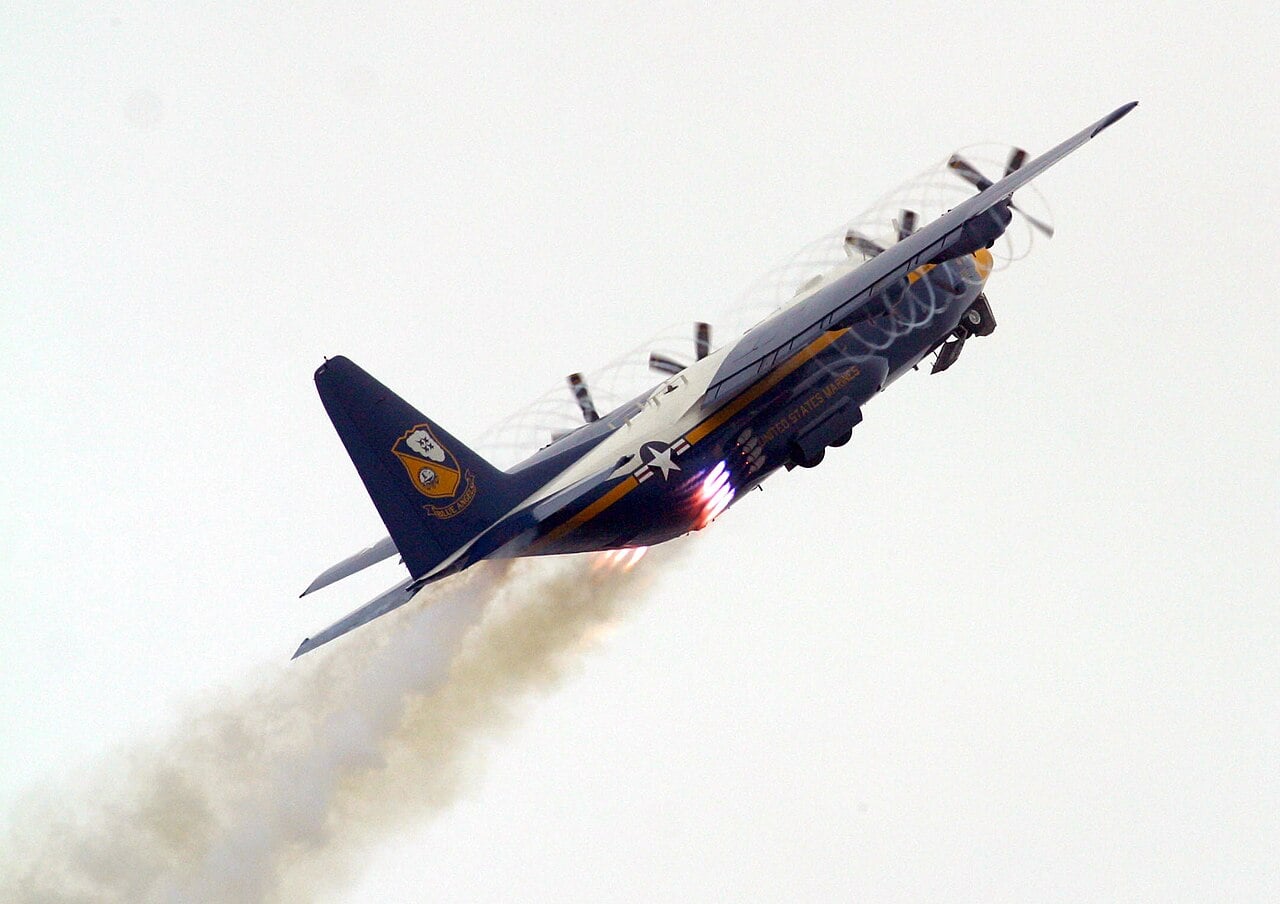
For three decades, Fat Albert's party trick was pure theatre. Starting in 1975, the Hercules made jet-assisted takeoffs, or JATO, at selected shows: rocket bottles strapped to the fuselage fired on the takeoff roll and shoved the transport into a startlingly steep climb. According to the Florida Times-Union, it used eight bottles, each producing about 1,000 pounds of thrust.
Fat Albert's JATO takeoff at the MCAS Miramar air show in October 2009, one of its last rocket-assisted launches.
The show ended because the rockets ran out. The JATO demonstration stopped in 2009 due to dwindling supplies, and Fat Albert fired its eight remaining bottles at the 2009 Pensacola Homecoming show. That was not only the squadron's last JATO performance but, according to Wikipedia's account, the final use of JATO by the Marines.
A Hand-Me-Down From the RAF
When the C-130T retired in 2019, the Navy went shopping second-hand. In June 2019 it announced a $29.7 million contract with the UK Ministry of Defence for a divested RAF C-130J Super Hercules. The Navy said buying used saved about $50 million compared with a new aircraft, and the deal was paid for with Foreign Military Sales proceeds.
The airframe has a proper British back story. According to Marshall Aerospace, it was built in Marietta, Georgia, prepared for RAF service in Cambridge, and flew as ZH885 with the RAF's 24 Squadron from 2001 to 2017. Marshall then did the maintenance, modifications and Blue Angels paint, and the new Fat Albert flew its first check flight over England in July 2020.
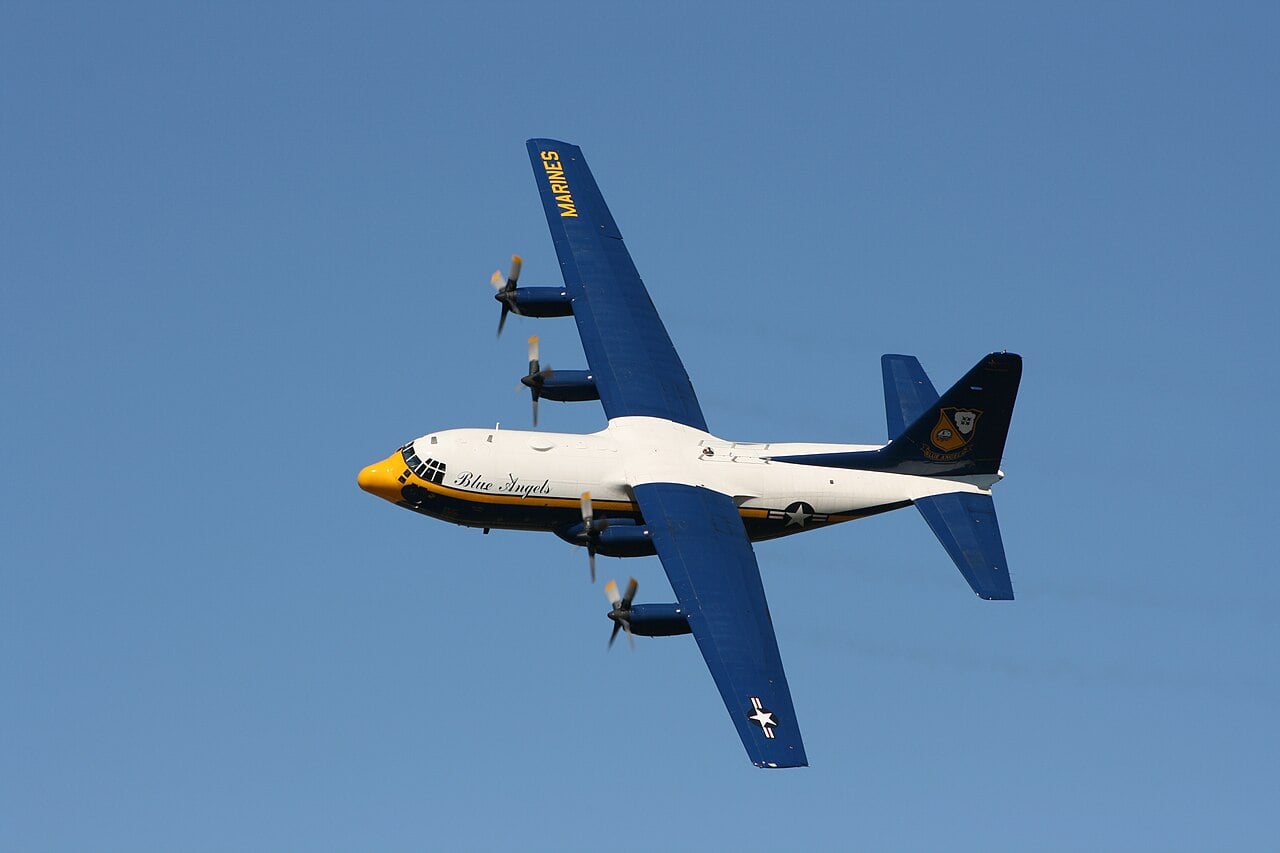
On 17 August 2020, according to a Navy photo release, the team's C-130 crew brought the new C-130J into Naval Air Station Pensacola, flying alongside the Delta formation, in the 50th year of the team's C-130 era. Stars and Stripes reported that the aircraft's air show debut came at the Pensacola Beach show in July 2021.
The Blue Angels welcome their new C-130J Fat Albert home to Pensacola with special flybys in August 2020.
All Marines, All the Time
The jets are flown mostly by Navy pilots, but Fat Albert is a Marine Corps operation, flown by an all-Marine crew with three Marine C-130 pilots on the team. The newer C-130J needs fewer people up front: as a cargo aircraft it is normally crewed by two pilots and a loadmaster, with no navigator or flight engineer. It also flies on four Rolls-Royce AE 2100D3 turboprops turning six-bladed composite propellers.
Some of the team's most visible milestones came from the Hercules cockpit. In 2015, Marine Capt. Katie Higgins became the first woman to fly with the Blue Angels, as a Fat Albert pilot for the 2015 and 2016 seasons. For 2026, Capt. Olivia Bair is one of the three C-130J pilots, according to the Times-Union.
And the job is not just showbiz. Former Fat Albert pilot Katie Cook, the same Katie Higgins, put the real workload in numbers when local station WEAR-TV asked her about the aircraft this summer.
Marshall Aerospace describes the routine as up to 45 personnel, over 100,000 miles a season and a 15-minute opening display of high-speed passes, steep climbs, sharp banks and combat landings, noting it is the only C-130 that performs regularly in flying displays. The exact figures vary by source and by year, but the point is the same: no Fat Albert, no show for the F/A-18E/F Super Hornets.
Spinal Surgery in Cambridge
Which is why 2026 is unusual. In November 2025, Fat Albert flew back across the Atlantic to Marshall's Cambridge facility for a centre wing box replacement, the structure that joins the wings to the fuselage. Marshall calls the box a lifed component: once it reaches the end of its life it must be replaced, or the aircraft is grounded. A new enhanced-service-life box from Lockheed Martin should add more than 20 years.
The job needs more than 2,000 maintenance hours and was planned to take 10 to 14 months, so Fat Albert is missing the 2026 season. WEAR-TV reports that a replacement C-130 has been carrying the squadron this year. In July, Marshall said the old box was out and the new one installed, and that it fully expects Fat Albert back with the Blue Angels for the 2027 season, in a fresh coat of blue and gold.
The Blue Angels' C-130J Fat Albert flying its practice demonstration at Airshow London in 2021.
The Unsung Seventh Jet
Fat Albert will never fly in the Diamond. It does not need to. It gets the team there, opens the show, and for 34 years it did it with rockets bolted to its sides.
In 2027, a freshly rebuilt, freshly painted ex-RAF Hercules should be back on the ramp at Pensacola. Expect the crowd to cheer for the jets. Expect the people who know the team to cheer for the big blue one first.
Sources: Florida Times-Union, US Navy, AIN, TWZ, Marshall Aerospace, WEAR-TV, KATU, Stars and Stripes, US Air Force (Scott AFB), Wikipedia (Blue Angels; Lockheed Martin C-130J Super Hercules)

0 Comments