
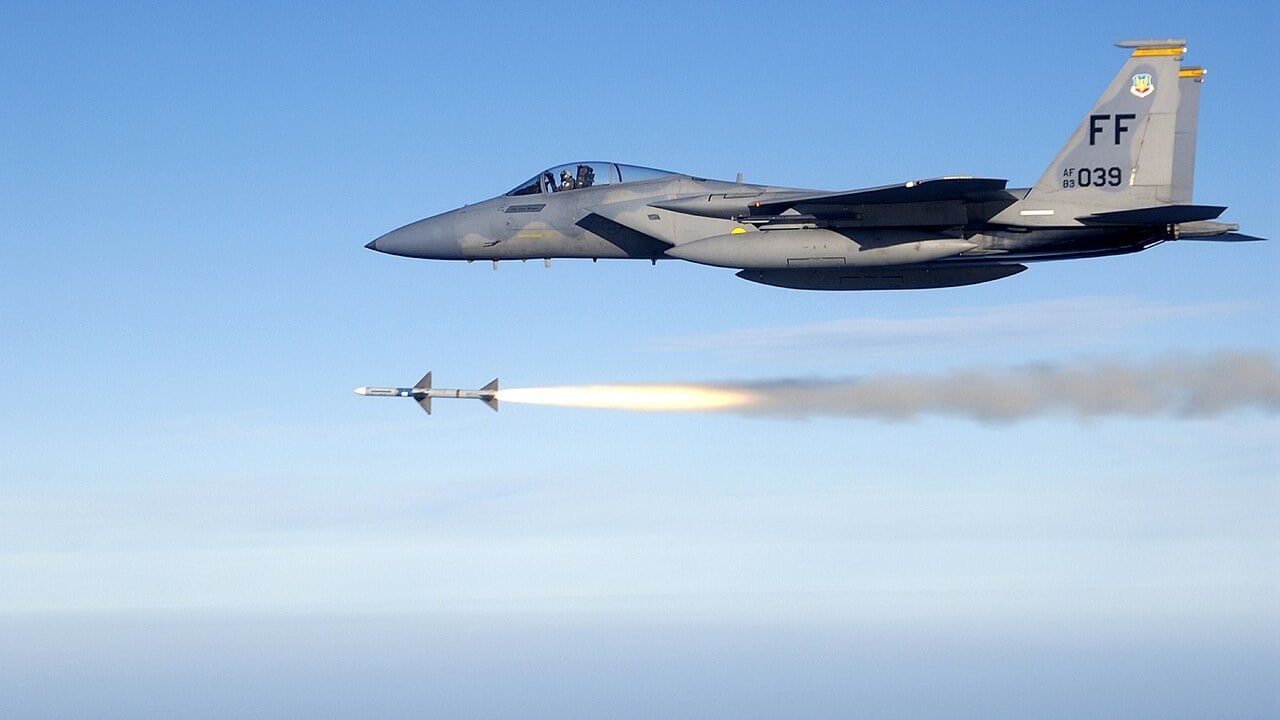
For half a century, fighter designers sold air forces a simple promise: kill the enemy before he can see you. Build a big radar, hang radar-guided missiles under the wings, and the dogfight becomes a relic. The Navy started developing the AIM-7 Sparrow in 1946 for exactly that job.
Then the shooting started. In 2005, US Air Force Lt Col Patrick Higby went through the combat record for an Air War College paper. Across the American air war over Vietnam, the 1973 Yom Kippur War and Israel’s 1982 Bekaa Valley fighting, he counted 528 air-to-air kills scored by American and Israeli pilots. Only four of them were documented beyond visual range.
Beyond-visual-range air combat, BVR for short, is the fight that happens before the pilots can see each other. It is less about the missile than about everything around it: finding the target, proving who it is, choosing the moment to shoot, and surviving the reply. That is why it took decades to work.
Datos rápidos
- Definition: Air combat in which the target is engaged before it can be seen, using radar, data links and radar-guided missiles
- Visual range: Fighters are typically visible in daylight only at about 1 to 3 nautical miles
- Key US missiles: AIM-7 Sparrow (semi-active), AIM-120 AMRAAM (active)
- Rivals: MBDA Meteor (ramjet), Vympel R-77, China’s PL-15
- Vietnam record: 612 Sparrows fired, 56 kills, 2 beyond visual range
- Before 1991: 4 documented BVR kills among 528 kills in the conflicts Higby studied
- Desert Storm: 16 US kills without visual identification, at least 5 certain BVR
- Key terms: No-escape zone, F-pole, A-pole, crank, notch
How far is “beyond visual range”?
Closer than most people think. A fighter is a small object, and Higby’s paper shows that typical fighters become visible in daylight only at roughly one to three nautical miles, depending on their size. The US Air Force analyst Col. James Burton used five nautical miles in daylight as his BVR line for judging missile results.
Anything beyond that is a blip on a screen. The radar can measure range, speed and heading, but it cannot read a roundel. So a BVR fight is really a chain of four links: detect, identify, shoot, and get out alive. Break any one of them and the long-range shot never happens.
The vocabulary shows where the difficulty lies. In NATO brevity code, a BOGEY is a contact whose identity is unknown. A BANDIT is positively identified as an enemy, but that does not authorise an attack. Only a HOSTILE, an enemy identified under the theatre rules of engagement, may be fired on. Getting from bogey to hostile at 30 miles is the whole game.
Vietnam: the promise meets the rules
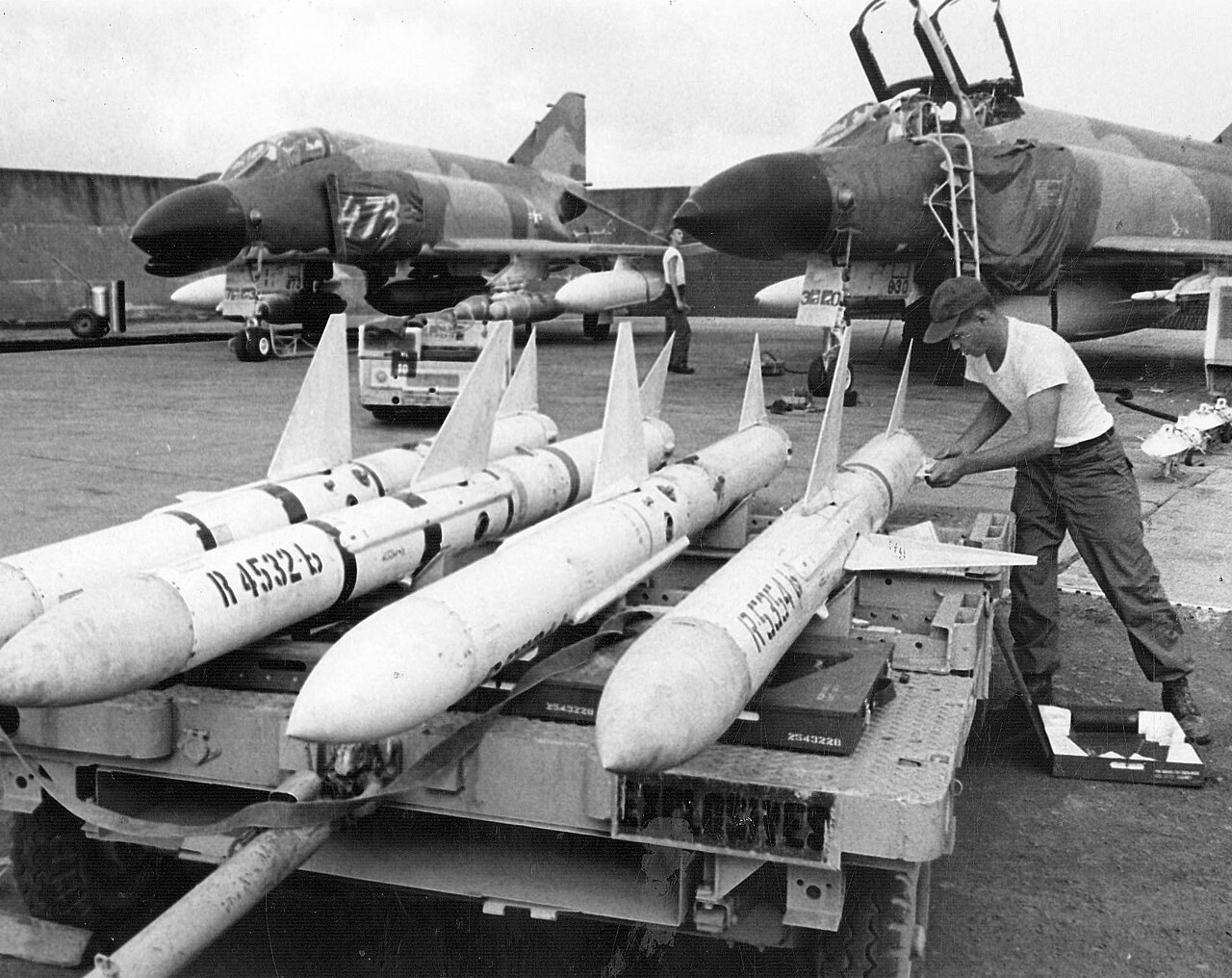
El F-4 Phantom II was the first fighter designed around the radar-guided Sparrow. Over North Vietnam it rarely got to use it as intended. Rules of engagement generally required pilots to identify targets visually, because nobody trusted the electronic means to tell a MiG-21 from a friendly aircraft at long range in a crowded sky.
When Sparrows were fired, they disappointed. American crews launched 612 AIM-7D, E and E-2 missiles in Vietnam. They scored 56 kills, a kill rate of 9.2 percent, and only two of those were beyond visual range. Higby pinned the failure on three things: the missiles often did not work, the shooter had to keep pointing his nose at the target to illuminate it, and the radar lock warned the victim that a shot was coming.
Missile kinematics: range is not a single number
Here is the first aha. A missile’s published range is a best case. A conventional air-to-air missile burns its rocket motor only briefly, then coasts. From that point they are trading speed for distance, and every turn bleeds energy. A target flying away from the missile, or forcing it to turn hard, can make it run out of speed long before its nominal range.
That is why shooters care about their own speed and height. In Cesar Rodriguez’s account of F-15C tactics before Desert Storm, his squadron planned to jettison its fuel tanks and climb towards 60,000 feet at high Mach before launching Sparrows. A missile fired high and fast starts with more energy and goes much further than one fired low and slow.
Pilots therefore think in zones, not ranges. The maximum range is the farthest a missile can reach a target that does nothing. Inside it lies the no-escape zone, the range at which the missile will still catch the target whatever the target does. The no-escape zone is far smaller, and it is the number that matters when the other side can manoeuvre.
F-pole and A-pole: the second aha
In a modern BVR fight, both sides usually have missiles that can reach each other. So the question is not only “can I hit him?” but “how close do I have to get?” Two measures capture that.
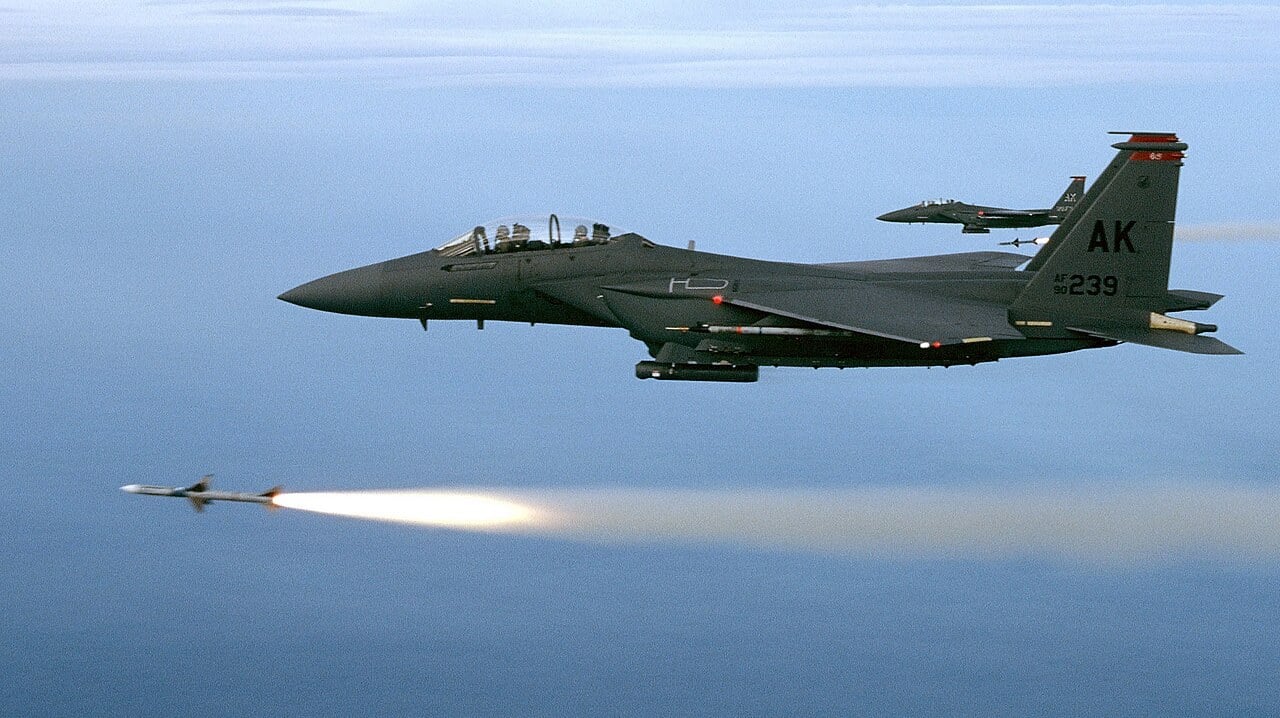
The F-pole is the distance between the shooter and the target when the missile arrives. The A-pole, used with active radar missiles, is the distance when the missile begins its own active guidance. A US Air Force Research Laboratory study of simulator training listed maximising both as desirable, because larger F-pole and A-pole ranges mean a pilot keeps more separation from the enemy.
The logic is ruthless. If my missile reaches you while I am still 15 miles away, and your missile needs you to be within 10, you may die before you can shoot back. So pilots fire, then manoeuvre to slow the rate at which they close on the target while still guiding their missile. The brevity call CRANK means turning while still illuminating the target at or near the radar’s gimbal limits. SKATE means launching and leaving at a pre-briefed range. BANZAI means launching and then pressing on into a visual fight.
Lockheed Martin footage of the first F-35 release of an AIM-120 AMRAAM, ejected from the internal weapons bay of test aircraft AF-1 over China Lake in October 2012.
The defender has tricks too. Rodriguez described two Iraqi MiG-29s doing exactly what Red Flag debriefs had warned about: turning to fly at right angles to the F-15s, the “notch”, at just the right range to hide in a blind zone of the mechanically scanned radar, then “dragging” away. The Americans lost their radar locks for a while.
Desert Storm: the turning point
In 1991 the radar missile finally delivered, at least by historical standards. The AIM-7M Sparrow scored the largest share of Coalition air-to-air kills. Of 41 US kills, Higby counted 16 that were not visually identified, the Gulf War Air Power Survey’s test for a BVR kill, and at least five that were certainly beyond visual range, including one at 16 nautical miles at night.
Higby was clear about why. E-3 Sentry AWACS aircraft were overhead all the time, giving pilots a far better picture than anyone had in Vietnam. US F-15C Eagles carried non-cooperative target recognition gear that helped identify targets. And the Iraqi pilots took no evasive action once they were locked up.
Even then, the identification problem never went away. On Rodriguez’s first Desert Storm mission, the rules of engagement required any radar lock inside 10 miles to be visually identified. That rule was written because of the risk of locking up a friendly F-117 at night, and it was rewritten the next day. Rodriguez also noted that the AWACS range calls were notoriously about three miles off.
The Fighter Pilot Podcast interviews Col. Cesar “Rico” Rodriguez, who scored two kills in Desert Storm and a third over Yugoslavia in 1999.
Fire and forget, and a vote from AWACS
The AIM-120 AMRAAM removed the Sparrow’s worst handicap. It flies most of the way on inertial guidance and data-link updates, then switches on its own radar, so the shooter no longer has to keep pointing at the target. It scored its first kill in December 1992, and it has since been credited with 16 air-to-air kills over Iraq, Bosnia, Kosovo, India and Syria.
During the 1999 NATO air war over Yugoslavia, Rodriguez scored his third kill with an AMRAAM fired from beyond 35 miles at a Yugoslav MiG-29. His account shows how the kill chain had changed. The missile could reach. The radar could track. What still held him back was proving identity, and AWACS now had a formal say in it.
Ramjets, data links and the next fight
The newest missiles attack the energy problem directly. Europe’s MBDA Meteor, which entered service on Swedish Gripen in 2016 and also arms the Rafale y Eurofighter Typhoon, uses a throttleable solid-fuel ramjet instead of a short-burning rocket. It can cruise at more than Mach 4 and keep power for the final chase. MBDA says it has three to six times the no-escape zone of other missiles in its class.
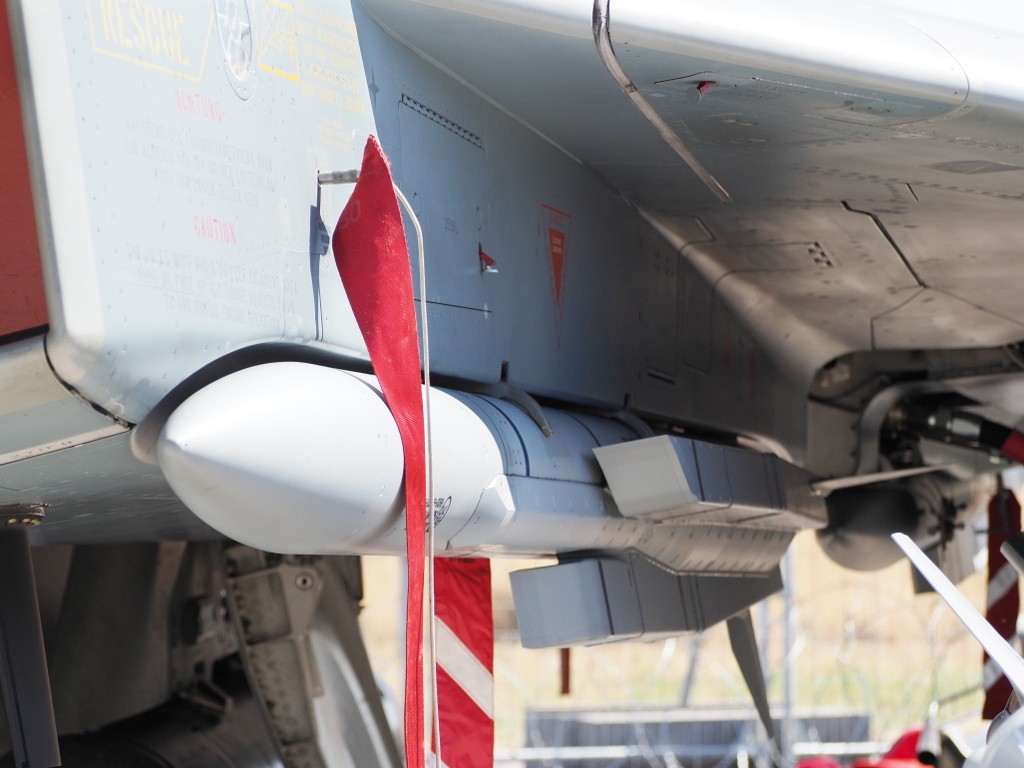
Russia’s answer to AMRAAM is the Vympel R-77, nicknamed “Amraamski” by Western journalists, whose R-77-1 version entered Russian service in 2015. China’s PL-15 arms the J-10C, J-16 and J-20. It is reported to reach Mach 5 and a maximum range of 200 to 300 km, while the PL-15E export version is reported to reach about 145 km.
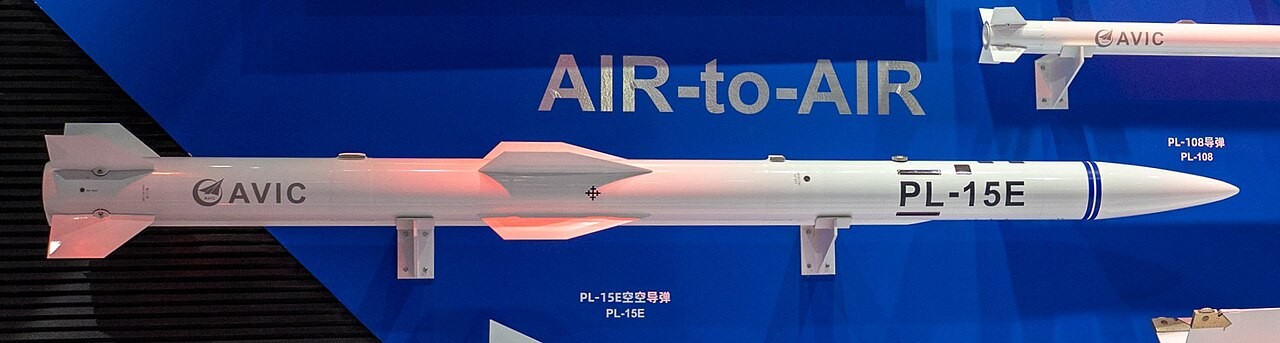
Long range only helps if somebody can say what the target is. That is why AWACS, data links and fifth-generation sensor fusion matter as much as the missiles. A fighter can now fire on a track built by another aircraft, and hand guidance of its missile to someone else.
MBDA footage of its ramjet-powered Meteor beyond-visual-range missile being loaded on a Eurofighter Typhoon in 2012.
Higby’s blunt verdict was that BVR “appears to work best in situations it is needed least”: against a weak enemy, under a friendly AWACS. Today’s air forces are spending billions to prove him wrong against a strong one. The missile was never the whole answer. The long-range kill is a team sport, and it always was.
Sources: Wikipedia (Beyond-visual-range missile; AIM-7 Sparrow; AIM-120 AMRAAM; Meteor (missile); R-77; PL-15; Multi-service tactical brevity code; Cesar Rodriguez), Lt Col Patrick Higby, Air War College (2005), US Air Force Research Laboratory report AFRL-HE-AZ-TR-2006-0015, The War Zone, MBDA

0 Comments