
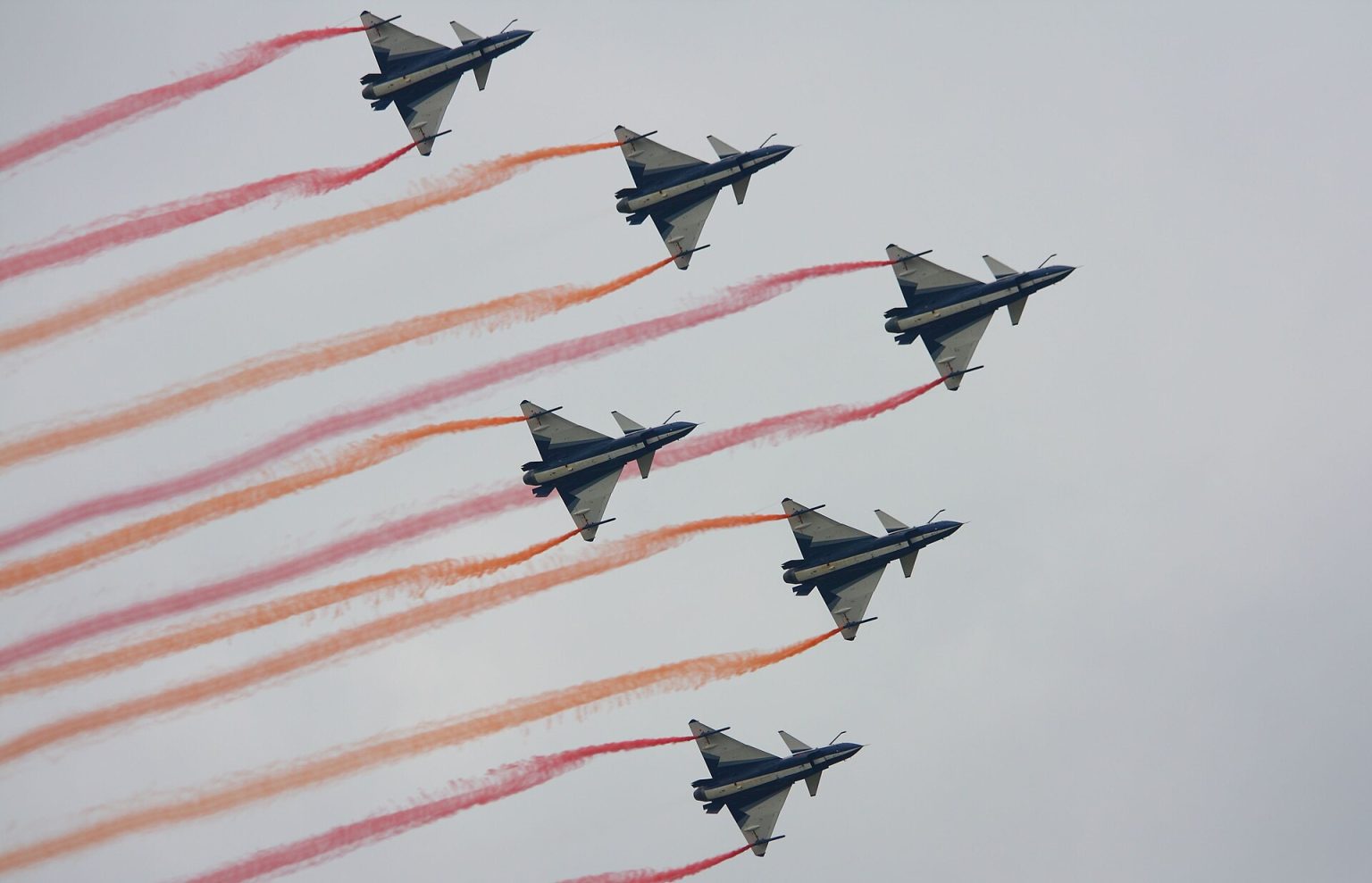
Chengdu J-10
“Vigorous Dragon”
China’s first fully indigenous 4th-generation fighter — a single-engine, canard-delta multirole jet that proved Chengdu could build a modern combat aircraft from the ground up, and whose latest J-10C version sits at the centre of one of the most contested air-combat claims in years.
China’s coming-of-age fighter
For decades the People’s Liberation Army Air Force flew licence-built and reverse-engineered Soviet designs. The Chengdu J-10 was meant to change that. Conceived under a programme reportedly approved in the 1980s as “Project No. 10,” it was China’s attempt to design and build a genuinely modern, agile multirole fighter using its own design bureau — the Chengdu Aircraft Design Institute (also called the 611 Institute), under chief designer Song Wencong.
The result, first flown on 23 March 1998 and fielded in numbers from the mid-2000s, is a single-engine, tailless canard-delta aircraft: a large delta wing paired with movable foreplanes, deliberately built to be aerodynamically unstable and flyable only through a digital fly-by-wire system. In broad configuration it resembles Western canard-delta fighters such as the Eurofighter and Gripen, and Chinese officials present it as a domestic design descended from earlier cancelled projects.
Where the aircraft came from remains debated. Russian engineers and some Western analysts have long argued that China benefited from Israeli work on the cancelled IAI Lavi — itself closely tied to the F-16 — while Chinese sources attribute the layout to indigenous research going back to the 1960s. The claims of direct technology transfer are unproven and denied by the parties involved; what is clear is that the J-10 became the platform on which China’s modern fighter, radar and engine industries matured, paving the way for the J-20.
01The J-10’s contested origins: the Lavi debate, and why it matters
The single most argued-over question about the J-10 is how much it owes to outside help. From the late 1980s onward, reports — amplified by Russian engineers quoted in the 2000s and by trade publications such as Jane’s — claimed the design drew on Israeli technical data from the cancelled IAI Lavi, a fighter developed with heavy US involvement and strong F-16 lineage. Israel officially denied transferring the Lavi to China, and the specifics have never been independently confirmed.
Chinese accounts, including statements attributed to chief designer Song Wencong, trace the canard-delta layout instead to earlier domestic studies such as the cancelled J-9. The honest position is that both influences may be partly true and neither is fully documented in open sources: the J-10 clearly sits in the same design family as several Western canards, but the airframe, intake, canard placement and systems differ enough that it is not a straight copy of any of them. Treat any confident claim in either direction — “it’s just a Lavi” or “it’s wholly indigenous” — with caution.
What makes the J-10 special
Canard-delta and relaxed stability
The J-10 pairs a large delta wing with all-moving canard foreplanes and is built to be relaxed-stability — deliberately unstable in pitch for sharper manoeuvring. That makes it impossible to fly by hand, so it depends entirely on a digital fly-by-wire flight-control system. Mastering that combination was a genuine milestone for China’s aerospace industry and is central to the aircraft’s reputation for agility.
The J-10C’s AESA radar and PL-15 missile
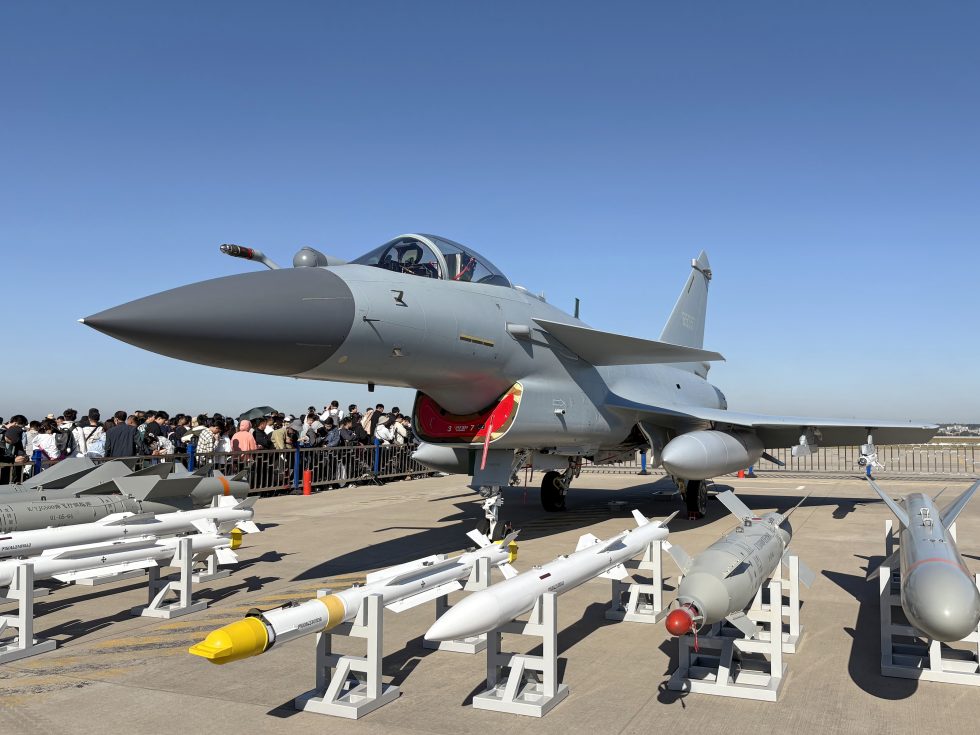
The latest J-10C reportedly carries an indigenous active electronically scanned array (AESA) radar and the long-range PL-15 air-to-air missile, alongside the short-range PL-10. On paper this pairing is meant to let the jet detect and engage targets at long range. Exact performance figures for both radar and missile are classified and the widely quoted numbers should be read as estimates, not verified data.
From Russian engine to homegrown WS-10
For most of its life the J-10 flew on the Russian Saturn AL-31FN because China’s own WS-10 “Taihang” engine was not ready. The airframe was even adapted to take the Russian engine. Only around 2019–2021 did the indigenous WS-10B appear on production J-10Cs — a long-delayed but significant step toward engine independence.
02The J-10’s fly-by-wire: why an unstable jet needs a computer to fly
A conventionally stable aircraft naturally returns to level flight; a relaxed-stability design like the J-10 does not, trading that self-correcting tendency for much quicker response to control inputs. The price is that a human pilot cannot react fast enough to keep it under control — the aircraft would diverge in fractions of a second. A digital fly-by-wire computer sits between stick and control surfaces, making dozens of tiny corrections per second. Developing a reliable, quadruple-redundant flight-control system was one of the hardest parts of the J-10 programme, and getting it right is a large part of why the aircraft is considered a real coming-of-age for Chinese fighter design.
03The J-10’s engine problem: two decades on a Russian powerplant
China selected an indigenous turbofan — the WS-10 — for the J-10 early in the programme, but the engine suffered years of reliability and quality problems. Rather than wait, Chengdu fitted the imported Russian AL-31FN, and the airframe was reworked to suit it. For roughly twenty years the flagship “indigenous” fighter therefore relied on a foreign engine — a standing reminder that jet engines were, and to some extent remain, one of the hardest technologies for China to master. The WS-10B only became a visible, fielded fit on the J-10C around 2021. Thrust figures for both engines are commonly cited in the ~122–147 kN (with afterburner) range but vary by source and variant.
Full J-10 specifications
Baseline note: these figures describe the J-10C in People’s Liberation Army Air Force service — the mark with the Shenyang WS-10B engine, an indigenous active electronically scanned array radar and the PL-15 missile, in serial production since 2015 and on combat duty since April 2018 — because that is the standard the aircraft is now built to and the standard Pakistan bought. Deltas for the J-10A of 2004 with its Russian AL-31FN and mechanically scanned radar, the J-10B of 2008 with the diverterless supersonic inlet, the two-seat J-10S and export J-10SY, the one-off J-10B TVC thrust-vectoring demonstrator and the export J-10CE are in grey. Figures reflect sources available on 3 September 2026. One warning belongs above the table rather than beneath it: China has never published an official specification for this aeroplane, so much of what circulates is not measurement but inference. Several widely reprinted "J-10 specifications" — a length of 14.57 m, a span of 8.78 m, a wing area of 33 m² and a maximum take-off weight of 19,277 kg — are, to the digit, the published figures for the Israeli IAI Lavi. They entered the literature from writers who assumed the J-10 was a Lavi and reasoned backwards. A J-10 table that agrees exactly with the Lavi is evidence about its author, not about the aircraft.
Dimensions & weights
- Crew
- 1 (2 in the J-10S and the export J-10SY, which keep the radar, the gun and the full weapons fit and serve as conversion trainers and as combat aircraft rather than as stripped hacks)
- Length
- 16.43 m (53 ft 11 in) including the nose pitot probe; roughly 15.5 m (50 ft 10 in) over the airframe alone. Several widely reproduced online references and the Hong Kong press give 16.9 m (55 ft 5 in); older Western tables give 14.57 m, which is the Lavi’s length.
- Wingspan
- 9.75 m (32 ft 0 in) over the wingtip missile rails (9.8 m is also printed; the difference sits inside the error of photogrammetry, which is how nearly every J-10 dimension was arrived at)
- Height
- 5.43 m (17 ft 10 in) to the fin tip (5.7 m / 18 ft 8 in in several tables)
- Wing area
- 39.5 m² (425 sq ft), a mid-mounted cropped delta of about 55° leading-edge sweep with close-coupled canard foreplanes ahead of it, a single fin and two ventral fins (published figures run from 37 to 40 m²)
- Empty weight
- 8,840 kg (19,490 lb) for the J-10A in Chinese sources. Western tables generally print 9,750 kg (21,500 lb). The J-10C is heavier again by an unpublished margin: the array antenna, the reinforced nose structure and the WS-10B all add weight.
- Normal take-off weight
- 12,400 kg (27,340 lb), the clean air-defence configuration with full internal fuel and two short-range missiles
- Maximum take-off weight
- Not officially published. The figure printed almost everywhere, 19,277 kg (42,500 lb), is the Lavi’s maximum take-off weight to the kilogram and should not be treated as a J-10 measurement — although empty weight plus internal fuel plus a 5,600 kg external load does land close to 19 tonnes, so the number may be right by accident
- Internal fuel
- ~3,600 kg (~7,940 lb; about 4,500 litres, 1,190 US gal)
- External fuel
- Three drop tanks totalling 4,000 litres (1,060 US gal): two of 1,600 litres underwing and one of 800 litres on the centreline. Several widely reproduced specification tables print "4,000 L" as though it were the internal figure; it is the external total.
- Maximum external load
- ~5,600 kg (~12,300 lb) of stores and fuel across all stations (some tables give 4,500 kg; neither figure is official)
- Hardpoints
- 11 (six under the wing, two under the intake trunk, three under the fuselage). In practice the centreline carries a tank on almost every sortie, so the usable weapons count is nine.
- Wing loading
- 318 kg/m² (65 lb/sq ft) at normal take-off weight (381 kg/m² is widely quoted, which is a 14,000 kg gross weight divided by the smaller 37 m² wing figure — two contested numbers multiplied together)
Performance
- Maximum speed
- Mach 1.8 at altitude (1,910 km/h, 1,190 mph, 1,030 kn at 11,000 m). Chinese sources claim Mach 2.0 for the J-10A. The J-10B and J-10C, with the fixed-geometry diverterless inlet, are generally credited with slightly less top-end speed and better transonic manners — precisely the trade that intake was designed to make.
- Maximum speed, sea level
- Mach 1.2 (1,470 km/h, 915 mph)
- Approach speed
- 200 km/h (124 mph, 108 kn), strikingly low for a delta and a direct product of the canard, which trims the wing to a lower angle of attack on finals
- Rate of climb
- 300 m/s (59,000 ft/min) at sea level, clean
- Service ceiling
- 18,000 m (59,000 ft) (Chinese tables give 17,000 m / 55,800 ft; the gap is probably service ceiling against absolute ceiling rather than a genuine disagreement)
- Combat radius
- ~550 km (~340 mi, ~300 nmi) on internal fuel in the air-defence role. ~1,240 km (~770 mi) is quoted for the J-10C with drop tanks, and Pakistani material claims ~2,600 km with air-to-air refuelling.
- Range
- 1,850 km (1,150 mi, 1,000 nmi) on internal fuel
- Ferry range
- 2,950 km (1,830 mi, 1,590 nmi) with three drop tanks
- Take-off run
- 350 m (1,150 ft) at normal take-off weight
- Landing run
- 400 to 650 m (1,310 to 2,130 ft) with the brake parachute
- Load factor limits
- +9 g / −3 g
- Thrust-to-weight ratio
- 1.05 to 1.11 at normal take-off weight (the spread reflects the 135 kN and 144 kN afterburning figures published for the WS-10B; a J-10A on the AL-31FN sits near 1.00)
Propulsion & systems
- Engine
- One Shenyang WS-10B Taihang afterburning turbofan. This is the milestone the aeroplane is remembered for in China: the first time a Chinese-designed engine displaced the Russian one on a front-line Chinese single-engined fighter, and therefore the end of a Russian veto over Chinese fighter production.
- Thrust
- 89.17 kN dry (20,050 lbf); 135 to 144 kN with afterburner (30,350 to 32,370 lbf). Chinese and Western sources do not agree, and the spread may reflect successive build standards rather than one disputed number.
- Engine, earlier marks
- J-10A and most J-10B use the Russian Salyut AL-31FN, 122.6 kN (12,500 kgf, 27,560 lbf) in afterburner, uprated to about 132 kN in the AL-31FN Series 3 offered from December 2013. The AL-31FN differs from the Su-27’s AL-31F chiefly in having its gearbox and accessory pack rotated to the underside to suit a single-engined fuselage.
- Air intake
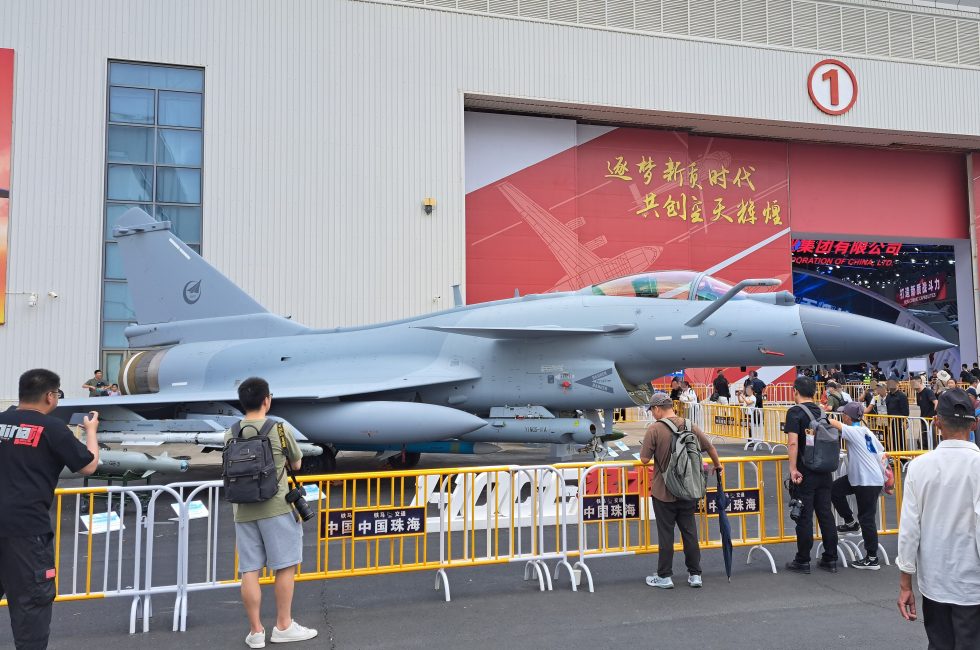
- J-10A: a rectangular external-compression inlet beneath the fuselage with a splitter plate and adjustable ramps. J-10B, J-10C and J-10CE: a diverterless supersonic inlet with a fixed compression bump — lighter, mechanically simpler, lower in radar return, and one of the earliest service applications of the idea anywhere.
- Flight control system
- Quadruplex digital fly-by-wire, the first full-authority digital system on a Chinese fighter, over an airframe deliberately unstable in pitch. The canard is not styling: without the computers this aeroplane cannot be flown at all, and getting that software right was as hard a problem for China as the engine.
- Radar
- Indigenous active electronically scanned array, generally attributed to the CETC 14th Institute. Several online references name it KLJ-7A, but that is properly the Nanjing-developed array of the JF-17 Block III; the J-10C set’s designation should be treated as unsettled.
- Radar, earlier marks
- J-10A: Type 1473 mechanically scanned pulse-Doppler set from the CETC 14th Institute, described in Chinese accounts as the country’s first genuinely practical pulse-Doppler radar. J-10B: disputed. Most Western references call it a passive electronically scanned array, while Chinese accounts say a PESA was built by AVIC 607 and CETC 14, tested, found shorter-ranged than the old pulse-Doppler set and rejected, with production aircraft flying an AESA. Both cannot be true. The passive-array reading is the majority Western view rather than a settled fact.
- Electro-optics
- J-10B and J-10C carry an internal infrared search and track sensor with laser rangefinder ahead of the windscreen, offset to starboard. The J-10A had no internal sensor and relied on the podded Hongguang-I.
- Cockpit
- Three colour liquid-crystal multi-function displays, a holographic head-up display, hands-on-throttle-and-stick controls and a helmet-mounted sight. The J-10C adds a wider-field head-up display and helmet cueing matched to the PL-10.
- Electronic warfare
- Internal radar warning receiver with wingtip and fin antennas, chaff and flare dispensers in the tail boom, and the podded KG600 jammer. The J-10B introduced an electronic support fairing on top of the fin, carried over to the J-10C.
- Air-to-air refuelling
- Probe and drogue, using a bolt-on probe on the starboard side of the nose. The PLAAF tanks from H-6U and Y-20U aircraft; the Pakistan Air Force from its Il-78.
- Datalink
- Encrypted tactical datalink for co-operative engagement with airborne early warning aircraft. This is central to how the type has actually been used: in May 2025 Pakistani J-10CEs are reported to have launched on tracks passed by Saab 2000 Erieye aircraft rather than on their own radar returns.
- Gun
- One twin-barrel 23 mm cannon in a fairing on the port side of the intake trunk, a Chinese Type 23-3 derived from the Soviet Gryazev-Shipunov GSh-23L (the magazine capacity is not reliably published anywhere)
04The J-10’s specs and price: why almost every figure is an estimate
The J-10 is a Chinese state programme, and China publishes very little verified data about it. As a result nearly every specification you will see — top speed, ceiling, weights, radar range, missile range, thrust and especially cost — is an outside estimate assembled from airshow observation, export brochures and analyst modelling, not an official figure. Reported export prices for the J-10CE cluster very roughly in the $40–60 million range, but even that is uncertain and package-dependent. No credible cost-per-flight-hour figure exists in open sources. Read the numbers on this page as best-available approximations, not hard facts.
Armament & payload
The J-10C exists to carry the PL-15, and almost everything else about the aircraft follows from that
The J-10 started as a point-defence fighter with a short-range infrared missile and a pulse-Doppler radar, and grew into a multirole aeroplane, but the change that matters is the one made between the J-10A and the J-10C: an active array radar, an encrypted datalink and a missile that flies more than twice as far as the one it replaced. A J-10C with four PL-15 and two PL-10 is a stand-off shooter that expects to be cued by an airborne early warning aircraft, to launch without ever radiating and to turn away — a way of fighting that asks less of the airframe than of the network behind it. The air-to-ground fit is genuine but secondary; Chinese practice gives the heavy strike work to the twin-engined J-16, and the gun is a survival from an earlier idea of the aeroplane. Clearances differ sharply by mark and by operator: a J-10A cannot carry the PL-15 or the PL-10 at all, and Pakistan’s J-10CEs carry the export PL-15E, whose published range is well under half the domestic missile’s upper figure.
Gun
- One twin-barrel 23 mm Type 23-3 cannon, a Chinese-built derivative of the Gryazev-Shipunov GSh-23L, in a fairing on the port side of the intake trunk.
- The parent GSh-23L fires at about 3,400 rounds per minute. The J-10’s magazine size is not published in any source that can be checked, and figures around 200 rounds circulate without attribution.
- Retained on every mark including the J-10C and the export J-10CE, at a time when several contemporaries were deleting the gun to save weight.
- No J-10 gun engagement has ever been claimed. In the type’s only combat use, on 7 May 2025, everything was fought beyond visual range and the gun was irrelevant.
Air-to-air
- PL-15 active-radar beyond-visual-range missile: dual-pulse solid motor, miniature AESA seeker, two-way datalink, burnout speed above Mach 5. Domestic range quoted at 200 to 300 km; the export PL-15E at about 145 km. J-10C and J-10CE only.
- PL-12 (export SD-10) active-radar medium-range missile, roughly 70 to 100 km. The standard beyond-visual-range round of the J-10A and J-10B and still carried as a second-tier weapon.
- PL-10 imaging-infrared short-range missile with thrust vectoring and very high off-boresight capability, cued by helmet sight. J-10C and J-10CE.
- PL-8 infrared short-range missile, a Chinese licence-built Rafael Python 3 — the one piece of Israeli technology in this aircraft that is documented rather than alleged. Standard on the J-10A and J-10S.
- PL-17 very-long-range missile has been photographed on a modified J-10C using deep external pylons. That is a trials configuration reported in 2026, not a service fit.
Air-to-surface guided
- KD-88 turbojet-powered stand-off land-attack missile with television or imaging-infrared terminal guidance, in the region of 180 to 200 km.
- YJ-91 anti-radiation missile, the Chinese development of the Russian Kh-31P, for defence suppression.
- YJ-83K sea-skimming anti-ship cruise missile of about 180 km, carried on the fuselage stations. This is the fit that turns a J-10 into a maritime strike aircraft.
- YJ-21 air-launched anti-ship ballistic missile: integration on the J-10C has been reported since January 2026 but has not been confirmed by imagery of a service aircraft.
- None of these is publicly confirmed on Pakistan’s J-10CE. The PAF’s stand-off strike work belongs to the JF-17 with Ra’ad and to the Mirage fleet.
Bombs
- LS-6 satellite- and inertially-guided glide bomb in 50, 100, 250 and 500 kg classes — the workhorse precision weapon of the fleet.
- LT-2 and LS-500J laser-guided bombs of the 500 kg class, delivered with the WMD-7 targeting pod.
- GB-series glide bombs (GB2A, GB3, GB3A, GB250) with folding wing kits for stand-off release.
- FT-1 satellite-guided bomb, functionally a Chinese tail kit on a 500 kg body.
- Unguided 250 kg and 500 kg low-drag bombs remain cleared, and are what the type actually drops on the range.
Rockets
- 90 mm unguided rocket pods are the only rocket armament reliably attributed to the type.
- Older Chinese 57 mm and 130 mm pods exist in the class and are sometimes listed, but they do not appear in J-10 photographs.
- This is a legacy capability rather than a real one. A single-engined fighter carrying an AESA radar is not sent to strafe, and the PLAAF has JH-7A, J-16 and armed drones for that work.
- No rocket armament has been shown on the export J-10CE.
Pods & other stores
- WMD-7 electro-optical targeting pod, the standard laser designator, carried on an intake station.
- K/JDC01A targeting pod and Hongguang-I infrared search and track pod, both J-10A-era fits made redundant by the internal sensor of the J-10B and J-10C.
- KG600 electronic countermeasures pod; a KG300G escort jammer is also associated with the type.
- Blue Sky low-altitude navigation and attack pod, the Chinese answer to the navigation half of LANTIRN.
- Up to three drop tanks — two of 1,600 litres underwing, one of 800 litres on the centreline. The centreline tank is carried on very nearly every operational sortie.
Three typical loadouts
- Beyond-visual-range air defence, the 7 May 2025 pattern
- Four PL-15E on the inner and middle underwing stations, two PL-10E outboard, one 800-litre centreline tank. Flown radar-silent, cued by a Saab 2000 Erieye through the datalink, launching from inside Pakistani airspace and turning away before the missiles went active. The aeroplane in this configuration is a launch rail for someone else’s picture.
- Homeland air defence, PLAAF standard
- Two PL-15 and two PL-12 underwing, two PL-10 outboard, two 1,600-litre wing tanks and one 800-litre centreline tank. Long loiter under ground control — the mission Project 10 was written for in 1981, and still the one the fleet flies most.
- Maritime strike
- Two YJ-83K anti-ship missiles on the fuselage stations, two PL-8 or PL-10 for self-defence, WMD-7 pod, one centreline tank. Rarely photographed on a J-10 and far more common on the J-16 and JH-7A, which is a fair guide to how seriously the PLAAF takes the J-10 as a strike aircraft.
No Chinese or Pakistani authority publishes a stores clearance list for this aircraft. The fits above are assembled from Zhuhai and Dubai display loadouts, from Andreas Rupprecht’s Harpia reference works and from photographs of service aircraft. A weapon bolted to a pylon on a static display has been mated, which is not the same as cleared for carriage and release. Every range figure for a Chinese missile here is a manufacturer or state-media claim with no independent verification, and the gap between domestic and export standards is real and large: the PL-15E sold to Pakistan is quoted at roughly half the range of the PL-15 the PLAAF carries.
Variants
The J-10 changed its intake, its radar and finally its engine, and each change was a Chinese industrial problem solved rather than an aerodynamic one
Project 10 began in 1981, when the PLAAF commander Zhang Tingfa put a proposal to Deng Xiaoping for a third-generation fighter at 500 million yuan. Three institutes competed — Shenyang offered a strake-winged design descended from its cancelled J-13, Hongdu a swing-wing in the manner of the MiG-23, and Chengdu a canard delta descended from its cancelled J-9 — and Chengdu won in February 1984, with Song Wencong as chief designer. It was the first Chinese combat aircraft chosen by competition rather than allotted to an institute, and the first in which the supplier answered directly to the customer. Chengdu reckoned that about 60 per cent of the aircraft needed technology China did not yet have, against a normal 30 per cent, which is the honest measure of how far ahead of its industrial base the programme was set. It was also China’s first major user of computer-aided design and computational fluid dynamics. Detailed design closed in 1994, the first airframe was assembled in June 1997, first flight came on 23 March 1998, the design was frozen in 2004 and the type was operational in 2006. Twenty-five years from proposal to squadron service, most of it spent waiting for Chinese industry to catch up with a Chinese design.
Then there is the Lavi, the question every account of this aeroplane has to answer. What is claimed: that the J-10 is a development of the Israeli IAI Lavi — first flown 31 December 1986, cancelled by the Israeli cabinet on 30 August 1987 after Washington withdrew funding — and that Israel sold or leaked the design to China. The Sunday Times reported a joint development agreement in 1988. Russian engineers of the Siberian Aeronautical Research Institute, who worked with Chengdu from 2006, told interviewers the J-10 was "more or less a version" of the Lavi and that a Lavi airframe had been at Chengdu; Janes repeated the claim in 2008, sourced to Russian engineers relaying what Chinese colleagues had told them. What China says: Song Wencong, who had worked on the J-9, and PLAAF Major General Zhang Weigang both attribute the canard delta to Chengdu’s own J-9 studies of the 1960s and 1970s. No Chinese account acknowledges Israeli involvement, and Israel’s defence minister denied it in 1988. What is established: the two aircraft are close in configuration and in size; Israeli and Chinese defence trade in that period was extensive and documented, including the PL-8, which is a licence-built Rafael Python 3 and still hangs on the J-10’s wingtips; and the United States blocked Israel’s Phalcon radar sale to China in 2000 precisely because it did not trust that channel. What is not established is a single document, contract, drawing or named engineer. The case rests on resemblance and on Russian hearsay. It has never been proved, and it has never been credibly refuted either; and it has quietly corrupted the reference literature, as the specification note above records.
The engine is the second thread, and the more important one. The WS-10 was chosen in 1983 and was not ready; the J-10A entered service in 2004 on the Russian AL-31FN, which meant China’s most important new fighter depended on a supplier it was simultaneously trying to stop depending on, and every squadron raised was another hostage. A WS-10A flew in a J-10B in July 2011 and was not selected for the production batch. Only in May 2021 did state media show a WS-10B on an operational J-10C, and by November 2021 WS-10B aircraft were in squadron service. Thirty-eight years from engine selection to fleet service is a brutal number, and it is also the single most consequential thing this programme did. A domestic engine of adequate thrust and acceptable life ended Moscow’s veto over Chinese fighter production; the J-20, the J-16 and the J-35 all stand on it.
The J-10CE’s combat debut on 7 May 2025 is the most consequential thing that has happened to the programme and the least settled. What Pakistan claims: that 42 PAF aircraft engaged 72 Indian aircraft in a 52-minute beyond-visual-range battle in which neither side crossed the border, and that J-10CEs firing PL-15E shot down five Indian aircraft — three Rafales, a MiG-29 and a Su-30MKI — plus a Heron drone; Pakistan later passed Dassault four Rafale tail numbers, BS001, BS021, BS022 and BS027. What India says: at first that the operation cost no Indian asset; on 11 May 2025 that "losses are a part of combat" and that all pilots were home; and on 31 May 2025 the Chief of Defence Staff, General Anil Chauhan, acknowledged that India had lost aircraft while rejecting Pakistan’s figure. India has never stated a number or a type. What independent reporting corroborates: two United States officials told Reuters on 8 May 2025 that they assessed with high confidence that Pakistani J-10s had downed at least two Indian fighters, one of them a Rafale; the French air force chief of staff, General Jérôme Bellanger, said he had seen evidence of three losses, a Rafale, a Mirage 2000 and a Sukhoi; the Washington Post located three crash sites inside India, at Akalia Kalan near Bathinda, at Wuyan near Pampore and near Akhnoor; and largely intact PL-15E debris, including a rear section recovered at Hoshiarpur in Punjab, put the missile itself beyond argument, with Indian authorities confirming its use on 13 May 2025. What remains contested is the count, and above all the number of Rafales. Dassault’s chief executive Eric Trappier told Challenges in June 2025 that "the Indians have not communicated, so we do not know exactly what happened", and that the Pakistani claim of three destroyed Rafales was "inaccurate"; French officials separately alleged a Chinese diplomatic campaign to talk the Rafale down after the battle. Both governments had strong reasons to shade this, both ran heavy information operations, and Chengdu Aircraft Corporation’s share price moved on the reporting within a day. No adjudication is offered here. The recovered missile debris and the located crash sites are hard evidence; the arithmetic beyond three aircraft is not.
- J-10 prototypes (1998–2003, six aircraft)
- AL-31FN, Type 1473 radar, rectangular splitter-plate intake. Lei Qiang flew the first aircraft on 23 March 1998; he was picked for his experience on modern foreign types. Aircraft reached PLA training units in 2003, ahead of schedule, and testing closed that December.
- J-10A (service 2004; 236 with the PLAAF)
- The production single-seater and the aircraft the world first saw when Xinhua published photographs in January 2007. Russian AL-31FN, mechanically scanned pulse-Doppler radar, PL-8 and PL-12, no internal infrared sensor, podded targeting. Offered for export as F-10A and FC-20 and never sold in that form.
- J-10S (from about 2005; 77 with the PLAAF)
- Tandem two-seater with a raised rear cockpit, a lengthened dorsal spine and a slightly enlarged fin. Fully combat-capable: the operational conversion aircraft and a back-seat weapons platform, not a stripped trainer. The export two-seat J-10SY follows the same pattern.
- J-10AH and J-10SH (designations reported, numbers not corroborated)
- Naval versions of the J-10A and J-10S for PLA Naval Aviation. No independent inventory has been published and the IISS carries no naval J-10 line, so they are excluded from the fleet chart below.
- J-10AY and J-10CY (from 2009 and about 2022)
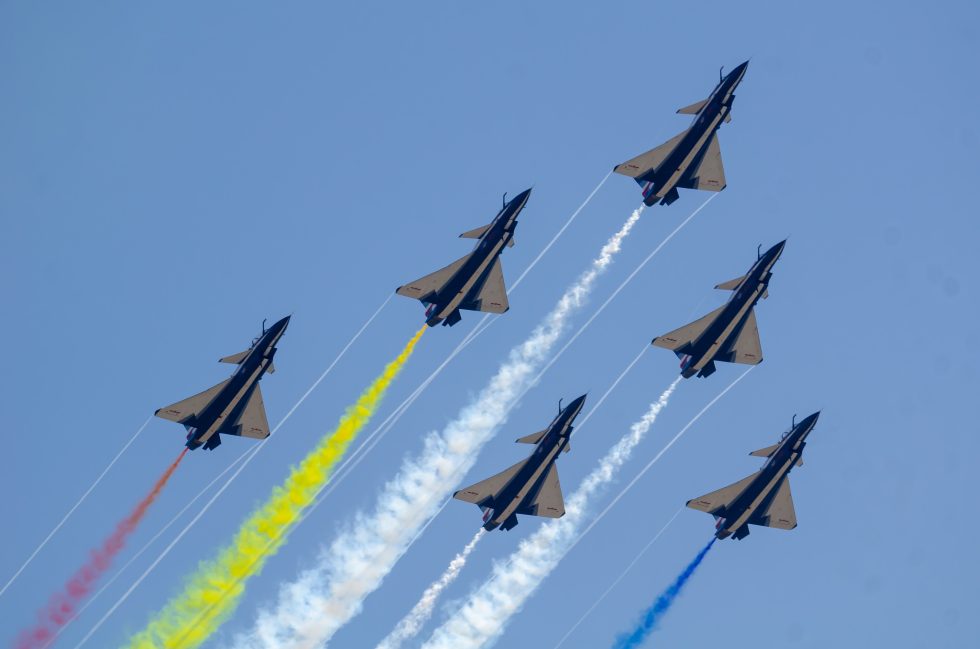
- Display aircraft for the August 1st aerobatic team, with pylons and some equipment removed and a smoke system fitted. The team lost Captain Yu Xu, the first woman cleared to fly the J-10, in a mid-air collision on 12 November 2016.
- J-10B (first flight by December 2008; 55 built)
- The aerodynamic and sensor rewrite: diverterless supersonic inlet, longer radome, internal infrared search and track with laser rangefinder, an electronic support fairing on the fin, AL-31FN M1. Built in small numbers because the radar was late. The J-10B is best read as the J-10C’s prototype batch that happened to receive a service designation.
- J-10B TVC (one aircraft, shown publicly November 2018)
- A J-10B fitted with a WS-10B carrying an axisymmetric thrust-vectoring nozzle, flown at Zhuhai through Pugachev’s Cobra, a J-turn and a falling leaf. A demonstrator for nozzle control laws and manufacturing, not a prototype for production: no J-10 in service has thrust vectoring, and none is expected to.
- J-10C (first flight December 2013, production from 2015, combat duty April 2018; 240 with the PLAAF)
- The baseline of this page. Indigenous AESA radar, WS-10B, PL-10 and PL-15, reworked electronic warfare and datalink; Justin Bronk classes it as a 4.5-generation fighter. Reported to have beaten both the Su-35 and the J-16 in PLAAF competitive exercises in 2019, 2020 and 2021 — a Chinese-sourced claim, but a consistent one.
- J-10CE (export; deliveries from March 2022; 36 ordered by Pakistan, about 24 by Uzbekistan)
- Export J-10C with the PL-15E in place of the PL-15 and export standards of radar and electronic-warfare software. Pakistan’s contract, reported at about US$1.5 billion, covered 20 aircraft, ten spare WS-10B engines and some 240 PL-15E; the first six landed at PAF Base Minhas on 4 March 2022 and were inducted into No. 15 Squadron "Cobras" on 11 March.
- J-10D (photographed from 2024, status unconfirmed)
- A further development with a straight raised spine, a one-piece canopy and a reworked wing, read variously as an electronic-warfare or an extended-range variant. Nothing about it has been confirmed by any Chinese official statement, and the Pakistan Air Force has been reported as interested in an upgrade to this standard.
Total production has never been announced. Adding the corroborated PLAAF inventory to the export contracts gives roughly 650 airframes built by the end of 2025, which is consistent with Chinese estimates of about 400 by August 2014. Unit cost is equally unofficial: ~US$28 million was quoted for the J-10A and ~US$41 million for the export FC-20 that never sold, while Pakistan’s 20-aircraft J-10CE package came to ~US$1.5 billion including missiles, spare engines and training, and Bangladesh’s proposed 20-aircraft deal is reported at ~US$2.2 billion on the same all-in basis. Package prices and flyaway prices are different numbers and are constantly confused, usually to make a point.
Operators today
China flies more than nine in ten of every J-10 ever built, and the export column only opened in 2022
The J-10 was built for China and sold abroad late and sparingly. For two decades it had no foreign customer at all: the FC-20 was dangled at Pakistan from 2006, negotiations dragged into 2012, and nothing was signed. What changed was the J-10C, and then what changed again was 7 May 2025, after which a queue formed. The counts below are of airframes delivered and in service, not of orders, authorised loans or letters of intent — which is why Bangladesh, Indonesia, Serbia, Venezuela and Algeria, all reported during 2025 and 2026 as prospective customers and some with money already approved, do not appear here.
These are estimates. China: 608 aircraft with the PLAAF in the IISS Military Balance 2025 — 236 J-10A, 77 J-10S, 55 J-10B and 240 J-10C — which makes the J-10 the most numerous fighter in Chinese service after the J-11 and J-16 family. Naval J-10AH and J-10SH designations are reported but no corroborated inventory exists, so none is counted. Pakistan: 20 J-10CE delivered as of May 2025 on both the IISS count and the United States Department of Defense China Military Power Report published in December 2025, against two orders totalling 36 aircraft since 2020, with the balance scheduled to arrive by early 2026. That balance has not been independently counted, so the row is given as a range rather than a single figure. They equip No. 15 Squadron "Cobras" at PAF Base Minhas, Kamra. Uzbekistan: at least six J-10CE shown in official footage during the independence day celebrations of late August 2026, from a reported order of about 24 confirmed by the defence minister in July 2025; Uzbekistan is the second export operator. Sources: IISS The Military Balance 2025, the US Department of Defense China Military Power Report of December 2025, and South China Morning Post reporting of 30 August 2026. Entries that could not be corroborated are omitted.
From secret programme to export fighter
Project No. 10 approved
China launches a programme to build an indigenous multirole fighter at Chengdu, with Song Wencong as chief designer. Much of the work stays secret for years.
First flight
The first prototype flies on 23 March 1998, piloted by Lei Qiang — the debut of China’s first home-designed 4th-generation fighter.
Enters PLAAF service
The baseline single-seat J-10A is fielded with the People’s Liberation Army Air Force in the mid-2000s.
Officially unveiled
China publicly reveals the J-10 in January 2007, ending years of secrecy around the programme.
J-10B arrives
The improved J-10B introduces a diverterless supersonic inlet, a new radar and infrared search-and-track; production runs into the mid-2010s.
J-10C in service
The J-10C, with a reported AESA radar and PL-15 missile, is declared combat-ready — the definitive current version.
Homegrown engine
Production J-10Cs appear with the indigenous WS-10B engine, reducing reliance on Russian powerplants after roughly two decades.
First export: Pakistan
Pakistan receives its first J-10CE fighters, making it the type’s launch export customer and first foreign operator.
Contested combat debut
During the May 2025 India–Pakistan clashes, Pakistan claims its J-10CEs downed Indian jets including Rafales — claims that remain disputed and unverified by neutral sources.
Twelve stories about the J-10
The fighter China built to grow up
Project No. 10 was as much about industrial capability as about the aircraft itself.
Read the full story
A jet that can’t be flown by hand
The J-10 is deliberately unstable — only a computer keeps it in the air.
Read the full story
Copy, inspiration, or coincidence?
Analysts still argue over how much the J-10 owes to Israel’s cancelled Lavi.
Read the full story
Twenty years on a borrowed heart
China’s indigenous fighter spent most of its life on a Russian engine.
Read the full story
The diverterless nose
The J-10B introduced a bumped intake that hints at stealth-era thinking.
Read the full story
The version everyone means today
The J-10C added an AESA radar and long-range missiles — and drew the export interest.
Read the full story
Pakistan takes the Dragon
In 2022 Pakistan became the J-10’s first foreign operator.
Read the full story
The contested Rafale claims
Pakistan says its J-10CEs downed Indian jets; the truth is genuinely disputed.
Read the full story
The August 1st display team
China’s national aerobatic team flies the J-10 in front of the world.
Read the full story
A fighter built in the hundreds
More than 600 J-10s are estimated to have been produced.
Read the full story
The stock that moved on a dogfight
Reports of the May 2025 clashes reportedly moved the maker’s share price.
Read the full story
The bridge to the J-20
The J-10 taught China the skills its stealth fighter would need.
Read the full story
The J-10 in pictures
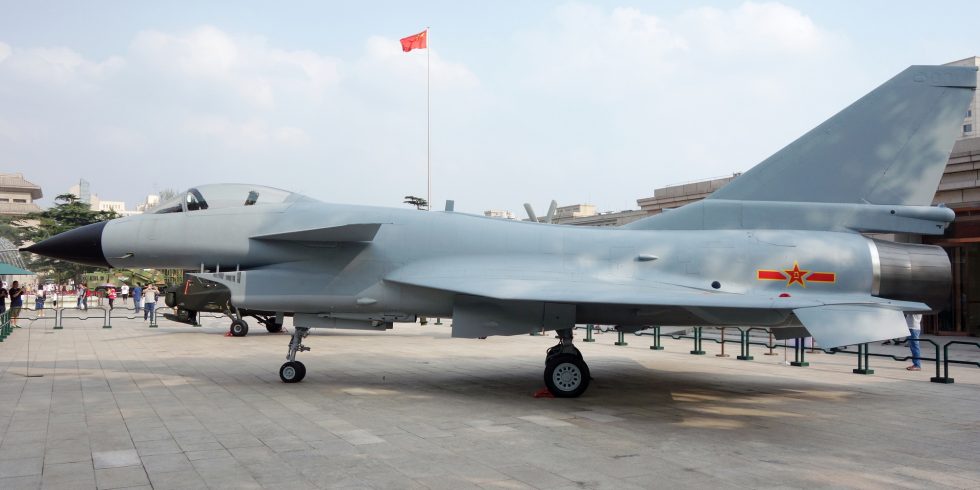
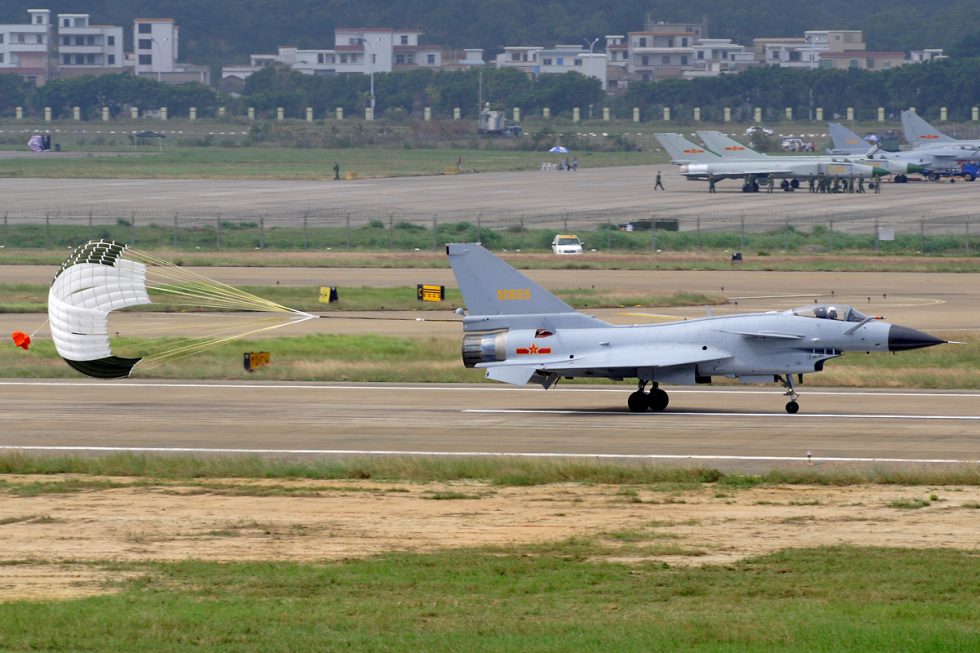
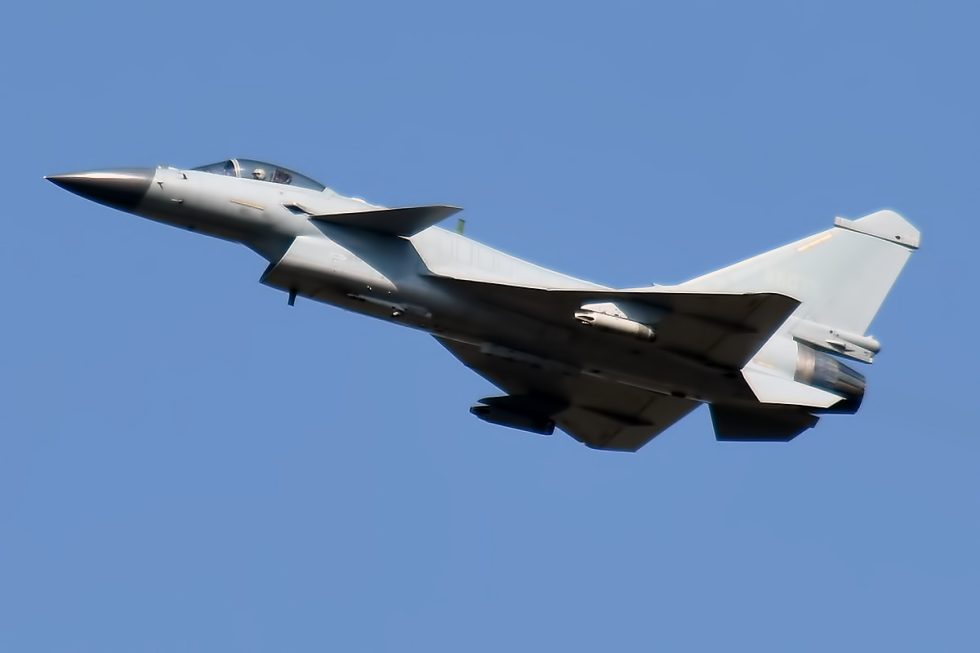
The J-10 in motion
Video coming soon. A featured flying-display and analysis video of the Chengdu J-10 will be added here.
The Chengdu J-10 in motion
Found And Explained — one of the most-watched Chengdu J-10 films on YouTube.
Where the J-10 flies
The contested combat record
For most of its life the J-10 had no combat history at all — it served as a peacetime frontline fighter. That changed, controversially, in May 2025, when Pakistan claimed its J-10CE fighters shot down Indian aircraft, including French-built Rafales, during cross-border clashes. The claims are heavily disputed and have not been independently verified, and they are the subject of active information warfare on both sides. The figures below are claims, not confirmed results.
Pakistan said its J-10CEs, firing PL-15 missiles, downed multiple Indian aircraft including Rafales; India initially denied losses and later acknowledged some without confirming numbers or causes. Independent outlets and some US and French officials indicated India likely lost at least a few aircraft, but did not fully confirm Pakistan’s specific tally or the exact role of the J-10C. Both governments have obvious incentives to shape the story, and no neutral body has published a definitive account. Compare the combat record of every military aircraft. Figures as of July 2026 and, for May 2025, unverified.
Everything people ask about the J-10
Can I fly in a J-10?
Can a civilian fly the J-10?
Is the J-10 a copy of the Israeli Lavi or the F-16?
Did a J-10 really shoot down a Rafale in 2025?
What engine does the J-10 use?
How does the J-10C compare to Western fighters?
Who operates the J-10?
You can’t fly the J-10.
These, you can.
Some legends only live in museums — others are fuelled and waiting. MiGFlug has put civilians in real military jet cockpits since 2004.
 Fly the L-39 AlbatrosThe world’s most-flown jet trainer — aerobatics included
 Fly the F-104 Starfighter“The missile with a man in it”
 Fly the MiG-21The Cold War’s most-produced jet
 Fly the T-33 Shooting StarAmerica’s first jet trainer
 Fly the DH VampireA piece of early jet history
 Fly the S.211Agile Italian jet trainer
 Fly the MB-326The classic Aermacchi jet
 Fly the MiG-15The Soviet legend of the Korean War
Continue the tour
Every fact, checked
- The War Zone (TWZ)The J-10 at 25: development, design and its significance to Chinese aviation.
- 19FortyFiveThe J-10’s long dependence on the Russian AL-31 engine before the WS-10 was ready.
- The AviationistReporting on the May 2025 clashes and the contested Rafale shootdown claims.
- ReutersIndependent reporting on Indian aircraft losses and the limits of verification.
- FlightGlobalAnalysis of the disputed imagery and claims from the 2025 conflict.
- Army RecognitionJ-10 variants, weapons and the J-10CE export configuration.
- Airforce TechnologyReference specifications and programme background for the J-10.
- The EurasianTimesJ-10C variant analysis and its role in the India-Pakistan air balance.