
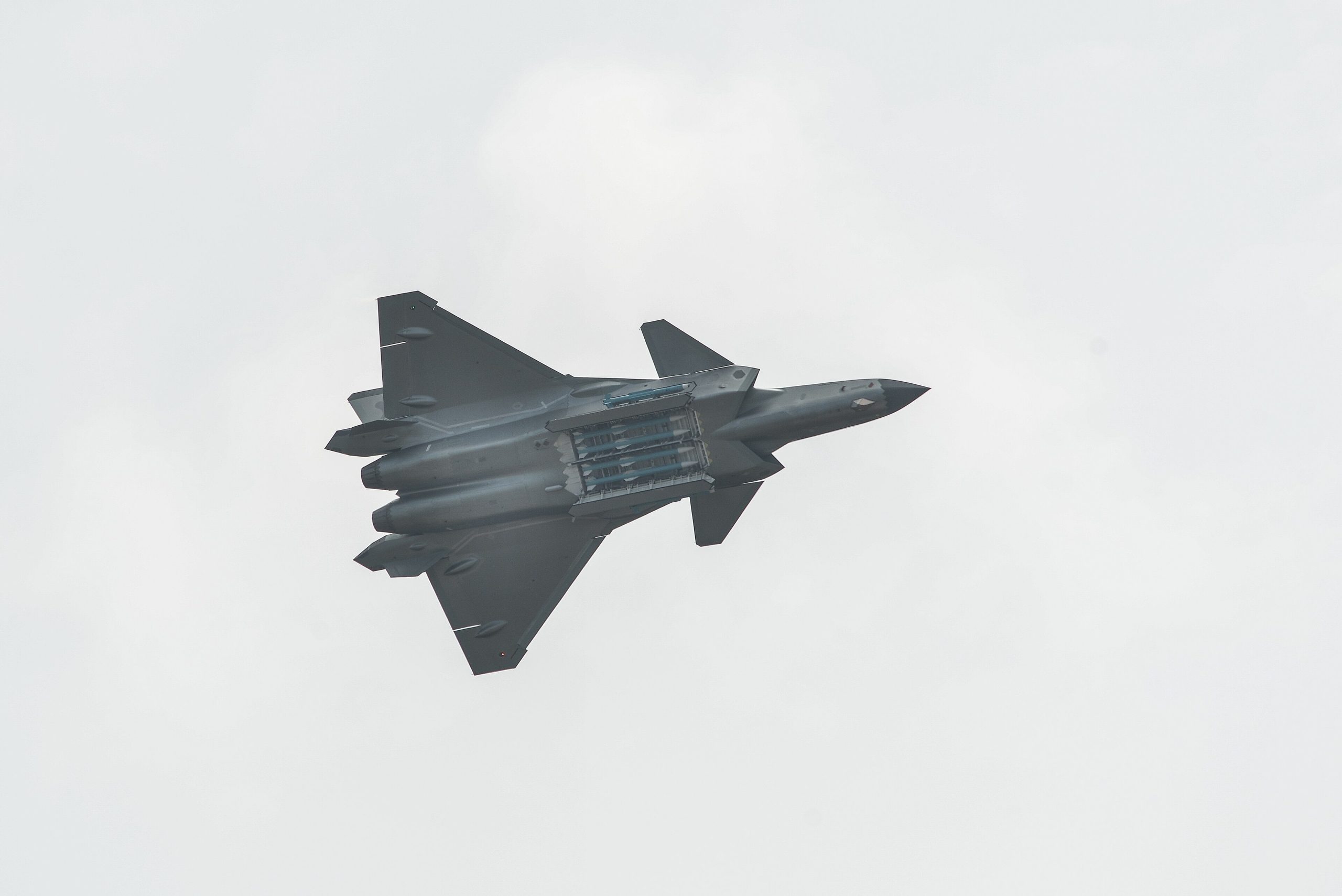
Chengdu J-20
“Mighty Dragon”
China’s first operational fifth-generation stealth fighter — a big, canard-delta interceptor now reportedly built in larger numbers than any non-American stealth jet. Much of what is public about it is estimate rather than confirmed fact.
China’s leap into the stealth age
For most of the jet age China flew derivatives of Soviet designs. The Chengdu J-20 was meant to end that. Developed by the Chengdu Aircraft Corporation and the 611 Institute (Chengdu Aircraft Design Institute) under chief designer Yang Wei, it emerged from a long-running “J-XX” fifth-generation programme. A prototype numbered 2001 made its first flight on 11 January 2011 — pointedly during a Beijing visit by US Defense Secretary Robert Gates.
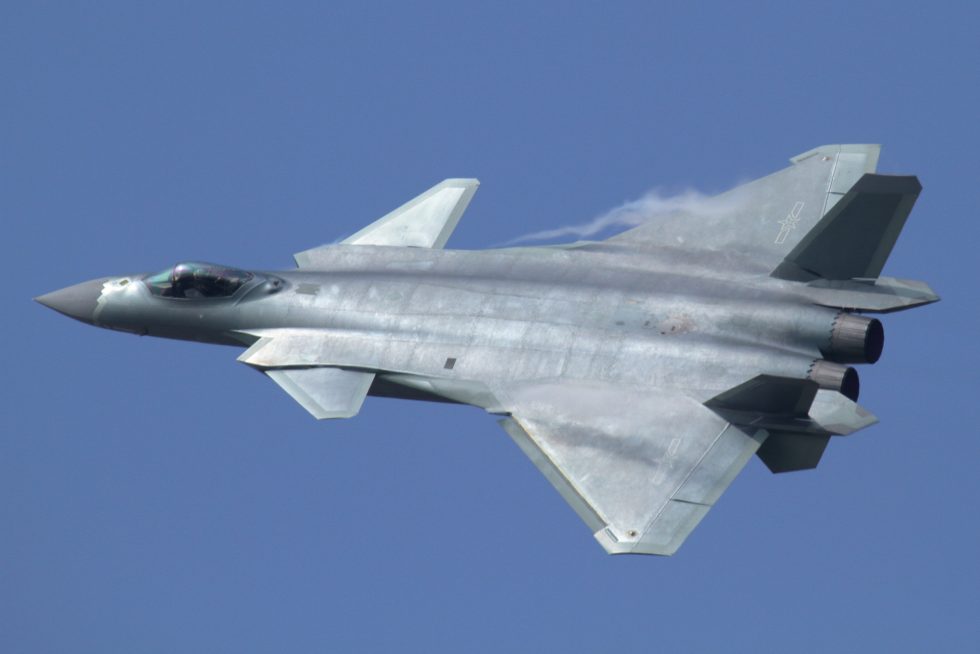
The aircraft that broke cover was unlike any Western stealth fighter: a long, twin-engined machine combining forward canards with a delta wing, diverterless supersonic inlets and internal weapon bays. Western analysts have argued for years about what that layout means — canards can help a big jet manoeuvre and lift, but they are usually seen as awkward for all-aspect stealth. China has released almost no hard data, so its true radar signature remains, in open sources, an estimate rather than a measured fact.
After a public debut at the 2016 Zhuhai airshow and entry into service around 2017, the J-20 moved from a handful of test airframes to serial production. It is now reportedly the most-produced fifth-generation fighter outside the United States, though exact numbers are secret and the widely quoted figures should be treated with caution. What is clear is the direction of travel: China set out to field a home-grown stealth fighter in quantity, and by the mid-2020s it plainly had one.
01The J-20’s long road: from the secretive J-XX programme to a frontline stealth fighter
China’s fifth-generation ambitions date back to the 1990s, when the PLAAF began studying a stealth fighter under the “J-XX” label. Chengdu’s proposal — sometimes referred to as Project 718 — was reportedly selected over a larger Shenyang design. The first flying prototype, “2001,” appeared at Chengdu in late 2010 and flew in January 2011, years before many Western observers expected China to fly a stealth fighter at all.
Development since has been incremental and, from the outside, opaque. Early airframes flew on interim engines; the airframe, intakes and coatings were refined across successive batches; and an upgraded J-20A and a two-seat J-20S followed. Because China publishes little and much reporting relies on spotter photos and state media, this history is best read as a reconstructed outline rather than a documented record.
What makes the J-20 special
A canard-delta stealth airframe
The J-20 pairs forward canards and a large delta wing with all-moving tail surfaces, ventral fins and diverterless supersonic inlets (DSI) that avoid radar-reflecting splitter plates. The shaping, faceting and internal bays are clearly aimed at a low frontal signature. How stealthy it really is remains disputed: China has released no radar-cross-section data, and analysts note canards are an unusual choice for all-aspect stealth. Treat any specific RCS figure as speculation.
Long-range missiles in internal bays
The J-20 carries its weapons internally to preserve stealth: a large ventral bay for PL-15 long-range radar-guided missiles and side bays for PL-10 short-range infrared missiles on extending rails. It is paired with an AESA radar (transmit/receive module counts are estimated, not confirmed), an electro-optical targeting system and infrared sensors feeding a sensor-fusion cockpit. The design intent is to see and shoot first; the real-world performance of these systems is not independently verified.
The engine question
Engines have been the programme’s long-running weak point. Early jets used Russian AL-31 derivatives; most in service now reportedly fly the Chinese WS-10C. The purpose-built WS-15 — intended to unlock genuine supercruise — has been flight-tested and is entering some airframes, but claims about its thrust and about sustained supersonic cruise come largely from Chinese sources and should be hedged accordingly.
02The J-20’s canards: clever aerodynamics or a stealth compromise?
No other operational fifth-generation fighter uses forward canards; the F-22, F-35 and Su-57 all avoid them. Canards give a large aircraft extra lift and pitch authority — useful for a jet the size of the J-20 — and Chinese engineers argue the surfaces can be aligned and managed to limit their radar return. Western analysts counter that any moving surface ahead of the wing is a potential reflector, especially from the side. Without measured signature data, both positions remain arguments rather than proof, and the canard debate has become the single most-discussed feature of the aircraft.
03The J-20’s WS-15 engine and the supercruise claim
A true fifth-generation fighter is often expected to “supercruise” — fly supersonically without afterburner. For years the J-20 could not, because its interim engines lacked the thrust. The indigenous WS-15 is meant to change that: Chinese state media report it has flown in the J-20 and quote thrust figures rivalling or exceeding the F-22’s F119. Those numbers are not independently confirmed, and how many aircraft fly the WS-15 versus the WS-10C is unclear. Until there is verified data, J-20 supercruise is best described as a stated goal that is being progressively realised, not an established fact.
Full specifications (estimates)
China has published almost no official figures for the J-20. Every number below is an open-source estimate drawn from analysts, spotters and state media, and different sources disagree. Read them as ranges, not gospel.
Baseline note: these figures describe the single-seat J-20 in its current Shenyang WS-10C production standard — the aircraft that makes up the great majority of the fleet, built since 2019 and shown publicly with its serrated WS-10C nozzles at Zhuhai on 28 September 2021. Deltas for the early AL-31FM2 and first WS-10 aircraft of 2011–2019, for the J-20S two-seater, and for the WS-15-engined aircraft now entering the line are in grey. Figures reflect sources available on 3 September 2026. Two warnings belong above the table rather than beneath it. The first is nomenclature: J-20A has meant two different aeroplanes. Until 2023 Western analysts used it for the WS-10C-engined production jet and reserved J-20B for the WS-15 aircraft; since the September 2025 parade the Chinese services have used J-20A for the revised airframe with the raised cockpit, enlarged spine and reshaped nose that was built to take the WS-15, and J-20B has quietly ceased to exist. A source that says J-20A without a date is not saying much. The second is measurement: China has never released a specification for this aircraft in the form an engineer would recognise. The dimensions and weights below trace to a Tsinghua University national-defence page and to a Xinhua release of September 2021, which is a Chinese state figure rather than an independent one, and the rest of the table is photogrammetry and inference. Where a number below is a guess dressed as a measurement, it says so.
Dimensions & weights
- Crew
- 1 (2 in tandem in the J-20S, which keeps the radar, the sensors and the full weapons fit; the back-seater is a mission and unmanned-teaming operator, not an instructor, and the J-20S is a combat aircraft rather than a trainer)
- Length
- 21.20 m (69 ft 7 in) A second Chinese figure of 20.30 m (66 ft 7 in) circulates with equal authority, and photogrammetric estimates cluster near 20.4 m. The J-20 is unambiguously the longest fighter of its generation — longer than the F-22 at 18.9 m and the Su-57 at 20.1 m — but the last metre is not settled. The J-20A adds a small amount forward of the cockpit.
- Wingspan
- 13.01 m (42 ft 8 in) (12.88 m / 42 ft 3 in in the alternative Chinese table)
- Height
- 4.69 m (15 ft 5 in) (4.45 m / 14 ft 7 in in the alternative table; the all-moving fins make the figure sensitive to where they are parked)
- Wing area
- 73 m² (786 sq ft) (78 m² / 840 sq ft elsewhere). Neither figure states whether the canards, the leading-edge root extensions or the covered fuselage area are counted, which is exactly the ambiguity that produces a 5 m² spread.
- Canard span
- Not published. The all-moving canards sit immediately behind the intakes with pronounced dihedral, and their leading-edge sweep is set parallel to the wing leading edge — a planform-alignment choice that is central to the stealth argument below.
- Empty weight
- 17,000 kg (37,479 lb) A competing Chinese compilation gives 19,391 kg (42,750 lb). The lower figure is hard to reconcile with a 21 m twin-engined airframe carrying 12 t of internal fuel; the higher one is more plausible and less often reprinted.
- Normal take-off weight
- 25,000 kg (55,116 lb) This is the published number and it cannot be right alongside the other two: 17,000 kg empty plus 12,000 kg of internal fuel is 29,000 kg before a single missile is loaded. Either the empty weight is understated, the fuel figure is overstated, or the three numbers come from three different documents. The table is best read as a set of loose bounds, not a weight statement.
- Maximum take-off weight
- 37,000 kg (81,571 lb) — the one weight on which the Chinese and Western compilations agree, and about 8 t heavier than an F-22 at its maximum (the J-20 is a heavy interceptor-sized aeroplane, not an F-22 analogue)
- Internal fuel
- ~12,000 kg (~26,455 lb), giving an unusually deep internal tankage fraction. Range, not agility, is the quantity this airframe was drawn around. Four underwing pylons for drop tanks exist but are non-stealthy and used for transit.
- Wing loading
- 342 kg/m² (70 lb/sq ft) at normal weight; 507 kg/m² (104 lb/sq ft) at maximum — both computed from the published figures rather than stated by any authority
- Maximum weapon load
- ~11,000 kg (~24,251 lb) internal and external combined. The internal bays hold a fraction of that; the rest is the four wing pylons, which are only used when stealth has already been given up.
Performance
- Maximum speed
- Mach 2.0, 2,130 km/h (1,323 mph) at altitude — disclosed by Chinese state media in September 2021 and the only performance figure the Chinese state has ever put a name to (older compilations claiming Mach 2.5 predate that disclosure and should be discarded)
- Supercruise
- Claimed for the WS-10C aircraft by Chinese sources and expected of the WS-15 aircraft. Never publicly demonstrated, never independently observed, and no speed or duration has ever been stated. Treat every supercruise number attached to this aircraft as advocacy.
- Service ceiling
- 20,000 m (65,617 ft)
- Rate of climb
- 304 m/s (59,843 ft/min) — a figure that appears in one commercial reference and is then reprinted everywhere. It implies a thrust-to-weight ratio the WS-10C does not have at that weight, and should be read as a manufacturer-style peak rather than a sustained rate.
- Combat radius
- ~2,000 km (~1,240 mi / ~1,080 nm) on internal fuel. If it is even approximately right it is the single most consequential number about the aircraft, because it puts Guam-bound tankers and AEW&C aircraft inside reach from mainland bases. It has never been verified.
- Range with external tanks
- 5,500 km (3,418 mi) with two drop tanks, in a configuration that is not stealthy
- Air-to-air refuelling
- Retractable probe faired into the right side of the cockpit, deployed only in the receiving position so that the airframe stays clean otherwise. The PLAAF tanker fleet, not the J-20, is the limiting factor on how far this aeroplane actually goes.
- Thrust-to-weight ratio
- 1.20 at 25,000 kg with two WS-10C at maximum reheat; 0.81 at maximum take-off weight. With the WS-15 at its upper claimed rating the figures become 1.47 and 0.99 — the difference between an aeroplane that accelerates like a heavy interceptor and one that accelerates like an F-22. Both are computed here, not published.
- g limits
- +9 / −3
- Radar cross-section
- Not publicly established, in any band, from any aspect. The Chinese-origin figure of 0.027 m² and the dismissive Western figures around 1 m² are both unsourced. Service aircraft fly with retractable Luneburg lenses fitted precisely so that nobody can measure the real value from the ground or from another aircraft.
- Take-off and landing run
- Not published. The canard-delta layout was chosen in part for short-field landing performance, and the type operates from ordinary PLAAF concrete without arrestor assistance, but no numbers exist.
Propulsion & systems
- Engines, current standard
- 2 × Shenyang WS-10C afterburning turbofans, 142–147 kN (31,900–33,050 lbf) each with reheat, with sawtooth-serrated afterburner nozzles for rear-aspect signature. Fitted from 2019; the last Russian-engined J-20 left Chengdu in mid-2019. No thrust vectoring.
- Engines, earlier aircraft
- Prototypes and the first production batches flew on the Salyut AL-31FM2, a Russian engine rated at 145 kN (32,596 lbf) at a special power setting — almost identical thrust to the WS-10C that replaced it. The switch bought industrial independence, not performance, and that is the correct way to understand it.
- Engines, intended
- Shenyang WS-15 "Emei", 161.9–180 kN (36,390–40,470 lbf) with reheat, 1,600 kg dry, 0.25 bypass ratio, turbine entry temperature quoted at 1,850 K (1,577 °C). AECC announced serial production in March 2023; WS-15-nozzled J-20A airframes in acceptance primer were photographed from late December 2025 and January 2026, which reads as scaling rather than trials. None of the thrust figures has been independently verified.
- The engine problem
- The WS-15 was begun in the early 1990s, ran on a testbed in 2005, failed final verification at the end of 2019, was delayed again by the pandemic, and only reached serial production some thirty years after it started — six years after the airframe it was drawn for entered service. This, not stealth shaping or radar, is the central industrial fact of the programme: China could design and build a fifth-generation airframe a decade before it could build the engine to put in it.
- Thrust vectoring
- Not fitted to WS-10C aircraft. Chinese state media described the J-20A’s engines as thrust-vectoring in September 2025; Janes noted that the WS-15 airframes observed on test appeared to lack vectoring paddles. Unresolved.
- Intakes
- Diverterless supersonic inlets — a fixed compression bump and forward-swept cowl lip replacing the boundary-layer splitter plate and its bleed system — feeding serpentine S-ducts that hide the compressor faces from a nose-on radar. Lighter, simpler and quieter to radar than a variable ramp, at the cost of optimisation across the Mach range. Chengdu had already proved the concept on the FC-1 and the J-10B.
- Radar
- An active electronically scanned array of undisclosed type; often listed as NRIET Type 1475 (KLJ-5A), which is an attribution rather than a confirmation. Analysts infer 2,000–2,200 transmit/receive modules from the nose cross-section and the known module pitch of the J-16 array. Detection range, bandwidth and modes are entirely unknown.
- Electro-optics
- EOTS-86 chin-mounted electro-optical targeting turret (also reported as EOTS-89); EORD-31 infrared search and track; six flush distributed-aperture windows around the fuselage for spherical missile-warning and infrared coverage. The architecture is openly F-35-like and is the aircraft’s best answer to other stealth aircraft, since infrared does not care about radar shaping.
- Cockpit and flight controls
- Frameless electroconductive bubble canopy; a single 610 × 230 mm (24 × 9 in) primary touchscreen with three auxiliaries, a wide-angle holographic head-up display and a helmet-mounted sight. Aerodynamically unstable, with all-moving canards, leading-edge root extensions, a delta wing with forward-swept trailing edges, two outward-canted all-moving fins and deep ventral strakes, all managed by digital fly-by-wire.
- Low-observable treatment
- Radar-absorbent coatings, sawtooth bay and gear-door edges, mesh-covered cooling apertures at the fin roots, antennas embedded in the skin, and retractable Luneburg lenses carried in peacetime to inflate the return. The axisymmetric nozzles and the ventral strakes are visible compromises: this is an airframe optimised for the forward sector, not an all-aspect design in the manner of the B-2.
- Gun
- None. No internal cannon or gun pod has ever been reported or photographed — unusual among fifth-generation fighters, and a clear statement that this aeroplane is not meant to arrive in a turning fight.
04The J-20’s cost: why no trustworthy price exists
The J-20 is a Chinese state programme and is not exported, so there is no market price and no published procurement figure. Estimates you may see — often around $100–120 million per aircraft — are Western guesses extrapolated from other stealth fighters and Chinese economics, not official data. Likewise, no credible cost-per-flight-hour number exists in open sources. Any precise dollar figure attached to a J-20 should be read as an estimate, not a fact.
Armament & payload
The J-20 carries four PL-15 in its belly and two PL-10 in its cheeks, and everything else it can lift costs it the reason it exists
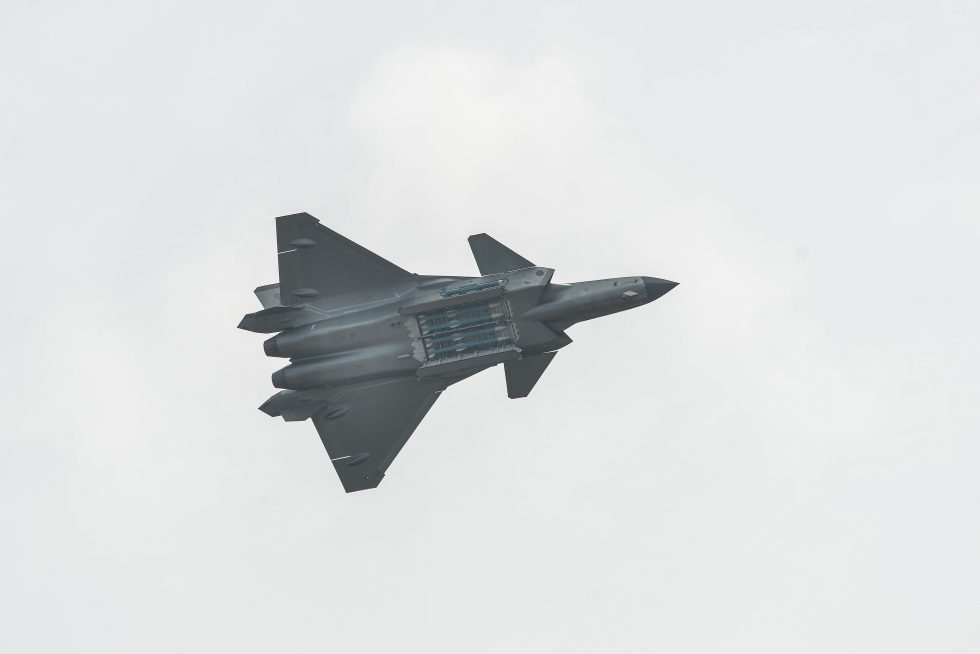
The J-20 is an air-superiority aircraft in the narrow sense: it is built to shoot other aeroplanes down at long range and to survive being shot at, and the weapons fit reflects that with unusual purity. One deep main bay under the flat belly takes four medium-to-long-range missiles; two small lateral bays behind the intakes take one short-range missile each, on rails that swing the missile out into the airstream and then close the door behind it so the aircraft is only briefly open. That is six missiles and no gun, which is a smaller stealthy load than an F-22 carries and a good deal more reach than an F-22 has. The air-to-ground fit is real on paper and almost invisible in photographs: small-diameter guided bombs sized to fit the same bay have been advertised, but no J-20 has been publicly shown carrying one. Almost nothing here is confirmed by a stores clearance document, and the distinction between what fits, what has been displayed and what a squadron is actually cleared to release is one that Chinese and Western sources alike routinely collapse.
Gun
- None. No internal cannon has ever been reported, no gun port has ever been photographed, and no gun pod exists for the type. This is a deliberate deletion, not an omission.
- It puts the J-20 alone among its generation: the F-22 has an M61A2, the Su-57 a GSh-30-1, and even the F-35 keeps a gun internally or in a pod.
- The weight and volume saved go to fuel and to the depth of the main bay. On an aeroplane drawn around a 2,000 km radius, that is a defensible trade.
- The cost is real if a J-20 is ever forced into a close engagement with its bays empty. Chinese doctrine plainly does not expect that to happen.
Air-to-air
- PL-15 long-range active-radar missile: about 4 m long, roughly 200 mm in diameter, dual-pulse solid motor, miniature AESA seeker with a two-way datalink, terminal speed above Mach 5. Domestic range quoted at 200–300 km; the export PL-15E at about 145 km. Four in the main bay is the standard fit and the whole point of the aeroplane.
- PL-10 short-range imaging-infrared missile with thrust vectoring, seeker tracking to roughly ±90 degrees off boresight and manoeuvre well above 60 g, cued by the helmet sight. One in each cheek bay.
- PL-12 medium-range active-radar missile, the earlier weapon of the fleet, listed for the type and largely superseded by the PL-15.
- PL-16, a slimmed PL-15 with a compressed airframe and folding fins intended to let six rather than four sit in the same bay, and PL-21, a very-long-range weapon. Both are development items; neither has been shown in service.
- PL-17, a very large very-long-range missile, is credited to the type only as an external carriage on the wing pylons, which means it cannot be carried stealthily at all.
Air-to-surface guided
- Nothing is confirmed in service. No air-to-surface missile has been photographed on a J-20, in a bay or on a pylon, in fifteen years of the type being watched closely.
- Chinese and Western sources both list an anti-radiation and precision-strike role as an intended supplementary mission; the US Department of Defense has said China intends to grow the internal load in low-observable configuration.
- The bay geometry — long, narrow and shallow relative to a bomb bay — is missile-shaped. Nothing about it suggests a heavyweight stand-off weapon.
- The PLAAF has the J-16 and the JH-7A for stand-off strike and does not appear to want its stealth fighters doing that work.
- Anyone quoting a J-20 anti-ship or cruise-missile fit is quoting an intention, not an observation.
Bombs
- LS-6/50 and LS-6/100 small-diameter satellite-guided glide bombs of the 50 kg and 100 kg classes, sized to the main bay and repeatedly listed as the intended internal store.
- FT-7 small-diameter guided bomb, from the same family of Chinese tail-kit weapons.
- CM-506KG small-diameter guided munition, also listed as intended.
- No unguided bomb has ever been associated with the type, internally or externally.
- Every one of these is an advertised fit. None has been publicly seen loaded on a service aircraft, and the word used in the reference literature is consistently "intended".
Rockets
- None, and none is plausible. No rocket pod has been shown, listed or credibly claimed for the J-20.
- A pod on a wing pylon would destroy the aircraft’s signature, and no pod fits any internal bay.
- The delivery profile a rocket pod implies — a shallow dive inside a defended area, in visual range of the target — is the opposite of what this airframe was built to do.
- Kept here as a card only because the absence is itself informative: this is not a multirole strike fighter with a stealth coating, whatever the brochures say.
Pods & other stores
- No targeting, navigation or jamming pods. Everything a pod would provide is built in: the EOTS-86 chin turret, the EORD-31 infrared search and track and six distributed-aperture windows. A pod on a stealth fighter is a contradiction and the PLAAF has not built one for it.
- Four underwing pylons for drop tanks, used for transit and for peacetime patrol. Also credited with rail launchers able to take two PL-15 each, giving a claimed eight externally in addition to the internal four.
- Retractable Luneburg lenses on the underside — radar reflectors carried in peacetime to inflate the return so that the true signature cannot be measured and so that air traffic control and wingmen can see the aircraft. On the 2021-standard aircraft the emitter retracts.
- Retractable refuelling probe on the right side of the cockpit, flush when not in use.
- The external missile fit is a wartime-attrition or second-wave idea, flown behind something else that is still stealthy. It is not how the aircraft is meant to fight.
Three typical loadouts
- Clean air superiority — the standard fit
- Four PL-15 in the main ventral bay, one PL-10 in each cheek bay, no external stores, Luneburg lenses removed. Six missiles, no gun, everything inside the mould line. This is the configuration that the entire airframe — the depth of the belly, the length, the internal fuel fraction — exists to fly, and the one in which the aeroplane is a genuine problem for an opponent.
- Long-range patrol and transit
- Internal fit as above plus two or four underwing drop tanks and Luneburg lenses fitted. This is what a J-20 looks like on a routine East China Sea or South China Sea patrol: deliberately visible, deliberately unmeasurable, and carrying the fuel to stay up. The tanks come off before anything serious happens.
- External missile carriage — the "magazine" configuration
- Four PL-15 internally plus up to eight PL-15, or a pair of the very large PL-17, on the four wing pylons with twin rails. Reported rather than photographed in service. The aircraft has given up its stealth entirely and is functioning as a missile lorry cued by something else; it is a fleet-arithmetic answer to a shortage of shooters, not a tactic the type was designed for.
No Chinese authority publishes a stores clearance list for the J-20, and no J-20 has ever fired a weapon in anger. The fits above come from the 2018 Zhuhai display in which the bays were opened for the public, from Chinese state-media renderings, from the annual US Department of Defense reports on Chinese military power, and from Andreas Rupprecht’s reference work. A missile shown in an open bay at an airshow has been fitted, which is not the same as cleared; a weapon described as "intended" in the literature has usually never been seen on the aircraft at all. Every range figure quoted for a Chinese air-to-air missile here originates with a Chinese state or manufacturer claim and none has been independently measured — the PL-15’s 200–300 km is the outstanding example, and the gap to the 145 km quoted for the export PL-15E is a reminder of how far these numbers can move.
Variants
The J-20 changed its engine twice and grew a second seat, and the argument that has followed it since 2011 is about its canards
The J-20 came out of the J-XX programme of the late 1990s, and its shape was published before it existed: a 2001 internal Chengdu paper by Song Wencong, the designer of the J-10, set out the case for an unstable canard-delta with leading-edge root extensions, and the aircraft that flew ten years later was recognisably that paper. Chengdu had form — the cancelled J-9 of the 1970s and the J-10 were both canard deltas — and the institute built what it knew how to build. Yang Wei took over as chief designer; the PLAAF endorsed the proposal as Project 718 in 2008; prototype "2001" flew at Chengdu on 11 January 2011, fifteen minutes with a J-10B as chase, on the day the US Secretary of Defense was in Beijing. Hu Jintao told Robert Gates the timing was coincidence.
Then came the argument that has never been settled. Canards are moving surfaces placed in the forward sector, ahead of the wing, exactly where a fighter is most anxious about its radar signature. The case against them is that they add two more edge families that must be planform-aligned, put a hinge line and a fuselage junction in the worst possible place, and — the crux — change the frontal signature continuously as they deflect, so the aircraft cannot be characterised from the front the way a fixed-planform design can. Both Lockheed and Northrop dropped canards from their ATF submissions; the F-22, the F-35, the B-2, the Su-57 and China’s own J-35 are all canardless. That is a considerable weight of practice.
The case for them is narrower but not weak. Edge alignment matters more than surface count, and the J-20’s canard leading edge is swept parallel to the wing leading edge, so its specular returns fall into the same spikes rather than opening new ones. A canard held near neutral is close to a flat plate in the wing plane; Eurofighter has long been said to command canard deflection partly for signature reasons, and the same is claimed for the J-20’s flight-control laws. Nor is a canard uniquely a moving surface: the F-22’s all-moving tailplanes and all-moving rudders move too, just aft of the wing. Lockheed carried canarded low-observable configurations through the early JAST studies and dropped them for carrier-recovery reasons rather than radar ones, and the McDonnell Douglas and NASA X-36 was canardless in the tail and canarded in the nose and was regarded as very stealthy. Aerodynamically the payoff is plain: Chengdu claims the canard-delta-with-LERX generates about 1.2 times the lift of a plain canard delta and 1.8 times that of an equivalent pure delta, allowing a smaller wing and less supersonic drag — which for an aircraft meant to run a long way at high speed is worth paying for.
The honest position is that nobody outside a Chinese test range knows who is right, because nobody outside it has measured a J-20. The Chinese-origin claim of a 0.027 m² frontal signature and the dismissive Western claims around 1 m² are equally unsourced, and the aircraft flies in peacetime with radar reflectors bolted on so that the question stays open. What can be said from the shape alone is that the J-20 is an aircraft optimised for the forward sector and for reach, with visible compromises aft — axisymmetric nozzles, deep ventral strakes — that an F-22 does not have. That is a coherent design for killing tankers and airborne early-warning aircraft eight hundred miles out. It is not a coherent design for penetrating a modern integrated air defence system from any aspect, and Chinese sources, unlike Western ones, have always described it as an air-superiority fighter rather than a penetrating striker.
- Prototypes "2001" to "2017" (2011–2015, at least eight flying airframes)
- Successive rebuilds rather than a fixed design: "2011" of March 2014 brought reshaped DSI bumps, revised fins, stealth coatings and the chin electro-optical turret; "2016" of September 2015 enlarged the tail booms and buried the nozzles deeper; "2017" of November 2015 reshaped the canopy and froze the configuration. Powered by AL-31FM2.
- J-20, initial production (low-rate from December 2015; in service 8 March 2017; first combat unit February 2018)
- Russian AL-31FM2 engines at 145 kN, full bubble canopy, no serrated nozzles. Made China the second country to field an operational stealth fighter, on a foreign engine — the fact the programme spent the next decade correcting.
- J-20, WS-10C standard (from 2019; deliveries to units from 2021; shown publicly 28 September 2021)
- Indigenous Shenyang WS-10C with sawtooth-serrated afterburner nozzles for rear-aspect signature, at essentially the same thrust as the Russian engine it replaced. Chengdu stopped building Russian-engined J-20s in mid-2019. This is the mark this page is baselined on and the bulk of the fleet.
- J-20A (prototype "2051" December 2022; officially debuted 3 September 2025)
- Revised airframe drawn around the WS-15: slightly raised cockpit with a lower-profile blended canopy, enlarged spine, reshaped nose radome, modified intakes, new coatings and structures, and an overhaul of software, avionics and thermal management. Chinese state media describe the engines as thrust-vectoring. Four of fourteen frontline units had converted by mid-2026.
- J-20S (first seen taxiing October 2021; five prototypes to March 2025; revealed at Zhuhai November 2024; in service by July 2025)
- Tandem two-seater on the J-20A airframe — the first two-seat stealth fighter built by any nation. The back-seater is a mission commander and unmanned-teaming operator rather than an instructor, tasked with battle management, electronic warfare and directing loyal-wingman aircraft such as the GJ-11. First seen in PLAAF camouflage with 172nd Brigade markings in July 2025. A USAF study in July 2024 concluded the concept had merit and should be examined for American collaborative-combat-aircraft programmes, which is an unusual compliment.
- J-20B (analysts’ designation, 2020–2023; does not exist)
- The name Western analysts gave the expected thrust-vectoring WS-15 aircraft. When the aircraft appeared it was designated J-20A, and J-20A in turn was the name analysts had previously used for the WS-10C jet. Any pre-2024 source using either letter means something different from a post-2025 source using the same letter.
- WS-15-engined production aircraft (first flight reported 29 June 2023; production airframes photographed from December 2025)
- The aircraft the whole programme was drawn for. J-20A airframes with WS-15 nozzles in acceptance primer rather than test markings were photographed from late December 2025 and through January 2026, which suggests series fitment rather than trials. Whether the engine delivers its claimed 180 kN, whether it supercruises, and whether vectoring paddles are fitted are all open.
- Naval J-20 (proposed 2019; never built)
- Reported in August 2019 as the PLAN’s preferred future carrier fighter over the Shenyang design. It was not: the length that gives the J-20 its range makes it a poor carrier aircraft, and the Navy went to the smaller J-35. A useful example of a widely reprinted 2019 report that the subsequent decade simply contradicted.
- Export (none)
- The J-20 has never been offered for export, has no announced export designation, and no foreign order exists. China’s stealth export offering is the Shenyang J-35A. Nothing in this table has ever left Chinese service.
Operators: China alone. No fleet chart is offered here because a one-bar chart is not a chart. The best-attested hard data point is a construction number: Andreas Rupprecht identified airframe 63106, carrying the construction number CB10300, at the Changchun air show on 12 September 2025 — batch ten, airframe three hundred — which fixes cumulative production at 300 at that date rather than estimating it. Rupprecht told The War Zone on 15 July 2026 that he believed around 500 had been delivered by mid-2026, spread across fourteen frontline PLAAF units and three flight test and training bases; four of those fourteen units had converted to the J-20A. RUSI put production at roughly 120 aircraft a year by late 2025 with about 300 in service across at least thirteen regiments, and noted that total production is higher than the in-service count because newly built aircraft await delivery; RUSI projects about 1,000 airframes of all versions by 2030. These figures do not reconcile cleanly: 300 in September 2025 rising to 500 by mid-2026 implies a rate well above the 120 a year the same analysts quote, so the truth is probably somewhere between 400 and 500 built with rather fewer in squadron hands. Earlier waypoints for calibration: IISS counted more than 140 in service in 2022 and more than 200 built by the end of 2023; Janes assessed about 195 in service in mid-2024 after more than 70 inductions in eleven months. Basing spans all five theatre commands, confirmed officially in September 2022 — the 172nd Brigade at Cangzhou as the test and training unit, then Anshan, Guilin, Changxing, Wuhu, Wuyishan, Zhengzhou, Dazu and Korla among the identified fighter brigades. Unit cost was estimated by GlobalData at about US$100 million in 2022 against a programme cost near US$30 billion, which is a commercial estimate and not a Chinese figure. Sources: Rupprecht via The War Zone, 15 July 2026; The Aviationist, 17 September 2025; RUSI; IISS The Military Balance 2023 and 2024; Janes; the China Aerospace Studies Institute. Anything not corroborated by at least two of those has been left out.
From secret programme to mass production
The J-XX programme
China begins studying a fifth-generation stealth fighter. Chengdu’s design, under chief designer Yang Wei, is eventually selected.
First flight
Prototype “2001” flies at Chengdu on 11 January — during a Beijing visit by US Defense Secretary Robert Gates.
Public debut
Two J-20s make a brief flypast at the Zhuhai airshow — the type’s first public appearance.
Enters service
The PLAAF announces the J-20 has entered service; a first combat unit forms over the following year.
Serial production
Output ramps up as interim engines give way to the Chinese WS-10C, and the type spreads across PLAAF brigades.
WS-15 flies
The indigenous WS-15 engine is reported to fly in a J-20 — the powerplant intended to enable true supercruise.
The two-seat J-20S
A twin-seat variant is revealed, reportedly aimed at commanding drones and handling electronic-warfare and sensor tasks.
The most-built non-US stealth jet
By open-source estimates the J-20 becomes the most-produced fifth-generation fighter outside the United States — exact numbers remain secret.
Twelve things to know about the J-20
The programme that surprised the West
The J-20’s 2011 first flight came years earlier than many analysts expected.
Read the full story
Yang Wei’s dragon
The J-20 is associated with chief designer Yang Wei and the Chengdu 611 Institute.
Read the full story
A layout no rival copied
The J-20 is the only operational fifth-gen fighter with forward canards.
Read the full story
How stealthy is it, really?
The J-20’s radar signature is, in open sources, an estimate — not a measured value.
Read the full story
PL-15 and the reach question
The J-20’s internal PL-15 missiles are central to its intended way of fighting.
Read the full story
The long search for the right powerplant
The J-20’s biggest weakness has been finding a suitable engine.
Read the full story
A goal, not yet a proven fact
Supercruise — sustained supersonic flight without afterburner — is claimed but unconfirmed.
Read the full story
J-20, J-20A and J-20S
The design has evolved through an upgraded single-seater and a two-seat version.
Read the full story
A stealth fighter with a back-seater
The two-seat J-20S is reportedly designed to command drones and manage complex missions.
Read the full story
The most-built non-US stealth fighter
By open-source estimates the J-20 is produced in larger numbers than any stealth jet outside America.
Read the full story
Untested in battle
The J-20 has never been used in combat.
Read the full story
Guarding China’s periphery
J-20s are deployed with front-line PLAAF units across China’s theatre commands.
Read the full story
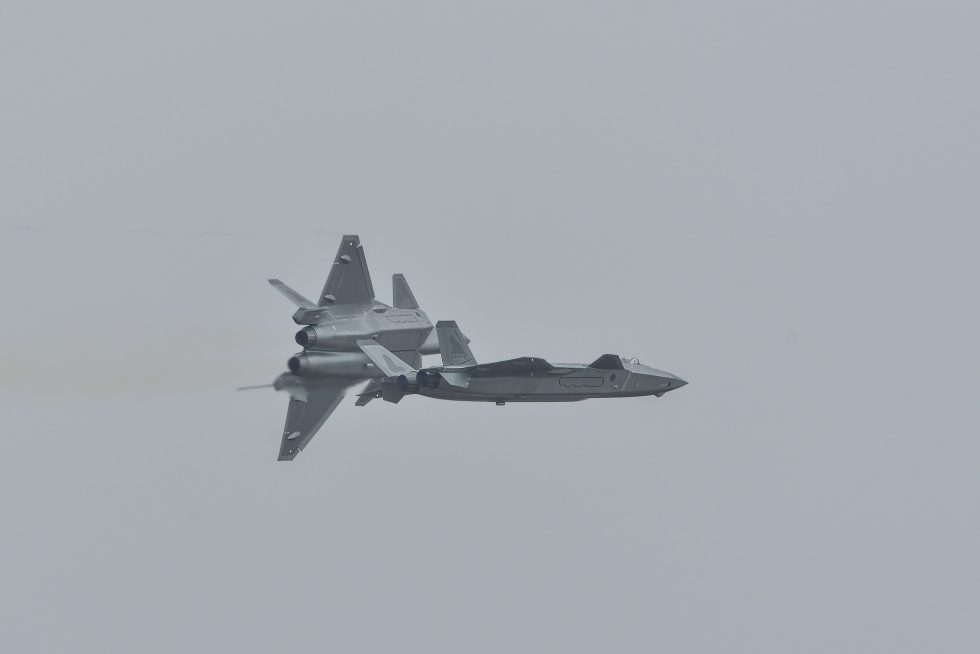
The Mighty Dragon in pictures
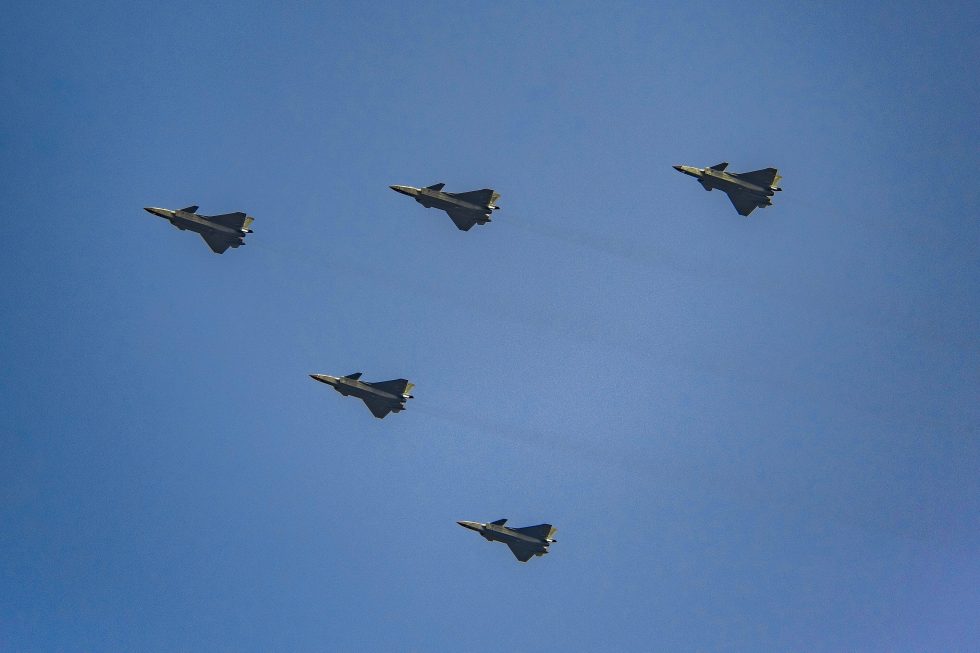
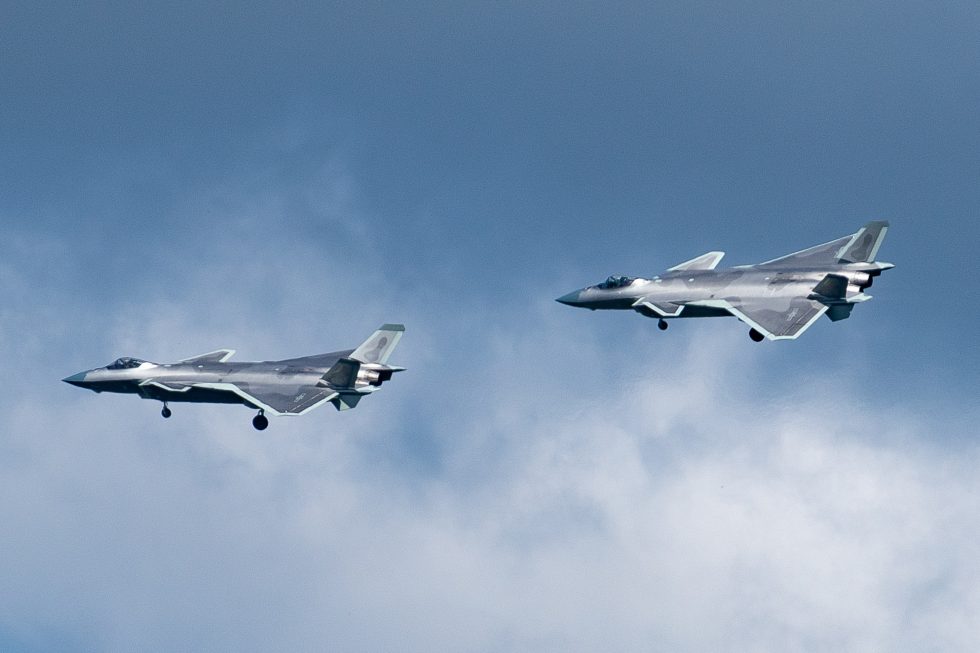
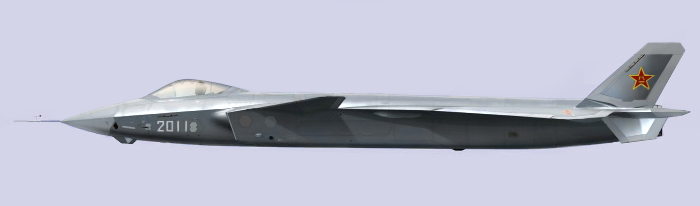
The J-20 in motion
A hand-picked J-20 video is coming soon. In the meantime, browse the photo gallery above and the twelve stories for a fuller picture of China’s Mighty Dragon.
The Chengdu J-20 in motion
Megaprojects — one of the most-watched Chengdu J-20 films on YouTube.
Where the J-20 flies
A stealth fighter yet to fire a shot
The J-20 has no combat record. It has never been used in war, and every assessment of how it would perform rests on exercises, analysis and inference rather than real fighting. It has reportedly taken part in patrols and regional encounters over the East and South China Seas and near Taiwan, but these have not involved combat. Its reputation is built on numbers produced and capabilities claimed — not on results in the air.
Compare the combat record of every military aircraft. Figures as of July 2026.
Everything people ask about the J-20
Can I fly in a J-20?
Is the J-20 a real fifth-generation stealth fighter?
How fast is the J-20?
Why does the J-20 have canards?
Has the J-20 ever been in combat?
How many J-20s has China built?
Does any country besides China operate the J-20?
What engines does the J-20 use?
You can’t fly the J-20.
These, you can.
Some legends only live in museums — others are fuelled and waiting. MiGFlug has put civilians in real military jet cockpits since 2004.
 Fly the L-39 AlbatrosThe world’s most-flown jet trainer — aerobatics included
 Fly the F-104 Starfighter“The missile with a man in it”
 Fly the MiG-21The Cold War’s most-produced jet
 Fly the T-33 Shooting StarAmerica’s first jet trainer
 Fly the DH VampireA piece of early jet history
 Fly the S.211Agile Italian jet trainer
 Fly the MB-326The classic Aermacchi jet
 Fly the MiG-15The Soviet legend of the Korean War
Continue the tour
Every fact, checked
Note: much J-20 data is secret. The sources below are used for context and open-source estimates; specification and production figures on this page are explicitly marked as estimates.
- JanesOpen-source intelligence on the J-20 fleet, variants and production growth.
- GlobalSecurity.orgProgramme history, design analysis and the J-20S two-seat variant.
- The National InterestAnalysis of the J-20’s capabilities, engines and the two-seat J-20S.
- 19FortyFiveProduction numbers, engine development and comparisons with the F-22 and F-35.
- Military Watch MagazineReporting on J-20 brigade deployments and fleet growth (figures are estimates).
- Defence Security AsiaWS-15 engine reporting and Indo-Pacific deployment context.
- RUSIProjections of Chinese stealth-fighter fleet size to 2030 (projections, not facts).
- National Museum of the US Air ForceReference context on fifth-generation fighter design.