
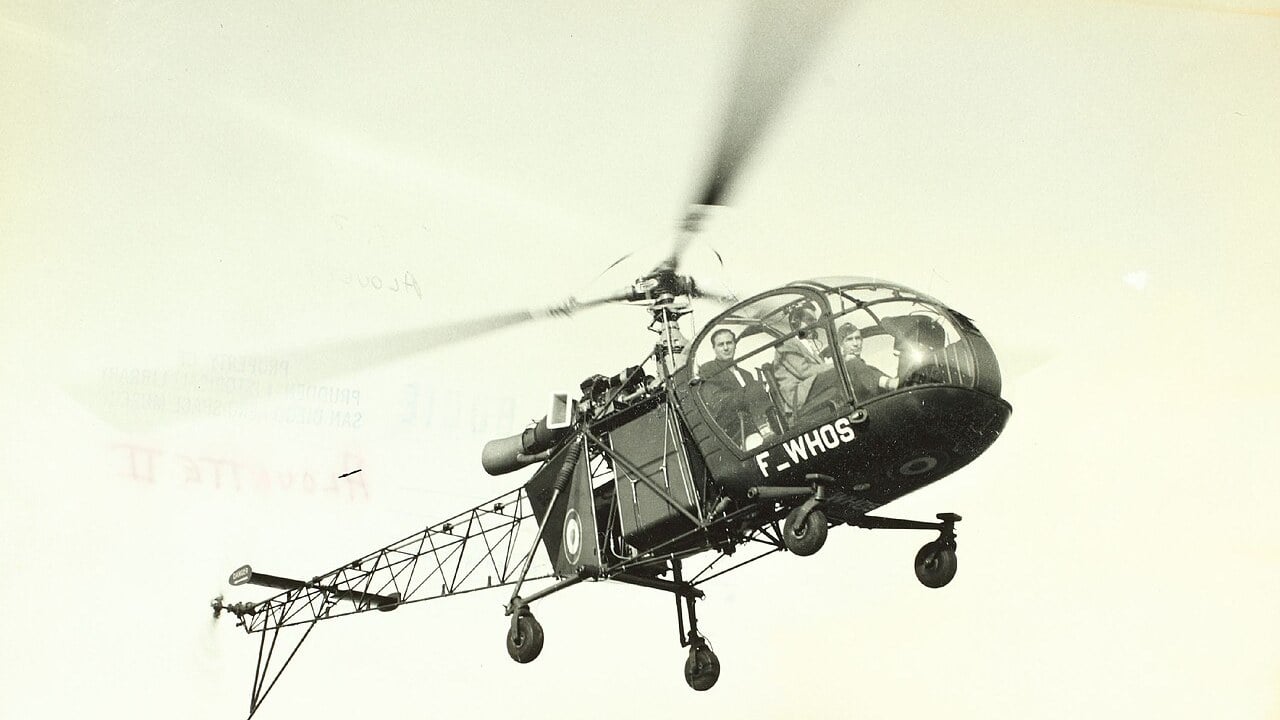
On the morning of 6 June 1955, a spindly little helicopter lifted off from the airfield at Buc, south-west of Paris, and simply kept climbing. Forty-two minutes later Jean Boulet, chief test pilot of the French state manufacturer SNCASE, had taken it to 8,209 metres, higher than any helicopter had flown before.
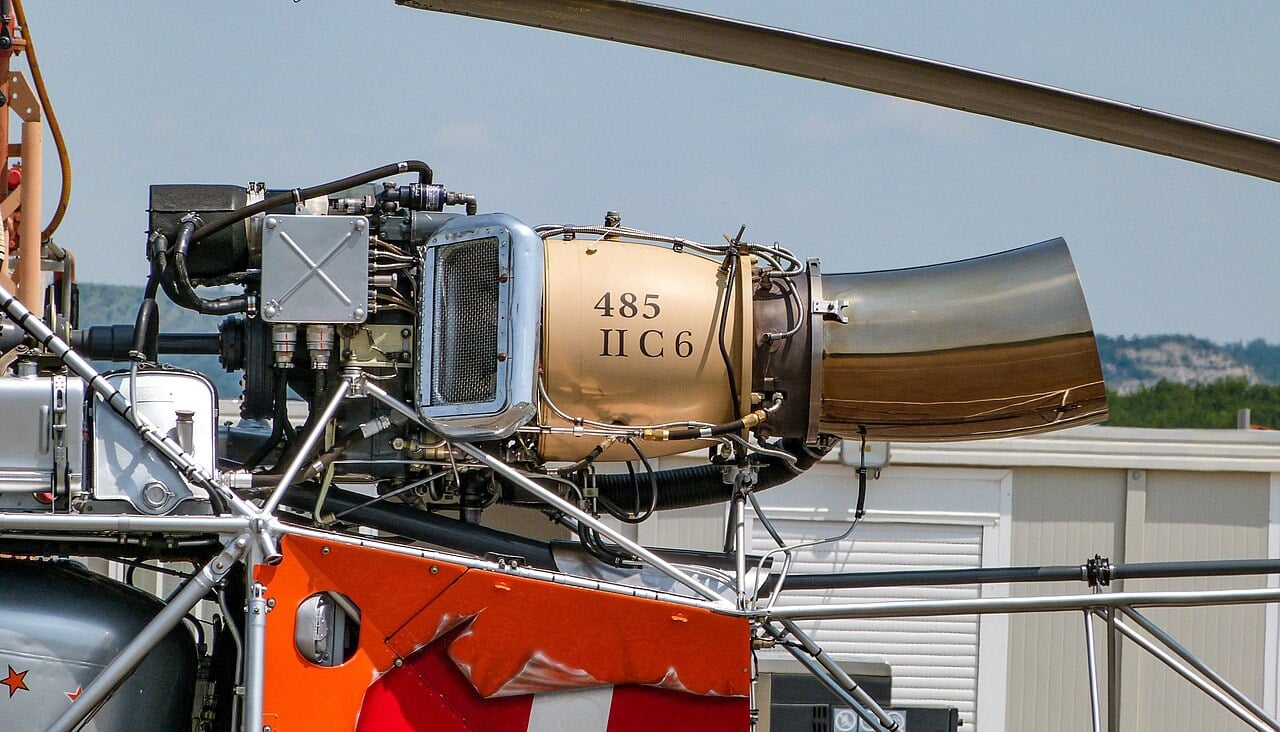
The machine looked almost unfinished: a glazed bubble for the crew, an open steel-tube tail boom and, sitting exposed behind the cabin, a small engine with no pistons at all. It was the SE 3130 Alouette II, and its Turbomeca Artouste turbine was about to change the helicopter for good.
Datos rápidos
- Tipo: SE 3130 / SE 313B / SA 318 Alouette II, light utility helicopter
- Fabricante: SNCASE, then Sud Aviation and Aérospatiale
- Primer vuelo: 12 March 1955, Buc, near Paris (pilot Jean Boulet)
- Motor: One Turbomeca Artouste turboshaft (later Astazou on the SA 318C)
- Motivo de su fama: First gas-turbine helicopter built in series
- Registro: 8,209 m helicopter altitude record, 6 June 1955
- Seats: Pilot plus four passengers
- Max take-off weight: 1,600 kg
- Producción: 1956 to 1975, more than 1,300 built
A turbine where the pistons used to be
By the early 1950s, helicopters had proved themselves in Korea and in rescue work, but they were still hamstrung by heavy, complex piston engines that ate into payload and demanded constant care. A gas turbine offered far more power for its weight and a smoother, simpler drive. The question was whether anyone could make it work in a production machine.
SNCASE, the Société nationale des constructions aéronautiques du Sud-Est, bet on Turbomeca’s Artouste, a compact single-shaft turboshaft. In the Alouette II it was rated at about 400 shaft horsepower but derated to protect the transmission, which left a useful margin when flying high or in the heat.
Boulet and flight test engineer Henri Petit made the first flight of the prototype, F-WHHE, at Buc on 12 March 1955. Less than three months later came the altitude record, homologated by the Fédération Aéronautique Internationale at 8,209 metres. Contemporary reports put the figure slightly higher. Series production started in 1956, and the Alouette II became the first gas-turbine helicopter to be built in series anywhere in the world.
The test pilot behind the records
Jean Boulet was the perfect man for the job. Born in Brunoy near Paris in 1920, he graduated from the École Polytechnique, trained as a military pilot in the United States, where he also learned to fly helicopters, and joined SNCASE as an engineer and test pilot in 1947.
Over the following decades he set a long series of rotorcraft records for speed, distance and altitude, and later wrote a history of the helicopter told by its pioneers. He died in 2011 at the age of 90.
Built on the principle of “nothing excessive”
What made the Alouette II so successful was not only the engine. The airframe was deliberately simple: a three-bladed main rotor of 10.2 metres, a truss-type tail boom, skids and a big, rounded canopy that gave the pilot a superb view. It seated a pilot and four passengers and had a maximum take-off weight of 1,600 kg.
British Movietone newsreel footage from March 1955 of the new French turbine helicopter, the Alouette II, from the AP Archive.
It cruised at about 170 km/h and topped out at 185 km/h, figures that were respectable rather than spectacular. But it could lift loads, operate from rough ground, and keep working where piston helicopters ran short of breath. Customers quickly noticed.
Testing and refinement were relatively brief. Some of the first production machines were sent straight to the Alps for evaluation flights, exactly the kind of thin, cold air where a piston helicopter struggled and the Artouste’s reserve of power paid off. For mountain pilots, a helicopter that still had power in hand at altitude was a revelation.
SNCASE became part of Sud Aviation in 1957, and the Alouette II turned into an export success. Production ran until 1975, by which time more than 1,300 had been built in a series of variants, including the later SA 318C Astazou version with a different Turbomeca engine.
Soldier, sailor and mountain rescuer
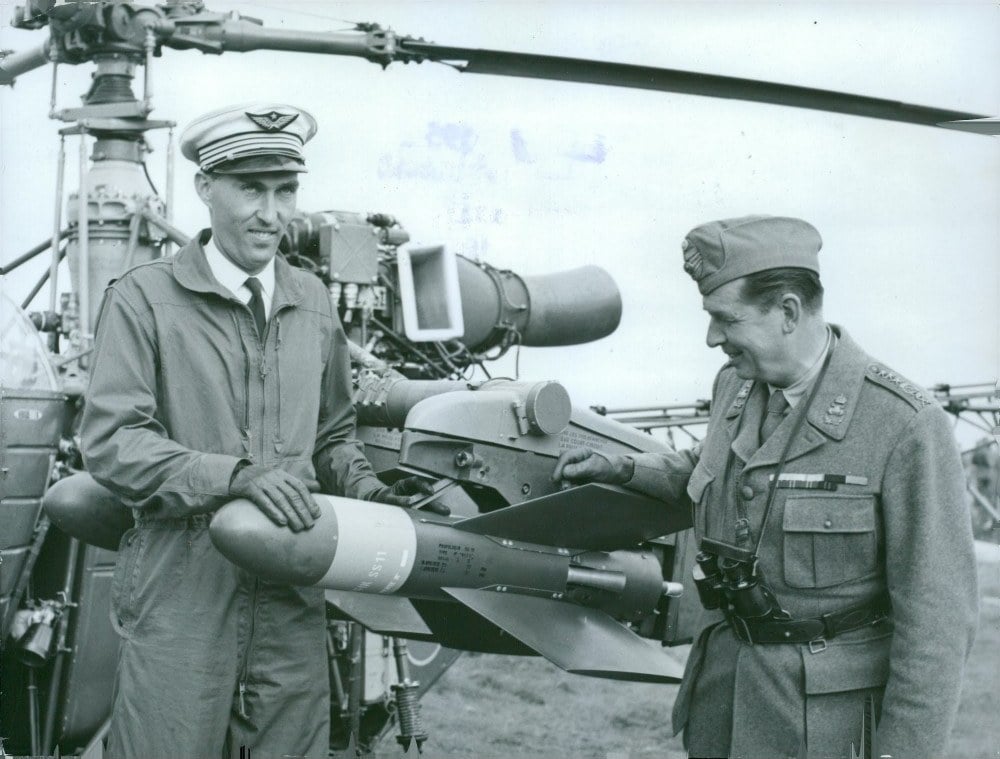
The French armed forces took the Alouette II in large numbers, starting with the French Army Light Aviation. It served in the Algerian War for observation, liaison and casualty evacuation, and French Army Alouette IIs were among the first helicopters to carry wire-guided anti-tank missiles, the Nord SS.11.
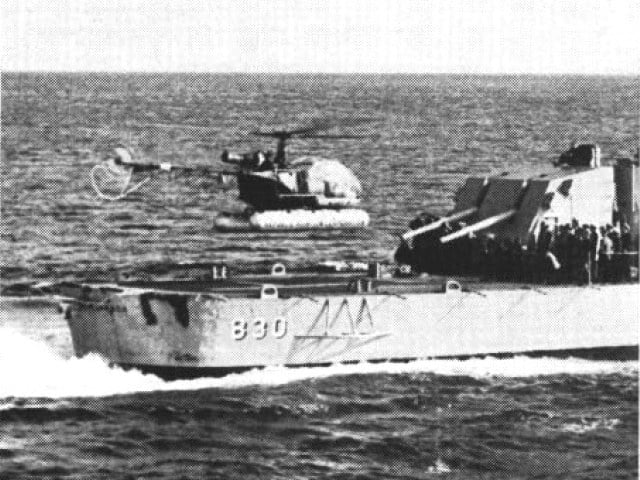
Abroad, the type became a fixture of European military aviation. The British Army Air Corps, the West German armed forces, the Austrian Air Force, el Swiss Air Force and many others flew it, often in the mountains where its turbine power counted most. Navies tried it too, including on floats and with a lightweight torpedo slung underneath.
French military film from 1963, from the ECPAD archive, showing an Alouette II firing a wire-guided SS.11 anti-tank missile.
In civilian hands, the little Alouette carried stretcher patients, sprayed crops, lifted cargo on a sling and plucked climbers off the Alps. Operators in dozens of countries kept it working for decades, and considerable numbers were still in service at the start of the 21st century, long after the last one left the factory.
The family that kept on climbing
The Alouette II also gave birth to two famous descendants. The larger Alouette III kept the same formula of turbine power and simple engineering but added a bigger, enclosed cabin and more seats. Then, for an Indian requirement to operate in the Himalayas, Sud Aviation combined a strengthened Alouette II airframe with the more powerful dynamic system of the Alouette III. The result was the SA 315B Lama.
On 21 June 1972, Jean Boulet took the very first Lama to 12,442 metres from Istres in southern France. It remains the absolute altitude record for helicopters. At the top of the climb, in temperatures around minus 60 degrees Celsius, the engine flamed out. With no way to restart it, Boulet autorotated all the way back down, an unpowered descent of more than 12 kilometres that ended safely at Istres.
Seventeen years after his first record in the Alouette II, Boulet had shown just how far the turbine idea could be pushed.
Archive footage of a Swiss Air Force Alouette II supplying mountain troops, the kind of high-altitude work where its turbine counted most.
Today almost every helicopter in the sky, from air ambulances to heavy military transports, is turbine-powered. It is easy to forget that the idea once had to be proved, and that the proof came from a light French helicopter with an open tail boom and a turbine in the back. The lark, as its name translates, was the bird that showed everyone else how to climb.
Sources: This Day in Aviation (Bryan Swopes), Flight and Aircraft Engineer (1955), AIN, State Aviation Museum of Ukraine, AP Archive / British Movietone, ECPAD, Wikipedia (Aérospatiale Alouette II; Aérospatiale SA 315B Lama)
Header photo: San Diego Air and Space Museum Archives / Wikimedia Commons, no known restrictions
0 Comments