

The Germans had radar too. Theirs was arguably better — Freya operated on a shorter wavelength, used a smaller steerable antenna, and gave sharper resolution than anything the British had strung along their coastline.
It did the Luftwaffe no good whatsoever, because radar on its own is just a machine that produces numbers. What Britain built in the four years before 1940 was not a radar network. It was a system for turning numbers into fighters arriving in the right place at the right altitude at the right minute.
That system is why the Battle of Britain went the way it did, and it is named after the man who insisted on building it.
Datos rápidos
| The system | The Dowding system — the world’s first wide-area ground-controlled interception network |
| Named for | Air Chief Marshal Sir Hugh Dowding, Air Officer Commanding-in-Chief, RAF Fighter Command from its creation on 6 July 1936 |
| The radar | Chain Home, officially AMES Type 1. Called RDF at the time — “radar” is a later American coinage |
| Origen | The Tizard Committee asked Robert Watson-Watt about death rays. His assistant Arnold Wilkins showed they were impossible, and proposed detection instead |
| Proof | The Daventry Experiment, 26 February 1935 |
| Escala | 21 Chain Home stations operational at the outbreak of war in September 1939; over 40 by 1945 |
| The towers | Four steel transmitter towers 360 ft high, four wooden receiver towers 240 ft high |
| Rango | Typically about 120 miles, up to roughly 200 in good conditions |
| Interception rate | Around 90% during the Battle, against a pre-war benchmark where 30–50% was considered excellent |
What Chain Home could not do
Start here, because the popular version of this story badly overstates the radar.
Chain Home aerials did not rotate. They faced out to sea on a fixed line of shoot, flooding a roughly 100-degree fan with radio energy. That meant that the moment a German formation crossed the English coastline, it disappeared from the radar picture entirely.
It could not see aircraft below about one and a half degrees above the horizon, which is why Chain Home Low was built — a separate, rotating, shorter-wavelength set that could catch low-level minelaying sorties down to about 500 feet, but which could not measure height at all.
It could not tell friend from foe. That required British fighters to transmit their own position via a system called pip-squeak, triangulated by ground direction-finding stations, until IFF transponders arrived in quantity around October 1940.
And it was useless at night, as was the Observer Corps — the human eyes and ears who took over tracking once raids crossed the coast. Solving the night problem needed airborne radar in Beaufighters, which did not start working until November 1940.
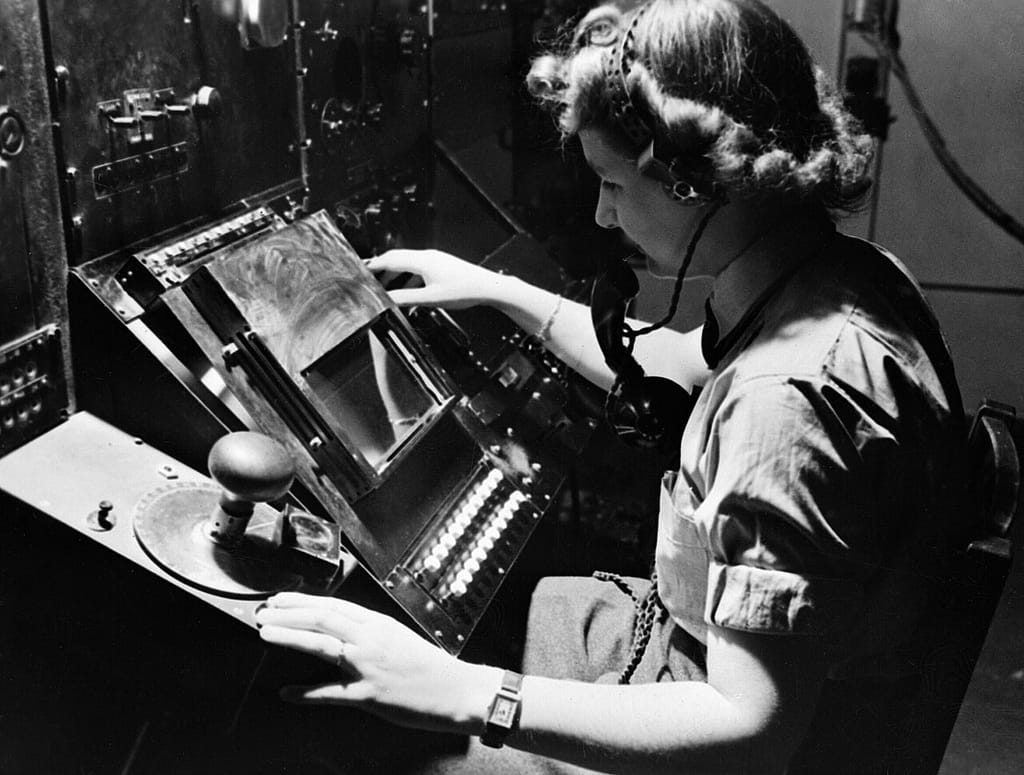
The filter room is the actual invention
Every Chain Home station reported to one place: the Filter Room at Fighter Command headquarters, Bentley Priory.
This is where the magic happened, and it was entirely human. Each station reported its own contact in its own coordinates, with its own errors, and the same German formation might generate three or four separate reports from three or four stations. Filter room staff correlated all of it into a single agreed track with a number, a hostile-or-friendly designation, an estimated aircraft count and an altitude.
Only then did it go out to Group headquarters, then to Sector control rooms — and only Sector controllers ever spoke to pilots.
The details of how they kept it comprehensible are wonderful. A sector clock divided the hour into five-minute colour bands, and plotters marked each track with whichever colour the clock was currently pointing at. So a glance at the map table told you not just where the enemy was, but how old every single piece of information on it was. Stale plots were visibly stale.
Alongside it a “tote board” of electric lamps showed the state of every squadron: released, available at twenty minutes, readiness at five, standby at two, airborne, enemy sighted, ordered to land, landed.

Göring's mistake
The Luftwaffe attacked the radar stations between 12 and 18 August 1940. Ventnor on the Isle of Wight was badly hit; a strike on the Kent power grid took several stations off the air at once.
And then they stopped.
He was not being stupid. He was being fooled by structural engineering. The towers were open steel lattice — blast passes straight through open lattice, and hitting a narrow tower with 1940-era bombing accuracy was genuinely difficult. What was actually vulnerable were the wooden equipment huts and the electricity supply, and the British went to considerable lengths to get damaged stations transmitting something, anything, quickly enough that the gaps never looked permanent.
So the Luftwaffe concluded the system could not be broken and moved on to airfields. It was the single most consequential intelligence misjudgement of the campaign.
It was not flawless
An operational research report in January 1940 found the Filter Room was producing results to what it called appallingly low standards, overloaded and over-centralised. Whether the report was wrong or the problems were fixed in the following months is genuinely unclear.
Dowding himself repeatedly refused to devolve filtering down to Group level, and was eventually summoned to the Air Staff on 1 October 1940 and made to comply. He was removed from Fighter Command not long after — a shabby end for the man whose system had just won the battle.
But the number that matters is the interception rate. Before the war, finding an incoming raid with fighters between 30 and 50 percent of the time was considered a good result. During the Battle of Britain the Dowding system averaged around 90 percent, and on some raids hit every single one.
El Spitfires get the statues. The plotting table won the battle.
The Imperial War Museum on why the RAF won — and why the aircraft were not the reason.
A dedicated explanation of how the Dowding system actually worked.
Period archive film of British radar in use during the war.
Sources: Imperial War Museum; RAF Museum; Bentley Priory Museum; Wikipedia.

0 Comentarios