
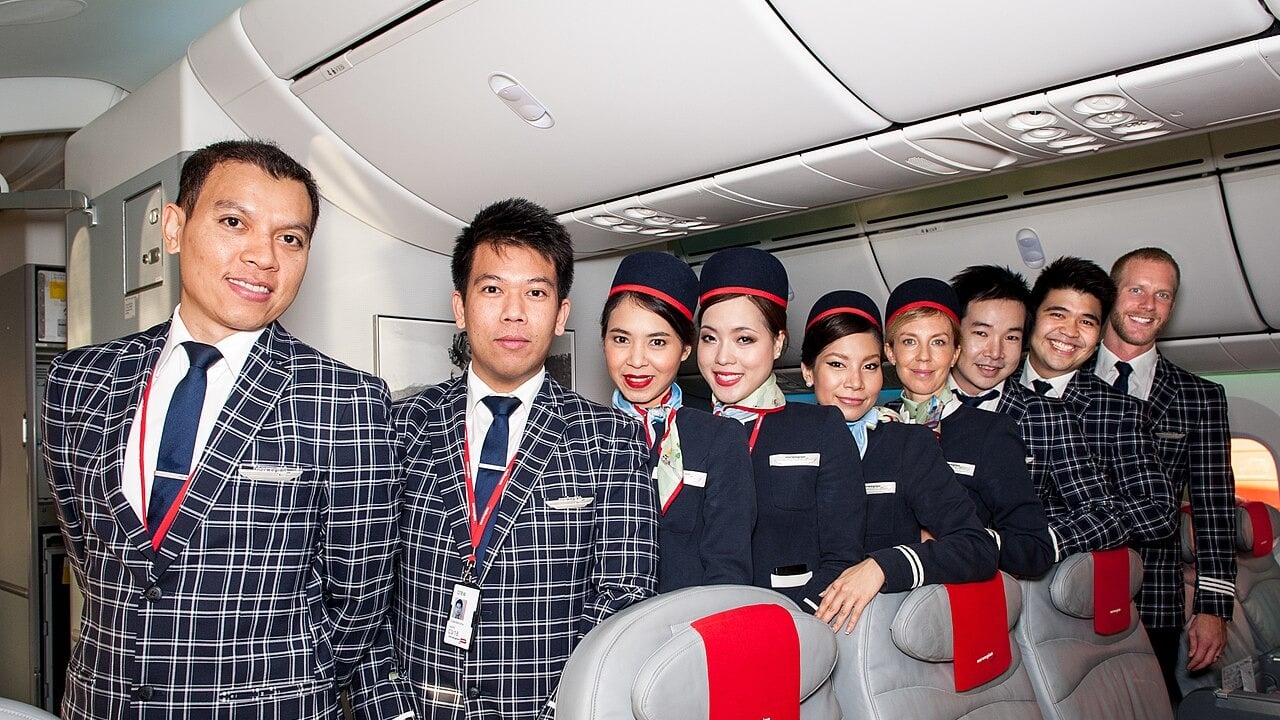
Count the cabin crew on your next flight. On a full Airbus A320 you will find four. On a half-empty one you will also find four, and that is not an accident or a union rule. It is the single most important thing to understand about how the number is set: in the United States and in Europe, the law counts the seats, not the people sitting in them.
The number comes from a short, unglamorous paragraph of the US Federal Aviation Regulations that has been on the books since 1965. It is not a service standard. Nobody worked out how many trolleys an aisle can support, or how many coffees a crew can pour. The number exists because of a single demonstration the manufacturer had to pass before the aeroplane was ever sold: getting everybody out of a full cabin, in the dark, with half the exits blocked, in ninety seconds.
And the countries that write the rules do not entirely agree with each other about it. One of them put in writing, as recently as 2015, that the standard most of the world uses is less than equivalent on a full aeroplane.
Datos rápidos
The US rule: 14 CFR 121.391, in force since Docket 2033, 30 FR 3206, 9 March 1965
The bands: one attendant for 10 to 50 seats; two for 51 to 100; two plus one more for every unit, or part of a unit, of 50 seats above 100
Counted by: seating capacity, not passengers carried. A nearly empty aeroplane carries the same crew as a full one
Europe: EASA requires the greater of the certification number or one cabin crew member per 50 passenger seats installed on the same deck
Canada: the operator chooses, per aeroplane model, between one per 40 passengers carried and one per 50 passenger seats
Smaller aircraft: under Part 135 a flight attendant is required above 19 passenger seats
Where it comes from: the 90-second evacuation demonstration, required for any type seating more than 44 passengers
The American table, in full
14 CFR 121.391(a) sets out four bands, and they are worth reading in the regulation’s own words because the thresholds are oddly specific. For aeroplanes with a maximum payload capacity over 7,500 pounds and “a seating capacity of more than 9 but less than 51 passengers”, the answer is one flight attendant. For a lighter aeroplane the band starts higher, at more than 19 seats. For “more than 50 but less than 101 passengers”, two. Above 100 seats, the rule becomes arithmetic:
“For airplanes having a seating capacity of more than 100 passengers—two flight attendants plus one additional flight attendant for each unit (or part of a unit) of 50 passenger seats above a seating capacity of 100 passengers.”
14 CFR 121.391(a)(4)
Run a 180-seat A320 through it. Eighty seats sit above the hundred, which is one full unit of fifty and part of a second, so the rule adds two to the base of two. Four cabin crew. Stretch the cabin to 220 seats and the 120 above the hundred buys three extra: five crew. The phrase “or part of a unit” is doing a lot of work — fitting a single extra seat above a round number adds a whole human being to the roster for the life of that configuration.
The number is welded to the evacuation demonstration
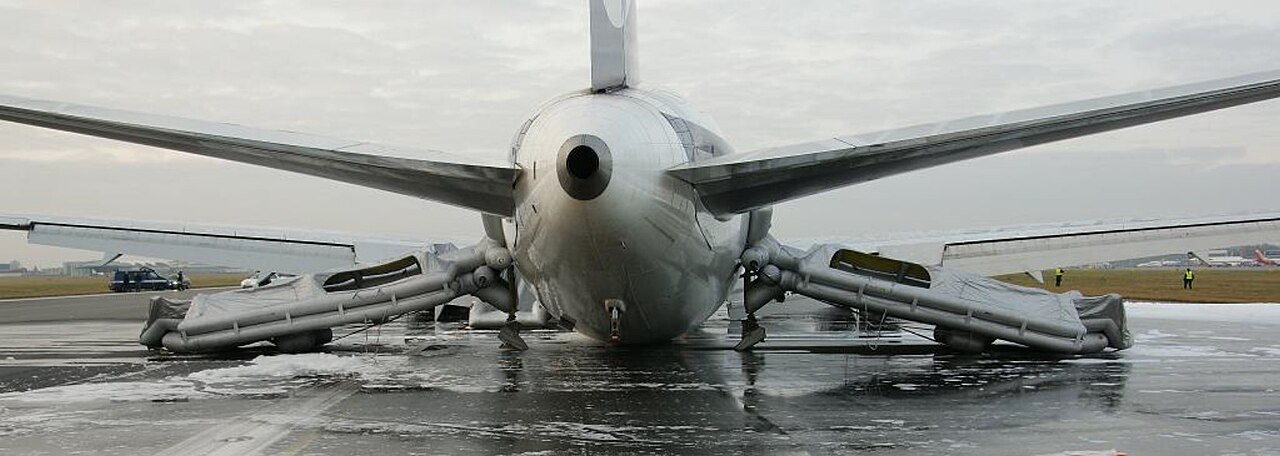
Why fifty? Not because fifty passengers is what one person can shepherd down an aisle. The ratio comes from the test that certifies the cabin in the first place. Under 14 CFR 121.291, any type seating more than 44 passengers must be shown to allow evacuation of its full capacity, crew included, “in 90 seconds or less”, in a demonstration conducted in darkness with half the exits unavailable.
That demonstration is run with a particular number of cabin crew on board, and the regulation then locks the airline to it. 121.391(b) says that if the certificate holder used more flight attendants in the demonstration than paragraph (a) would require, it may not afterwards take off that aeroplane, in that configuration, with fewer than the number used in the demonstration. The crew count is not a floor the airline can negotiate down later; it is a property of the aeroplane, recorded in the operations specifications.
The Airbus A380 certification evacuation test. Everyone out, in the dark, with half the exits blocked.
Why fifty, and who decided
The most candid account of where the ratio comes from is not American at all. It is buried in a Canadian regulatory impact analysis statement published in the Canada Gazette on 17 June 2015, when Transport Canada finally let its airlines adopt the international standard.
Canada had been the odd one out. Since long before the modern Canadian Aviation Regulations were written in 1996, its airline operators had been required to carry one flight attendant for every forty passengers on board — a ratio counted in people, not seats, and a tighter one than almost anybody else used. The 2015 statement explains, in a single paragraph, why that was awkward.
Read that twice. The ninety-second demonstration that proves the cabin is survivable is run at one crew member per fifty seats, because that is the number most of the world buys aeroplanes against. The ratio is not a conclusion drawn from the test. It is an assumption fed into it.
The Canadian story from there is a long one. The Air Transport Association of Canada asked for the option in 2002. A Transport Canada risk assessment in 2003 said it would be acceptable with “mitigating features” such as clearer training requirements and a designated in-charge flight attendant. In 2006 the department decided not to proceed. In 2013 and 2014 the Minister of Transport issued exemptions letting one private operator and seven commercial operators move to the new ratio anyway. The regulation itself came in 2015, and it did not replace the old ratio: it offered it alongside, letting an operator choose, per aeroplane model, between one attendant per forty passengers carried and one per fifty passenger seats.
The sentence the regulator did not have to write
The consultation was not quiet. Seventy-three comments came back on the revised proposal, from airlines, associations and five components of the Canadian Union of Public Employees, with sixty per cent of all submissions coming from individual flight attendants who were not even council members. Their objection, as the statement summarises it, was “the perception that no amount of mitigation can make up for the reduced number of flight attendants on flights”. A pilot association said it did not believe the new ratio gave an equivalent level of safety.
Transport Canada’s reply is the most interesting thing in the whole document, because it concedes the point rather than denying it.
A regulator writing down that the standard it is adopting is “less equivalent” on a full aeroplane, and publishing it in the official gazette, is not a common sight. It is also the clearest possible statement of what the one-per-fifty rule actually is: a workable compromise that is at its thinnest precisely when the aeroplane is fullest.
What the required crew member is trained for. Evacuation drills inside an airline cabin crew course.
Europe takes the higher of two numbers
EASA writes the rule differently again, in ORO.CC.100 of Commission Regulation (EU) No 965/2012. At least one cabin crew member is required on any aircraft with a maximum operational passenger seating configuration above 19 when passengers are carried. Beyond that, the minimum is the greater of two figures: the number established during the aircraft’s certification for the cabin layout the operator actually flies, or “one cabin crew member for every 50, or fraction of 50, passenger seats installed on the same deck of the aircraft to be operated.”
Two details there repay attention. “On the same deck” matters on a double-decker, where each deck is counted separately rather than the seats being pooled. And “installed” closes the loophole that counting passengers would open: on the European rule, as on the American one, an airline cannot reduce its crew because the flight did not sell.
Where more than one cabin crew member is assigned, the regulation also requires the operator to nominate one of them as responsible to the commander. The in-charge role that Transport Canada listed among its mitigating features is, in Europe, simply part of the baseline.
Where the required crew member has to sit
Having fixed the headcount, 121.391 goes on to fix the geography, and the wording makes the purpose explicit. During takeoff and landing, the regulation says, flight attendants “shall be located as near as practicable to required floor level exits and shall be uniformly distributed throughout the airplane in order to provide the most effective egress of passengers in event of an emergency evacuation.” During taxi they must stay at their stations with safety belts and shoulder harnesses fastened, except to perform duties related to the safety of the aircraft and its occupants.
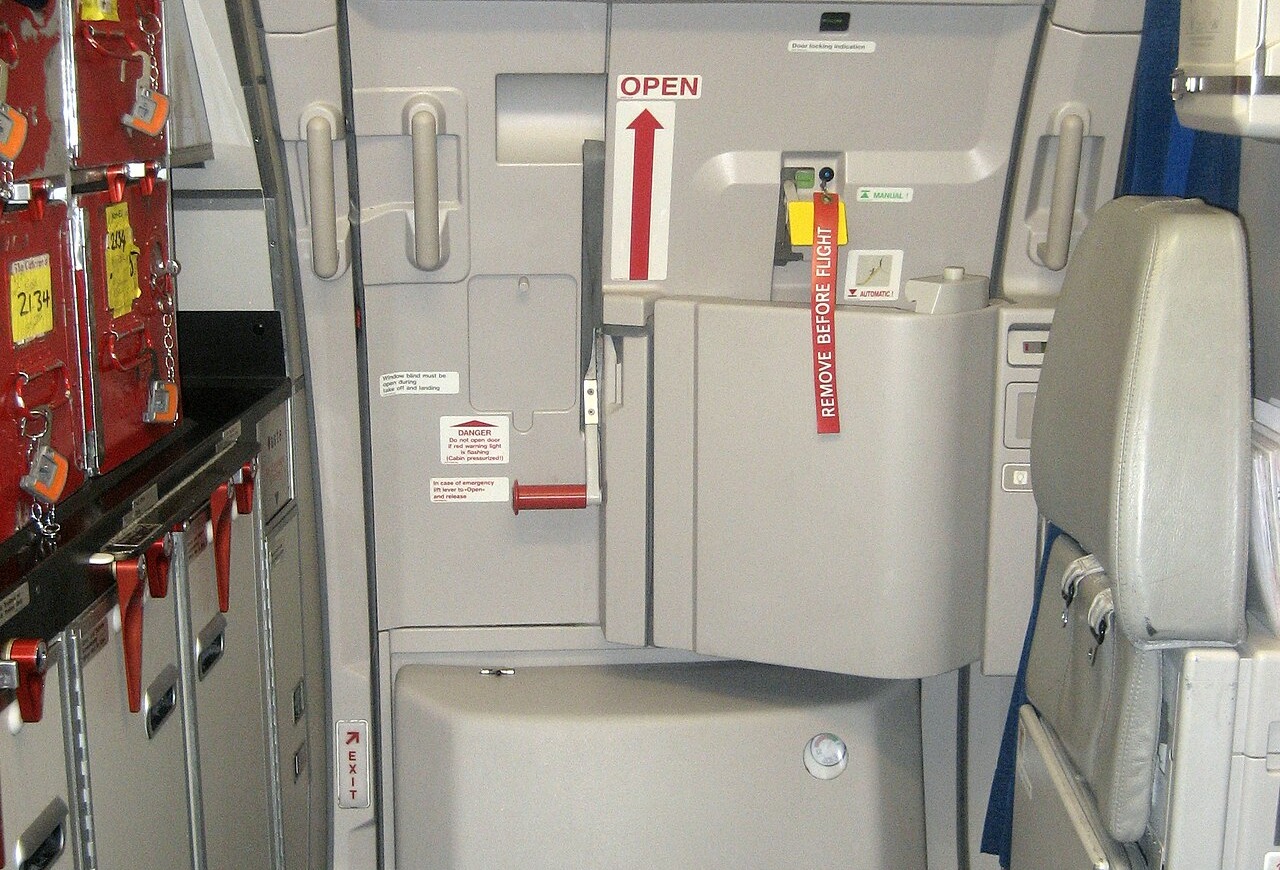
That is the whole logic of the job described in one sentence. The crew member is not positioned where the service is; they are positioned where the door is. The jumpseat faces backwards, next to a door whose slide they armed on pushback, and the ninety-second clock is the reason it exists.
A full-scale evacuation demonstration on the Boeing 777, the test that produces the number in the first place.
When the aeroplane is on the ground, the rules relax
The full complement is a flight requirement, not a round-the-clock one, and two sibling rules say so. At a stop where passengers stay on board, 121.393 allows the number on board to fall to “at least half the number required”, rounded down but never below one — and only if the engines are shut down and at least one floor-level exit stays open for deplaning. The operator may even substitute other people qualified in that aircraft’s emergency evacuation procedures, provided they are identified to the passengers.
During boarding, 121.394 permits a different trade. Where more than one attendant is required, one may step off the aircraft entirely, so long as they stay in the immediate vicinity of the boarding door, do only safety duties for that flight, and the engines are shut down with a floor-level exit open. Alternatively the operator may substitute a pilot or flight engineer trained and qualified on the type, with the functions written into the company manual. The aeroplane that pushes back with four cabin crew may well have been boarded by three.
Below the airline bands there is a cliff rather than a slope. Under Part 135, which covers commuter and on-demand operations, no certificate holder may operate an aircraft with a passenger seating configuration of more than 19, excluding pilot seats, “unless there is a flight attendant crewmember on board”. Nineteen seats and you may fly with none. Twenty and you need one.
What the number is, and what it is not
None of this is a staffing level for service. It is the minimum number of trained people the regulator believes can get a full cabin out of a burning aeroplane in ninety seconds, in the dark, with half the exits unusable. Airlines routinely carry more than the minimum on long sectors, because meals and rest periods demand it, and the regulation does not stop them. What the regulation stops is going the other way.
And because it is counted in seats, the arithmetic is unmoved by how your particular flight turns out. The nearly empty red-eye carries the same four people as the Friday evening departure with every seat sold. One of those two flights is comfortably over-crewed. The other is the one Transport Canada was describing when it wrote that the standard is “less equivalent when operating at full passenger loads.”
Sources: 14 CFR 121.391, 121.393, 121.394 and 121.291, and 14 CFR 135.107, as published in the current electronic Code of Federal Regulations; Commission Regulation (EU) No 965/2012, Annex III (Part-ORO), ORO.CC.100 and ORO.CC.110; Canadian Aviation Regulations SOR/96-433, section 705.201; Regulatory Impact Analysis Statement, SOR/2015-127, Canada Gazette Part II, 17 June 2015.


0 Comments