
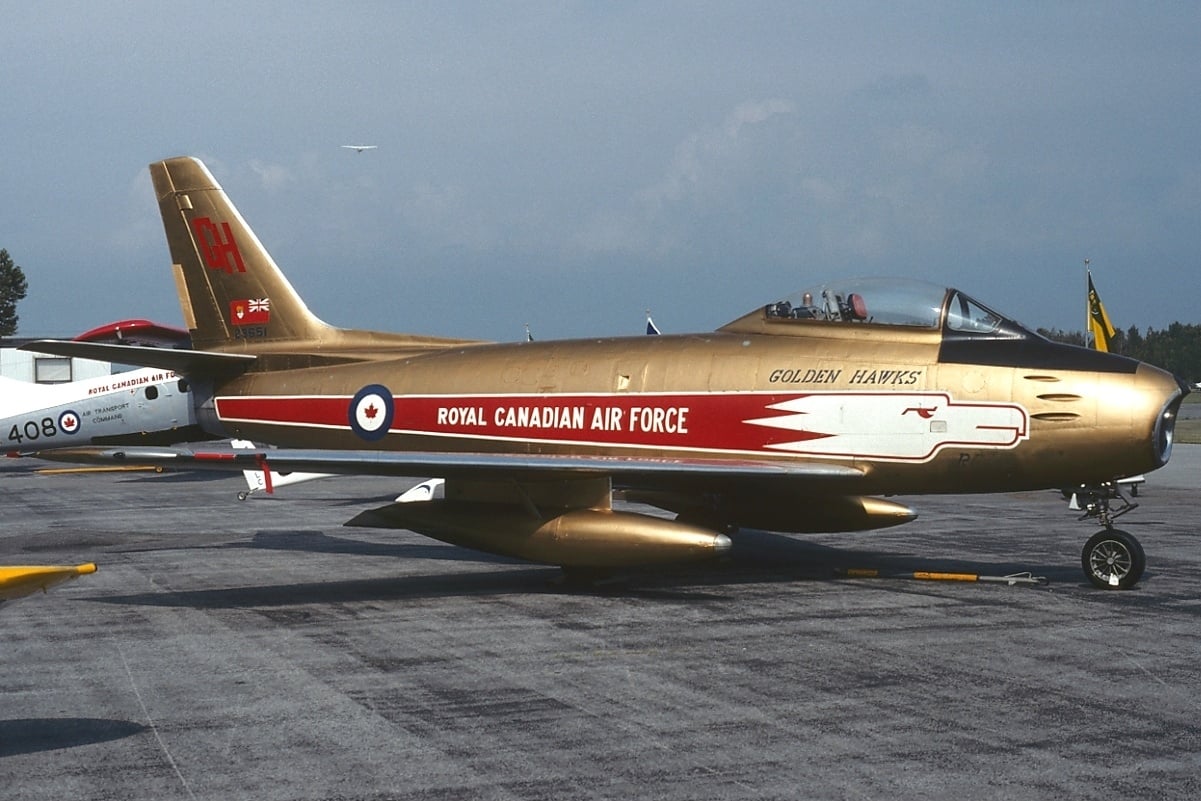
Long before the red-and-white Tutors of the Snowbirds, Canada had a jet team that glowed in the sun. In 1959 the Royal Canadian Air Force painted a group of Canadair Sabres gold, trimmed them in red and white, and sent them across North America as the Golden Hawks.
The team was only meant to last one season. It flew for five, put on 317 shows, lost pilots along the way and was disbanded in 1964 for financial reasons. On the day the Snowbirds fly their last home show in the Tutor, the Golden Hawks are a reminder of how Canada’s jet display tradition began.
Datos rápidos
- Team: Golden Hawks, Royal Canadian Air Force aerobatic team
- Años: 1959–1964 (disbanded 7 February 1964)
- Formed for: The RCAF’s 35th anniversary and 50 years of Canadian flight (Silver Dart, 1909)
- Aeronave: Canadair Sabre (Mk 5 and Mk 6), seven-aircraft team, plus a T-33 support aircraft
- Bases: RCAF Station Chatham and RCAF Station Trenton
- First leader: Squadron Leader Fern Villeneuve
- Shows: 317 across North America
- Legado: Hawk One Sabre (2009); the Snowbirds
A Birthday Present in Gold
In 1959 Canada had two anniversaries to celebrate: 35 years of the RCAF, and 50 years since the AEA Silver Dart made the first powered flight in Canada in 1909. The air force decided to mark them with a jet team. The original plan was a six-aircraft team for a single season, with eight pilots led by Squadron Leader Fern Villeneuve.
El avión era el Canadair Sabre, the Canadian-built version of the North American F-86, which had equipped RCAF fighter squadrons in Europe through the 1950s. Painted gold with a red and white flash, the Sabres looked unlike any other military jets of the time. A T-33 trainer flew with the team as its support aircraft.
A restored 1962 CBC television segment on the RCAF Golden Hawks.
The team quickly proved so popular that the RCAF brought it back for 1960. It went on to perform 317 shows across Canada and the United States, operating from RCAF Station Trenton and RCAF Station Chatham in New Brunswick, and grew to seven aircraft.
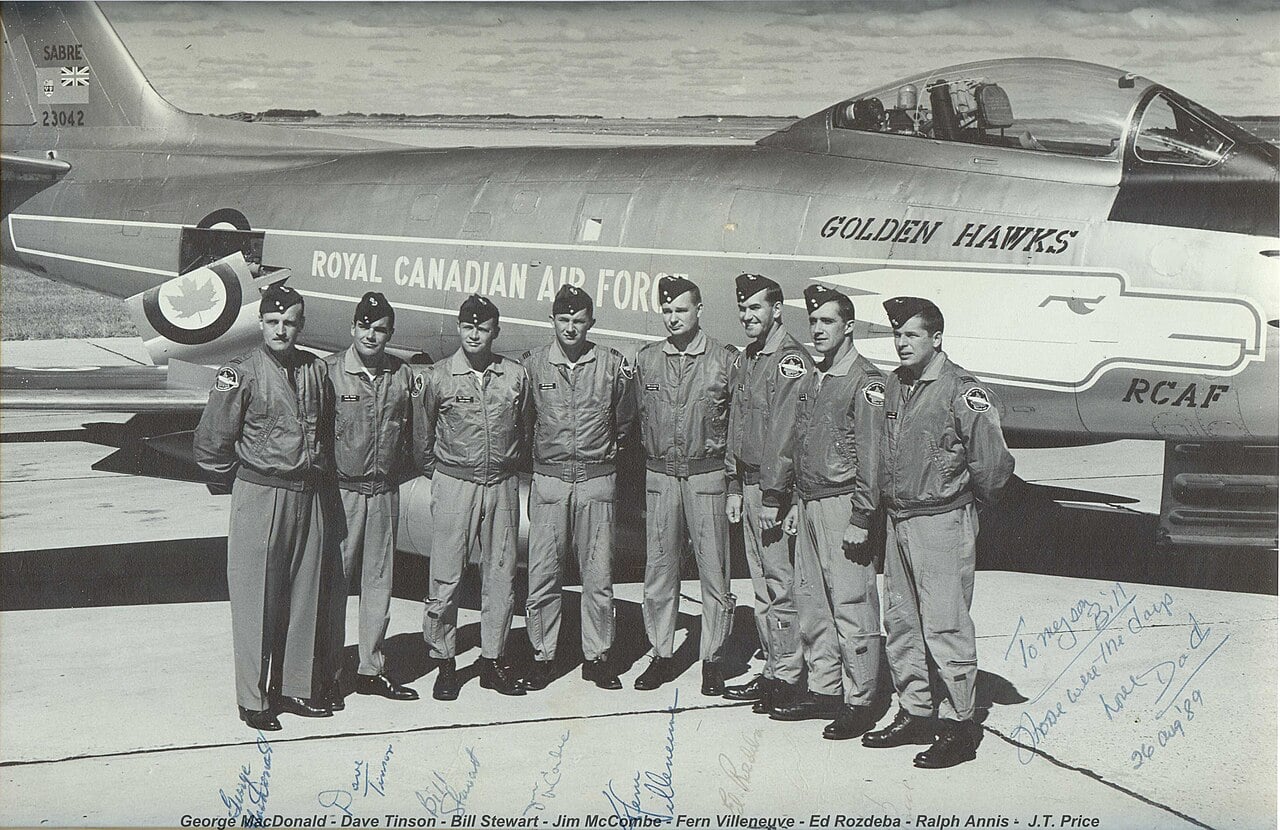
Los pilotos
Villeneuve led the team in 1959 and again in 1960, when Wing Commander Jack Allan commanded it. For 1961 he handed the lead to Flight Lieutenant James McCombe. The rules of the time limited single pilots to three years on the team and married pilots to two, and Villeneuve left after he married. He later flew the CF-104 Starfighter and the CF-101 Voodoo, retired in 1982 with more than 13,000 flying hours, and was inducted into Canada’s Aviation Hall of Fame in 2006.
Other pilots included Flight Lieutenants Edward Rozdeba, Jeb Kerr and Ralph Annis, and Flying Officers Jim Holt, Bill Stewart and John T. Price. The team is credited with pioneering the “Card 5” formation, a coordinated two-aircraft 360-degree turn and a head-on routine for the two solo jets.
The Cost of Flying Close
Display flying in the 1950s was dangerous, and the Golden Hawks paid a price. On 12 March 1959, before the team’s first season, Flight Lieutenant Sam Eisler was killed when his Sabre crashed into woodland near Chatham during a practice. On 10 August 1959, at McCall Field in Calgary, a Golden Hawks Sabre on approach collided with a Piper Tri-Pacer that had not been cleared into the control zone, killing Flight Lieutenant Jeb Kerr and the two people in the Piper.
There were narrow escapes too. On 21 June 1959 a bird shattered the windscreen and canopy of Flight Lieutenant J.T. Price’s Sabre over Halifax, and he landed safely with help from Flight Lieutenant Ralph Annis. On 22 February 1961 Flying Officer Jim McCann was killed in a collision with another Sabre during formation practice, and in April 1961 Flying Officer Bill Stewart ejected at low altitude near Chatham after an engine problem and survived.
Archive footage of the RCAF Golden Hawks and their gold Sabres.
Grounded in 1964, Flying Again in 2009
The Golden Hawks were disbanded on 7 February 1964, officially for financial reasons. Several of their Sabres survive in museums and parks across Canada and in Germany, including Sabre 6 23651, which belongs to the national collection and has been on loan to the Canadian Warplane Heritage Museum, and 23641 at the National Air Force Museum of Canada in Trenton.
In 2009, for the centennial of flight in Canada, Vintage Wings of Canada restored Sabre 5 23314 in Golden Hawks colours as “Hawk One”. Fern Villeneuve served as its honorary team leader from 2009 to 2013. The Golden Hawks’ spirit also lives on in the Canadian Forces Snowbirds, the team that took up Canada’s jet display role in 1971.
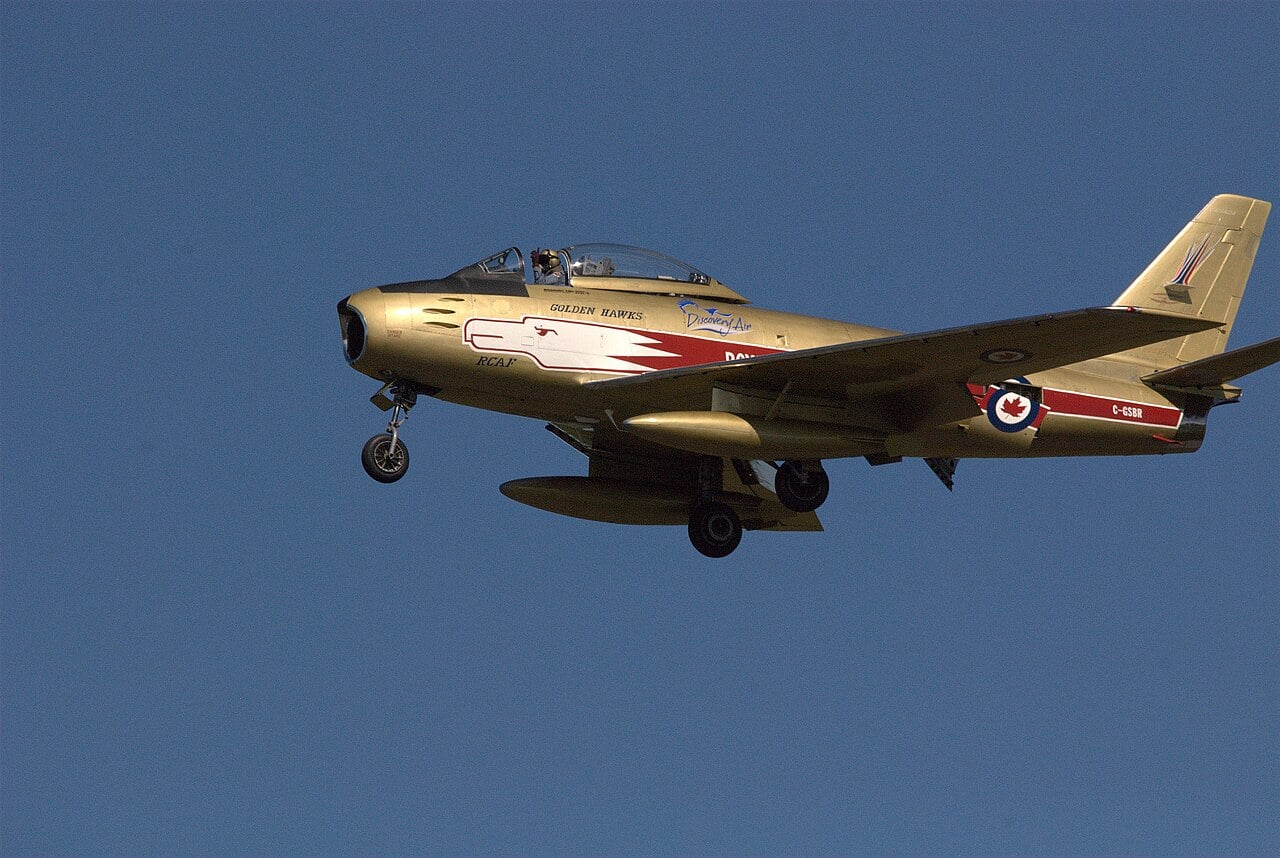
The Hawk One Sabre displaying in Golden Hawks colours at the Gatineau air show.
Sources: Wikipedia (Golden Hawks; Fern Villeneuve); Silver Hawk Author; Vintage Wings of Canada; CBC archive



0 Comments