
In the summer of 1919, almost every aeroplane in the world was made of wood, wire and doped fabric. On 25 June that year, at Dessau in Germany, test pilot Emil Monz took off in something entirely different: a low-wing monoplane with no bracing wires at all, skinned from nose to tail in ribbed, corrugated metal.
It was the Junkers F 13, the first all-metal aircraft built from the start to carry passengers. It seated four people in a closed, heated cabin, and it went on to fly with airlines on every continent for more than three decades.
The F 13 did more than carry passengers. It proved that metal was the right material for an airliner, years before the rest of the industry agreed.
Datos rápidos
- Tipo: Single-engined all-metal passenger and cargo monoplane
- Primer vuelo: 25 June 1919, Dessau, pilot Emil Monz
- Diseñador: Otto Reuter, for Hugo Junkers
- Estructura: Duralumin, corrugated skin, cantilever low wing
- Accommodation: 2 crew, 4 passengers in a heated cabin
- Motores: Mercedes D.IIIa (prototype); mostly Junkers L5
- Producción: About 320, 1919-1932 (sources range 314-351)
- Last airline use: Brazil, 1951
- Sobrevivientes: Five original airframes, all in museums
A Professor Who Hated Wires
Hugo Junkers was not an aircraft man by trade. He made gas water heaters in Dessau, and in 1910 he patented a radical idea: a thick, unbraced cantilever wing that carried all its loads internally. In 1915 his factory produced the J 1, an all-metal monoplane built from sheet steel. It flew, but it was heavy.
The company's own account of that first experiment, translated into English for the US National Advisory Committee for Aeronautics in 1926, is refreshingly blunt.
The answer was duralumin, an aluminium alloy with copper, manganese and magnesium. According to the same NACA circular, it had a specific gravity of 2.8 yet roughly the strength of Siemens-Martin steel, which was three times as heavy. After the Armistice, Junkers asked his chief designer Otto Reuter for something new: a passenger aircraft made entirely of metal, with no military purpose at all.
How the F 13 Was Built
The F 13 was a single-engined, low-wing cantilever monoplane. Its wing was built up on nine circular-section duralumin tubes acting as spars, with transverse bracing between them, and all of it was covered in Junkers' trademark corrugated duralumin skin. The corrugations stiffened the thin sheet and helped the structure resist torsion, so no external struts or wires were needed.
That thick wing was the heresy. Conventional wisdom in 1919 favoured thin profiles. Junkers' research showed that a deep section could carry the bracing inside it and still perform well across a wider range of speeds and climb rates. The wing came in three parts for transport, and the outer panels could be removed by two people in a few minutes.
The fuselage sat on top of the wing centre section, whose framework formed the floor of the cabin. That made a strong, light structure and put the main spar between the passengers and the ground in a crash landing. The cabin held four passengers in upholstered seats, with heating, windows and, unusually for the time, seat belts. The two pilots sat in front in an open cockpit; later versions enclosed it.
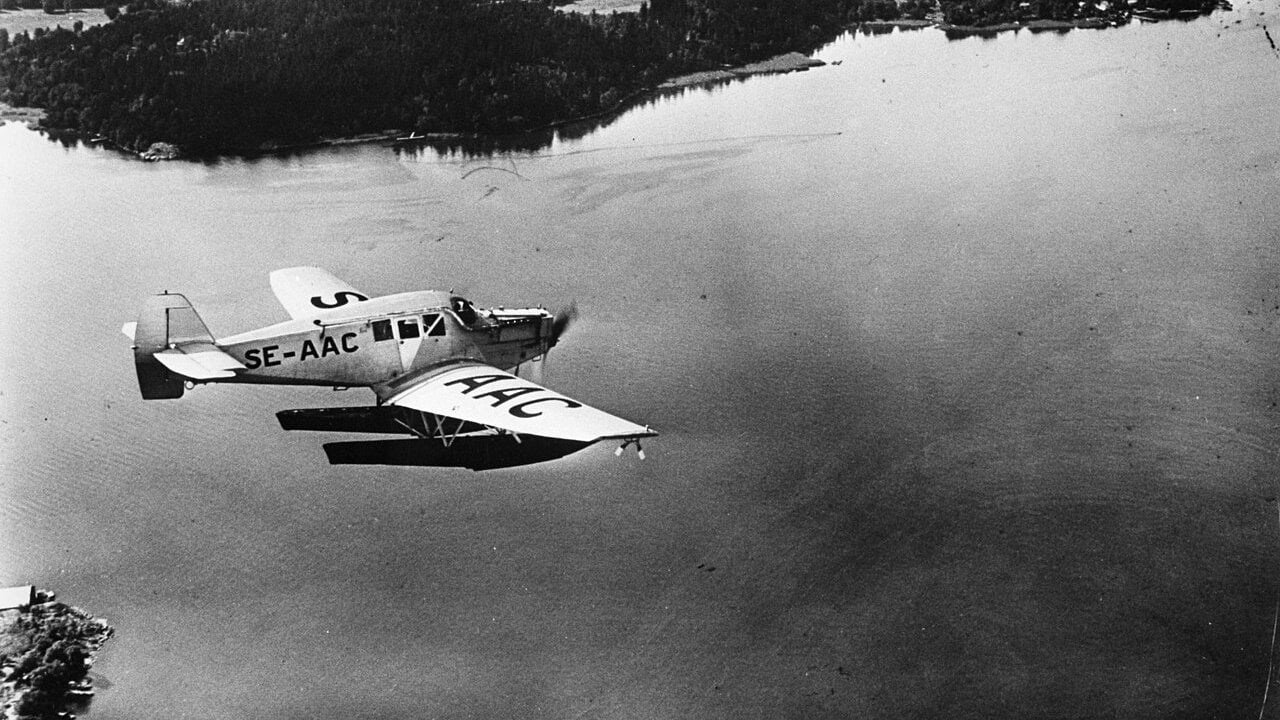
There were smaller clever touches, too. Instead of an adjustable tailplane, the F 13 used a trim tank near the tail, and the pilot pumped fuel to or from it to balance nose- or tail-heaviness. The wheels could be swapped for duralumin floats or for ski runners, which made the aircraft just as useful on a lake in Finland as on a grass field in Germany.
Performance and Engines
The prototype flew with a 160 hp-class Mercedes D.IIIa six-cylinder inline engine. Early production machines used the BMW IIIa, and most F 13s were later powered by the Junkers L5 of around 300 hp. Wikipedia lists a maximum speed of 173 km/h for the basic aircraft and around 198 km/h for the L5-powered F 13fe, with a range of about 1,400 km.
Within three months of the first flight, the F 13 announced itself. On 13 September 1919, Monz climbed to 6,750 metres with eight people aboard, a height record that This Day in Aviation describes as unofficial.
Junkers made bold claims about durability, and the NACA circular repeated them with evident relish. Wooden aircraft fatigued, warped and needed costly hangars; the first F 13s, the company said, had flown daily since 1919 without losing performance, and some had stood out in snow and rain for months.
Sold Abroad Before It Could Fly at Home
Postwar Germany was a hard place to sell aircraft. The Allied control commission restricted German aircraft building, and a total ban ran from 1921 into 1922. So Junkers looked abroad. According to German Wikipedia, the first production F 13 was sold on 29 October 1919 to John M. Larsen in the United States, where the type was marketed as the Junkers-Larsen JL-6. The US Post Office Department bought it for airmail.
Junkers also built demand himself. He set up his own airline, Junkers Luftverkehr, which by 1923 was flying 60 F 13s, and he offered the aircraft on cheap leases and even free loans. Some 16 operators across Europe took it up. When Junkers Luftverkehr merged into the new Deutsche Luft Hansa in 1926, its F 13s had flown 9.5 million miles, and Luft Hansa kept some in service until 1938.
Period film of the Junkers F 13 in scheduled airline service in the 1920s.
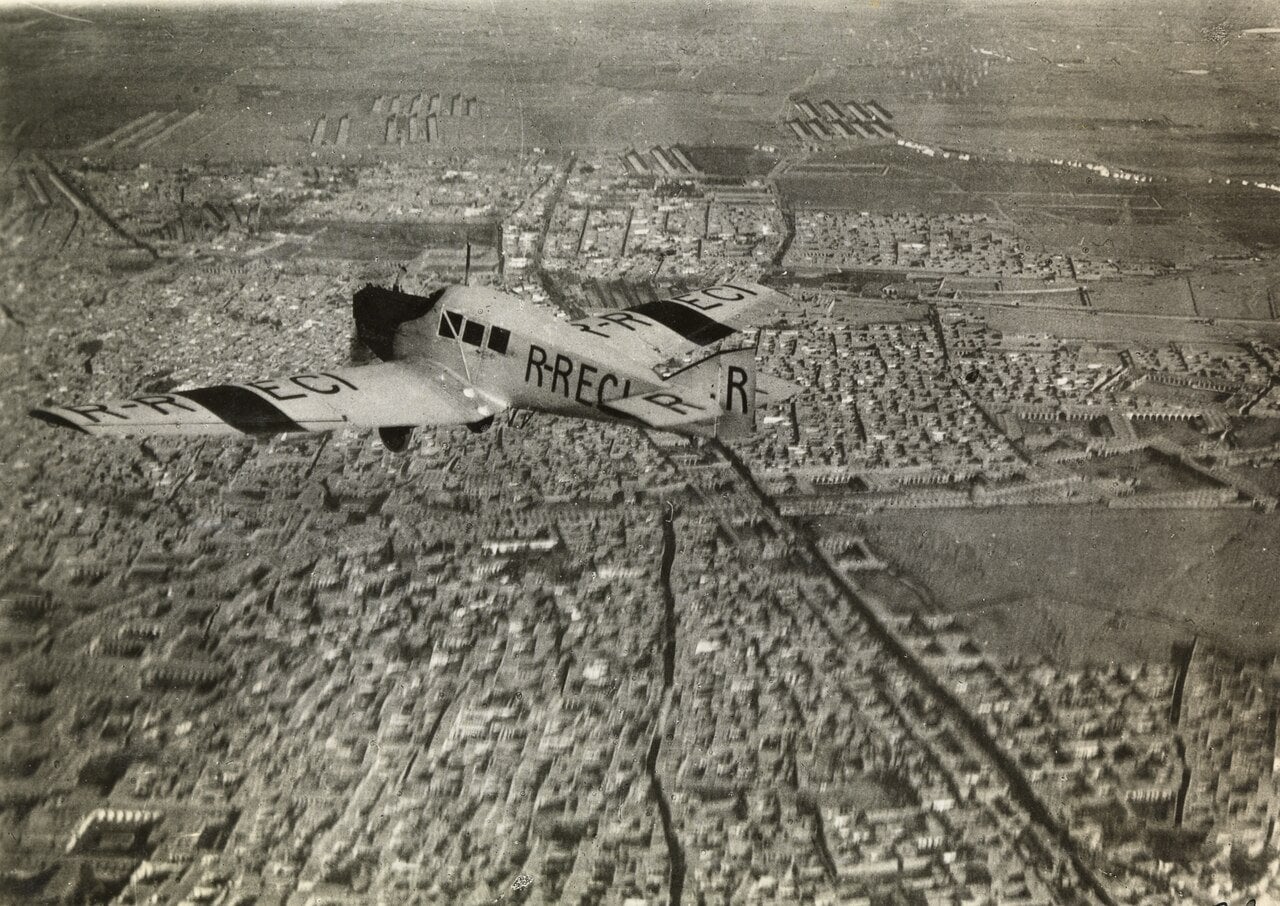
The customer list reads like an atlas: SCADTA in Colombia, Lloyd Aéreo Boliviano, Varig and Syndicato Condor in Brazil, Aerolot in Poland, AB Aerotransport in Sweden, airlines in Persia, Hungary, Finland, Iceland and South Africa. In Switzerland, Ad Astra Aero flew at least four F 13s from 1919. Production also ran at Danzig, Reval (Tallinn) and Fili near Moscow, where the Soviet-built version was called the Ju 13.
By 1925, according to both German Wikipedia and Junkers Aircraft's own company history, Junkers aircraft accounted for around 40 per cent of the world's air traffic network, overwhelmingly on F 13s. English Wikipedia gives a more cautious figure of over a third. Either way, no other airliner of the early 1920s came close.
A Long Service Life
Exactly how many were built is uncertain. Most sources give around 320 between 1919 and 1932, but surviving Junkers documents and later reports range from 314 to 351. The F 13 also seeded a family: the W 33 and W 34 transports were developed from it, and the corrugated-skin formula ran all the way to the three-engined Junkers Ju 52.
Metal also meant longevity. The F 13 stayed in commercial service for more than thirty years; the last one was retired in Brazil in 1951. Five original airframes survive, all in museums: at the Musée de l'Air et de l'Espace at Le Bourget, the Tekniska museet in Stockholm, the Deutsches Museum in Munich, the Royal Aviation Museum of Western Canada in Winnipeg, and the Transport Museum in Budapest.
The Deutsches Museum in Munich on its original Junkers F 13, D-366 (in German).
The Budapest aircraft, CH 59, has the most dramatic past. In October 1921 the exiled former emperor Karl I of Austria used it to fly from Switzerland to Hungary in a failed attempt to reclaim the Hungarian throne. The Stockholm machine, SE-AAC, opened AB Aerotransport's Stockholm to Helsinki route in 1924 and later tested night mail flights, while the Munich aircraft spent decades in Afghanistan before being brought home in 1969.
The F 13 Flies Again
In 2009 a German-Swiss project began to build a new F 13, backed by luggage maker Rimowa and its chief executive Dieter Morszeck. The team worked from original drawings and a laser scan of the Le Bourget aircraft. The replica first flew on 15 September 2016 and was presented at Dübendorf near Zurich. Outwardly it follows the American JL-6, but it uses a Pratt & Whitney R-985 Wasp Junior radial and carries modern radio and a transponder.
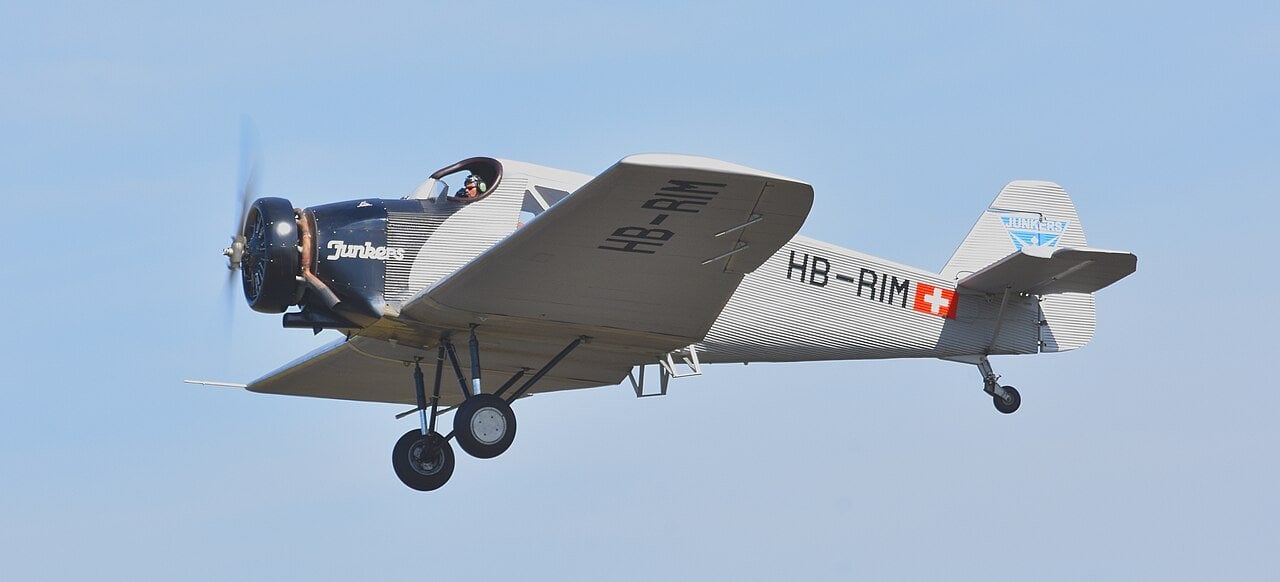
Morszeck's company, now Junkers Aircraft, says small-series production of the F 13 began in 2018, with maintenance based at Altenrhein in eastern Switzerland. Reports at the 2016 launch put the price of each new F 13 at about $2.5 million.
More than a century on, the shape still looks modern in a way its fabric-covered contemporaries never do. A cantilever monoplane, an enclosed cabin and a metal airframe: that is the blueprint of every airliner since.
Junkers Aircraft's film on the new-build F 13 replicas.
In 1919 it was a corrugated four-seater from a heater factory in Dessau. Hugo Junkers had got there first.
Sources: Wikipedia (Junkers F 13, English and German editions), NACA Aircraft Circular No. 6 (1926, via NASA NTRS), This Day in Aviation, 1000aircraftphotos.com (Johan Visschedijk), Junkers Aircraft company history, FLYING Magazine, CNN Travel, ETH-Bibliothek Zurich, Deutsches Museum
0 Comments