
A radar is a very simple liar detector. It shouts a pulse into the dark, waits, and measures how long the echo takes to come back. Distance is just time multiplied by the speed of light and halved. There is no judgement in it and no scepticism. Whatever comes back, it believes.
That credulity is the whole opening for electronic attack, and it is why jamming splits into exactly two families. You can bury the echo in noise so the radar cannot hear it. Or you can send the radar an echo it likes better than the real one. Everything else is detail, and the detail is where it gets interesting.
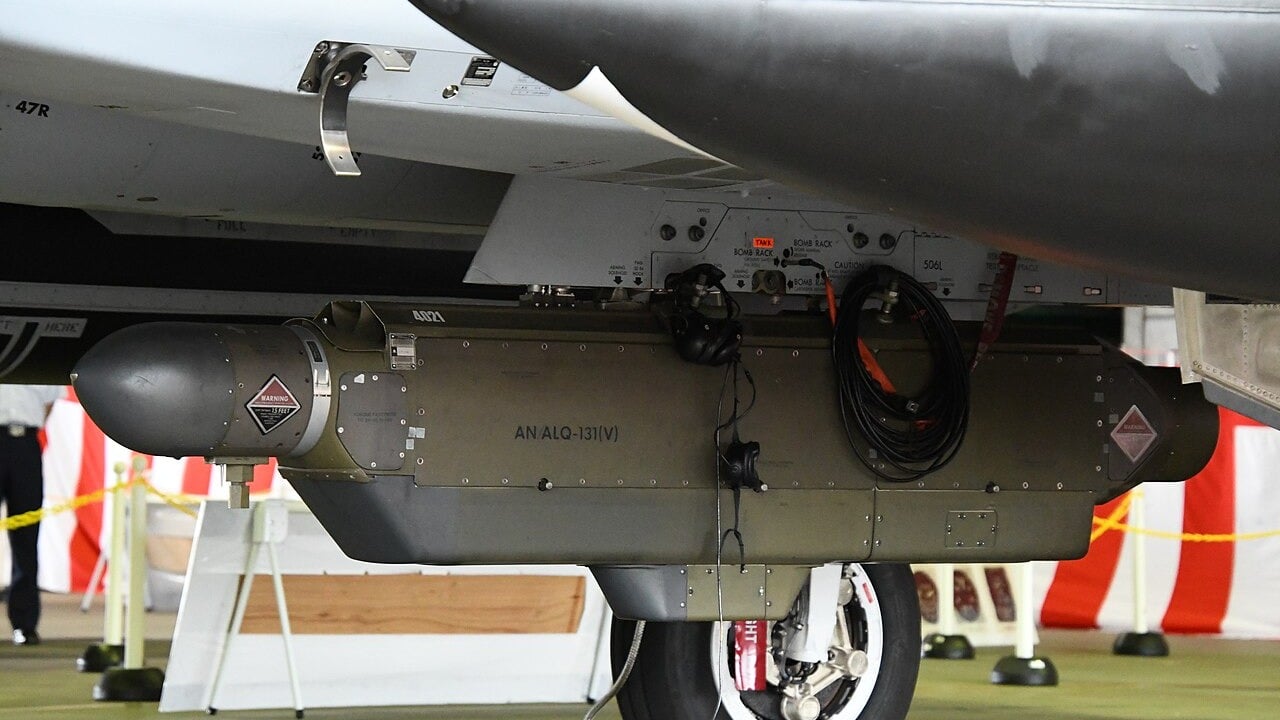
Afterburner has written about the aircraft that carry jammers and about the chaff and flares that decoy a missile in its last seconds. This is the layer underneath: what the jammer is actually doing to the radar while all that is going on.
Quick Facts: the jamming taxonomy
Two families: noise jamming (hide the target) and deception jamming (replace the target)
Noise, three forms: spot, barrage and swept, grouped by how the jammer concentrates its power
Spot jamming: all power on one frequency. Devastating against a fixed-frequency radar, almost useless against a frequency-agile one
Barrage jamming: many frequencies at once, so each is jammed less hard. The handbook figure is an 8.6 dB loss in jam-to-signal ratio against 0.7 dB for spot
Deception, the classics: range-gate pull-off, velocity-gate pull-off, inverse gain, cross-polarisation, terrain bounce
The modern enabler: digital radio frequency memory (DRFM), which records the incoming pulse and replays it altered
Primary source: U.S. Naval Air Warfare Center Weapons Division, Electronic Warfare and Radar Systems Engineering Handbook
Noise: Hiding in Plain Hearing
Noise jamming is the blunt half of the business. The U.S. Navy handbook defines it as a continuous random signal radiated to conceal the aircraft echo, and adds the condition that makes or breaks it: the average amplitude has to be at least as great as the average amplitude of the radar echo. Below that, you are not hiding, you are just adding a hiss the operator may not even notice.
There are three ways to spend a jammer’s power, and the handbook groups them exactly that way. Spot jamming puts everything on one frequency. Barrage spreads it across many at once. Swept jamming shifts the full power from one frequency to the next, sweeping through a band.
Spot is the most violent and the most brittle. Focus all your transmitter output on the frequency a radar is using and you will comprehensively ruin its day. The handbook puts 85 per cent of that jamming energy inside the victim receiver, which costs you only 0.7 dB of jam-to-signal ratio. Then the radar hops to a different frequency and you are jamming empty sky. Against a frequency-agile set, the handbook is blunt: it would hardly be affected.
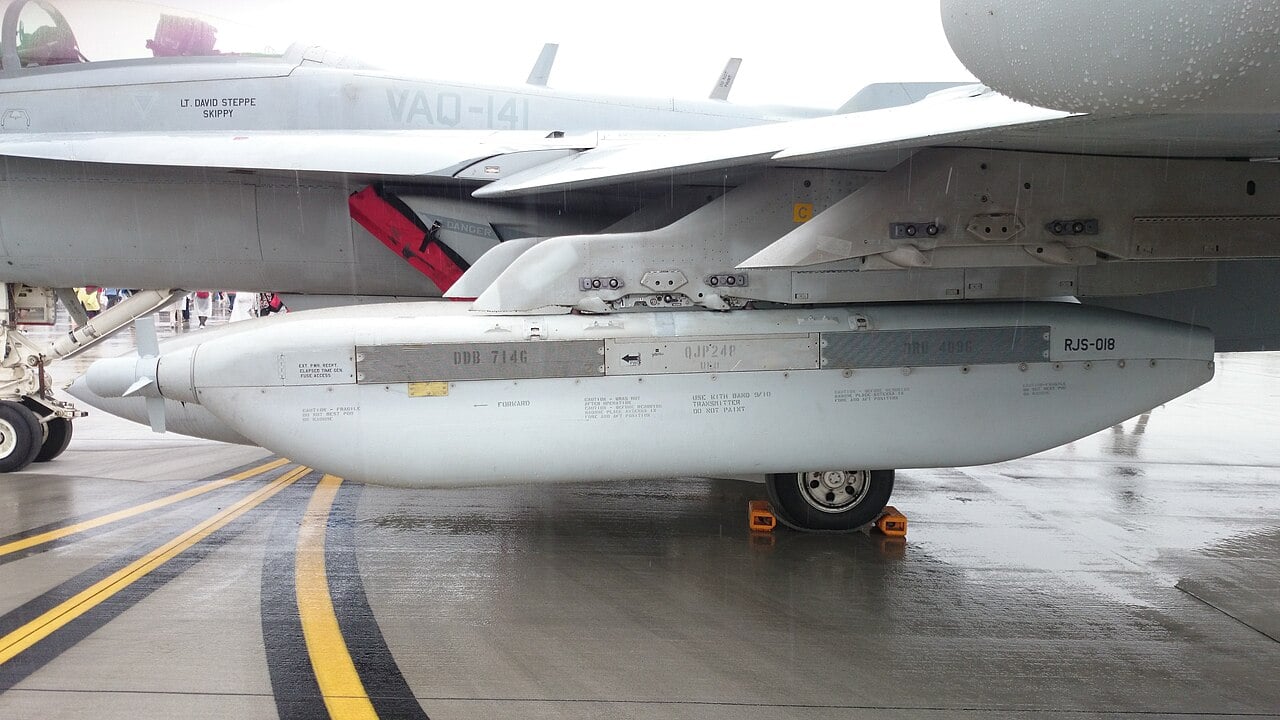
Barrage is the answer to agility and it comes with an honest bill. Jam fifty frequencies at once and the radar cannot run away from you, but your transmitter has to divide its output between all fifty. The handbook’s worked example drops the jamming energy reaching the receiver from 100 per cent to 14 per cent, an 8.6 dB penalty against spot jamming’s 0.7 dB. Its own summary of the trade is the sentence every EW officer eventually says out loud: the more frequencies being jammed, the less effectively each is jammed.
Swept jamming is the compromise. Keep the narrow bandwidth and the power density of spot, but move it continuously across the band, so that any given radar is blanketed some of the time rather than slightly annoyed all of the time. It is spot jamming trying to look like barrage jamming, and against some receiver designs it works.
A clear walk through what a jammer is doing to a radar receiver, and why raw transmitter power is not the whole answer.
Deception: Giving the Radar Something Better to Believe
Noise jamming announces itself. A radar screen full of hash tells the operator, instantly, that somebody is out there and roughly where. Deception jamming is the opposite: done properly, the radar never knows anything is wrong. It is tracking a target, it is happy, and the target is not there.
To understand how that is possible you need one piece of radar plumbing: the range gate. Once a tracking radar finds something, it stops looking at everything else.
That narrowing is a defence. It is what makes a tracking radar hard to jam with noise, because noise arriving from outside the window is simply discarded. But it is also a handle. The radar has committed itself to one short slice of range, and it is no longer looking anywhere else. Steal the slice and you steal the radar.
Range-Gate Pull-Off, Step by Step
Range-gate pull-off, RGPO in the literature and range-gate stealing in conversation, is the oldest and most elegant trick in deception jamming. The handbook sets it out in four phases, and it is worth following them in order because each one depends on the last.
First, the jammer samples the illuminating pulse and works out the radar’s pulse repetition frequency. It then amplifies that sample and retransmits it in step with the real pulses. At this point the aircraft is deliberately making itself brighter, not dimmer. The jamming power is increased steadily until the replica is far stronger than the aircraft’s own skin return.
Second, the radar does what a well-designed radar does when a signal gets too strong: it reduces the sensitivity of its receiver to avoid overload. That is the moment the trap closes. With the gain turned down, the genuine skin echo sinks below the noise floor. The radar is now tracking the replica and only the replica, and it has no idea.
Third comes the walk. Each replica is retransmitted with a slightly longer delay than the last, which the radar reads as the target receding. The range gates follow obediently, because that is their job. The handbook notes the detail that makes this plausible: the delays are small and incremental, so there is no sudden jump for a tracker to reject.
Fourth, the jammer simply stops. The range gates are now sitting somewhere out in empty space, holding nothing at all, and the real aircraft is far outside the window the radar is looking through. Break-lock. The radar has to fall back to search, reacquire, and start again, and every second of that is a second the aircraft is using.
One refinement is worth knowing because it reverses the intuition. As described, RGPO can only create false targets at greater ranges than the real one, since the replica is transmitted after the skin echo. But if the victim radar’s pulse repetition frequency is constant, the jammer can calculate when the next pulse is coming and place its reply so that the false target appears closer rather than further away. A constant PRF is, in this sense, a vulnerability.
The Doppler Version, and the Rest of the Family
Velocity-gate pull-off is the same idea aimed at a different gate. Against a continuous-wave or pulse-Doppler radar that tracks by velocity rather than range, the jammer amplifies and retransmits the signal with its frequency shifted, so the radar reads an apparent Doppler shift and an apparent rate of change. The velocity gate walks off the target exactly as the range gate does. Modern jammers routinely run both at once, because a radar that is being lied to about where you are and how fast you are going has very little left.
Beyond the two gate-stealers sits a whole shelf of angle-deception techniques, and they are all attacks on a specific radar design rather than on radar in general. Inverse gain re-radiates the radar’s pulse train modulated at the rate of the radar’s own scan, which confuses a conical-scanning tracker about bearing. Cross-polarisation radiates a signal polarised at right angles to the radar’s, which induces angle errors in trackers and sensing errors in the jamming-suppression circuits of surveillance radars. Terrain bounce aims the jamming at the ground so it reflects upwards, creating a virtual image of the jammer on the earth for a home-on-jam missile to chase.
Each of these works beautifully against the right radar and does nothing at all against the wrong one. That is the defining property of deception jamming and the reason electronic order of battle, knowing precisely which radar you are facing, is worth more than transmitter power.
Rohde & Schwarz demonstrate range-gate and velocity-gate pull-off on test equipment, which is the closest most people will get to watching a gate being stolen.
DRFM: The Trick That Made Everything Above Harder
Every deception technique described so far has the same weakness. The jammer has to reproduce the radar’s signal, and for forty years it reproduced it badly. Analogue memory loops worked by circulating the captured signal through a front-end amplifier over and over, and every lap degraded it. The copy was recognisably a copy.
Digital radio frequency memory removed that limit. A DRFM digitises the incoming signal at whatever frequency and bandwidth is needed to represent it properly, holds a digital copy in memory, then reconstructs and retransmits it on demand. Because the copy is digital, it is coherent with the original, and a coherent copy is a problem of a completely different order. The radar cannot tell it apart from a legitimate target return, because in every measurable respect it is one.
The idea is older than most people assume. The earliest published description of storing radar pulses digitally appeared in January 1975, in a piece by Sheldon C. Spector in the Association of Old Crows journal Guerra electrónica, under a title that still describes the technology better than any acronym: the loopless memory loop.
What a DRFM does with the stored copy is where the capability lives. It can change the apparent radar cross section of the false target, so the thing the radar is tracking can be made to look like a fighter, a bomber or a cruise missile. It can change the apparent range, the apparent velocity, and the apparent angle. Small frequency shifts introduce velocity errors. More aggressively, a DRFM can distort the phase fronts arriving at the victim’s receiving antenna, which attacks monopulse angle measurement, historically the hardest tracking method to deceive.
It also breaks the asymmetry that limited classical RGPO. Because the device is no longer passing a decaying analogue signal round a loop, it can hold a copy and place it where it likes. Reactive jamming puts false targets behind the protected aircraft, as a repeater always did. Predictive jamming puts them in front of it. A radar that could once rely on a false echo always arriving late has lost that comfort.
A wider survey of electronic warfare, useful for seeing where the techniques above sit in a real air campaign.
What Jamming Still Cannot Do
It is worth ending on the limits, because the subject attracts more breathlessness than it deserves. Noise jamming only works if it is at least as loud as the echo it is hiding, and loud transmissions are themselves a signal: a jammer announces a bearing to anyone listening, and home-on-jam seekers exist precisely because of that.
Deception jamming is the opposite problem. It is quiet, but it is specific. Every technique on the list above is built against a particular radar behaviour, and against the wrong radar it does nothing. Inverse gain needs a conical-scanning tracker. Range-gate pull-off needs a range gate to steal. A technique that works perfectly on Monday is worthless on Tuesday if the opposition has changed a waveform.
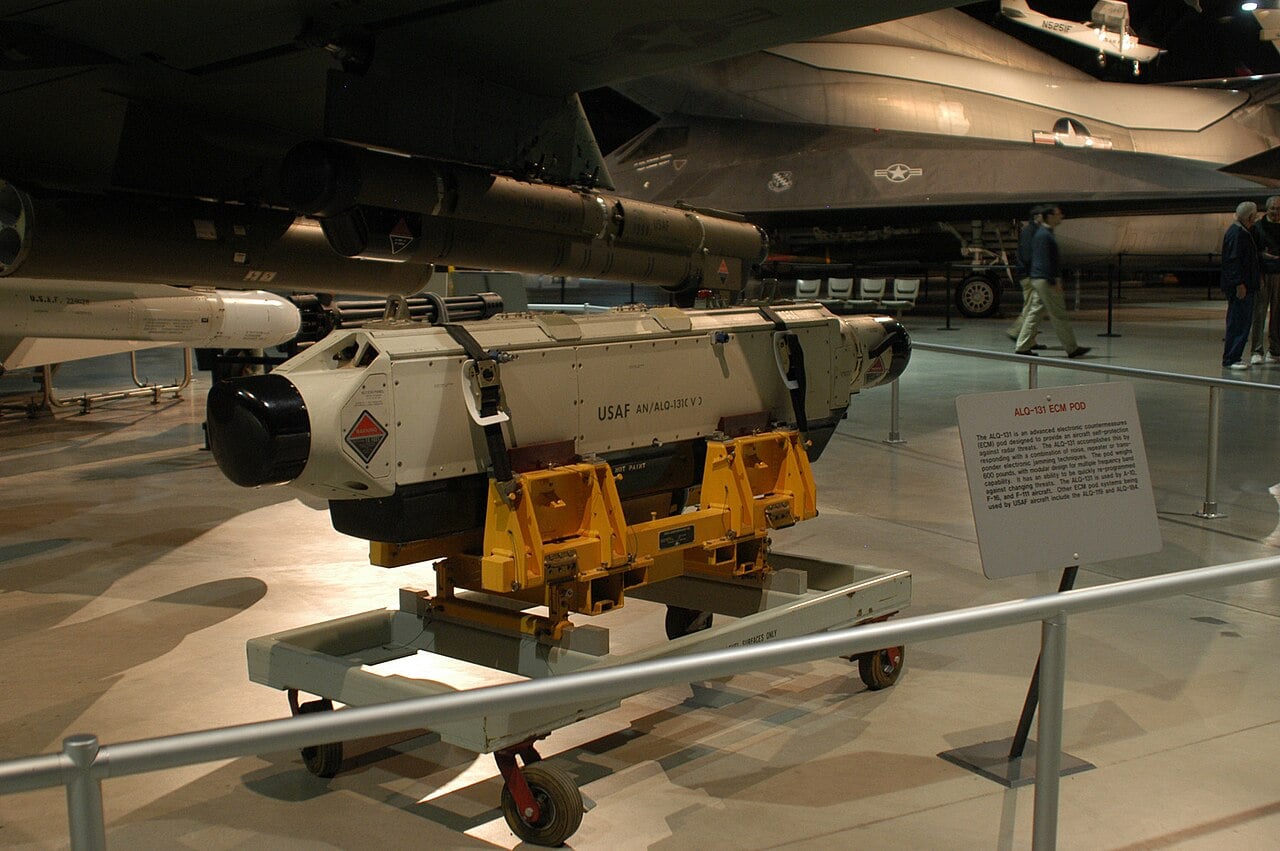
That is why the serious money in electronic warfare goes on knowing what you are facing rather than on raw output, and why a jamming pod is only as good as the threat library loaded into it. The physics of lying to a radar has not changed much since the 1970s. The difficulty has always been knowing exactly which lie to tell.
Sources: U.S. Naval Air Warfare Center Weapons Division, Electronic Warfare and Radar Systems Engineering Handbook; Association of Old Crows, Electronic Warfare, January 1975; Armada International; National Museum of the United States Air Force.


0 Comments