
On the morning of 15 April 1969, a lumbering four-engine reconnaissance aircraft climbed away from a Japanese airfield on a mission its crew had flown, in one form or another, roughly 200 times in three months without incident. It was routine. It was rated minimal risk. And by early afternoon all 31 men aboard were dead in the Sea of Japan.
The aircraft was a US Navy Lockheed EC-121M Warning Star, radio call sign Deep Sea 129. Two North Korean MiG-21s found it over international water, and a single missile did the rest. It remains the largest single loss of American aircrew in the entire Cold War reconnaissance program.
What followed was not a war, but something stranger: a superpower weighing tactical nuclear strikes one week and quietly resuming spy flights the next. This is the story of the shootdown Washington chose to swallow.
Informations clés
| Aéronef | Lockheed EC-121M Warning Star (four-engine, Super Constellation-based) |
| Date | 15 April 1969 |
| Unité | Fleet Air Reconnaissance Squadron One (VQ-1), NAS Atsugi, Japan |
| Crew lost | 31 (30 US Navy sailors and 1 US Marine) |
| Attacker | North Korean Air Force MiG-21 |
| Contexte | 15 months after the USS Pueblo seizure; largest single Cold War aircrew loss |
A routine track over a cold sea
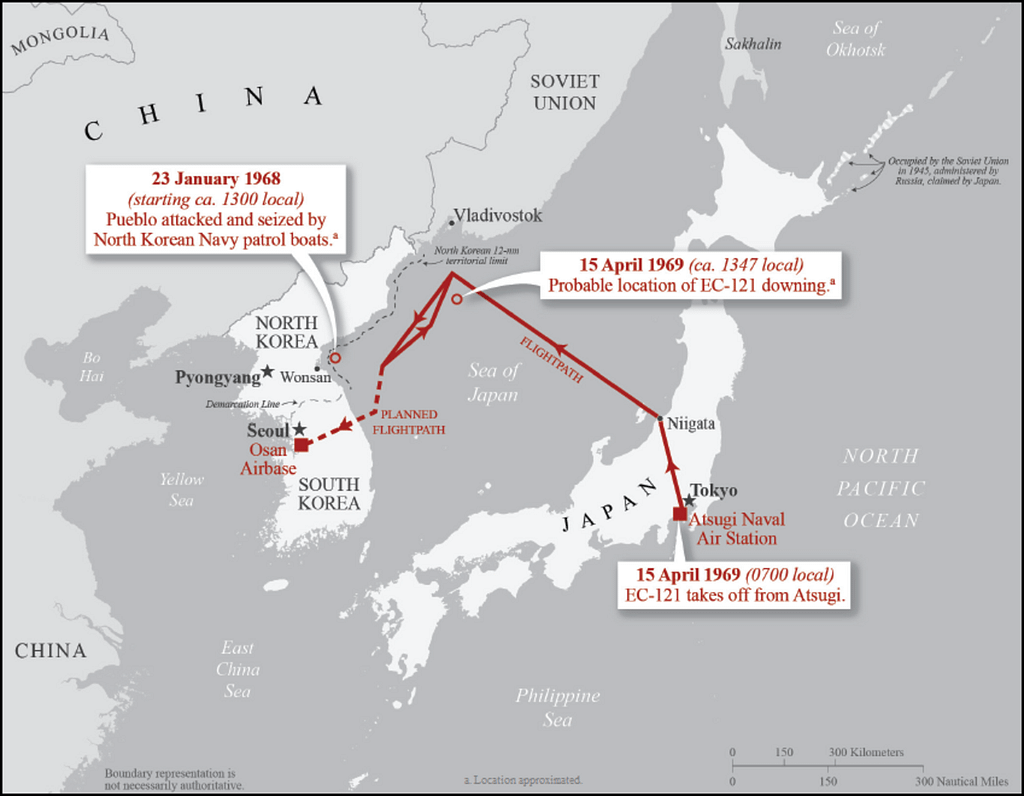
At 07:00 local on Tuesday, 15 April 1969, Deep Sea 129 lifted off from Naval Air Station Atsugi, Japan. Aboard were eight officers and 23 enlisted men under Lieutenant Commander James Overstreet, among them nine cryptologic technicians and linguists in Russian and Korean. Their job was a Beggar Shadow signals-intelligence run: fly northwest over the Sea of Japan, orbit a long elliptical racetrack off North Korea's east coast, hoover up radar and radio emissions, and land at Osan in South Korea.
Overstreet's orders were explicit. He was to come no closer than 50 nautical miles to the North Korean coast. Nobody expected trouble. Navy and Air Force aircraft had flown nearly 200 similar missions off North Korea in the first three months of 1969 alone, all without a shot fired.
An airliner turned electronic eavesdropper
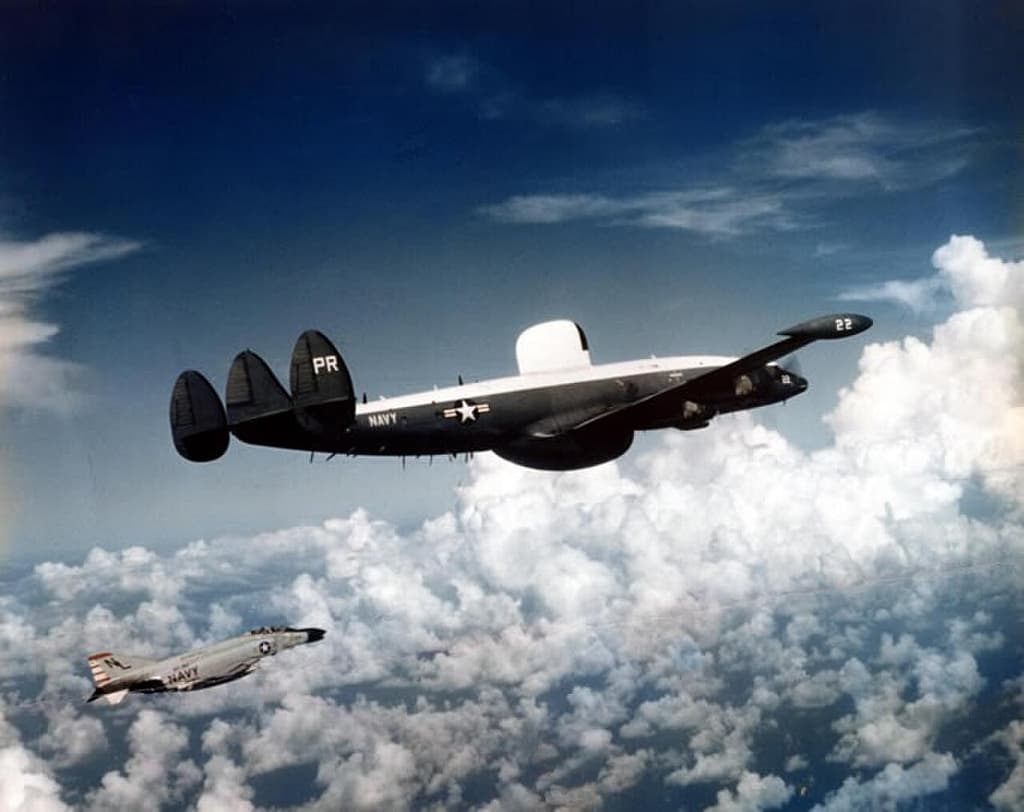
The Warning Star was not a warplane in any obvious sense. It was a militarised Lockheed Super Constellation, the graceful four-engine, propeller-driven airliner that carried the world's well-heeled passengers before the jet age swept it aside. The Navy bought scores of them, nicknamed them Willie Victors, and packed the EC-121M variant with roughly six tons of electronic gear, a fuselage radar, and a large dorsal radome.
All that equipment came at a price. The EC-121M cruised at barely 220 knots and topped out around 20,000 feet. Crucially, it carried no weapons and no defensive jammers of any kind. Against a supersonic fighter it was, in every practical sense, defenceless, a fact that would matter enormously in the space of about ten minutes.
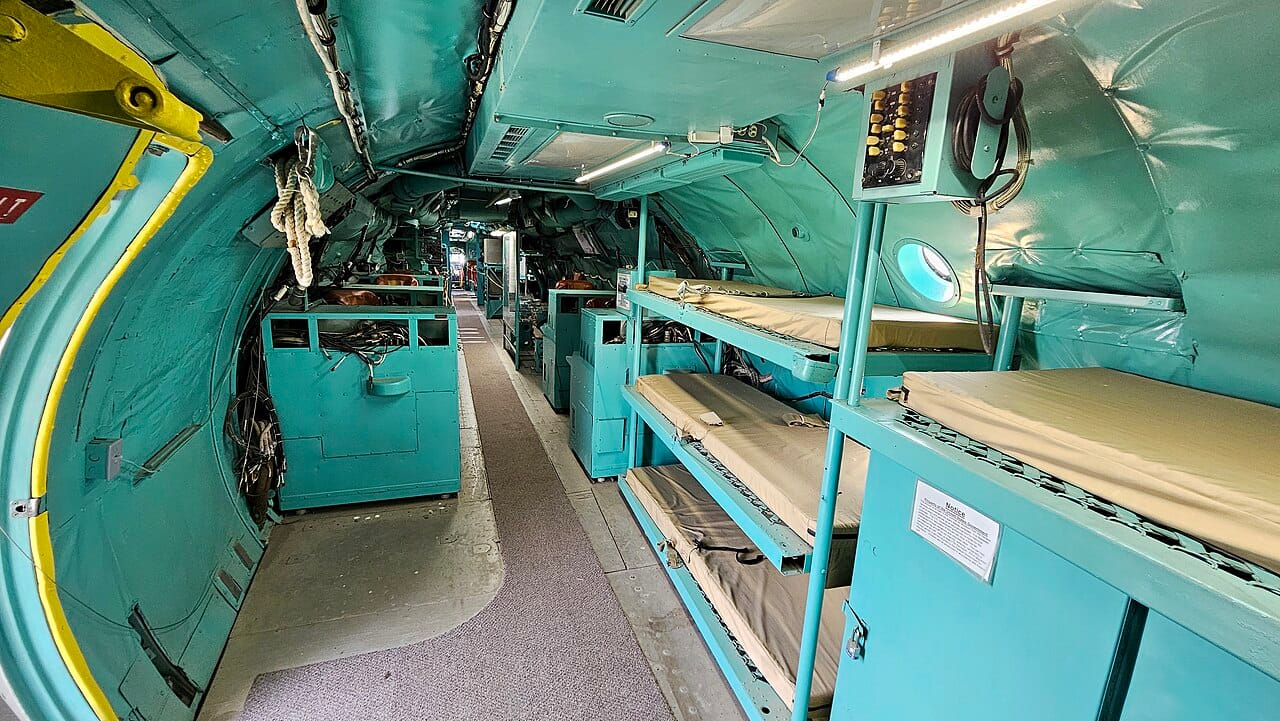
A walk-through of a preserved Lockheed EC-121 Warning Star, showing the Super Constellation airframe.
Fifteen months after the Pueblo
The shootdown did not happen in a vacuum. Just 15 months earlier, in January 1968, North Korean forces had seized the US Navy intelligence ship USS Pueblo and its crew, holding the sailors for eleven months. The peninsula was seething: the Blue House Raid assassination attempt on the South Korean president, deadly firefights along the DMZ, and a tripling of North Korea's defence budget all belonged to the same violent stretch.
American planners knew the history and still rated the mission low-risk, gambling that Pyongyang would respect international airspace as a matter of course. It was, as the Navy's own historians later conceded, an assumption North Korea had given them no reason to make.
The intercept
Around midday, US signals-intelligence sites tracked two North Korean MiG-21s launching from an airfield near Wonsan. The timing was clean, too clean, calculated to put the fighters on the shortest possible intercept of a flight path the North Koreans clearly knew by heart. One MiG set up a defensive patrol; the other bored straight in toward Deep Sea 129 at supersonic speed.
Warnings went out. VQ-1 radioed an alert, and Overstreet acknowledged it and turned for home, aborting the mission. But the EC-121 could not outrun a fighter. At 13:47 local the radar tracks merged some 90 nautical miles off the coast, well inside international airspace. Two minutes later, Deep Sea 129 was gone.
Silence, then a single shot
Standard procedure for a threatened EC-121 was to dive for the deck, so its disappearance from radar did not immediately read as catastrophe. For an agonising stretch, radar and intercept sites across Japan and Korea simply did not know. There had been no distress call.
North Korea removed the doubt. About two hours later its state media crowed that the aggressor aircraft had been downed with a single shot. Recovered debris later showed shrapnel damage consistent with an air-to-air missile. In a striking Cold War courtesy, two Soviet destroyers reached the crash site first and helped recover wreckage; only two of the 31 bodies were ever found.
Historian Mark Felton sets the EC-121 shootdown within North Korea's forgotten 1966-69 conflict.
Washington weighs the unthinkable
The reaction in Washington ran hot. President Nixon, who had campaigned dismissing North Korea as a fourth-rate power, now faced options that ranged from a show of force to selective air strikes to something far darker. The chairman of the Joint Chiefs presented a plan to strike North Korea with tactical nuclear warheads. The US assembled Task Force 71, one of the largest shows of force in the region since the Korean War, built around four aircraft carriers and the battleship New Jersey.
The planning was serious. The follow-through was not.
The muted answer
In the end, Nixon did essentially nothing to North Korea. With over 500 Americans dying every month in Vietnam and public patience for war evaporating, another conflict, one that put Seoul's millions within artillery range, was unthinkable. Task Force 71 steamed into the Sea of Japan, made its point, and by late April began peeling away to resume operations off Vietnam.
Instead, the administration resumed the reconnaissance flights within a week, now with fighter escort, to show it would not be intimidated. Nixon promised the North Koreans would never get away with it again.
How a failure in intelligence gave rise to a Cold War tragedy.
Why it still echoes
The tragedy of Deep Sea 129 forced a hard look at how these missions were tasked, briefed and protected, reforms in threat assessment and warning that reshaped Cold War reconnaissance. But the strategic lesson North Korea drew was blunter and more lasting: that American outrage could be absorbed, and that a defenceless aircraft over international water was a target a small state could hit and survive. It would be more than three decades before another US Navy VQ-1 reconnaissance aircraft came to grief in a hostile intercept, the 2001 EP-3 collision off Hainan Island. The men of Deep Sea 129 are remembered each April, their names read against a bell that rings once for each of the 31.
Sources: Wikipedia (1969 EC-121 shootdown incident), Naval History and Heritage Command (H-029-2), HistoryNet

0 commentaire