
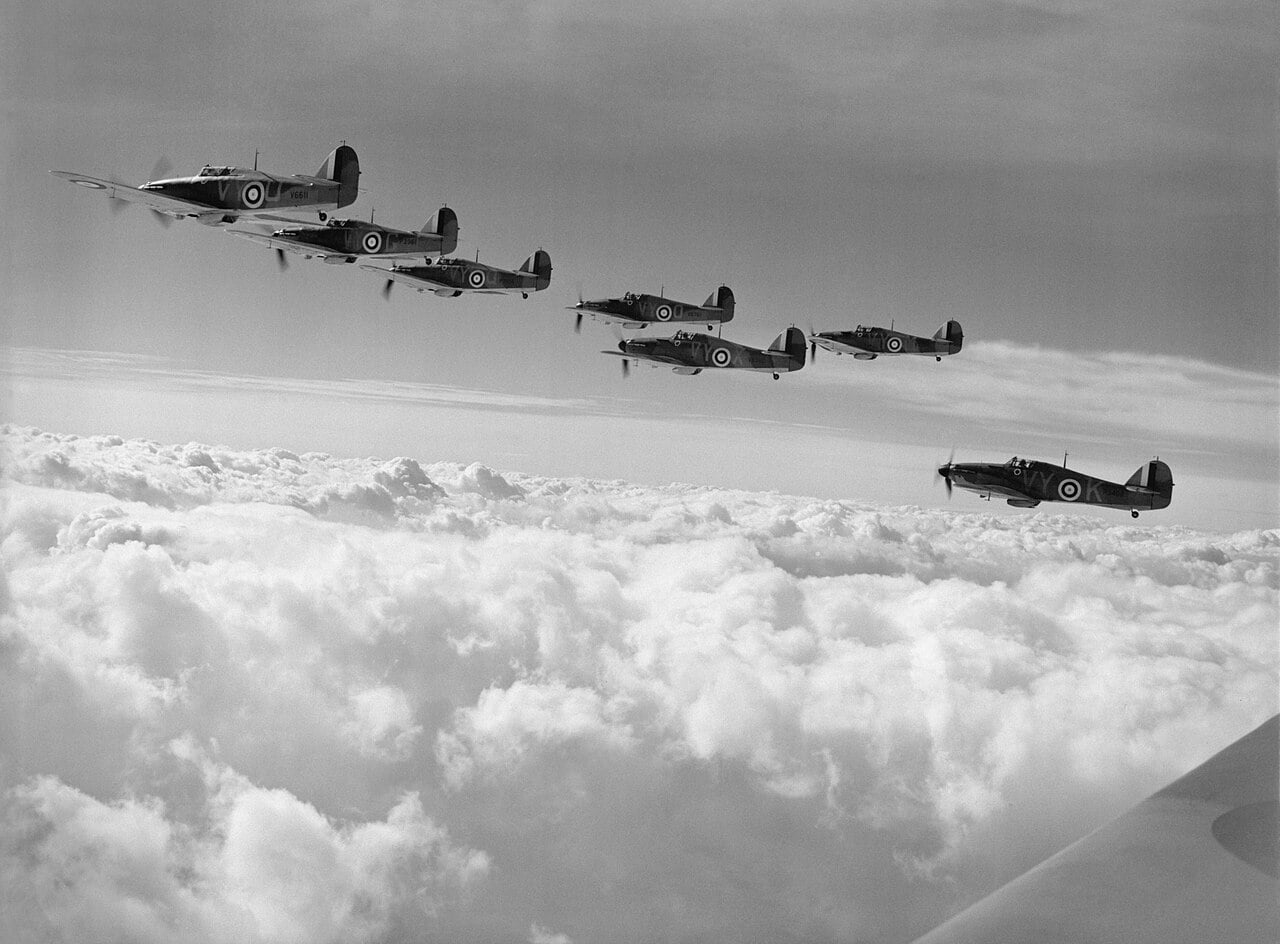
Britain had been at war for three days. At quarter past six on the morning of 6 September 1939, a radar station on the Essex coast reported unidentified aircraft approaching at high altitude over West Mersea.
There were no German aircraft. The plots were reflections of British aircraft flying inland, bounced back the wrong way by a radar chain that was brand new and not yet fully understood by the people reading it.
By the time the morning was over, two RAF Hurricanes had been shot down by RAF Spitfires, and a 26-year-old pilot officer was dead. He was the first British fighter pilot killed in the Second World War, and he was killed by his own side.
Informations clés
| Date | 6 September 1939, three days into the war |
| Déclenchement | Radar fault at 6:15 a.m. reporting aircraft inbound over West Mersea, Essex |
| Reality | Radar returns from British aircraft flying inland, misread as inbound |
| Scrambled | 56 and 151 Squadron Hurricanes from North Weald; 54, 65 and 74 Squadron Spitfires from Hornchurch |
| Who fired | Flying Officer Vincent ‘Paddy’ Byrne and Pilot Officer John Freeborn, 74 Squadron |
| Pertes | Two Hurricanes. Pilot Officer Montague Hulton-Harrop killed; Frank Rose survived |
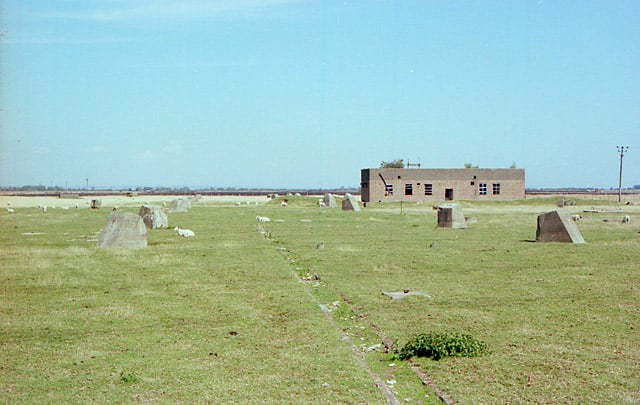
| Lieu du crash | Manor Farm, Hintlesham, Suffolk, about 5 miles west of Ipswich |
| Résultat | Court martial at Bentley Priory. Both pilots exonerated |
| Surnom | The Battle of Barking Creek, after a music-hall punchline of a place miles from the shooting |
Everything that could go wrong already had
The failure was not one mistake. It was a stack of them, each individually forgivable.
Coastal radar in 1939 could mistake returns from aircraft flying inland for aircraft flying towards England, because the equipment that was supposed to suppress the back-signal had failed. So the plot showed a raid coming in when what it was actually seeing was Britain’s own aeroplanes going the other way.
Then the response escalated. 11 Group ordered six Hurricanes up from 56 Squadron at North Weald. The sector controller, Group Captain David Lucking, sent all fourteen. Two more pilot officers took reserve aircraft and followed at a distance, which nobody else in the air knew about. Hurricanes from 151 Squadron went up as well, and Spitfires from three squadrons at Hornchurch.
None of those pilots had ever been in action. Few had ever seen a German aircraft. Radio communication with the ground was poor. And critically, there was no procedure for telling an RAF aircraft from a Luftwaffe one in the air. Identification friend or foe equipment existed as a concept but had not been fitted to most of the fleet.
So a large number of inexperienced pilots were sent into the same patch of sky, all of them told to expect enemy aircraft, none of them able to prove that the aeroplane in the gunsight was not one.
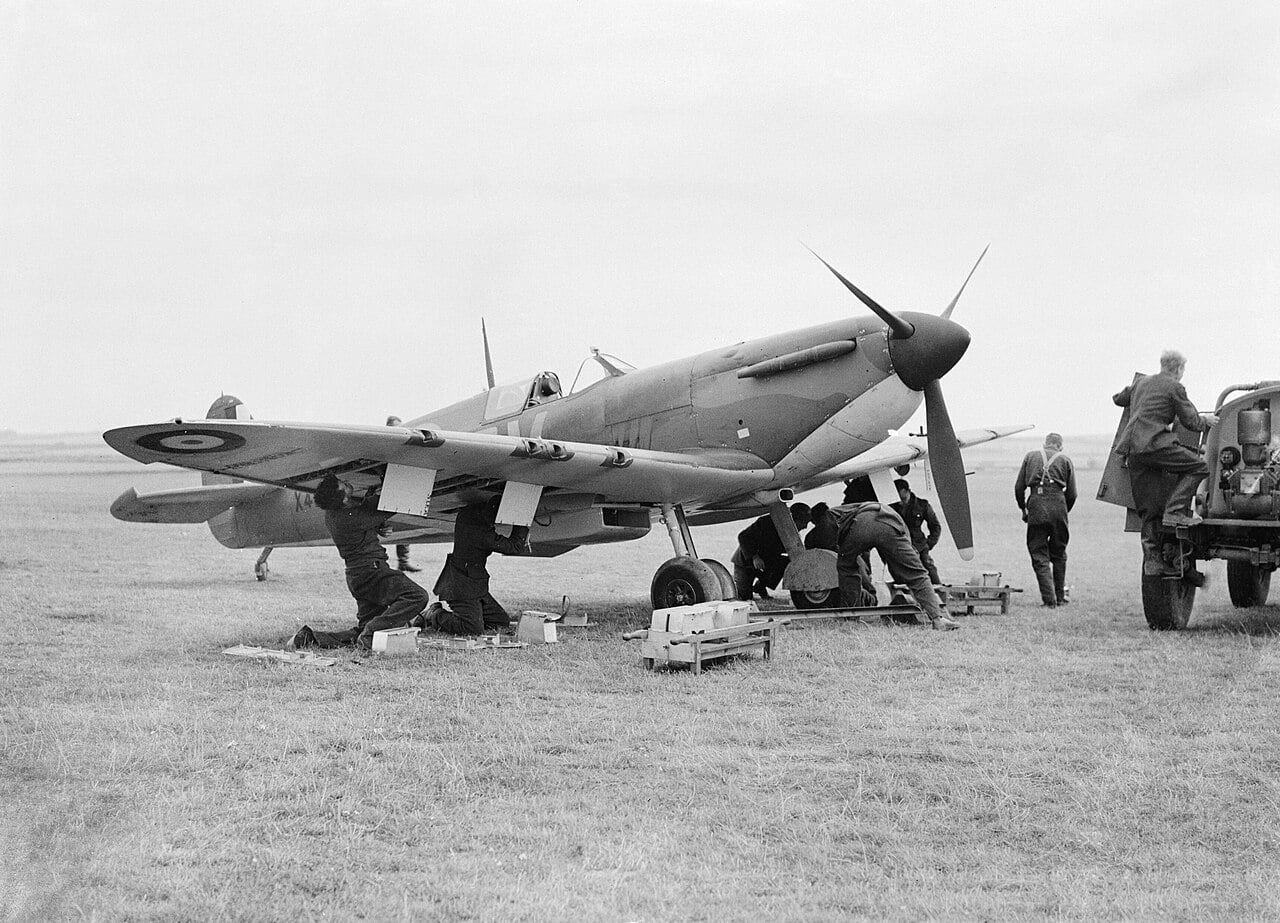
The two fighters involved, and how different they looked from a distance to a pilot who had never seen combat.
Period newsreel of the Hurricane entering RAF service. A year later, two of them were shot down by Spitfires over Essex.
Three seconds of fire
‘A’ Flight of 74 Squadron saw aircraft they took for German. Their commander, Adolph ‘Sailor’ Malan, is said to have given the order to engage. Byrne and Freeborn opened fire.
Malan later said he had called a last-minute warning, “friendly aircraft, break away”. If he did, neither of the two men who were shooting heard it.
Frank Rose was shot down and survived. Montague Hulton-Harrop was hit in the back of the head and was dead before his Hurricane came down at Manor Farm in Hintlesham, Suffolk. His aircraft has the grim distinction of being the first ever shot down by a Spitfire.
It could have been worse. Squadron Leader Edward Donaldson, commanding 151 Squadron, worked out what was happening, told his pilots the attackers were British and ordered them not to fire back.
The court martial nobody was allowed to hear
Byrne and Freeborn were court-martialled in camera at Bentley Priory, the headquarters of Fighter Command. The proceedings were closed, and the transcript has still not been released. Some records, including squadron operations record books and certain court documents, were only opened by the National Archives in 2019.
What is known is that it turned ugly. Malan gave evidence against his own pilots, describing Freeborn as irresponsible and impetuous and saying he had failed to heed vital communications. Freeborn’s counsel, Sir Patrick Hastings, called Malan a bare-faced liar to his face in court.
The court exonerated both pilots and recorded the whole thing as an unfortunate accident. Then it was buried. The RAF gave it a joke name, after a place several miles from where any of it happened, and moved on.
What the survivors did next
Almost everyone in this story went on to a remarkable war.
Sailor Malan became one of the most successful Allied fighter pilots of the conflict, with 27 victories, the DSO and bar and the DFC, rising to group captain. He returned to South Africa and spent the rest of his life campaigning against apartheid until his death in 1963.
Paddy Byrne was shot down and captured over France in 1940 and imprisoned at Stalag Luft III alongside Roger Bushell, who had been his defence lawyer at the court martial. In 1944 he was repatriated after convincing both the Germans and the repatriation board that he was insane. He was never allowed to fly operationally again.
Frank Rose, the pilot who survived being shot down, was killed in action over Vitry-en-Artois in France on 18 May 1940.
John Freeborn flew more operational hours in the Battle of Britain than any other pilot, won the DFC and bar, and finished the war a wing commander. He carried the other thing for seventy years.
The Hurricane and the Spitfire, the two aircraft that met over Essex on the wrong terms in September 1939.
There is a case that Barking Creek saved lives. It exposed how badly the radar chain, the identification procedures and the reporting system were integrated, and all three were substantially fixed before the summer of 1940. The Dowding System that won the Battle of Britain was built partly on the lessons of a morning when it did not work at all.
Montague Hulton-Harrop is buried under a war grave headstone at St Andrew’s Church in North Weald, a few minutes from the airfield he took off from.
Foire aux questions
What was the Battle of Barking Creek?
Who was the first RAF fighter pilot killed in the Second World War?
What caused the Battle of Barking Creek?
Were the pilots who opened fire punished?
Why is it called the Battle of Barking Creek?
Did anything good come out of the incident?
What happened to John Freeborn afterwards?
Sources: Hough and Richards, The Battle of Britain (1990); Bishop, Fighter Boys (2004); Cossey, A Tiger’s Tale (2002); Yeoman and Freeborn, Tiger Cub (2009); Kaplan, Sailor (2012); Terraine, The Right of the Line (1998); The National Archives; Commonwealth War Graves Commission; RAF Museum.
0 commentaire