
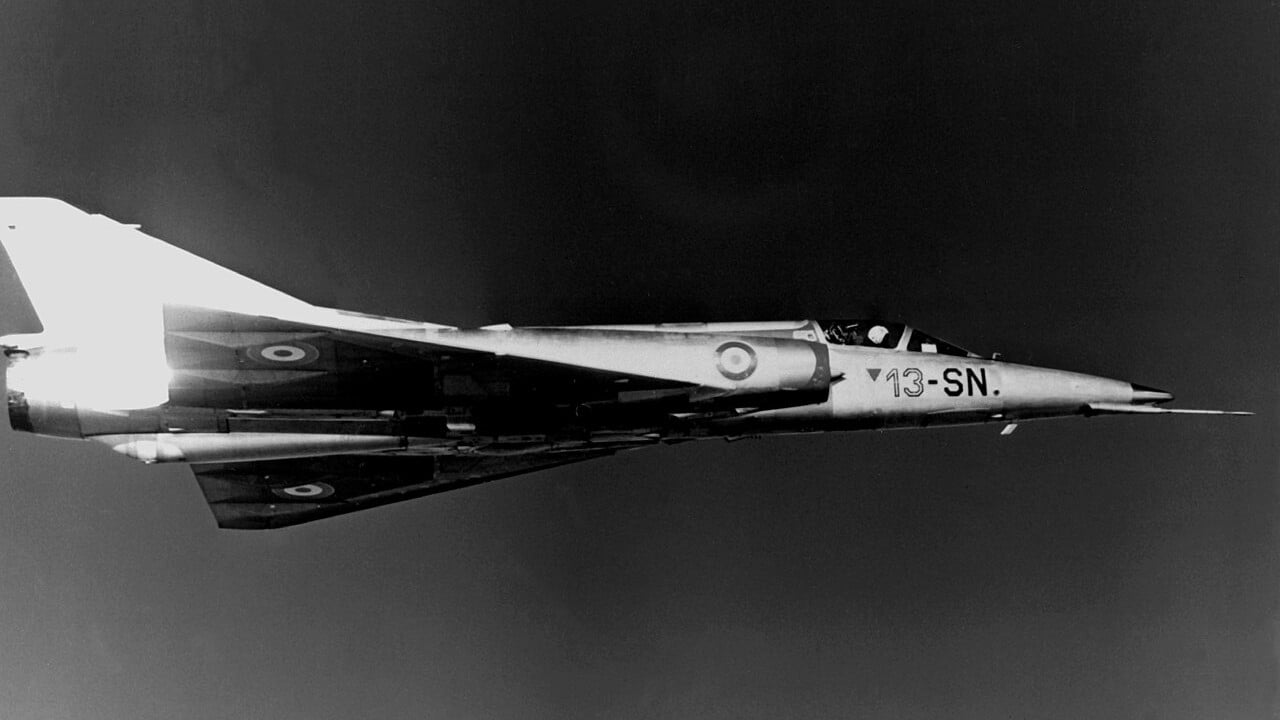
On 19 May 1967, test pilot Hervé Leprince-Ringuet took a new delta off the runway at Melun-Villaroche. From the outside it looked like a Mirage III with a slightly longer, slimmer nose. Inside, the radar was gone. The jet had been designed for one customer, Israel, and barely two weeks later that customer would be barred from receiving it.
That aircraft was the Dassault Mirage 5. It never flew for the air force that asked for it, yet it became, in Dassault’s own words, the company’s most widely exported combat aircraft. Its story runs from the Six-Day War to the Falklands, from Belgian factories to Pakistani night-attack squadrons, and it still flies today.
Informations clés
- Taper: Single-seat, single-engine delta ground-attack fighter derived from the Mirage IIIE
- Designed for: Israel (order for 50, 1966)
- Premier vol : 19 May 1967, Melun-Villaroche, Hervé Leprince-Ringuet
- Moteur: SNECMA Atar 9C afterburning turbojet
- Armement: Two 30 mm DEFA cannon; up to 4,000 kg of external stores
- Construit: 517 for 11 countries, according to Dassault
- Derivatives: Mirage 50, IAI Nesher, IAI Kfir
- Toujours en vol : Pakistan Air Force (ROSE upgrades)
A Mirage without a radar
The idea came from the Israeli Air Force, already a satisfied Mirage III operator. Middle Eastern skies are clear most of the year, and the Israelis wanted a cheaper, simpler ground-attack Mirage. Their suggestion was to take out the air-intercept radar and the avionics behind the cockpit, and fill the space with fuel.
Dassault’s technical department defined the aircraft on 9 July 1965 as a simplified Mirage IIIE for low-level tactical support. The nose now held navigation and attack equipment instead of a radar, more points were added for external loads, and the option of a booster rocket was deleted. Israel ordered 50 in 1966.
Like the IIIE, the Mirage 5 was a single-seat, single-engine delta powered by a SNECMA Atar 9C afterburning turbojet, with two 30 mm DEFA cannon. It could reach about 2,350 km/h at altitude and carry up to 4,000 kg of external stores. The extra fuel made it a longer-legged striker than the interceptor it came from.
Telling one from a Mirage III takes a trained eye. The nose is about half a metre longer and slimmer, and on most versions the pitot tube moved from the tip of the nose to underneath it. Without a radar to feed, the aircraft was also cheaper to buy and to maintain, which was exactly the point.
De Gaulle says no
History moved faster than the production line. On 3 June 1967, two days before the Six-Day War began, President Charles de Gaulle placed the Israeli Mirage 5s under embargo. The aircraft kept rolling out of the factory, and Israel kept paying for them, but they stayed in France. Dassault’s own history dates the embargo that finally ruled out delivery to January 1969.
Israel eventually gave up and accepted a refund. The 50 aircraft went to the Armée de l’Air instead as Mirage 5Fs. One of their units, Escadron de Chasse 3/13 at Colmar, won the Vulcan Trophy at an inter-allied tactical weapons contest in April 1976. The French Mirage III and 5 family left operational units in 1994.
Israel, meanwhile, built its own. Officially, Israel Aircraft Industries produced the IAI Nesher from complete Mirage 5 drawings; some accounts claim that France quietly supplied airframes in crates. Either way, the Nesher was a Mirage 5 in all but name, and it grew into the IAI Kfir. Afterburner told that side of the story in How an Embargo Made Israel Build Its Own Mirage.
Former Mirage 5 pilot Marcel De Petter talks about flying the type with the Aircrew Interview channel.
The export hit
What Israel could not have, everyone else could. The Mirage 5 sold to Abu Dhabi, Belgium, Colombia, Egypt, Gabon, Libya, Pakistan, Peru, Venezuela and Zaire, with France the eleventh country to fly it. Dassault counts 517 built for 11 nations. Customers chose their own equipment, so the “radarless” Mirage soon came in radar-equipped versions too, alongside the Mirage 5R for reconnaissance and the two-seat 5D.
The biggest order came from the Libyan Air Force, which signed for 110 aircraft in December 1969. Libya did not yet have enough pilots for them, and Egyptians trained on the type alongside Libyans. Egypt later bought its own and took about 101 in total, using them mainly as strike aircraft.
The aircraft also had a second life in South America through Israel. Between 1978 and 1980, Israel sold Neshers to the Argentine Air Force, where they were called Daggers and flew against the British in the Falklands War in 1982. The Mirage 50, with the more powerful Atar 9K50 engine, followed in the 1970s and went to Chile and Venezuela.
To help make good Argentina’s losses, Peru later transferred ten of its own Mirage 5Ps across the continent. In Africa, Gabon ordered Mirage 5s in 1975; they reached Libreville in 1980 as the country’s first fighters and were retired between 2006 and 2008.
Made in Belgium
Belgium ordered 106 Mirage 5s in 1968, and all but the first of each version were built under licence by SABCA, with components made at Haren near Brussels and final assembly at Gosselies, near Charleroi. FN built the Atar engines at Liège. The Belgian Air Force flew three versions: the 5BA for ground attack, the 5BR for reconnaissance and the 5BD two-seat trainer.
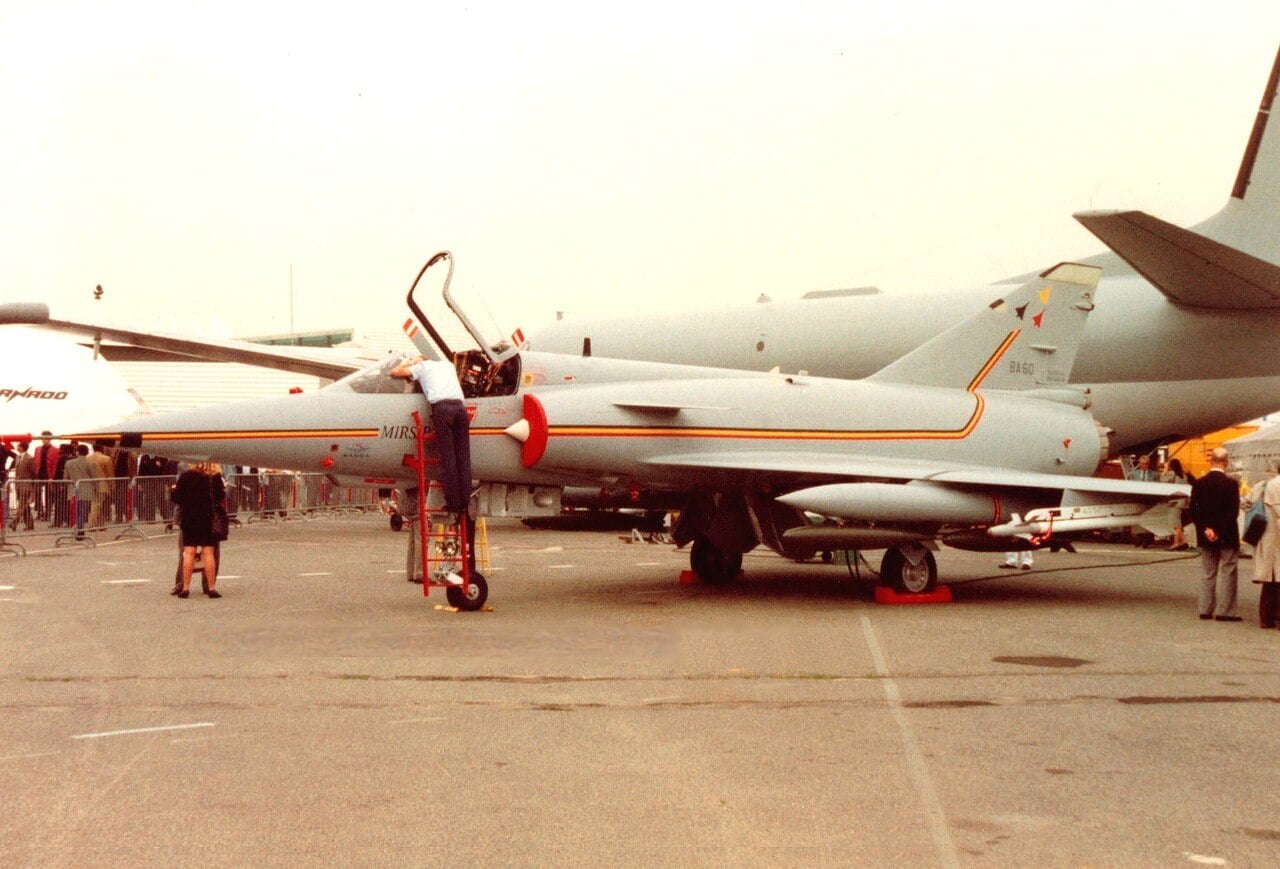
Belgian Mirages were fitted mostly with American avionics. During the 1991 Gulf War, 18 of them deployed to Turkey alongside German Alpha Jets and Italian F-104s to protect NATO’s southern flank. A late upgrade, MIRSIP, added canards, a new cockpit, a new ejection seat and a laser rangefinder to 20 jets, which Belgium then sold to Chile.
Still flying in Pakistan
Le Force aérienne pakistanaise bought its first Mirage 5s in 1970 and never stopped collecting them. It took second-hand airframes from retired fleets, including ex-French Mirage 5Fs, and rebuilt many under Project ROSE, adding modern cockpits, new navigation and attack systems and a forward-looking infrared sensor under the nose for night attack.
Not all of Pakistan’s Mirage 5s were pure bomb trucks. Later batches included Mirage 5PA3s with an Agave radar and AM39 Exocet anti-ship missiles, ordered to give the air force a maritime strike role in support of the navy. The radarless Mirage had come full circle.
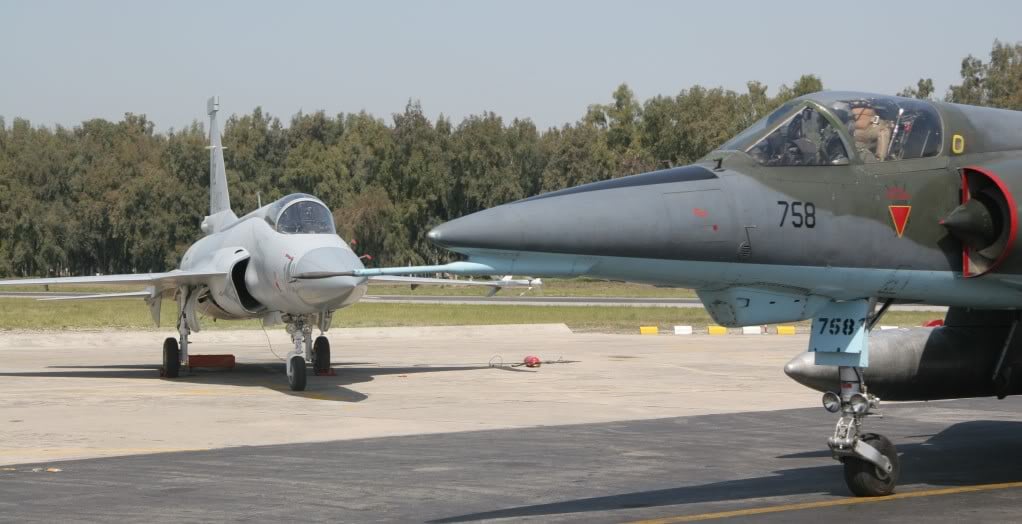
In February 2019, according to Pakistani accounts, Mirage 5PAs dropped H-4 glide bombs during Operation Swift Retort, guided by weapon systems officers in Mirage IIIs. By then the jets were sharing ramps with the JF-17 Thunder, which is gradually replacing them.
The Pakistan Air Force’s own film of its Mirage fleet, made for the Virtual Air Tattoo in 2021.
Almost six decades after Leprince-Ringuet’s first flight, the Mirage 5 is still on the flight line. Not bad for a jet whose first customer never took delivery of a single one.
Sources: Dassault Aviation (Mirage 5 history)
Header photo: U.S. armed forces photo / Wikimedia Commons, public domain
0 Comments