
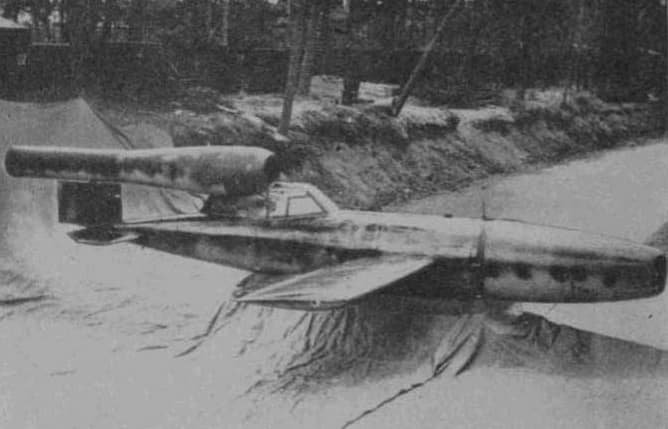
By 1944, Germany's bomber fleets were spent, and the V-1 flying bomb — the "buzz bomb" — was terrorising London with one glaring flaw: it could miss a target the size of Greater London entirely. Someone proposed a brutally simple fix for the accuracy problem. Put a pilot inside the bomb.
The result was the Fieseler Fi 103R "Reichenberg": a cruise missile with a human being in the nose, and almost no realistic way for that human being to survive the mission. It was, in effect, a German kamikaze — and the strangest thing about it is that it was never actually used.
Informations clés
| Aéronef | Fieseler Fi 103R "Reichenberg" (manned V-1) |
| Origine | Piloted version of the Fi 103 / V-1 flying bomb |
| But | A precisely guided flying bomb against point targets |
| Ogive | ~1,900 lb (almost a tonne) |
| Vitesse | ~450 mph at the attack run |
| Launch | Air-dropped from a Heinkel He 111 |
| Construit | ~175 converted by October 1944 |
| utilisation au combat | None — cancelled before deployment |
The accuracy problem
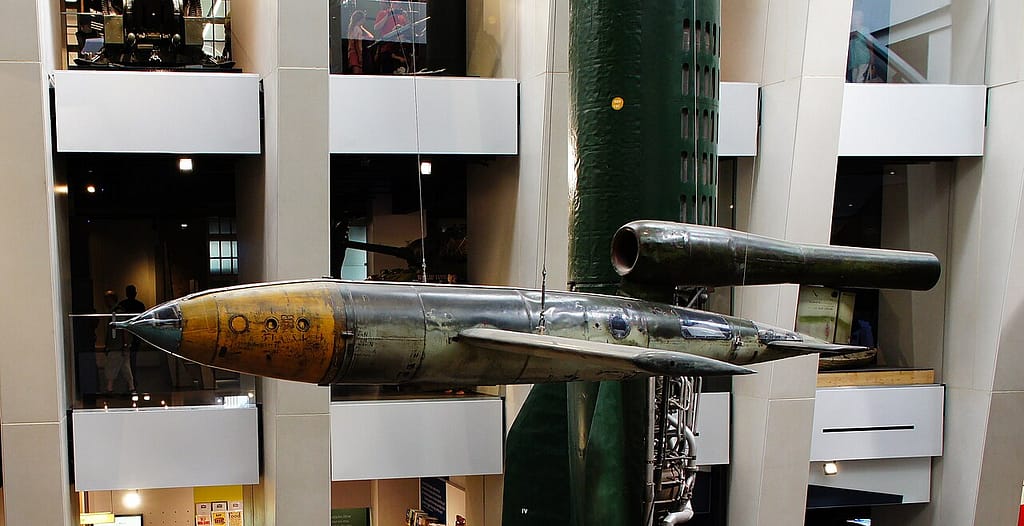
The V-1 flew on a simple gyro-and-timer guidance system: when its fuel ran out over roughly the right place, it fell. Against a sprawling city that was terrifying enough, but militarily useless against a bridge, a ship, or a single power station. A pilot could solve that — a human eye and hand to steer the bomb precisely onto a small, vital target. The idea traced back to SS commando Otto Skorzeny, who had been studying manned torpedoes.
From "self-sacrifice" to "Reichenberg"
The project was first, chillingly, named Selbstopfer — "self-sacrifice" — before being softened to the innocuous "Reichenberg." The unit that would fly it, a staffel of the secret Kampfgeschwader 200, took the name "Leonidas," after the Spartan king whose stand at Thermopylae was suicidal by design. Sixty pilots from KG 200 and thirty of Skorzeny's commandos volunteered.
The woman who flew it
The test pilot handed the job was Hanna Reitsch, already famous, already holder of the Iron Cross First Class, and one of the few people willing to fly a bomb. Air-launched from a Heinkel He 111 — a ramp launch was judged too dangerous — she flew the manned V-1 to a safe landing after a harrowing flight, diagnosing the stability problems that had made early bombs crash. Her fixes fed directly into the V-1 campaign. When the first two Reichenberg prototypes were lost on their maiden flights, she took over the trials herself.

A ticket with no return
Four variants were built — two unpowered gliding trainers, a powered trainer, and the operational Reichenberg IV. In the R-IV the pilot sat in a moulded bucket seat directly in front of the pulsejet, with a warhead of nearly a tonne ahead of him and the crudest possible instruments. A Heinkel He 111 carried it slung under a wing to within range of the target; because there was no way in once airborne, the pilot climbed aboard before takeoff.
Officially, it was not a suicide weapon — there was a "bail-out" procedure. In practice, that was a comforting fiction.
The weapon that was never used
By October 1944 around 175 flying bombs had been converted with cockpits and controls. That same month, command of KG 200 passed to Oberstleutnant Werner Baumbach, who had no faith in the project at all and said so. With manpower and materials running short, he judged it a waste of both — and the Reichenberg was quietly scrapped. It never flew a single operational mission.
Japan's rocket-powered Ohka, a near-identical concept, was used in earnest against Allied ships in 1945, with deadly results. Germany built its manned missile, trained its volunteers, and then — almost uniquely among the Reich's desperate late-war weapons — chose not to send men to certain death in it. The Reichenberg remains the cruise missile that history, for once, thought better of.
Sources: Warfare History Network (David Alan Johnson); Wikipedia; Megaprojects; Leonidas Squadron histories.

0 commentaire