
Seventy miles south of Hanoi, a steel bridge 540 feet long sat on a single concrete pier in the middle of the Song Ma river. It carried the only railway in the North Vietnamese panhandle, with a road lane on either side. Locals called it Ham Rong: the Dragon’s Jaw.
On 3 April 1965, American planners expected to drop it in an afternoon. Instead, the Thanh Hoa Bridge soaked up hundreds of bombs that day and the next, and kept standing for seven more years. Wave after wave of US Air Force and US Navy strikes went at it, and aircraft and crews were lost in the attempt.
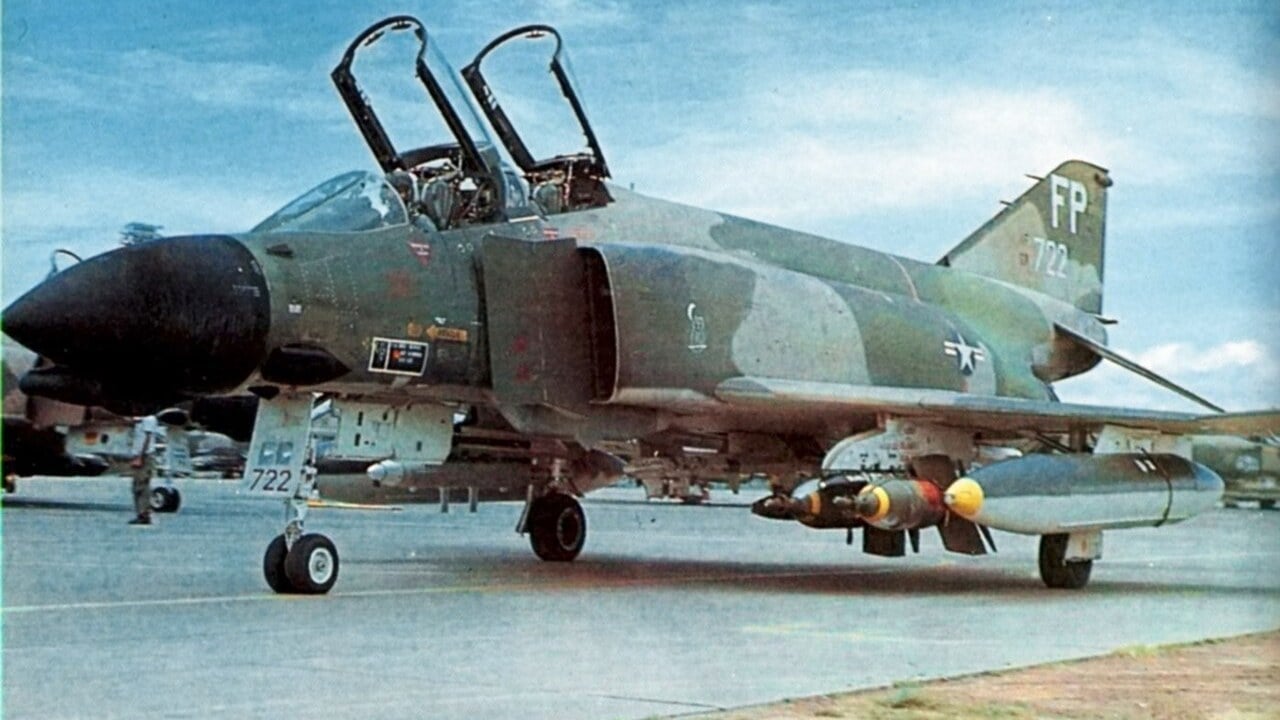
What finally broke the Dragon’s Jaw was not more bombs. It was better bombs. In 1972, F-4 Phantoms carrying laser-guided weapons did in a few strikes what more than 800 sorties before them had not, and in doing so they opened the age of precision air warfare.
Informations clés
- Cible: Thanh Hoa (Ham Rong) road and rail bridge over the Song Ma, about 70 miles south of Hanoi
- Surnom: The Dragon’s Jaw
- Structure : Steel truss, 540 ft long and 56 ft wide, on a 16 ft concrete centre pier; opened 1964
- Première frappe : 3 April 1965: almost 80 aircraft led by Lt Col Robinson Risner, including 46 F-105s
- Campaign: More than 870 US sorties, 1965 to 1972; officially 11 US aircraft lost
- Breakthrough: 13 May 1972: 14 F-4 Phantoms of the 8th TFW with laser-guided bombs knock the western span off its abutment
- Final blow: 6 October 1972: four US Navy A-7s from USS America break the bridge in half
- Aujourd'hui: Rebuilt after the war and still in use
A bridge built to survive
The French built the first bridge here. In 1945 the Viet Minh destroyed it by exploding two trains loaded with explosives on the span. Reconstruction began in 1957, and Ho Chi Minh opened the new bridge in 1964: a steel through-truss structure 56 feet wide, riding about 50 feet above the water.
It was massively overbuilt. The centre pier was a reinforced concrete column 16 feet in diameter, and the abutments were anchored in hills on both banks. Supplies flowed across it towards the Ho Chi Minh Trail and the war in the South, so Hanoi defended it accordingly, eventually ringing it with five air defence regiments of anti-aircraft guns.
When Operation Rolling Thunder began in March 1965, the US Joint Chiefs of Staff rated the bridge the 14th most important target in North Vietnam. It was picked for early attack.
Two days in April 1965
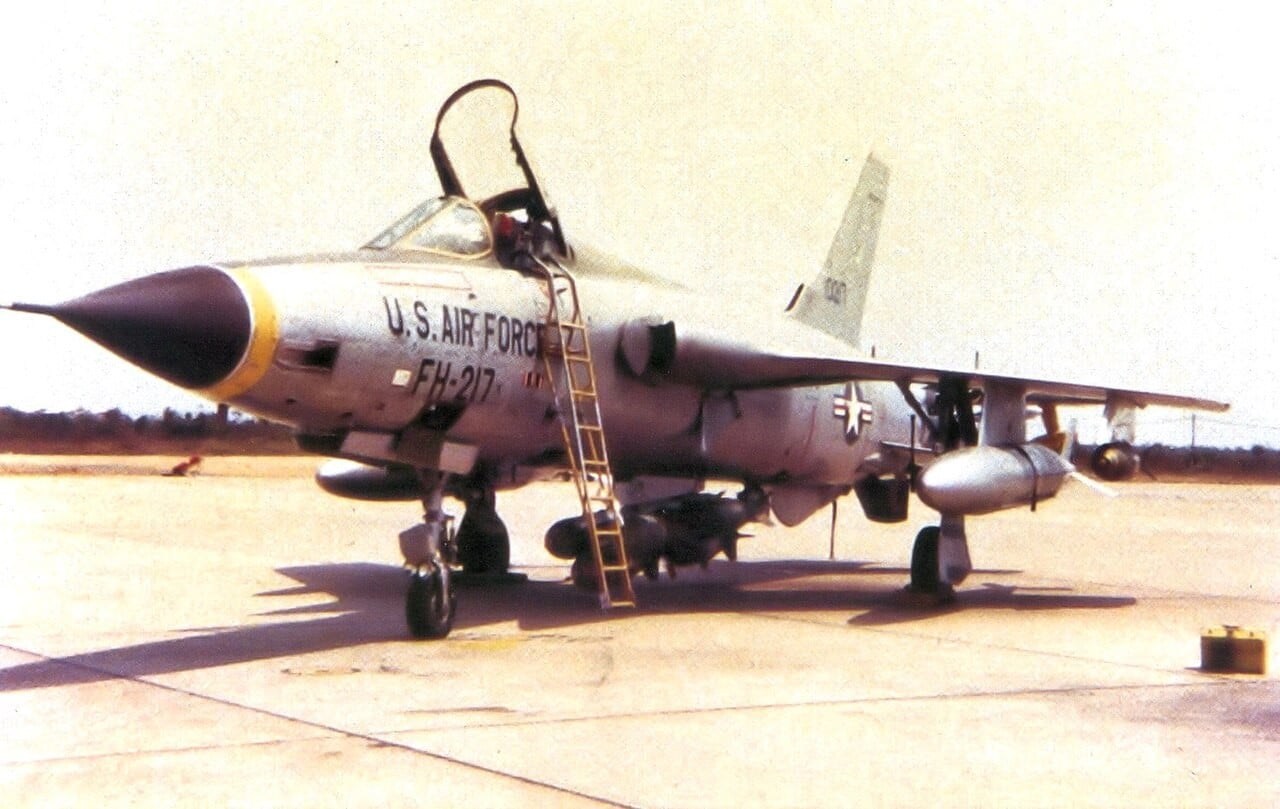
The first strike, on 3 April 1965, was led by Lieutenant Colonel Robinson Risner, a Korean War ace commanding the 67th Tactical Fighter Squadron at Korat in Thailand. His package numbered almost 80 aircraft: 46 F-105 Thunderchiefs, 21 F-100 Super Sabres, two RF-101 reconnaissance jets and ten tankers.
Sixteen of the F-105s carried a pair of AGM-12 Bullpup missiles, an early guided weapon the pilot steered by radio with a small joystick. The rest carried 750-pound bombs. The Bullpups hit, but their 250-pound warheads did little more than char the steel. One pilot said they simply bounced off.
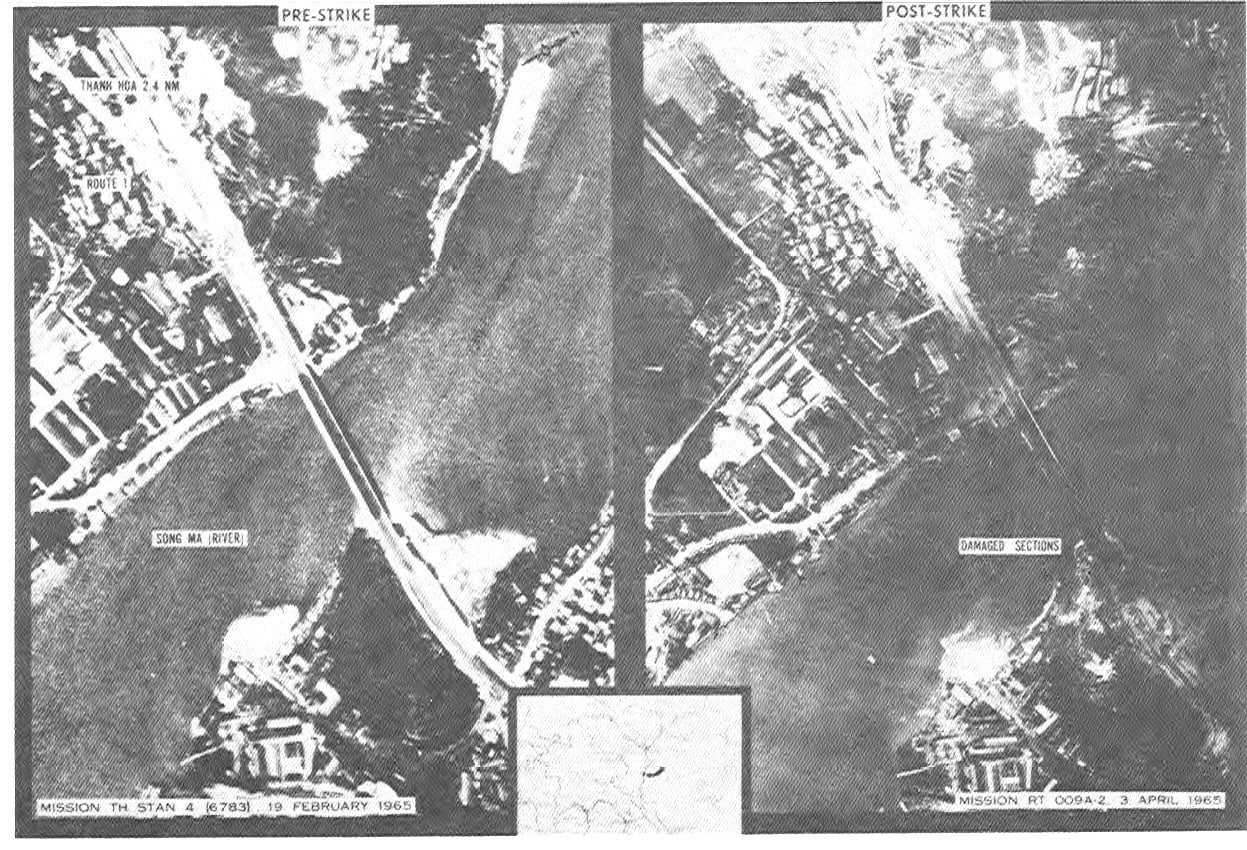
An F-100 and an RF-101 were shot down, and Risner nursed his damaged Thunderchief back to Da Nang. The next day he went back with 48 F-105s carrying only bombs. Some 300 bombs struck the bridge. Traffic stopped for a while. The bridge did not fall.
Worse, a handful of subsonic MiG-17 of the North Vietnamese air force slipped past the escorts and shot down two bomb-laden F-105s, the MiG-17’s first kills of the war. Another Thunderchief pilot, Captain Carlyle “Smitty” Harris, was brought down near the bridge and spent the rest of the war as a prisoner in Hanoi.
Archival footage of a 1965 Rolling Thunder attack on the Thanh Hoa Bridge, including a Bullpup missile striking the span.
Risner received the Air Force Cross for the two missions and appeared on the cover of Temps that month. On 16 September 1965 he was shot down again, this time about ten miles from the Thanh Hoa Bridge, and spent more than seven years as a prisoner of war.
The most heavily defended target on earth
From November 1965, the Route Package system handed the Thanh Hoa area to the Marine américaine. For three years, carrier aircraft including A-4 Skyhawks, A-6 Intruders, F-8 Crusaders and Phantoms struck the bridge again and again, with iron bombs and later the TV-guided Walleye. They closed it for days at a time. Repair crews reopened it every time.
The Navy pilots developed a dark humour about it. “We thought of calling Hanoi,” one later joked, “and saying we’d push three A-4s overboard if they would just blow up that damn bridge!”
The problem was simple arithmetic. The bridge was overbuilt and the bombs were too small and too inaccurate. Only 11 miles from the sea, the target was often hidden by bad weather, which gave the defenders time to repair and strengthen it while more guns flowed into the area.
Carolina Moon
In 1966 the Air Force tried something radical. Engineers at Eglin produced a 5,000-pound “mass-focus” weapon shaped like a giant pancake, meant to be parachuted into the river upstream, float down to the bridge, and detonate magnetically beneath it. Only a C-130 Hercules could carry it, so the drops had to be made at night and at very low level.
On the night of 30 May 1966, Major Richard Remers’ crew flew up the Song Ma at about 400 feet and dropped five weapons. Reconnaissance the next morning found the bridge intact. The following night, Major Thomas Case’s C-130 took off for the second drop and was never heard from again. A diversionary F-4 was also lost. It was later learned that four of the first five mines had exploded under the bridge without doing serious damage.
When President Johnson halted the bombing of North Vietnam on 31 October 1968, the Dragon’s Jaw was still standing. Officially, the US lost 11 aircraft on strikes against it, and many more were shot down in the heavily defended area around it.
The smart bomb arrives
Back home, the answer was taking shape at Eglin and Texas Instruments: a bolt-on kit that turned an ordinary bomb into a laser-guided one. One aircraft held a laser spot on the target, and the bomb’s seeker steered it into the reflected energy. The Air Force called it Paveway and combat-tested it in 1968 with the 8th Tactical Fighter Wing at Ubon, Thailand.
AP Archive: 1972 US Defense Department footage of laser-guided bombs hitting a railway bridge, an airfield and a power plant in North Vietnam.
The 1968 bombing halt meant the new weapons spent four years over South Vietnam and Laos. Then, in March 1972, North Vietnam launched its Easter Offensive, and the bombing of the North resumed under Operation Linebacker. The Dragon’s Jaw went back on the list.
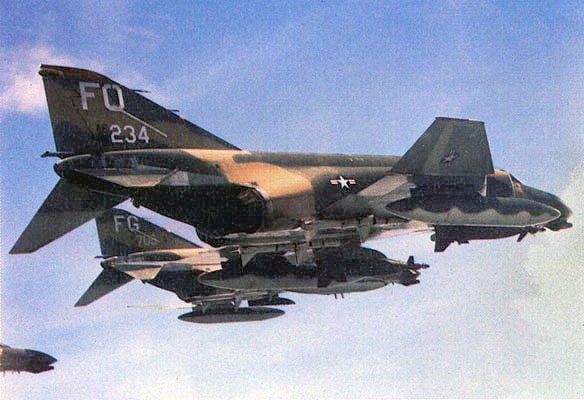
On 27 April 1972, 8th Wing F-4 Phantoms from Ubon attacked with laser- and TV-guided bombs. Low cloud got in the way of the lasers, and the bridge was damaged but not finished. On 13 May the weather cleared. Fourteen Phantoms came back with 2,000-pound and 3,000-pound laser-guided bombs, and the western span was knocked clean off its abutment.
Breaking the Jaw
North Vietnamese crews went straight to work on repairs, so the Navy delivered the last blow. On 6 October 1972, four A-7 Corsair IIs from the carrier USS America attacked, two with improved Walleyes and two with 2,000-pound Mk 84 bombs. They hit the centre pier and broke the bridge in half. It was removed from the target list.
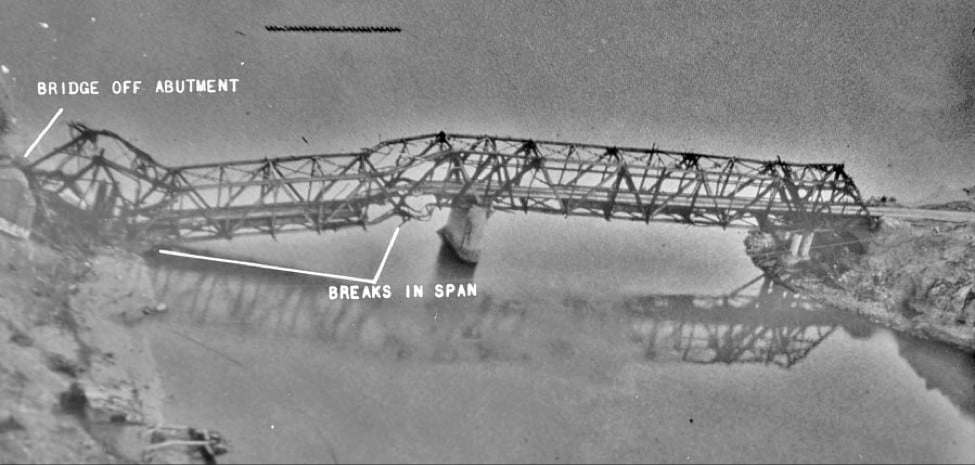
The scorecard spoke for itself. Over seven years, more than 870 sorties of unguided bombs and early missiles had failed to keep the bridge down for long. A few dozen laser-guided bombs did it in two strikes. Across the Linebacker campaign, precision weapons destroyed bridges by the score, and the lesson carried straight through to the Gulf War in 1991.
Authors Stephen Coonts and Barrett Tillman discuss their book Dragon’s Jaw and the seven-year battle for the Thanh Hoa Bridge.
The Vietnamese rebuilt the Dragon’s Jaw after the war, and it still carries traffic across the Song Ma today. It stands as a monument to the gunners who defended it, to the American crews who never came home from it, and to the moment air power stopped carpeting targets and started hitting them.
Sources: Wikipedia (Thanh Hoa Bridge; Robinson Risner), Air & Space Forces Magazine (Walter J. Boyne, “Breaking the Dragon’s Jaw”; John T. Correll, “The Emergence of Smart Bombs”), HistoryNet, AP Archive
0 Comments