
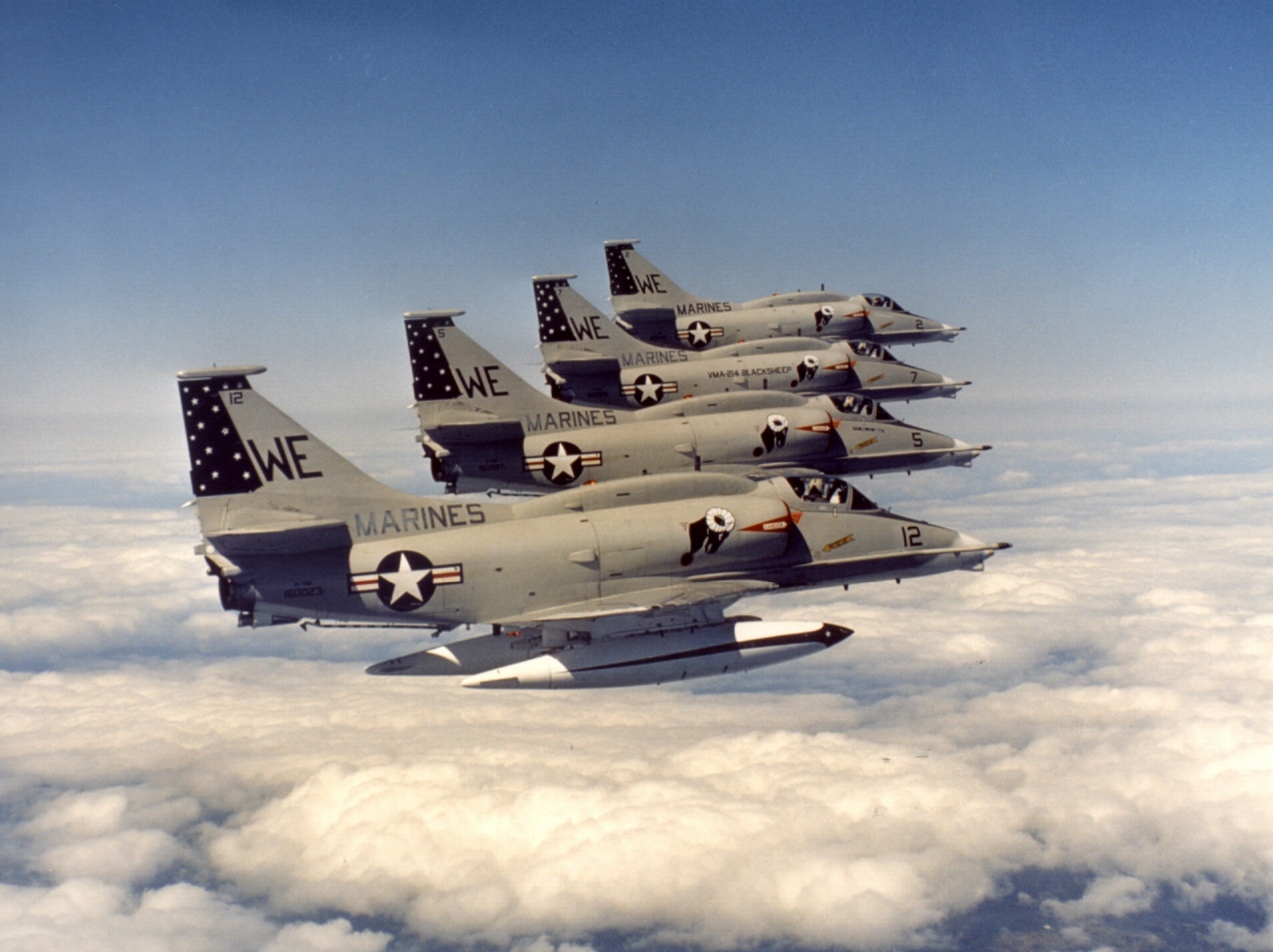
Douglas A-4 Skyhawk
“Heinemann’s Hot Rod”
The tiny carrier attack jet that came in at half the Navy’s weight limit — a delta-winged “Scooter” that flew for over half a century, from Vietnam to the Falklands, and never needed its wings to fold.
The little jet that beat its own spec
In the early 1950s the US Navy wanted a jet attack aircraft and set a ceiling: no more than 30,000 lb at takeoff. Douglas’s chief designer Ed Heinemann looked at the number and decided it was far too generous. He and his El Segundo team promised the Navy the range and payload it asked for in an aircraft weighing less than half the limit — and 90 knots faster. The prototype rolled out at an empty weight of just 7,896 lb.
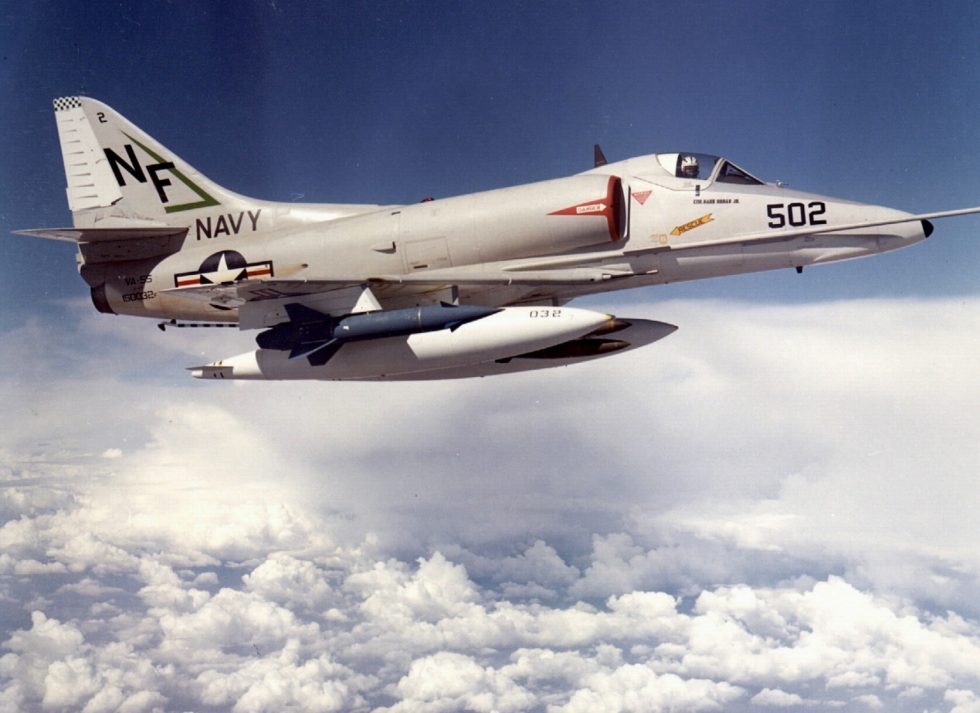
The result, first flown on 22 June 1954 and in fleet service by 1956, was a masterpiece of ruthless simplicity. Its modified-delta wing was so compact (~27.5 ft span) that it did not need to fold for carrier stowage — a first for a US Navy jet and a saving of some 200 lb of hinges and hydraulics. Pilots nicknamed the nimble little machine the “Scooter,” and the press dubbed Heinemann’s creation the “Hot Rod.”
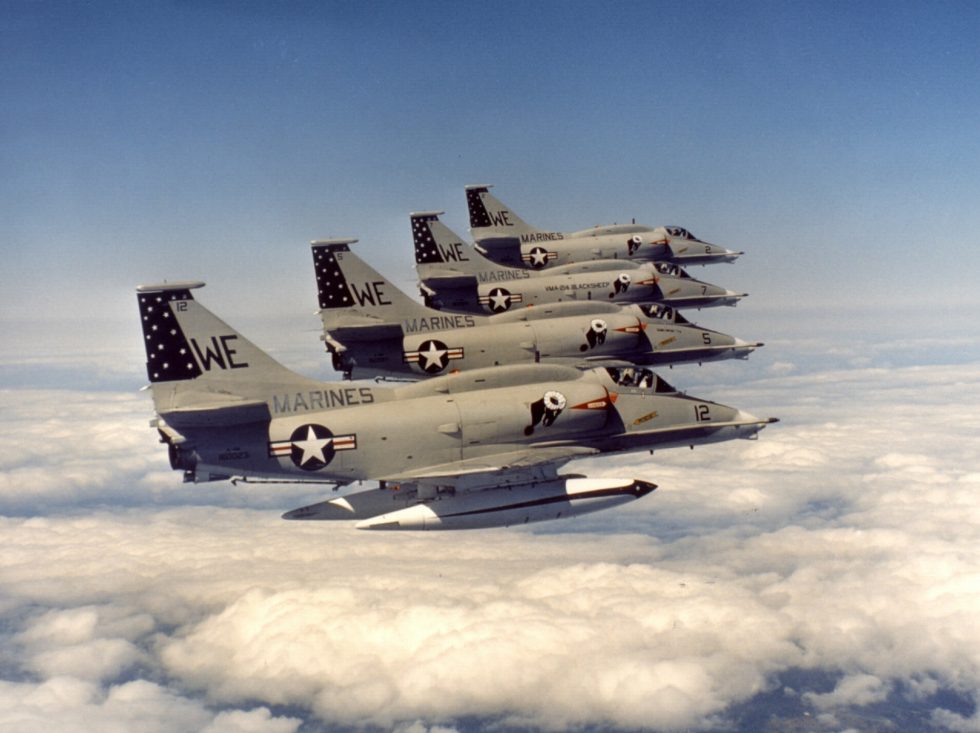
Small did not mean slight. The A-4 was designed from the start to loft-deliver a nuclear bomb, and it could haul a large conventional load on five hardpoints. It became the US Navy and Marine light-attack workhorse over Vietnam, equipped the Blue Angels, taught fighter pilots as a TOPGUN aggressor, and went to war for Israel, Argentina and Kuwait. Production ran an extraordinary 25 years to ~2,960 aircraft, and the type served on somewhere for more than 70 years.
01How Ed Heinemann built the A-4 Skyhawk at half the Navy’s weight limit
Heinemann treated every pound as the enemy. He deleted the wing-fold mechanism by making the wing small enough to fit carrier hangars as-is; he consolidated the avionics into a single package to save wiring and weight; he redesigned the ejection seat with roughly a third fewer parts; and he kept the structure and systems as simple as the mission allowed. The payoff was an attack jet that was cheap to build, easy to maintain, hard to break and delightful to fly.
The Navy’s specification had allowed 30,000 lb. The XA4D-1 prototype came in at an empty weight under 8,000 lb and a design gross weight far below the ceiling — while still meeting the range and payload the Navy demanded. It was one of the purest expressions of the idea that the best part is no part, and it defined a career that outlasted almost every contemporary.
What makes the A-4 Skyhawk special
Minimalism as a weapon
Heinemann’s philosophy was subtraction. By making the wing small enough to skip the fold, packaging the avionics tightly and simplifying every system, he produced an attack jet at roughly half the Navy’s 30,000 lb weight ceiling. Light meant cheap, rugged, agile and easy to maintain — the qualities that kept the “Scooter” in service for decades.
Delta wing, growing engine
The compact modified-delta wing gave good load-carrying and honest handling without needing to fold. Early A-4s (A/B/C) used the Wright J65 turbojet; from the A-4E onward the aircraft switched to the more powerful Pratt & Whitney J52, reaching about 11,200 lbf in the A-4M. Singapore later re-engined its fleet with a modern F404 turbofan.
A heavyweight punch for a featherweight
Despite its size the Skyhawk was built as a nuclear striker, designed to toss an early tactical bomb clear using LABS loft-bombing, and later cleared for weapons such as the B43/B57/B61. Conventionally it carried up to roughly 4,500 kg (~9,900 lb) of ordnance plus two 20 mm cannon — a remarkable load for so small an airframe.
02The A-4 Skyhawk’s wing: why it never needed to fold
Every other US Navy jet of its era folded its wings to fit the crowded carrier hangar deck. The Skyhawk did not. Heinemann sized the delta wing at about 27.5 ft span — small enough to strike below and park without any folding joint at all. Deleting that mechanism saved an estimated 200 lb of structure, hydraulics and maintenance, and removed a common source of failures. It became the aircraft’s signature trait and a neat symbol of the whole design: solve the problem by removing weight, not adding it.
03The A-4 Skyhawk as a nuclear bomber: LABS and the toss
Behind the modest “light attack” label, the A-4 was conceived as a carrier-based tactical nuclear delivery aircraft. Using the Low-Altitude Bombing System (LABS), a lone Skyhawk would sprint in at low level, pull up into a climbing arc and release its weapon so that it was “tossed” forward onto the target while the aircraft rolled and dived away to escape the blast. Early on it carried weapons such as the Mark 7 and Mark 12; later variants were cleared for the B43, B57 and B61. The mission shaped the airframe — small, fast at low level and long-legged for its size.
Full specifications — A-4M Skyhawk II
Baseline note: the figures below describe the Douglas A-4M Skyhawk II as delivered to the United States Marine Corps between 1970 and February 1979 — the last, heaviest and most powerful mark, with a single Pratt & Whitney J52-P-408A turbojet of 11,200 lbf, an enlarged canopy, a braking parachute and, on later aircraft, the Hughes AN/ASB-19 Angle Rate Bombing System in a lengthened nose. It is the right baseline because it is the end point of the design argument: the aeroplane Ed Heinemann drew to weigh half of what the Navy asked for, twenty-five years later, still weighing half of what the Navy asked for, and still in production. Deltas for the A-4A/B/C with the Wright J65, the A-4E/F, the two-seat TA-4J, the Israeli A-4H/N and the Argentine A-4AR Fightinghawk are in grey. Seven cautions before any number here is used. First and most important: the A-4M is not the Skyhawk that fought in Vietnam. The aeroplanes that flew the Navy’s light-attack war from 1964 to 1973 were A-4Cs and A-4Es with 8,500 lbf and no head-up display; the A-4M entered squadron service in 1971 with the Marine Corps and never flew a combat mission over Vietnam. A table that puts A-4M thrust next to A-4C avionics describes an aeroplane that never existed. Second: the family contains a complete engine change. The A-4A, A-4B and A-4C used the Wright J65, an American-built Armstrong Siddeley Sapphire of 7,700 lbf; the Pratt & Whitney J52 arrives only with the A-4E in 1962. Roughly 1,350 of the 2,960 Skyhawks built — nearly half — had the wrong engine for every J52 figure on this page. This is the single largest discontinuity in the type and it is routinely elided in online compilations. Third: length depends on the mark and on the nose. 12.22 m (40 ft 3 in) is the A-4E/F figure; 12.57 m (41 ft 3 in) is the A-4M with the ARBS nose; the Singaporean A-4SU and the Argentine A-4AR differ again. A commonly reproduced specification table gives 40 ft 1.5 in for an A-4E. Nobody is lying; they are measuring different aeroplanes. Fourth: wingspan is 8.38 m on every single mark ever built, and 8.38 m is 27 ft 6 in. A number of reference sites and mirrors print "26 ft 6 in (8.38 m)", which is an arithmetic error propagated by copying, not a variant. Fifth: maximum external load is quoted at 8,200 lb, 8,500 lb, 9,155 lb and 10,000 lb by different authorities. All are pylon-rating arithmetic. No Skyhawk ever left a catapult with ten thousand pounds hanging on it, and with maximum ordnance the internal fuel had to come out. Sixth: rate of climb. 8,440 ft/min is the well-attested A-4F figure; the Marine Corps museum publishes 13,500 ft/min for the A-4M, which is a clean aeroplane at light weight and should not be read as an operational number. Seventh: production. 2,960 airframes to February 1979, of which 555 were two-seaters, is the agreed total; the A-4M count is given as 158 in several standard references and 160 by both the Flying Leathernecks and Prairie Aviation museums, and the discrepancy is almost certainly whether the two prototype conversions are counted.
Dimensions & weights
- Crew
- 1 — and the single seat is the whole design. Heinemann’s team removed everything that could be argued away: a second crewman, a wing fold, a radar in the early marks, redundant systems. The TA-4F and TA-4J trainers added a second cockpit by inserting a 0.71 m (28 in) plug in the forward fuselage and stretching the aeroplane to 12.98 m (42 ft 7 in), and cost about 500 lb of internal fuel to do it
- Length overall
- 12.57 m (41 ft 3 in) for the A-4M with the ARBS nose. Earlier and non-ARBS marks are 12.22 m (40 ft 3 in); the A-4E is sometimes given as 12.23 m (40 ft 1.5 in). The two-seaters are 12.98 m (42 ft 7 in). Length is the one dimension on this aeroplane that genuinely moved
- Wingspan
- 8.38 m (27 ft 6 in) — identical on every mark from the 1954 prototype to the last aircraft delivered in February 1979. Beware the widely mirrored "26 ft 6 in", which is simply a bad conversion of the same 8.38 m
- Wing folding
- None. The wing does not fold. This is the most quoted fact about the Skyhawk and it deserves its reputation. A carrier aeroplane whose span is under the deck-edge lift limit needs no hinges, no locks, no hydraulics and no inspection schedule for any of them, and Douglas costed the saving at about 91 kg (200 lb). The wing was also built as a single one-piece multi-spar structure passing straight through the fuselage, which is why Skyhawk wings are famously long-lived and why forty-year-old airframes were still worth rebuilding in the 1990s
- Height
- 4.57 m (15 ft 0 in); 14 ft 11 in appears in museum data plates for individual airframes. Low enough to matter on a crowded hangar deck, and low enough that a Skyhawk could be worked on from a standard maintenance stand rather than a gantry
- Wing area
- 24.15 m² (260 sq ft; 259 sq ft in some tables). A modified delta — a cropped, low-aspect-ratio wing swept 33° at quarter chord, with leading-edge slats that deployed by aerodynamic force alone with no actuator, no switch and no pilot action. The slats are a Heinemann economy in the purest form: the aeroplane does the work instead of a system
- Aspect ratio
- 2.91 — very low, which is what makes the Skyhawk a rolling aeroplane rather than a turning one. Roll rate at low level was ferocious, sustained turn was not, and every Skyhawk pilot learned to fight in the vertical and in roll rather than trying to out-circle anything
- Empty weight
- 4,747 kg (10,465 lb) for the A-4M. The A-4E/F is 4,750 kg (10,450 lb) — effectively identical, despite twenty years and several hundred pounds of added avionics, because Douglas kept taking weight out as fast as the Navy put it in. The XA4D-1 prototype came in at about 3,400 kg (7,500 lb) empty
- Normal gross weight
- 8,318 kg (18,300 lb) in the typical clean-plus-fuel condition usually tabulated for the A-4F. A useful reference point: this is a fully fuelled combat aeroplane weighing less than an empty F-4 Phantom II
- Maximum take-off weight
- 11,113 kg (24,500 lb). The Navy’s 1952 specification asked for 30,000 lb. Heinemann delivered an aeroplane whose absolute maximum, tanks and bombs and all, was under 25,000 lb, and whose normal loaded weight was well under 20,000 lb. That is the entire story of the type in one row
- Internal fuel
- ~3,030 litres (800 US gal), in one fuselage cell and integral wing tanks. External capacity ran to a 400 US gal centreline tank and two or four 300 US gal wing tanks; a maximum ferry fit was three tanks and nothing else. The trainers gave up roughly 500 lb of internal fuel to the second cockpit
- Maximum external stores
- ~4,150 kg (9,155 lb) across five stations for the A-4M — one centreline rated at about 3,500 lb, two inboard wing at about 2,250 lb each and two outboard at about 1,000 lb each. Published maxima for the family range from 8,200 lb to 10,000 lb. All of these are the sum of the pylon ratings; the operational limit was the catapult, the fuel state and the runway
- Wing loading
- 305 kg/m² (62.4 lb/sq ft) at gross weight. High for a 1950s attack aeroplane, and deliberately so: it bought a stable, hard-riding platform at 500 kt and 200 ft that did not get thrown about by low-level turbulence, at the cost of a fast, unforgiving approach that had to be flown exactly on speed
Performance
- Maximum speed, sea level
- 1,102 km/h (595 kt, 685 mph) clean for the A-4M; 1,083 km/h (585 kt, 673 mph) for the J52-P-8A marks. No Skyhawk of any mark was supersonic in level flight, and no Skyhawk needed to be. It could go supersonic in a dive, and Blue Angels solo pilots did so deliberately for the crowd
- Maximum speed, loaded
- Roughly 900 km/h (485 kt) with a war load on all five stations, and considerably less with tanks. The Argentine A-4Bs that crossed 400 nautical miles of the South Atlantic in 1982 were flying at maximum continuous and had fuel for a single pass
- Cruise speed
- 805 km/h (435 kt, 500 mph) at altitude in the usual tabulation. The Skyhawk was economical to cruise and thirsty to fight, which is the normal shape of a small single-engined jet and which is why every Skyhawk mission from the A-4B onwards was planned around the refuelling probe
- Initial rate of climb
- 68.6 m/s (13,500 ft/min) as published by the Flying Leathernecks Aviation Museum for a clean A-4M at combat weight. The well-attested A-4F figure is 42.9 m/s (8,440 ft/min) and the A-4E figure 29.2 m/s (5,750 ft/min). The J52-P-408A gave the Marine aeroplane about 20 per cent more thrust than the A-4F for a one per cent weight penalty, which is where the difference comes from
- Service ceiling
- 12,880 m (42,250 ft) in the standard tables; the Marine Corps museum publishes 13,500 m (44,300 ft) for the A-4M and 14,080 m (46,200 ft) as a combat ceiling. None of this mattered much: the Skyhawk was an aeroplane that worked between the deck and 15,000 ft and spent most of its operational life well below the lower end of that
- Combat radius
- ~555 km (300 nmi) on a hi-lo-hi profile with a useful bomb load and no external tanks; ~1,000 km (540 nmi) with tanks and a lighter load. Radius is the number that killed Argentine pilots in 1982 — from Río Gallegos and San Julián the Falklands sat at the absolute end of an A-4B’s reach, with tanker support that was never sufficient and a fuel margin measured in single-digit minutes over the target
- Combat range
- 1,770 km (955 nmi) for the A-4M as published; 1,867 km (1,008 nmi) appears for the A-4E. Both are specific profiles with specific loads and neither is a general-purpose figure
- Ferry range
- 4,063 km (2,194 nmi, 2,525 miles) with maximum external tankage and no weapons. Skyhawks were ferried across the Atlantic and the Pacific on their own wheels, probe-and-drogue all the way, which for a single-engined single-seat aeroplane over open water was an act of some faith
- Approach speed
- Roughly 250 km/h (135 kt) at typical landing weight, flown to an angle-of-attack indexer rather than to an airspeed. The Skyhawk had a reputation as an honest but wholly unforgiving aeroplane in the groove: small, light, with a high wing loading and a delta’s drag rise if allowed to get slow, and it would sink alarmingly if a pilot let the nose come up
- g limits
- +8 / −3 — genuinely high for an attack aeroplane, and a straightforward consequence of the one-piece wing. Skyhawks were used as dissimilar air-combat adversaries from the early 1970s precisely because they could be pulled hard, day after day, without eating their fatigue life
- Thrust-to-weight
- 0.526 at gross weight for the J52-P-6A A-4E; about 0.60 for the A-4M at the same weight. Modest by fighter standards, entirely adequate for the mission, and the reason the Singaporean A-4SU rebuild with a non-afterburning General Electric F404 — some 40 per cent more thrust — produced an aeroplane that startled everybody who flew it
- Deck operation
- Catapult launch and arrested recovery from every US carrier from the Essex class upward — and the Essex-class point is important. The Skyhawk was small enough and light enough to operate from the Second World War-era decks that could not take an A-6 or an F-4, which is why Oriskany, Bon Homme Richard, Hancock and Intrepid were able to fight a modern air war at all. Land-based operators flew it from short strips with a braking parachute (standard on the A-4M and the Israeli marks)
Propulsion & systems
- Engine
- 1 × Pratt & Whitney J52-P-408A axial-flow turbojet — twin-spool, with a five-stage low-pressure and seven-stage high-pressure compressor, no afterburner and no variable geometry. The A-4E introduced the J52-P-6A, the A-4F the J52-P-8A, and the A-4M the P-408A. The A-4A, A-4B and A-4C used the Wright J65 instead, an American-built Armstrong Siddeley Sapphire
- Rated thrust
- 50.0 kN (11,200 lbf) dry. For comparison: J52-P-8A 41.4 kN (9,300 lbf); J52-P-6A 37.8 kN (8,500 lbf); Wright J65-W-16A 34.3 kN (7,700 lbf) in the A-4B and A-4C. Douglas noted that the P-408 gave twenty per cent more thrust than the P-8A for one per cent more weight and no increase in fuel consumption, which is about as good a bargain as an airframer ever gets offered
- Specific fuel consumption
- 0.79 lb/(lbf·h) at maximum rating. A plain turbojet of 1950s architecture, and by the 1970s an anachronism — the reason Singapore’s A-4SU re-engining with the F404 turbofan transformed both the performance and the radius of an otherwise identical airframe
- Air-refuelling
- Fixed probe on the starboard side of the nose, from the A-4B onward — retro-fitted to surviving A-4As. The Skyhawk was also the fleet’s own tanker: with a D-704 buddy store on the centreline an A-4 could refuel other A-4s, and for years the tanker on the deck was simply another Skyhawk. Argentine A-4Bs in 1982 depended entirely on two elderly KC-130H Hercules for their tanking, and the arithmetic never worked comfortably
- Flight controls
- Conventional hydraulically boosted ailerons, elevators and rudder with manual reversion, plus split flaps and fully automatic leading-edge slats. There is no autopilot on the early marks and no fly-by-wire on any of them. The Skyhawk is a cable-and-pushrod aeroplane in an era of increasingly electronic ones, and its serviceability rates showed it
- Attack system
- Hughes AN/ASB-19 Angle Rate Bombing System on later A-4Ms and retro-fitted fleet-wide — a nose-mounted television and laser spot tracker that computed a bomb solution from angular rates rather than from a radar range. It could track a laser spot put down by somebody else but could not designate one itself. Aircraft so fitted were briefly redesignated A-4Y in 1979, a designation that never stuck and is best forgotten
- Radar and navigation
- AN/APG-53A terrain-clearance and ranging radar from the A-4C onwards — a small set for night and poor-weather work, not a strike radar in the A-6 sense. The A-4E added Doppler navigation and the AJB-3A all-attitude bombing system for loft and over-the-shoulder nuclear delivery; the A-4F added a head-up display. Later rebuilds went much further: New Zealand’s Project Kahu and Argentina’s A-4AR both fitted the Westinghouse AN/APG-66 of the F-16, and Brazil’s AF-1B carries the Elta EL/M-2032
- Cockpit
- Enlarged bulged canopy on the A-4M — a genuine operational improvement for a close-air-support aeroplane whose pilot needs to find troops in contact. Earlier marks had a lower, more cramped hood. The A-4M also introduced a head-up display as standard and, on ARBS aircraft, a television repeater beside it
- Ejection seat
- Douglas ESCAPAC 1C-3 rocket-assisted seat on the A-4M, with genuine zero-zero capability. The A-4F introduced the zero-zero seat to the family; earlier marks had seats with minimum speed and altitude requirements that killed pilots who ejected on the deck or in the groove. Israeli aircraft were later fitted with Martin-Baker seats
- Self-protection
- Braking parachute in a fairing under the jet pipe, chaff and flare dispensers, and AN/ALQ-51 or ALQ-100 deception jamming pods on the pylons. The Israeli A-4H and A-4N carried an extended tailpipe that pushed the exhaust plume aft of the airframe, a field answer to the SA-7 Grail that saved aeroplanes and is one of the quickest visual identifiers of an Israeli Skyhawk
- Undercarriage
- Retractable tricycle with a steerable nosewheel (nosewheel steering from the A-4F). Short-stroke, wide-track and rugged, with an arrester hook and a nose-tow catapult attachment. The main gear retracts forward into the wing without intruding on the integral fuel tanks — another of the small structural economies that made the aeroplane light
- Unit cost
- ~US$860,000 average across the first 500 production aircraft, against a Navy ceiling of US$1 million — roughly US$10.3 million in 2025 money. Delivering an aeroplane under both its weight target and its cost target, and then keeping it in production for twenty-five years, is a combination that has essentially never happened again in American military aviation
04The A-4 Skyhawk’s specifications: why the numbers vary
The A-4 was built in many variants over 25 years, so a single spec sheet never tells the whole story. Figures here are for the late A-4M Skyhawk II. Even for one variant, published maximum speeds range from about 645 to 688 mph and quoted bomb loads run from roughly 9,150 to 9,900 lb depending on the source and configuration — so treat those as ranges, not exact values. The A-4 was famously cheap for its day: early aircraft are commonly cited around $860,000, a fraction of the fighters around it. No reliable modern cost-per-flight-hour figure exists in open sources.
Armament & payload
The Skyhawk carried more than its own empty weight, and its most famous kill was scored with an unguided rocket
The A-4 has five pylons and two cannon, and that is the whole of it — there is no bomb bay, no internal missile carriage and no gun other than the pair in the wing roots. What makes the list remarkable is the ratio. An empty A-4M weighs 10,465 lb and its published external load is 9,155 lb: the aeroplane can hang very nearly its own airframe weight underneath itself. That was the point of the 1952 requirement, which was not really a conventional attack specification at all. The Navy wanted a carrier aeroplane small enough to live on an Essex-class deck that could throw a nuclear weapon at a target and escape the blast, and every early Skyhawk was built around the Mk 7 store, the AJB low-altitude bombing system and the over-the-shoulder toss delivery that went with it.
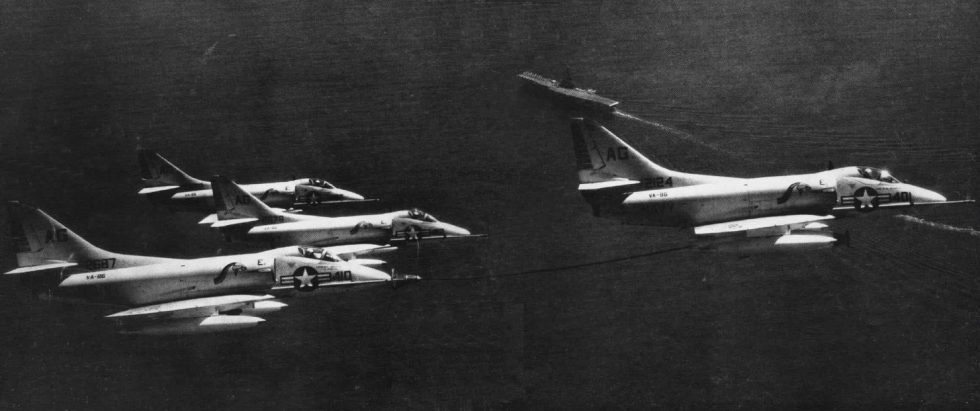
The conventional war arrived anyway. From August 1964 the Skyhawk became the US Navy’s principal light-attack aircraft over North Vietnam, and it flew more combat sorties than any other naval aeroplane of the war carrying iron bombs, Zuni rockets and, from 1965, the first American guided air-to-surface weapons used in anger. 195 carrier-based Skyhawks were lost to enemy fire, and 362 A-4s and TA-4Fs were lost to all causes across the Navy and Marine Corps combined — the largest loss of any single American type in the war after the F-4. The pilots who did not come back include Everett Alvarez, the first American aviator taken prisoner in the North, shot down on 5 August 1964 on the very first strike; James Stockdale, who went down in September 1965 and spent seven and a half years in Hoa Lo; and John McCain, shot down in an A-4E of VA-163 over Hanoi on 26 October 1967 by an SA-2 that took his starboard wing off.
Three months before that, McCain had been sitting in another Skyhawk on the flight deck of USS Forrestal. At about 1051 on 29 July 1967 an electrical surge in a parked F-4B fired a Mk 32 Zuni rocket across the deck — a rocket whose safety pin had been removed early under a local procedure that had been quietly relaxed — and it ruptured the 400 US gal external tank on Skyhawk 405, flown by Lieutenant Commander Fred White. The fuel caught. Within ninety seconds the first of a batch of Korean War-vintage AN-M65A1 "fat boy" 1,000 lb bombs cooked off, killing the damage-control party outright, and the fire burned into the second deck. 134 men died and 161 were injured; 21 aircraft were destroyed, of which eleven were A-4E Skyhawks, and 40 more were damaged. McCain got out of aircraft 416 over the nose and through the fire. The Navy’s modern fire-fighting doctrine, its deck wash-down systems and the Farrier Firefighting School all date from that morning.
The Skyhawk’s only air-to-air victory of the Vietnam War was scored on 1 May 1967 by Lieutenant Commander Theodore R. Swartz of VA-76 off USS Bon Homme Richard, who put a salvo of unguided Zuni rockets into a MiG-17 that had made the mistake of getting in front of him. It is a fair summary of the aeroplane: no radar missile, no gunsight worth the name for air combat, and a kill anyway. Fits varied enormously by mark and by operator. Israeli A-4H and A-4N aircraft replaced the American 20 mm guns with locally built 30 mm DEFA cannon; Argentine A-4Bs in 1982 flew with Second World War-vintage bomb racks and no electronic warfare equipment at all; the Argentine A-4AR and the Brazilian AF-1B carry weapons the 1967 aeroplane could not have talked to. Any single armament table for "the A-4" is a composite that no individual airframe ever matched.
Gun
- 2 × Colt Mk 12 20 mm cannon in the wing roots, 100 rounds per gun on most US marks and 200 rounds per gun on the A-4M and later rebuilds. A short-recoil revolver-action gun, reliable enough but light on ammunition and prone to jamming under high g in early service.
- 2 × DEFA 553 30 mm cannon, 150 rounds per gun, on the Israeli A-4H and A-4N — built under licence in Israel and fitted because the IAF wanted a gun that would destroy armour and trucks rather than merely perforate them. This is the single most significant armament change made by any export operator.
- The Mk 4 HIPEG gun pod, a podded 20 mm high-performance gun with roughly 750 rounds, was carried on the wing pylons in Vietnam when a strafing pass was the point of the sortie. Two pods roughly quadrupled the aeroplane’s gun ammunition.
- Argentine A-4Bs in the Falklands strafed with the Mk 12 after bomb release, and Marine A-4Ms in the close-air-support role used the gun routinely. Unlike the A-6 Intruder, the Skyhawk could always answer back.
Air-to-air
- AIM-9 Sidewinder on the outboard pylons — a self-defence fit rather than an interception capability, carried routinely by Israeli, Australian, New Zealand and Argentine aircraft and by US adversary units. The Australian A-4G was specifically wired for four Sidewinders for a limited fleet-defence role.
- Rafael Shafrir 2 on Israeli A-4H and A-4N aircraft, and AIM-9M on the Argentine A-4AR with its AN/APG-66V2 radar. The A-4AR was the first Skyhawk with a genuine air-intercept radar and a credible, if modest, air-to-air capability.
- The cannon accounted for the type’s few other kills. An Israeli Skyhawk pilot shot down two Egyptian-flown MiG-17s over southern Lebanon in May 1970, and an IAF A-4 downed a Syrian MiG-17 during the 1982 Lebanon campaign.
- The Vietnam kill was scored with rockets, not missiles. Swartz’s MiG-17 on 1 May 1967 fell to unguided Zunis fired from an A-4C, which remains one of the more improbable air-to-air victories of the jet age.
- Set against that: Israeli Skyhawks lost at least five and probably more aircraft to Egyptian and Soviet-piloted MiG-21s in the War of Attrition alone, and at least nine to MiGs in the Yom Kippur War. Against a fighter, an A-4 was prey.
Air-to-surface guided
- AGM-12 Bullpup A and B — the A-4B was the first Skyhawk cleared for it, and Skyhawks fired more Bullpups over North Vietnam than any other type. It was radio command-guided, which meant the pilot had to fly straight and level towards the target while steering it with a thumb control, and it was a good way to be shot down.
- AGM-62 Walleye television-guided glide bomb. Its combat debut was flown by A-4Es of VA-212 off USS Bon Homme Richard in March 1967 against the Sam Son barracks in North Vietnam — the first American electro-optically guided weapon used in war, and a genuine landmark.
- AGM-45 Shrike anti-radiation missile on A-4E and A-4F aircraft flying "Iron Hand" defence-suppression missions against North Vietnamese SA-2 sites, alongside the A-6B and the Air Force Wild Weasels.
- AGM-65 Maverick on the A-4M and on later export rebuilds, and laser-guided Paveway bombs on ARBS-equipped aircraft — though the ARBS could only track a laser spot generated by somebody else, never create one.
- Later rebuilds broadened this considerably: the Argentine A-4AR was cleared for guided weapons its 1970s airframe was never designed around, and the Brazilian AF-1B modernisation with the Elta EL/M-2032 was built for anti-shipping work.
Bombs
- Nuclear stores were the original reason the aeroplane exists. The Mk 7, Mk 12, B43, B57 and later B61 were all carried on the centreline, delivered by low-altitude loft or over-the-shoulder toss using the AJB-3A all-attitude bombing system. Every A-4 pilot on a nuclear-alert squadron practised a manoeuvre designed to get him away from his own weapon.
- Mk 80 series low-drag general-purpose bombs — Mk 81, Mk 82, Mk 83 and Mk 84 — plus Mk 82 Snakeye retarded bombs for low-level release, and the older 750 lb M117. A typical Rolling Thunder load was six to twelve Mk 82s on multiple ejector racks.
- Mk 20 Rockeye II and CBU-24 and CBU-59 cluster weapons, used heavily against troops, vehicles and anti-aircraft sites.
- The Falklands demonstrated what happens when the fuzing does not match the delivery. Argentine A-4s attacking at masthead height released British-supplied and locally made 500 lb and 1,000 lb bombs whose fuzes had no time to arm; a substantial number of hits on Royal Navy ships simply did not explode. Improvised retarding devices fitted by June 1982 fixed it, and the results at Bluff Cove on 8 June were catastrophic for the British.
Rockets
- 5-inch Zuni in four-round LAU-10 pods — the Skyhawk’s heavy unguided weapon, used against bunkers, bridges, gun positions and, on one occasion, a MiG-17. Four pods gave sixteen rockets.
- 2.75-inch FFAR in LAU-3, LAU-61 and LAU-68 pods of seven or nineteen rounds, for area suppression and marking.
- Zuni also has the grimmest association of any weapon on this list: it was a stray Zuni that started the Forrestal fire on 29 July 1967 by rupturing a Skyhawk’s fuel tank on a crowded flight deck.
- By the A-4M era rockets had largely given way to cluster weapons and guided bombs in the American inventory, though export operators kept them in use for decades — and Israeli, Argentine and Kuwaiti Skyhawks all flew combat sorties with rocket pods long after the US Navy had moved on.
Pods & other stores
- D-704 buddy refuelling store on the centreline — the hose-and-drogue package that let one Skyhawk tank another. For years the recovery tanker orbiting overhead an Essex-class carrier was simply another A-4, and the type refuelled itself into and out of far more missions than its internal fuel would suggest.
- Drop tanks of 150, 300 and 400 US gal. The standard Vietnam configuration was one 400 gal centreline and two 300 gal wing tanks, leaving two stations for weapons; the standard Argentine Falklands configuration was two 300 gal tanks and three bombs, with no margin whatever.
- AN/ALQ-51 and AN/ALQ-100 deception jamming pods and AN/ALE-29 chaff dispensers, added in response to the SA-2. Argentine A-4Bs and A-4Cs in 1982 had none of this and paid for it.
- Mk 4 HIPEG gun pods, buddy stores, travel pods and practice multiple bomb racks. The Blue Angels aircraft carried a centreline smoke-generating tank in place of the fuel tank, which is the only Skyhawk store ever designed purely to be looked at.
- The five stations were plumbed and wired for a genuinely wide inventory, and the mix on any given sortie was dictated far more by fuel than by pylon capacity. A Skyhawk with a full war load had, in practical terms, no legs at all.
Three typical loadouts
- Rolling Thunder alpha strike, Gulf of Tonkin, 1967
- A-4E of VA-163 off USS Oriskany: 6 × Mk 82 500 lb bombs on the inboard multiple ejector racks, one 400 US gal centreline tank, two 300 US gal wing tanks, and an AN/ALQ-51 deception pod. Two dozen aeroplanes crossing the coast together at medium altitude into the densest anti-aircraft environment yet seen, rolling in from 12,000 ft and pulling out below 4,000 with SA-2s in the air. This is the mission that cost the Navy 195 Skyhawks and put Alvarez, Stockdale and McCain in Hoa Lo.
- Anti-shipping strike, Bluff Cove, 8 June 1982
- A-4B of Grupo 5 de Caza from Río Gallegos: 3 × 500 lb bombs with improvised retarders, two 300 US gal tanks, no electronic warfare fit and no radar. Refuelled once each way from a KC-130H, flown at fifty feet across four hundred nautical miles of open ocean, with fuel for exactly one pass. Five Skyhawks caught RFA Sir Galahad and Sir Tristram unloading at Fitzroy: three bombs into Sir Galahad, two into Sir Tristram, 48 British dead and 115 wounded, the worst single British loss of the war. Every aircraft came home.
- Marine close air support, A-4M with ARBS, 1980s
- A-4M of VMA-311: 4 × Mk 20 Rockeye cluster weapons and two LAU-10 Zuni pods, 400 rounds of 20 mm, one centreline tank, ARBS nose tracking a laser spot laid by a ground controller. Operating from a short expeditionary strip with a braking parachute, close enough to the front line that the transit was measured in minutes. This is the mission the Marine Corps refused to give up the Skyhawk for — it turned down the A-7 Corsair II to keep it, and the last USMC A-4Ms did not leave the front line until the AV-8B Harrier II had fully arrived.
Sourcing caveat: weapons clearance and squadron practice are different things. Almost everything above was certified for some Skyhawk somewhere across twenty-five years of production and sixty years of service, but no single airframe could carry all of it and most squadrons trained on a fraction. Loadout descriptions are reconstructed from published mission accounts and standard reference tables rather than from release authorities. The Vietnam loss figures are the most contested numbers on this page: 195 is the National Naval Aviation Museum’s count of carrier-based Skyhawks lost to enemy fire, while 362 is the all-causes total for USN and USMC A-4s and TA-4Fs together, and the two are frequently conflated. Argentine and Israeli loss figures come from a mixture of national and Western sources that have never fully agreed.
Variants
Twenty-five years in production, one airframe, and four separate national air forces that rebuilt it rather than replace it
The Skyhawk story starts with a number. In 1952 the US Navy asked for a jet attack aircraft to replace the piston-engined AD Skyraider, and specified a maximum take-off weight of 30,000 lb and a unit cost under one million dollars. Ed Heinemann, Douglas’s chief engineer at El Segundo, looked at where aircraft weight actually goes and concluded that most of the specification was self-inflicted. He deleted the wing fold, because a wing under 28 ft of span did not need one. He made the wing a single one-piece structure passing through the fuselage. He used aerodynamically actuated leading-edge slats with no actuators. He put the fuel in the wing and one fuselage cell. He kept the aeroplane to one seat and one engine. The result flew on 22 June 1954 weighing about half the Navy’s specification, and the first 500 production aircraft averaged US$860,000 apiece. It is very difficult to overstate how unusual this is.
The aeroplane that followed was in production from 1954 to February 1979 — at the time, the longest production run of any American tactical aircraft — and 2,960 were built, of which 555 were two-seaters. Its second life was longer than its first. Because the airframe was structurally over-engineered and cheap to run, four separate nations chose to rebuild rather than replace: Singapore fitted an F404 turbofan, New Zealand fitted an F-16 radar, Argentina did both in effect, and Brazil is still flying jets originally built for Kuwait in the 1970s. In the United States the type became the standard dissimilar air-combat adversary at Top Gun and the Marine Corps’ weapons school, the Navy’s advanced trainer, and from 1974 to 1986 the Blue Angels’ display aircraft — a role it got because the F-4 Phantom II had become absurdly expensive to run for the purpose, and one it filled better than anything before or since.
The type’s combat record is genuinely global and genuinely bloody. It was the US Navy’s principal light-attack aircraft in Vietnam and lost more aircraft there than any American type except the Phantom. It was Israel’s primary ground-attack aeroplane through the War of Attrition and the Yom Kippur War, where 53 were lost, and it was still being shot at over Lebanon in 1982. And it was Argentina’s weapon in the South Atlantic, where 48 A-4Bs, A-4Cs and naval A-4Qs flew at the outer limit of their range against the Royal Navy: A-4Qs of 3 Escuadrilla finished HMS Ardent on 21 May 1982, A-4Bs of Grupo 5 put three bombs into HMS Coventry on 25 May and sank her in twenty minutes, and the same unit wrecked RFA Sir Galahad and Sir Tristram at Fitzroy on 8 June. HMS Glasgow, HMS Broadsword, HMS Argonaut and HMS Antelope were all hit by Skyhawk bombs, several of which did not go off. 22 of the 48 Skyhawks deployed were lost. Very few aircraft have been used so hard by so many people who were not the customer it was designed for.
- XA4D-1 / A4D-1, later A-4A (1954–58; 1 prototype, 19 pre-production, 166 production)
- First flight 22 June 1954, in service 1 October 1956. Wright J65-W-4 of 7,700 lbf, no refuelling probe, three pylons, no radar. A pure day nuclear and conventional bomber, and by a considerable margin the lightest Skyhawk. Most were later retro-fitted with a probe.
- A4D-2, later A-4B (1956–60, 542 built)
- The first big production run: strengthened airframe, powered rudder, a fixed air-refuelling probe as standard, and clearance for the AGM-12 Bullpup. This is the mark Argentina bought as the A-4P and A-4Q, and it is the mark that fought the Falklands twenty-two years after the last one was built.
- A4D-2N, later A-4C (1959–62, 638 built — the largest single production block)
- Limited night and adverse-weather capability: AN/APG-53A terrain-clearance radar, autopilot, LABS low-altitude bombing system, and the uprated J65-W-16A. 100 were later rebuilt to near A-4F standard as the A-4L for the Naval Air Reserve.
- A-4E (1961–66, 499 built)
- The turning point. The Wright J65 goes, replaced by the Pratt & Whitney J52-P-6A of 8,500 lbf; the airframe is strengthened, Doppler navigation and the AJB-3A bombing system are added, and two more pylons take the total from three to five. This is the definitive Vietnam Skyhawk and the one McCain was flying when he was shot down.
- A-4F (1966–68, 147 built)
- The A-4E refined with combat experience: J52-P-8A of 9,300 lbf, nosewheel steering, a zero-zero ejection seat, spoilers, and the distinctive avionics "hump" on the spine that also appears retro-fitted on many earlier aircraft. The Blue Angels flew a lightened, hump-less A-4F from 1974 to 1986.
- TA-4F, TA-4J and the export two-seaters (1965–75; 241 TA-4F, 277 TA-4J new-build, 555 two-seaters in total)
- A 28-inch fuselage plug, a second cockpit and a lengthened canopy. The TA-4F kept full combat capability and flew as a forward air controller in Vietnam, where ten were lost; the TA-4J stripped out the weapons systems and became the US Navy’s standard advanced jet trainer for a quarter of a century. Almost every American naval aviator of the 1970s and 1980s learned to fly a tactical jet in one.
- A-4M Skyhawk II and A-4Y (1970–79; 158 built per several standard references, 160 per the Marine Corps museums)
- The definitive and final mark, and the baseline for this page. J52-P-408A of 11,200 lbf, enlarged bulged canopy, head-up display, braking parachute, 200 rounds per gun, IFF. First flight 10 April 1970. Later aircraft received the Hughes AN/ASB-19 ARBS with television and laser spot tracker and were briefly redesignated A-4Y. The Marine Corps chose it over the LTV A-7 Corsair II and kept it in the front line into the mid-1980s.
- A-4H and A-4N Ayit (Israel, 1967–76; 90 A-4H and 117 A-4N, plus 46 transferred in Operation Nickel Grass)
- Israel became the first foreign customer, agreed in February 1966 and delivered from December 1967, and eventually bought 217 Skyhawks outright. The A-4H was an A-4F with two locally built 30 mm DEFA cannon, a braking parachute and a squared-off fin; the A-4N was an A-4M derivative with an Israeli attack system. The extended tailpipe fitted to both, a field answer to the SA-7, is the type’s most distinctive foreign modification. The last IAF Skyhawks — by then trainers — were retired on 13 December 2015 after 48 years.
- Export new-build and remanufactures (1967–90s: A-4G, A-4K, A-4P, A-4Q, A-4KU, A-4S, A-4SU, A-4PTM, A-4E)
- Australia took 20 A-4G and TA-4G in two batches for HMAS Melbourne; New Zealand 10 A-4K and 4 TA-4K, later joined by ten ex-Australian aircraft and rebuilt under Project Kahu with the AN/APG-66 radar of the F-16, which made them arguably the most capable Skyhawks then flying; Argentina 50 A-4P and 16 A-4Q remanufactured from A-4Bs; Kuwait 30 A-4KU and 6 TA-4KU; Malaysia 40 A-4PTM; Indonesia 32 A-4Es quietly transferred from Israel. Singapore’s A-4S and then the A-4SU Super Skyhawk went furthest of all, replacing the J52 with a non-afterburning General Electric F404 for some 40 per cent more thrust.
- A-4AR Fightinghawk and AF-1 / AF-1B / AF-1C (Argentina 36, 1997–2026; Brazil 23 from 1997, 6–7 modernised)
- The last two acts. Argentina took 32 A-4Ms and 4 TA-4Fs out of the Davis-Monthan boneyard under a US$282 million programme, rebuilt them with a Westinghouse AN/APG-66V2 radar, HOTAS and a glass cockpit, and flew them from 1997 until 14 May 2026, when the survivors were retired at Villa Reynolds and replaced by 24 ex-Danish F-16AM/BM. Brazil bought Kuwait’s 23 A-4KU and TA-4KU in 1997 for its carrier São Paulo, and had Embraer modernise a handful between 2009 and April 2022 with the Elta EL/M-2032 radar as the AF-1B and AF-1C.
Operators and survivors, as of early September 2026. Exactly one military operator of the A-4 remains anywhere in the world: the Brazilian Navy. Its 1st Interceptor and Strike Fighter Squadron at São Pedro da Aldeia holds the six or seven Embraer-modernised AF-1B and AF-1C aircraft completed between 2015 and April 2022 — the squadron’s own account gives four AF-1B and two AF-1C, Flightglobal’s 2019 World Air Forces directory gave four AF-1B and three AF-1C, and Argentine reporting at the time of the Fightinghawk’s retirement gave five and two; the discrepancy is small and unresolved. They have had no carrier to fly from since NAe São Paulo was decommissioned in 2017, and the stated intention is to operate them until about 2030. Because only one military operator can be corroborated, no fleet chart is published on this page. The Argentine Air Force retired the A-4AR on 14 May 2026 after a fatal accident in 2024 and years of worsening serviceability, ending sixty years of Argentine Skyhawk operations; the Israeli Air Force finished on 13 December 2015, Singapore in 2013, Indonesia in 2004, New Zealand in 2001, Kuwait around 1998 and Australia in 1984. The largest flying fleets are now civil: Top Aces operates 21 ex-Israeli A-4N and one TA-4J as contracted adversary aircraft, fitted with AESA radar and infra-red search and track and probably the most capable Skyhawks ever flown, and Draken International at Lakeland holds seven ex-New Zealand A-4K and TA-4K and six ex-Israeli A-4N. A handful more fly in private warbird hands. Museum survivors run to well over a hundred original airframes worldwide, including the last aircraft built — A-4M BuNo 160264, delivered 27 February 1979 — held by the Flying Leathernecks collection. There are no Skyhawk reproductions and there is no reason there ever would be: the real ones are still cheap enough to buy.
Seven decades of the Scooter
The under-weight bet
Douglas and Ed Heinemann win the Navy light-attack contract with a design at roughly half the 30,000 lb weight limit.
First flight
The XA4D-1 prototype flies on 22 June with Douglas test pilot Robert Rahn at the controls.
Enters the fleet
The A4D-1 reaches operational Navy squadrons, beginning a service life that would run for decades.
Vietnam workhorse
The A-4 becomes the Navy and Marines’ primary carrier light bomber, flying tens of thousands of Rolling Thunder sorties.
McCain and the Forrestal
Lt Cdr John McCain survives the 29 July Forrestal fire in his A-4, then is shot down in an A-4E over Hanoi on 26 October.
The Yom Kippur crucible
Israel’s Skyhawks carry the ground-attack load and take heavy losses to Egyptian and Syrian SAM belts.
The Blue Angels years
The US Navy flight-demonstration team flies the nimble, economical A-4F Skyhawk II for twelve seasons.
Falklands strikes
Argentine A-4s press home low-level attacks on the Royal Navy, sinking and damaging warships at heavy cost.
The last operators
Singapore retires in 2005 and Argentina in May 2026, leaving Brazil’s navy the world’s final military Skyhawk operator.
From the deck: twelve Skyhawk stories
Half the weight, all the punch
Heinemann bet he could beat the Navy’s 30,000 lb limit by 50% — and won.
Read the full story
The wing that never folded
Every carrier jet folds its wings — except the Scooter.
Read the full story
Why they called it the Scooter
Small, light and quick, the A-4 buzzed around the deck like a scooter in traffic.
Read the full story
A tiny jet built to carry the bomb
Behind the “light attack” label, the A-4 was a nuclear striker from day one.
Read the full story
McCain’s two brushes with death in 1967
Twice in three months, disaster found John McCain in an A-4.
Read the full story
The Zuni that burned the Forrestal
A single stray rocket caused the Navy’s worst carrier fire since WWII.
Read the full story
The Scooter goes show-business
From 1974 the Blue Angels traded the thirsty Phantom for the nimble A-4.
Read the full story
Red Air’s favourite little jet
The A-4’s size and agility made it a superb stand-in for enemy fighters.
Read the full story
Skyhawks against the Royal Navy
In 1982 Argentine A-4 pilots pressed suicidally low attacks on the British fleet.
Read the full story
The Ayit in the wall of SAMs
Israel’s Skyhawks carried the load in 1973 — and paid dearly.
Read the full story
Skyhawks off the highway
When Iraq invaded in 1990, Kuwaiti A-4 pilots fought from public roads.
Read the full story
The Super Skyhawk reborn
Singapore ripped out the old engine and gave the A-4 a modern turbofan.
Read the full story
The Skyhawk in pictures
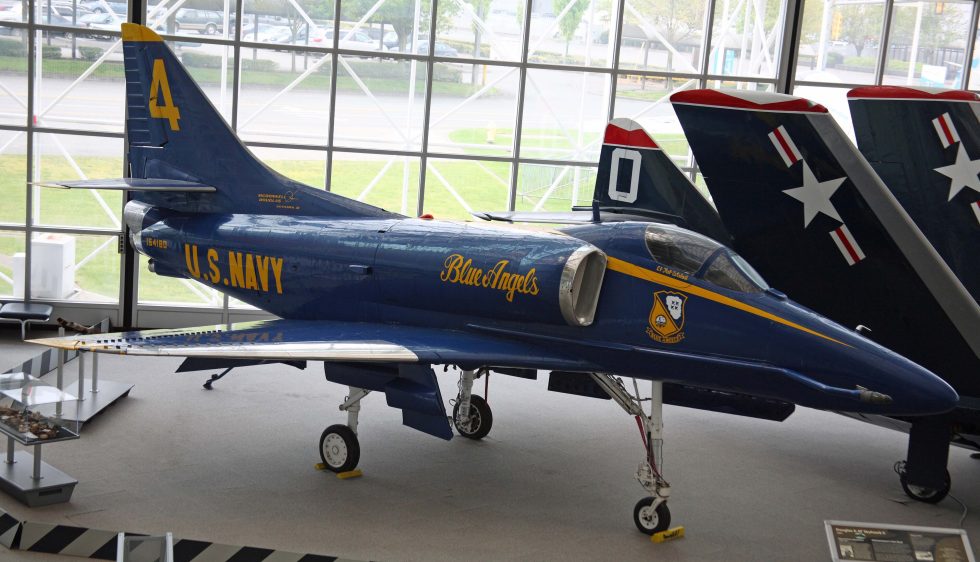
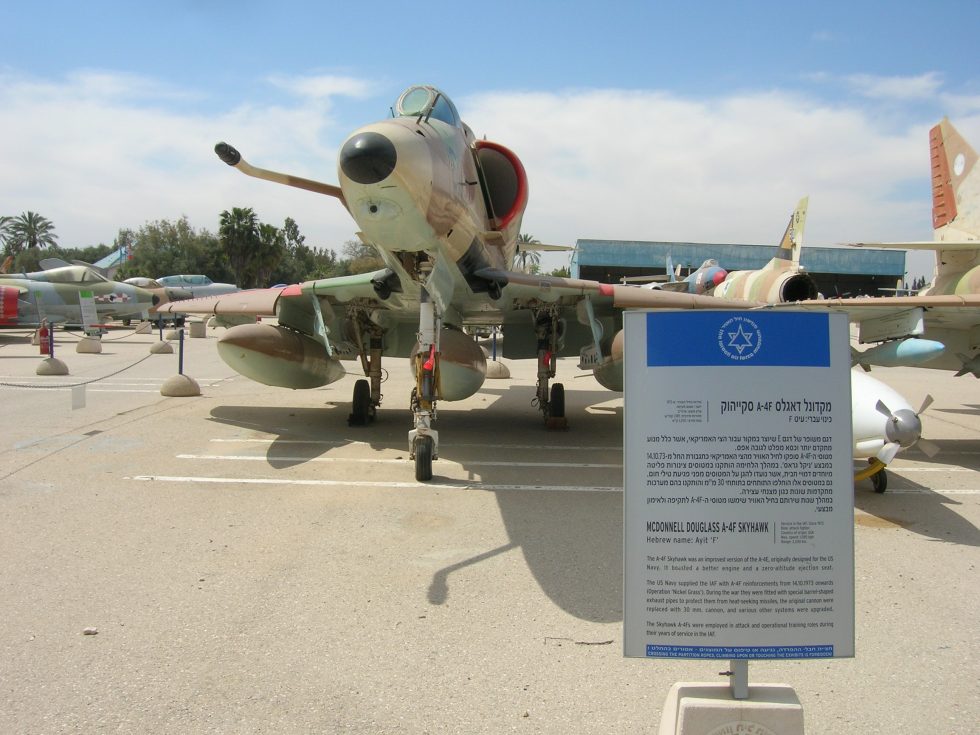
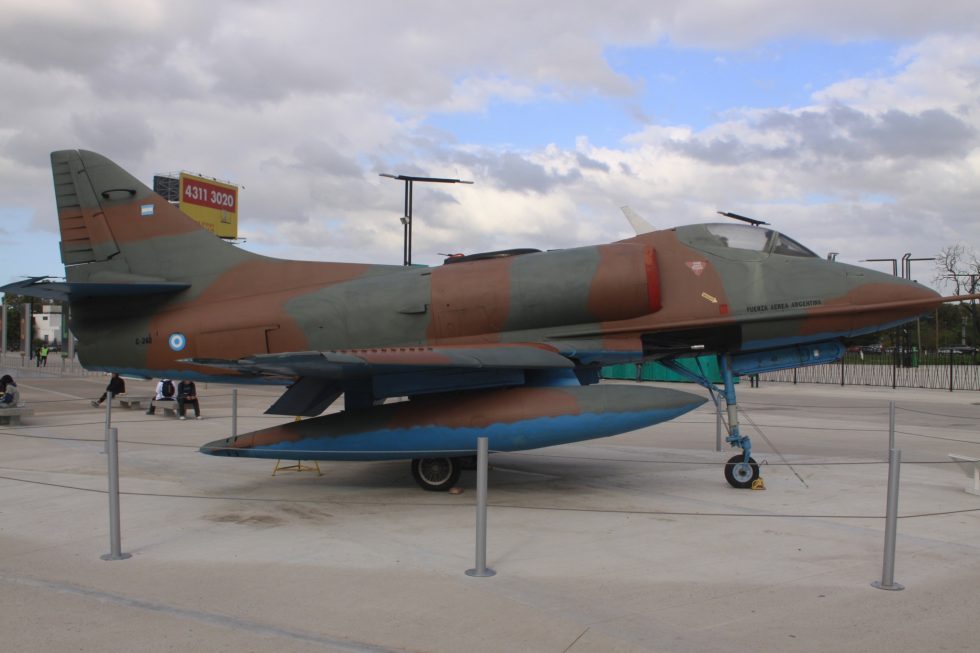
The A-4 Skyhawk in motion
Yarnhub — one of the most-watched A-4 Skyhawk films on YouTube.
Where the Skyhawk flew
The score that defines it
The A-4 was an attack jet, not a dogfighter, so its record is written in bombs delivered, ships hit and sorties survived rather than air-to-air kills. It was the US Navy’s light-attack backbone over Vietnam, Israel’s hardest-worked striker in 1973, and the jet that bloodied the Royal Navy in 1982 — often at a punishing cost to its own crews. Loss figures are contested and quoted here as ranges.
Compare the combat record of every military aircraft. Figures as of July 2026.
Everything people ask about the A-4 Skyhawk
Can I fly in an A-4 Skyhawk?
Why is it called “Heinemann’s Hot Rod”?
Why didn’t the wings fold?
How many A-4 Skyhawks were built?
Was John McCain flying an A-4?
What ships did Argentine Skyhawks sink?
Could the A-4 carry a nuclear bomb?
Is the A-4 Skyhawk still in service?
You can’t fly the A-4 Skyhawk.
These, you can.
Some legends only live in museums — others are fuelled and waiting. MiGFlug has put civilians in real military jet cockpits since 2004.
 Fly the L-39 AlbatrosThe world’s most-flown jet trainer — aerobatics included
 Fly the F-104 Starfighter“The missile with a man in it”
 Fly the MiG-21The Cold War’s most-produced jet
 Fly the T-33 Shooting StarAmerica’s first jet trainer
 Fly the DH VampireA piece of early jet history
 Fly the S.211Agile Italian jet trainer
 Fly the MB-326The classic Aermacchi jet
 Fly the MiG-15The Soviet legend of the Korean War
Continue the tour
Every fact, checked
- HistoryNet — Heinemann’s Hot RodThe design story and the under-weight bet that produced the Skyhawk.
- The Skyhawk AssociationProduction history, and the Israeli, Argentine, Kuwaiti and Singaporean combat records.
- Naval History and Heritage CommandThe 1967 USS Forrestal fire and US Navy Skyhawk service.
- Military FactoryA-4M specifications, engine and armament data.
- Flying Leathernecks Aviation MuseumA-4M dimensions, weights and performance figures.
- FactCheck.orgJohn McCain’s 26 October 1967 shootdown in an A-4E.
- The AviationistArgentina’s 2026 A-4AR retirement and Falklands operations.
- Sea Power Centre (RAN)Australian A-4G Skyhawk carrier operations.