
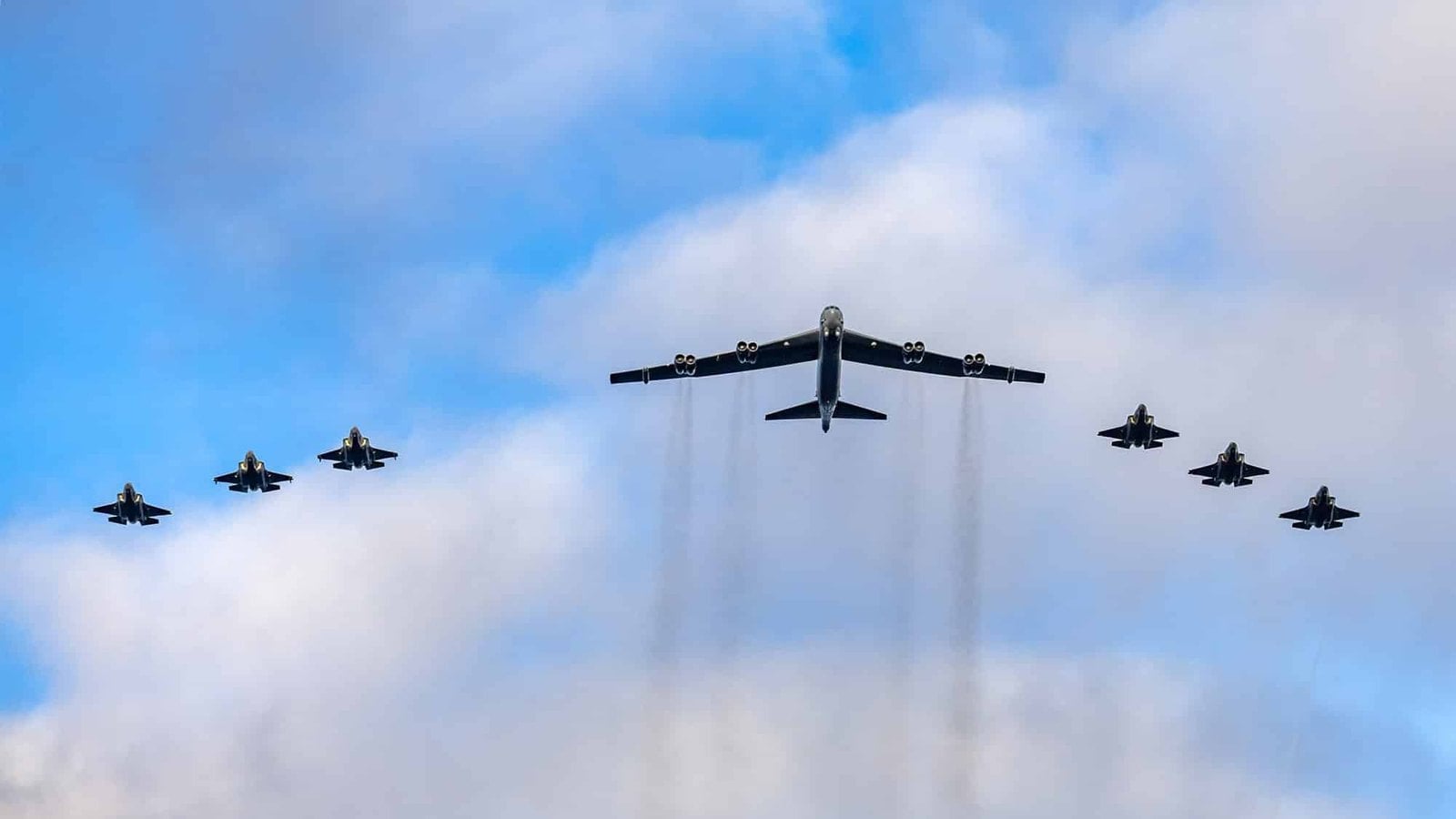
In the early hours of 24 October 2026, UTC, a single B-52H Stratofortress using the callsign HUSH 11 left Minot Air Force Base in North Dakota and pointed its nose at the Atlantic. Flight trackers listening to its HF position reports watched it complete a refuelling with a tanker cell and turn north into the Nuuk and Reykjavik flight information regions.
Somewhere over the cold water of the High North it picked up company. British F-35Bs launched from the aircraft carrier HMS Prince of Wales slid in alongside, joined by Royal Norwegian Air Force F-35As. The UK Carrier Strike Group called it a first. Air Force Global Strike Command called it strategic deterrence meeting allies and partners.
The sortie was part of Global Thunder 27, US Strategic Command's annual nuclear command-and-control exercise. It says a lot about how NATO now rehearses deterrence on its northern flank, and slightly less about firsts than the headlines suggest.
Quick Facts
- Exercise: Global Thunder 27, run by US Strategic Command, began 22 October 2026
- Bomber: One B-52H, callsign HUSH 11, from Minot AFB (per flight trackers)
- Mission: Transatlantic global power mission on 24 October 2026
- Escorts: UK F-35Bs from HMS Prince of Wales and Royal Norwegian Air Force F-35As
- Tankers: RAF Voyager, plus a KC-135 of the 100th Air Refueling Wing (The Aviationist)
- Carrier deployment: Operation Firecrest, within NATO exercise Neptune Strike 26-4
- Second bomber: HUSH 12 scrubbed with a technical issue (The Aviationist)
- Area: The High North, over the Norwegian Sea
What Global Thunder actually is
Global Thunder is US Strategic Command's yearly test of the machinery behind America's nuclear deterrent. It mixes command-post work, where staffs rehearse planning and the flow of orders, with field activity by bomber, tanker and missile units. STRATCOM says its purpose is to enhance nuclear readiness and keep the strategic deterrent safe, secure, effective and credible.
STRATCOM announced the start of Global Thunder 27 on 22 October 2026. As every year, the command stressed that the timing is routine, and warned that bomber and other aircraft flights may increase while the exercise runs. Allied air forces join when invited. In Global Thunder 20 in October 2019, according to Defence Industry Europe, US B-2 and B-52 sorties over Europe were escorted by Polish F-16s.
That line is part of the ritual. Moscow is told in advance, the exercise is published, and the bombers fly where they can be seen. Visibility is the point: deterrence only works if the other side notices.
Navy Lookout footage of HMS Prince of Wales off Norway, with F-35B launches and a B-52 flypast.
HUSH 11's long day out
The B-52 flew what the US Air Force calls a global power mission: a single sortie from the United States into a distant theatre and back again, without landing. It is the bomber force's way of showing it can reach Europe from North Dakota at short notice, with tankers rather than forward bases doing the heavy lifting.
Open-source trackers followed the jet out of Minot, through an air-refuelling track and north towards Greenland and Iceland. A second bomber, HUSH 12, was planned to join at least part of the mission but was scrubbed with a technical problem, according to The Aviationist. The single B-52 carried on alone.
Tanking for the escort was multinational. An RAF Voyager supported the British jets, according to the UK Ministry of Defence's Defence Operations account and UK Defence Journal. The Aviationist reports that the Norwegian F-35As refuelled from a KC-135 of the 100th Air Refueling Wing, the US Air Force tanker unit based at RAF Mildenhall in Suffolk.
Escorts from a carrier deck
HMS Prince of Wales left Portsmouth on 18 October for the second phase of Operation Firecrest, the Royal Navy's main 2026 carrier deployment to the North Atlantic, the High North and the Arctic. The Type 45 destroyer HMS Dauntless sails with her, and the group works under NATO command.
Firecrest overlaps with Neptune Strike 26-4, which runs from 16 October to 5 November. NATO's Naval Striking and Support Forces is coordinating three carrier groups at once: Italy's Cavour and Turkey's Anadolu in the Mediterranean, and Prince of Wales in the north, where the Norwegian frigate HNoMS Fridtjof Nansen has joined the British screen, according to The Aviationist.

The Norwegian half of the escort came from much closer to home. Norway flies 52 F-35As from Ørland and Evenes and has spent years practising with American bombers over its own waters. For the British jets, the bomber rendezvous meant a launch from a ship at sea, tanker support and a recovery to a moving deck.
The Carrier Strike Group added that it was a milestone for the UK, the United States and Norway. The Ministry of Defence's own post was blunter: operating together to defend NATO's northern flank.
A first, with a footnote
The "first time" claim needs a qualifier. In February 2022, NATO's Allied Air Command reported that British and Norwegian F-35s escorted B-52s across the North Sea during a Bomber Task Force Europe deployment, with British integration focused on bomber escort and close air support. US Air Forces in Europe described the same mission.
So British F-35s and B-52s have flown together before. What does appear to be new is the setting: British F-35Bs launching from a Royal Navy carrier on an operational deployment to meet a bomber flying a nuclear readiness exercise, with a Norwegian formation alongside. That is a different and more demanding problem than a land-based escort.
It also hints at where carrier aviation fits in NATO's plans for the north. A carrier air wing can sit off northern Norway for weeks, giving the alliance fifth-generation fighters in a region where airfields are few, far apart and close to Russia's heavily armed Kola Peninsula.

Why the High North, and why now
Britain is moving closer to NATO's nuclear mission itself. UK Defence Journal notes that the government has confirmed the purchase of twelve F-35As and UK entry into the alliance's nuclear role, which would give the Royal Air Force a nuclear task for the first time since the WE.177 bomb was withdrawn in 1998.
The week before the B-52 escort, UK Defence Journal reports, RAF Typhoons escorted French Rafales simulating a nuclear strike over the Mediterranean on Exercise Rummy, the first British participation in a French nuclear exercise. Taken together, the two events show the UK practising alongside both of NATO's other nuclear powers within a fortnight.
Air Force Global Strike Command framed its own post around readiness, saying its combat-ready force will act, if directed, to guarantee the security of the nation and its allies. The language is standard. The geography is not: the Norwegian Sea sits on the approaches to the Kola Peninsula, home of Russia's Northern Fleet and much of its ballistic-missile submarine force.
What the escort tells us
A single bomber, a handful of fighters and two tankers do not change the strategic balance. What they show is plumbing. Every rendezvous over the Norwegian Sea tests whether American, British and Norwegian crews can share tankers, radio procedures and airspace at short notice, which is exactly what a real crisis would demand.
Global Thunder 27 runs on, and STRATCOM has warned that more bomber flights may follow. HMS Prince of Wales remains in the north for the rest of Firecrest. If HUSH 11 was a rehearsal, the cast is now in place for an encore.
BFBS Forces News on HMS Prince of Wales and her F-35B air wing returning to Europe in 2025.
Sources: US Strategic Command, UK Ministry of Defence (Defence Operations), UK Carrier Strike Group, Air Force Global Strike Command, NATO Allied Air Command, US Air Forces in Europe, Forces News, UK Defence Journal, The Aviationist, Defence Industry Europe


0 Comments