
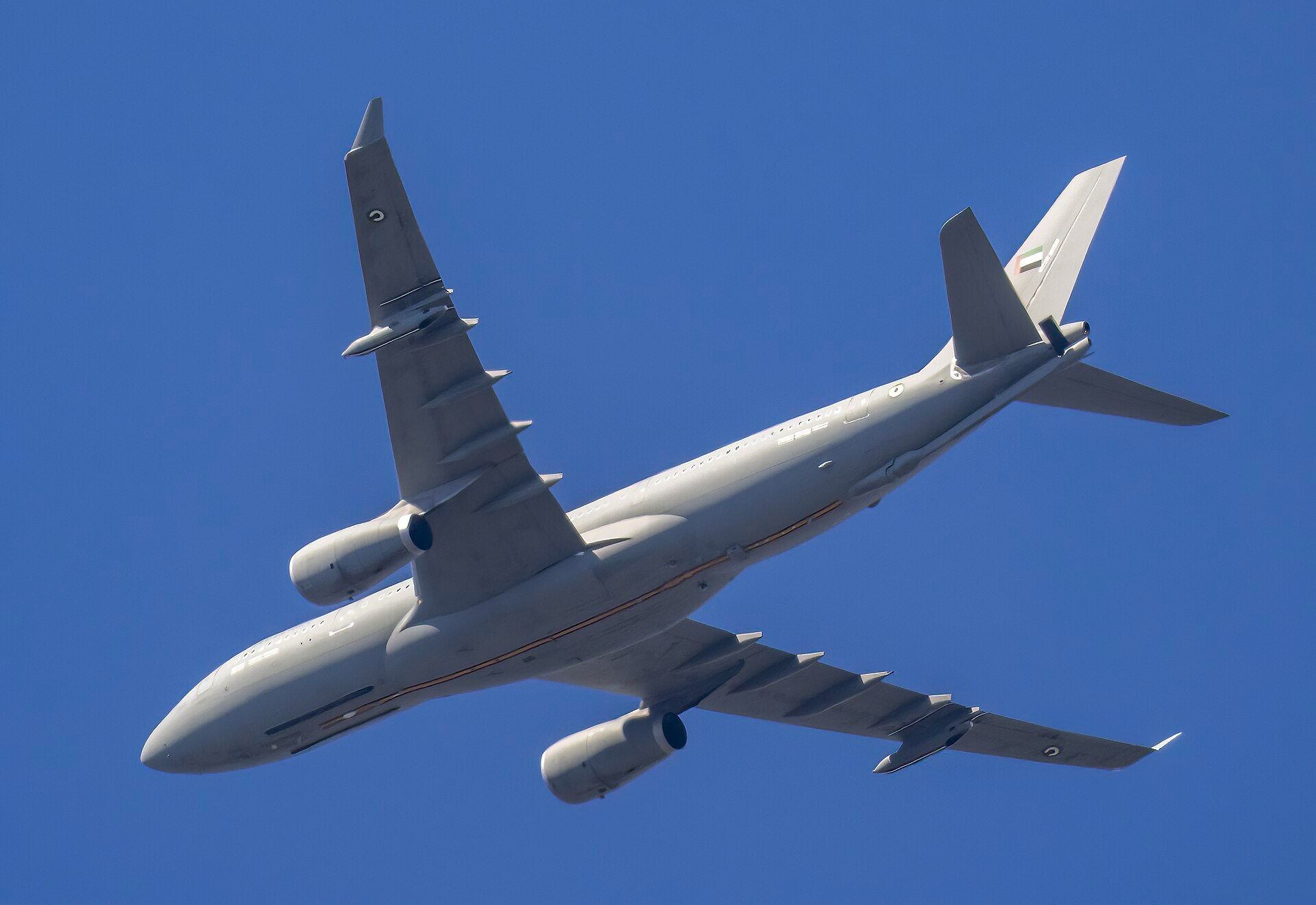
Airbus A330 MRTT
The Tanker the World Bought
It lost America’s tanker contract and won almost everyone else’s: the A330 MRTT refuels air forces on four continents, flies Europe’s shared tanker fleet and made the first automatic boom contacts.
The A330 MRTT: how an airliner became the West’s standard tanker
The A330 MRTT, for Multi Role Tanker Transport, is a simple idea done on a large scale. Airbus takes a standard A330-200 airliner from the Toulouse line and converts it at Getafe, near Madrid, into a tanker that keeps its whole passenger cabin and cargo hold. The fuel tanks are the airliner’s own: the A330-200 already carries about 111 tonnes of fuel in its wings and centre section, so the MRTT needs no extra tanks in the hold. Airbus then adds wing refuelling pods, a fuselage hose unit or its own Aerial Refuelling Boom System, military communications and defensive aids. The first converted aircraft flew in 2007, and Australia became the launch customer, receiving its first KC-30A in mid-2011.
The aircraft’s big break and its biggest setback came in the United States. In February 2008 the Northrop Grumman and EADS KC-45A, an A330 tanker, won the US Air Force KC-X competition. Boeing protested, the award was overturned, and in 2011 Boeing’s KC-46 won the rerun. Everywhere else the A330 kept winning. The Royal Air Force leases 14 as the Voyager; France flies its Phénix; Saudi Arabia, the UAE, Singapore, South Korea, Spain and Canada have bought it; and in 2026 Italy and Poland joined them. By 2026 Airbus counted 91 orders, 67 deliveries and 17 operating nations, and claimed more than 340,000 flight hours and 310,000 refuelling contacts.
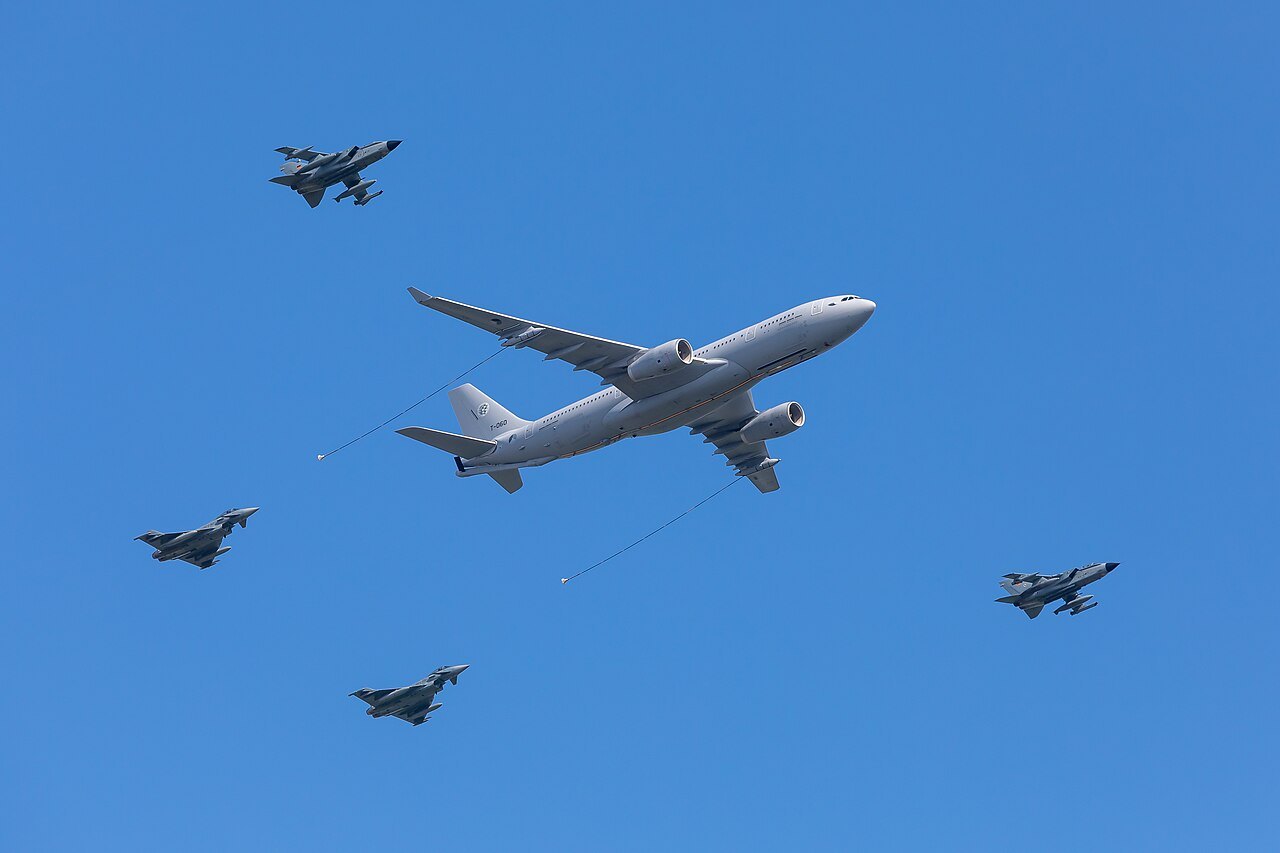
The most unusual operator is not a country. The Multinational MRTT Fleet, launched in 2012 with the Netherlands as lead nation, pools aircraft owned through NATO’s support agency for a group of European air forces that could not each afford their own tankers: the Netherlands, Luxembourg, Germany, Norway, Belgium, the Czech Republic, and later Denmark, Sweden and Finland. Its first aircraft arrived in 2020, and by 2025 it had 12, based at Eindhoven and Cologne-Bonn. In 2022 the MRTT became the first tanker certified to make automatic boom contacts, with Airbus’s A3R system flying the boom into the receiver without an operator’s hand on the controls. A new version, the MRTT+ on the A330-800, has Thailand, Poland and Spain among its first customers.
01The A330 MRTT’s Voyager: the RAF’s private-finance tankers
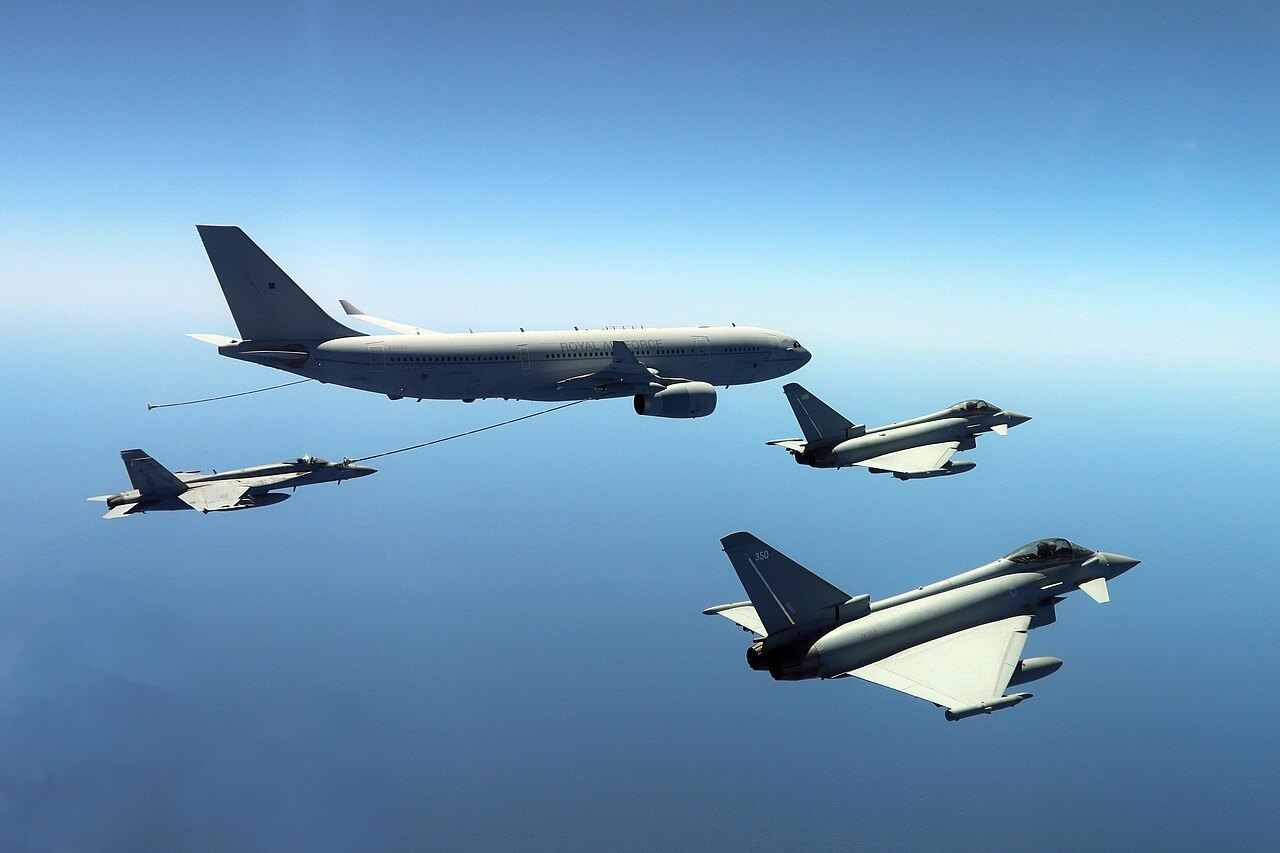
The RAF did not buy its tankers. In 2008 the Ministry of Defence signed a Future Strategic Tanker Aircraft contract with AirTanker, a consortium including Airbus, Rolls-Royce and others, which owns 14 A330s, maintains them at RAF Brize Norton and provides tanking and transport as a service for about 27 years. Nine aircraft form the core RAF fleet, flown by mixed RAF and sponsored-reserve crews of Nos. 10 and 101 Squadrons; the others can be released for civil charter flying when not needed, wearing civil registrations.
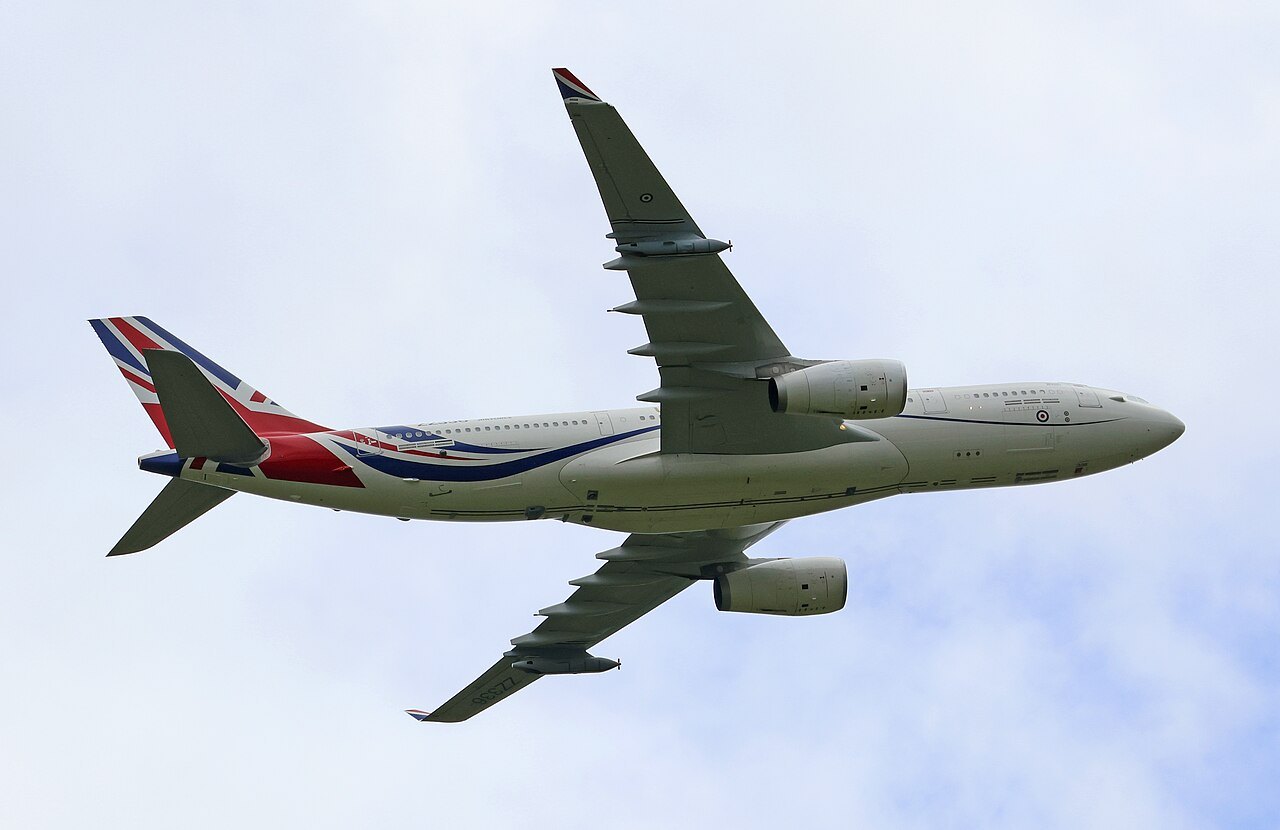
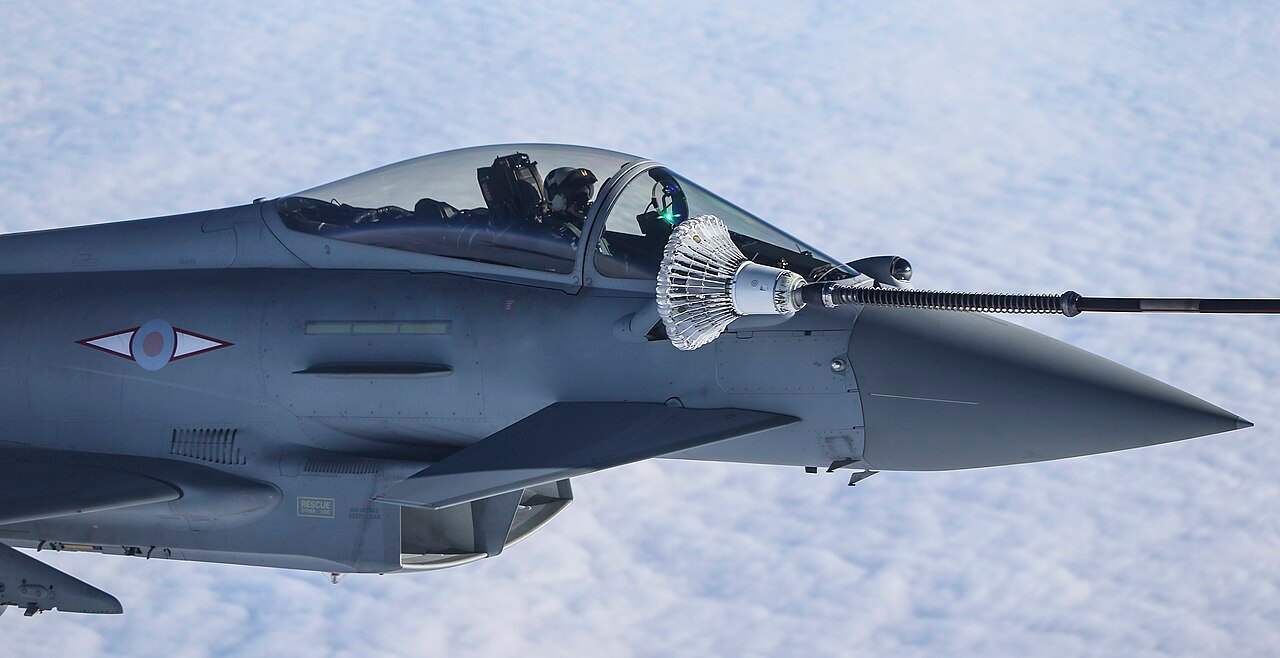
RAF Voyagers do not carry a boom, only hoses, so they can refuel probe-equipped aircraft such as the Typhoon, F-35B, A400M and Atlas but not boom receivers like the RAF’s own RC-135 and C-17. They support the Quick Reaction Alert Typhoons that intercept Russian aircraft, flew the long tanker missions of Operation Shader against Islamic State from 2014, and carried evacuees out of Kabul in 2021. One Voyager, ZZ336, is fitted for VIP use and carries the Prime Minister and the royal family, and its 2020 repaint in Union Flag colours, reported to have cost around £900,000, caused a political row.
02The A330 MRTT’s Multinational Fleet: Europe’s shared tankers
European air forces learned in the Libya campaign of 2011 that they depended on American tankers. The European Defence Agency responded with a plan to pool tanker capacity, and the Multinational MRTT Fleet, or MMF, was born. The aircraft are owned through the NATO Support and Procurement Agency and flown by a Multinational MRTT Unit of crews from the member nations, each country buying a share of flying hours rather than individual aircraft.
The Netherlands and Luxembourg signed first in 2016, followed by Germany, Norway, Belgium and the Czech Republic, and later Denmark, Sweden and Finland. The first aircraft was delivered in June 2020 and initial operational capability was declared in 2023. By 2025 the fleet had 12 aircraft, with a main base at Eindhoven in the Netherlands, a forward operating base at Cologne-Bonn in Germany and a further base planned at Karup in Denmark. The aircraft refuel NATO fighters, carry troops and cargo and fly medical evacuation flights, including during the pandemic.
What makes the A330 MRTT special
Fuel without extra tanks
Most tankers have extra fuel tanks in the cargo hold. The A330 MRTT does not need them: the standard A330-200 already holds about 111 tonnes of fuel in its wings and centre tank. Airbus says it can offload up to 70 tonnes of fuel during a one-hour loiter at 1,250 nautical miles from base. Because the hold stays empty, the aircraft can carry up to 37 tonnes of cargo and around 300 passengers at the same time as it tanks, which makes it ideal for moving a fighter squadron with its people and spares in a single deployment.
The Airbus boom and A3R
Airbus developed its own Aerial Refuelling Boom System for the MRTT, flown fly-by-wire by an operator at a console behind the cockpit using cameras rather than a window. Airbus quotes up to 3,600 kg of fuel a minute through the boom and 1,300 kg a minute through each wing pod. In 2022 the MRTT became the first tanker certified for automatic air-to-air refuelling with a boom, the A3R system, in which computers fly the boom into the receiver’s receptacle while the operator supervises. It aims to cut operator workload and improve safety.
Choose your configuration
Customers can choose their refuelling kit. Australia, France, Saudi Arabia, the UAE, Singapore, South Korea and the MMF have the Airbus boom plus two Cobham wing pods, so they can refuel both boom and probe receivers. The RAF Voyagers have only hoses: pods on all, and a fuselage hose unit on some. Canada’s CC-330 Husky fleet includes aircraft without refuelling equipment for transport and VIP work. Engines vary too: Rolls-Royce Trent 700 or General Electric CF6, and the Trent 7000 on the A330-800-based MRTT+.
03The A330 MRTT’s versions and names
- KC-30A: Royal Australian Air Force, the launch customer, No. 33 Squadron at Amberley.
- Voyager KC2 / KC3: Royal Air Force, leased from AirTanker; hose-only versions with and without a centreline hose unit.
- MRTT Phénix: French Air and Space Force; supports the nuclear Rafale force.
- KC-330 Cygnus: Republic of Korea Air Force.
- CC-330 Husky: Royal Canadian Air Force; mix of new aircraft and converted airliners.
- KC-45A: the proposed US Air Force version that won and then lost the 2008 competition.
- MRTT+: new version on the A330-800 with Trent 7000 engines, higher take-off weight and lower fuel burn.
Airbus A330 MRTT specifications
Specifications
- Crew
- 3 (2 pilots, 1 refuelling operator), plus mission crew
- Length
- 58.80 m (192 ft 11 in)
- Wingspan
- 60.30 m (197 ft 10 in)
- Height
- 17.40 m (57 ft 1 in)
- Empty weight
- about 125,000 kg (276,000 lb)
- Max take-off weight
- 233,000 kg (514,000 lb); 242,000 kg on the MRTT+
- Fuel capacity
- 111,000 kg (245,000 lb)
- Payload
- up to 45,000 kg (99,000 lb); up to 300 passengers
- Powerplant
- 2 × Rolls-Royce Trent 772B or General Electric CF6-80E1 turbofans, about 316 kN (71,000 lbf) each
- Cruise speed
- about 860–870 km/h (535–540 mph)
- Range
- ferry range up to 16,000 km (8,700 nmi)
- Service ceiling
- 12,500 m (41,000 ft)
- Boom offload rate
- up to 3,600 kg (about 1,200 US gal) per minute
Costs & production
- Unit cost
- Commonly reported in the range of roughly US$250–350 million per aircraft including support, based on contract values such as Italy’s 2026 order of six for about €1.6 billion and Canada’s C$3.6 billion for nine
- Cost per flight hour
- Hedged estimate: roughly US$15,000–25,000 per hour, based on comparable widebody twin-jet fuel burn and maintenance; actual military figures are rarely published
- Production
- 91 ordered and 67 delivered by 2026 (Airbus figures)
- Programme
- First flight 2007; in service since 2011; MRTT+ on the A330-800 from the late 2020s
04The A330 MRTT’s operating costs: the price of a widebody
The MRTT is an expensive aircraft to buy but benefits from the A330 airliner’s global support network. Engines, spares and maintenance practices are shared with hundreds of civil aircraft, which keeps parts available and simplifies training. Its two modern turbofans burn far less fuel per tonne carried than the four-engined tankers it replaced, and the MRTT+ on the A330-800 promises up to 8 percent lower fuel burn again.
How much an hour costs depends on how an air force pays. The RAF buys capacity from AirTanker as a service, so its costs are bundled into a long-term contract. The MMF nations pay for shares of flying hours. Others own their aircraft outright. Any single hourly figure is therefore an estimate rather than an official number.
The A330 MRTT from Getafe to four continents
First flight
The first converted A330 MRTT flies; Australia is the launch customer.
Win, loss and Voyager
The KC-45A wins the US contract in February and loses it on protest in June; the UK signs the Voyager deal with AirTanker.
Into service
Australia receives its first KC-30A in mid-2011.
RAF Voyager and MMF
The Voyager enters RAF service, and the European pooled-tanker initiative that becomes the MMF is launched.
Combat debut
RAAF and RAF tankers begin supporting operations against Islamic State over Iraq and Syria.
France, Singapore and Korea
The first Phénix, Singaporean and Korean aircraft are delivered.
First MMF aircraft
The Multinational MRTT Fleet receives its first tanker in June.
Kabul airlift
RAF, French, Korean and other MRTTs help carry evacuees during the withdrawal from Afghanistan.
Automatic boom refuelling
The A3R system is certified, the first automatic boom refuelling capability on any tanker.
Canada’s Husky
Canada receives its first CC-330 Husky.
Italy, Poland and MRTT+
Italy orders six, Spain and Poland order the MRTT+, and the first A330-800-based MRTT+ is rolled out.
Stories & eyewitnesses: the A330 MRTT from Amberley to Eindhoven
The KC-45 that never was
The A330 tanker briefly won America’s biggest contract.
Read the full story
The boom that broke away
A development setback for the launch customer.
Read the full story
Operation Okra
Australia’s tanker goes to war.
Read the full story
The Voyager dive, 2014
A camera that jammed a side-stick.
Read the full story
Vespina and the Union Flag
A tanker that carries prime ministers.
Read the full story
Kabul, 2021
Tankers turned into evacuation airliners.
Read the full story
Phénix and the nuclear mission
France’s tankers have a strategic job.
Read the full story
The first automatic boom contact
A tanker that flies the boom by itself.
Read the full story
Cygnus and the game
A Korean tanker named after a video game character.
Read the full story
Where to see one
Too young for museums, but easy to spot.
Read the full story
The A330 MRTT in pictures
Where the A330 MRTT flies and flew
The A330 MRTT’s record
The MRTT has been in combat support since 2014, over Iraq and Syria, in Yemen with Saudi and Emirati forces, over Libya and the Sahel, and on NATO missions along the eastern flank. Airbus’s own fleet figures give the clearest picture of its service.
See how training and combat types compare in the military aircraft statistics database. Figures are approximate.
Everything people ask about the A330 MRTT
Can I fly in an Airbus A330 MRTT?
What does MRTT stand for?
Is the RAF Voyager an A330 MRTT?
What is the Multinational MRTT Fleet?
Why did the US not buy the A330 tanker?
How much fuel does it carry?
Can the A330 MRTT refuel itself?
You can’t fly the A330 MRTT.
These, you can.
Most of this museum you can only look at. These genuine military jets you can fly yourself with MiGFlug — with aerobatics and time on the controls.
 Fly the L-39 AlbatrosThe world’s most-flown jet trainer — aerobatics included
 Fly the F-104 Starfighter“The missile with a man in it”
 Fly the MiG-21The Cold War’s most-produced jet
 Fly the T-33 Shooting StarAmerica’s first jet trainer
 Fly the DH VampireA piece of early jet history
 Fly the S.211Agile Italian jet trainer
 Fly the MB-326The classic Aermacchi jet
 Fly the MiG-15The Soviet legend of the Korean War
Continue the tour
Every fact, checked
- A330 MRTTAirbus: fuel, offload, payload, A3R, orders, flight hours, MRTT+
- A330 MRTT: the evolution of the world’s leading air-to-air refuelling tankerAirbus history of the programme
- KC-30A Multi-Role Tanker TransportRoyal Australian Air Force: fleet, specifications, Middle East deployment
- AirTanker: about usVoyager contract (2008), Brize Norton operations
- First RAAF KC-30 arrives (Australian Aviation, June 2011)Launch-customer delivery
- Airbus A330 multi-role tanker transport goes neo (AIN, July 2024)MRTT+ on the A330-800
- Airbus mulls boosting tanker production (Defense News, June 2025)Demand, MMF growth and production
- Government Accountability Office: decision on Boeing’s protest of the KC-X award (B-311344, June 2008)Why the KC-45A award was overturned