
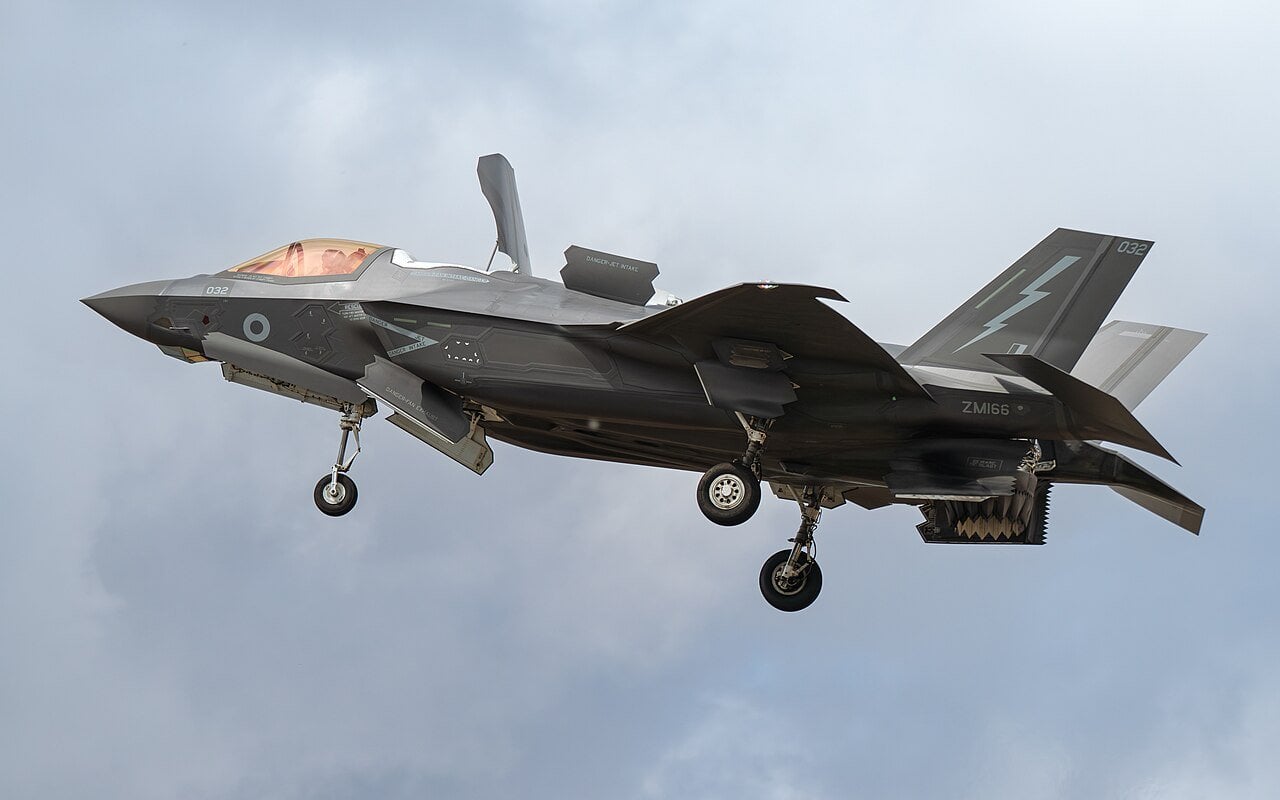
A fighter jet standing still in mid-air breaks every instinct you have about aeroplanes. There is no airflow over the wings, so the wings do nothing. The jet hangs there for one reason only: its engine is pushing down harder than gravity is pulling, and something is keeping that push exactly underneath the centre of gravity.
That second part is the hard part. Pointing thrust at the ground is easy. Balancing it, steering it and keeping it from cooking the runway is what took engineers decades, and in the West only two families of jet fighter have made it into front-line service doing it: the Harrier e il F-35B Lightning II.
Here is how jump jets hover, why the two do it in completely different ways, and what the pilot is actually doing with the controls while the aeroplane is behaving like a helicopter.
Informazioni rapide
- Core principle: Engine thrust must exceed weight and sit under the centre of gravity
- Harrier engine: Rolls-Royce Pegasus, four swivelling nozzles
- Harrier nozzle range: 0 to 98.5 degrees, front nozzles cold, rear nozzles hot
- Harrier hover control: Reaction control puffers in nose, tail and wingtips
- F-35B system: Rolls-Royce LiftSystem with Pratt & Whitney F135
- LiftFan: 50 in, two-stage, about 20,000 lbf cold thrust
- Swivel nozzle: Rotates 95 degrees in 2.5 seconds
- Combined lift thrust: About 40,000 lbf (Rolls-Royce)
- Pietra miliare: X-35B: short take-off, supersonic dash, vertical landing, 20 July 2001
The Only Rule: Thrust Above the Centre of Gravity
In normal flight, a wing makes the lift and the engine only has to overcome drag. In a hover, the engine has to carry the whole weight of the aircraft on its own. That means installed thrust greater than weight, which is a brutal requirement for a combat jet loaded with fuel and weapons.
Thrust alone is not enough. If the upward push sits even slightly ahead of or behind the centre of gravity, the aircraft pitches over. So every successful jump jet arranges its lifting jets around the balance point, and then adds some way to nudge the nose, tail and wingtips in the absence of any aerodynamic control.
Designers found three ways to do it. The Soviet Yak-38 carried separate lift engines. The Harrier rotates the exhaust of a single engine. The F-35B drives a big fan from its main engine. Each choice shaped everything else about the aircraft.
The Harrier: One Engine, Four Nozzles
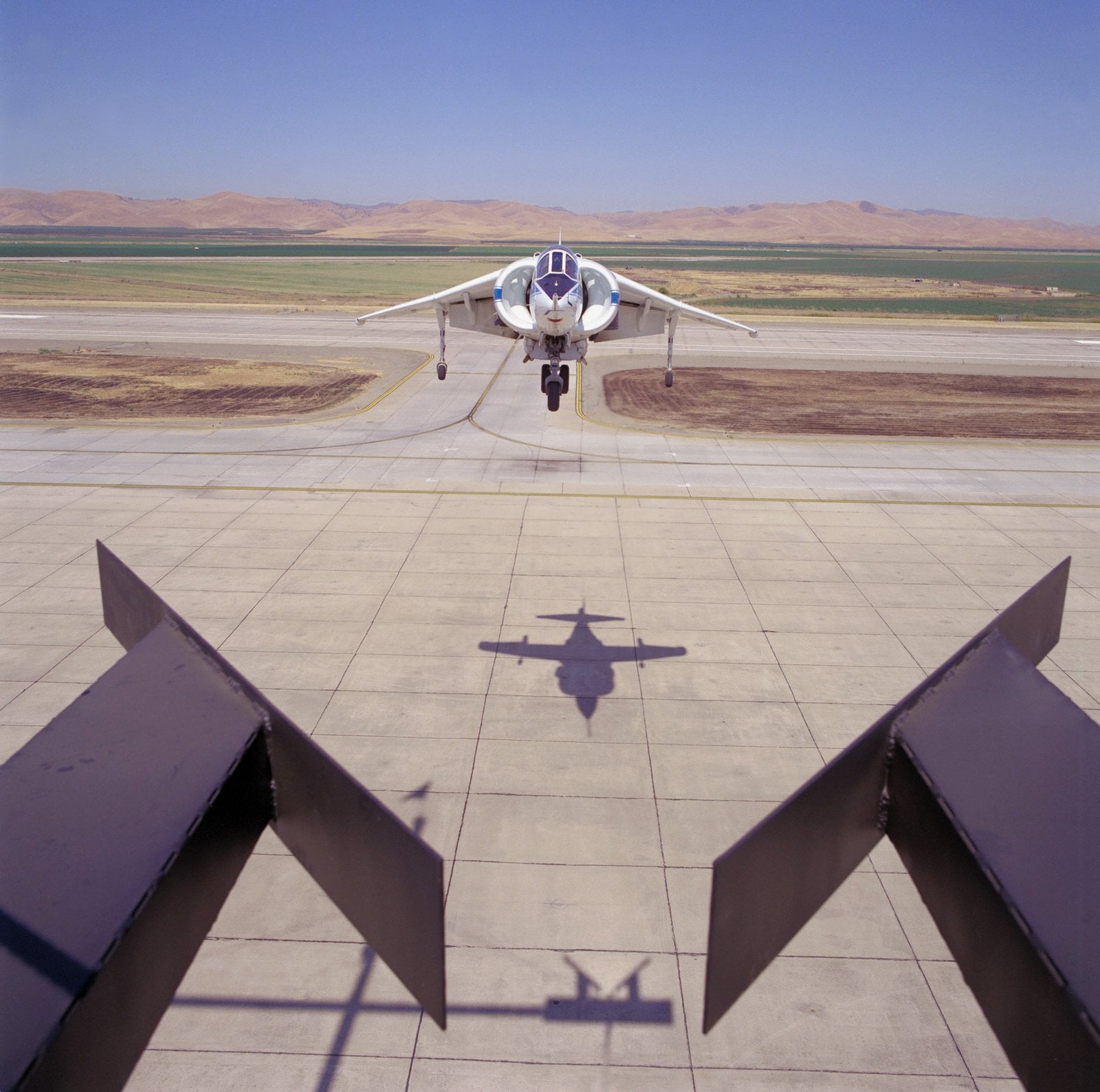
The Harrier's secret is the Rolls-Royce Pegasus, a turbofan designed from the start to point its thrust anywhere between straight back and straight down. Instead of a single tailpipe, it has four swivelling nozzles, two on each side of the fuselage. The front pair blow cold air from the fan. The rear pair carry the hot core exhaust, at around 650 degrees Celsius.
Because the nozzles sit either side of the aircraft's middle, the thrust is spread around the centre of gravity rather than concentrated at the tail. The engine sits in the centre of the airframe for exactly that reason, which is why ground crews had to take the wing off to change a Pegasus. Roughly 60 per cent of the airflow leaves through the front nozzles and 40 per cent through the rear.
All four nozzles move together, driven by motorcycle chains and air motors powered by air from the engine's high-pressure compressor. They turn through 98.5 degrees, which means the pilot can point the thrust slightly forward of vertical and fly the aircraft backwards. The engine's two spools also spin in opposite directions, which cancels out much of the gyroscopic kick that would otherwise fight the pilot at low speed.
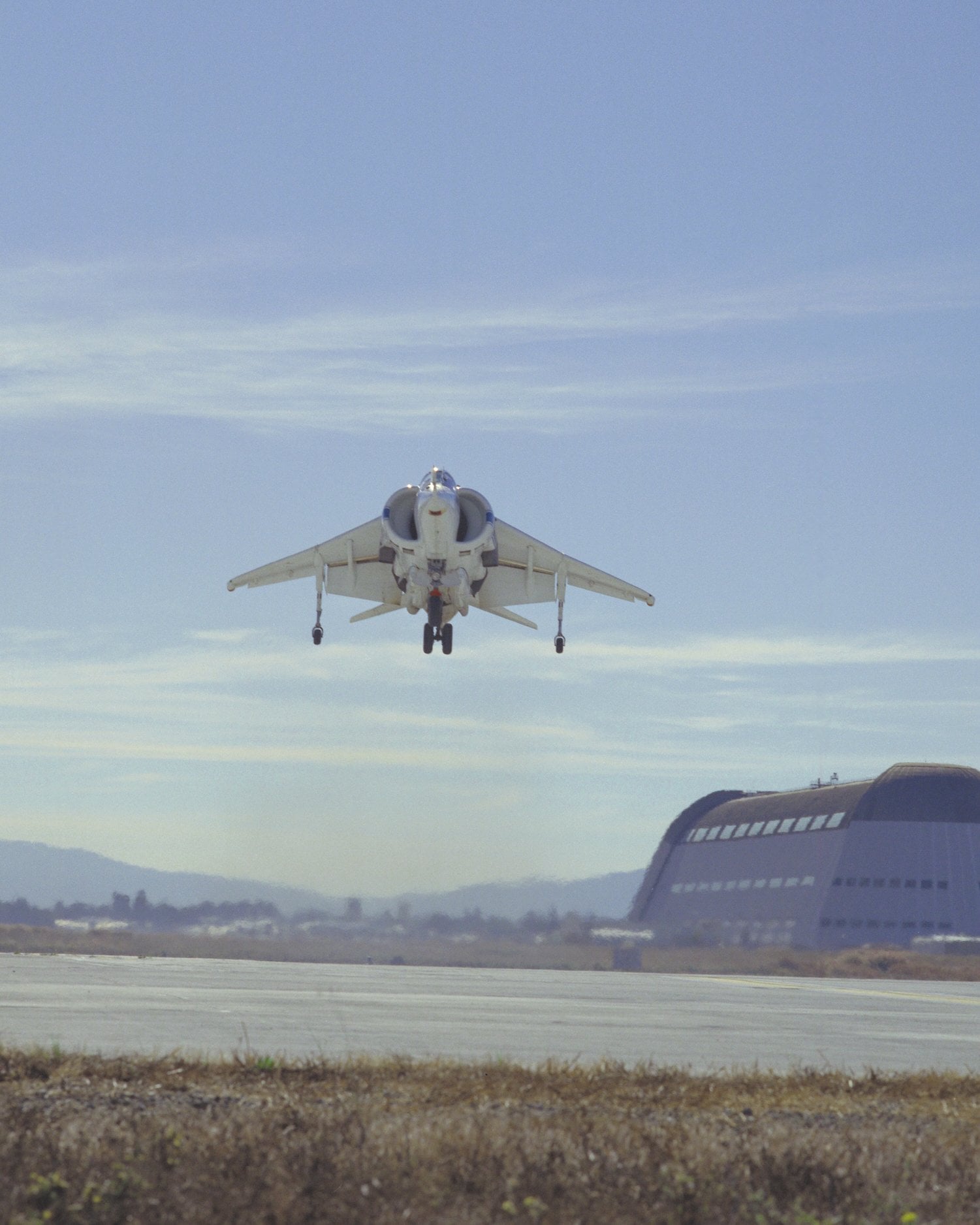
The Pegasus grew up alongside the Hawker P.1127, the Harrier's direct ancestor. The P.1127 hovered on a tether on 21 October 1960, achieved its first free hover on 19 November 1960, and made its first transition from hover to wing-borne flight on 8 September 1961. According to the engine's development history, the early engines barely had enough thrust to lift the aircraft at all.
Puffer Jets and the Nozzle Lever
With no air flowing over the tail, the rudder and elevators are useless in a hover. The Harrier replaces them with a reaction control system: small nozzles in the nose, the tail and the wingtips. Air is siphoned from the engine and squirted out of these puffers when the pilot moves the stick, nudging the aircraft in pitch, roll and yaw.
The cockpit adds one lever no conventional jet has. Alongside the throttle sits the nozzle control, which sets the thrust angle from 0 degrees for normal flight to 98 degrees. For a vertical take-off, the pilot faces into the wind, selects 90 degrees and opens the throttle to maximum until the jet lifts off, then trims the throttle to hold the hover.
Hot days are the enemy. The Pegasus is limited by turbine blade temperature, so the Harrier carries a tank of up to 500 lb of distilled water that is sprayed into the combustion chamber and turbine. That buys extra engine speed and thrust for about 90 seconds, typically for a heavy vertical landing in high ambient temperatures.
An AV-8B Harrier II display at the Royal International Air Tattoo 2023, including the hover.
Why Harriers Rarely Took Off Vertically
The hover is the most expensive thing a jump jet can do. Taking off straight up limits how much fuel and how many weapons the aircraft can carry, because the engine has to lift all of it with no help from the wing. Hawker Siddeley itself pointed out that short take-off operation saved fuel and let the aircraft carry more ordnance.
So the normal technique is a short take-off roll. The pilot accelerates with the nozzles aft, then snaps them partly down at a speed below a normal take-off speed, usually around 65 knots. The wing and the engine share the load, and the Harrier leaves the ground in a fraction of a conventional runway.
Test pilots found that the transition the other way was surprisingly simple. Even a 15-degree nozzle angle accelerated the aircraft well, and coming back to the hover was a matter of slowing to roughly 200 knots and rotating the nozzles down as the wing stopped lifting. Trainee Harrier pilots were often drawn from experienced helicopter pilots, because the low-speed regime demands helicopter skills.
The F-35B: A Fan Behind the Cockpit
The F-35B had a problem the Harrier never faced: it had to be supersonic and stealthy as well as hover. Four swivelling nozzles on the sides of a stealth fighter were never going to work. The answer was the Rolls-Royce LiftSystem, built around a shaft-driven LiftFan invented at Lockheed Martin's Skunk Works by chief engineer Paul Bevilaqua.
Behind the cockpit sits a 50-inch, two-stage, counter-rotating fan. For vertical flight, a clutch connects it through a driveshaft and bevel gearbox to the front of the Pratt & Whitney F135 engine, feeding it up to 29,000 shaft horsepower. The fan blows about 20,000 lbf of cold air straight down through louvred vanes in the belly. Rolls-Royce gives the combined short take-off and vertical landing thrust as about 40,000 lbf.
At the back, the three-bearing swivel module turns the engine's exhaust from straight aft to straight down. Its three angled segments rotate against each other, swinging the nozzle through 95 degrees in 2.5 seconds and vectoring about 18,000 lbf in lift mode. Two roll posts under the wings bleed bypass air from the engine to hold the wings level.
The F-35B steers in the hover without puffers at the nose. Pitch is controlled by varying the areas of the exhaust nozzle and the LiftFan inlet while keeping total lift constant. Yaw comes from swivelling the rear nozzle, roll from the roll posts, and forward or backward motion from tilting the rear nozzle and the fan's vanes.
Cold Air Versus Hot Air
The lift fan does something clever beyond adding thrust. Its air is cold and comparatively slow, which balances the hot jet at the back without blasting the ground under the nose with exhaust. The alternative, separate lift engines behind the cockpit, put hot, high-pressure jets right where the aircraft meets the surface.
The Soviet Yak-141 showed why that matters. According to Lockheed Martin's Code One magazine, its flying displays at the 1991 Paris Air Show were suspended when heat from the lift engines started to dislodge asphalt from the tarmac. At Farnborough the following year it was limited to conventional take-offs and landings, with hovers flown 500 feet above the runway.
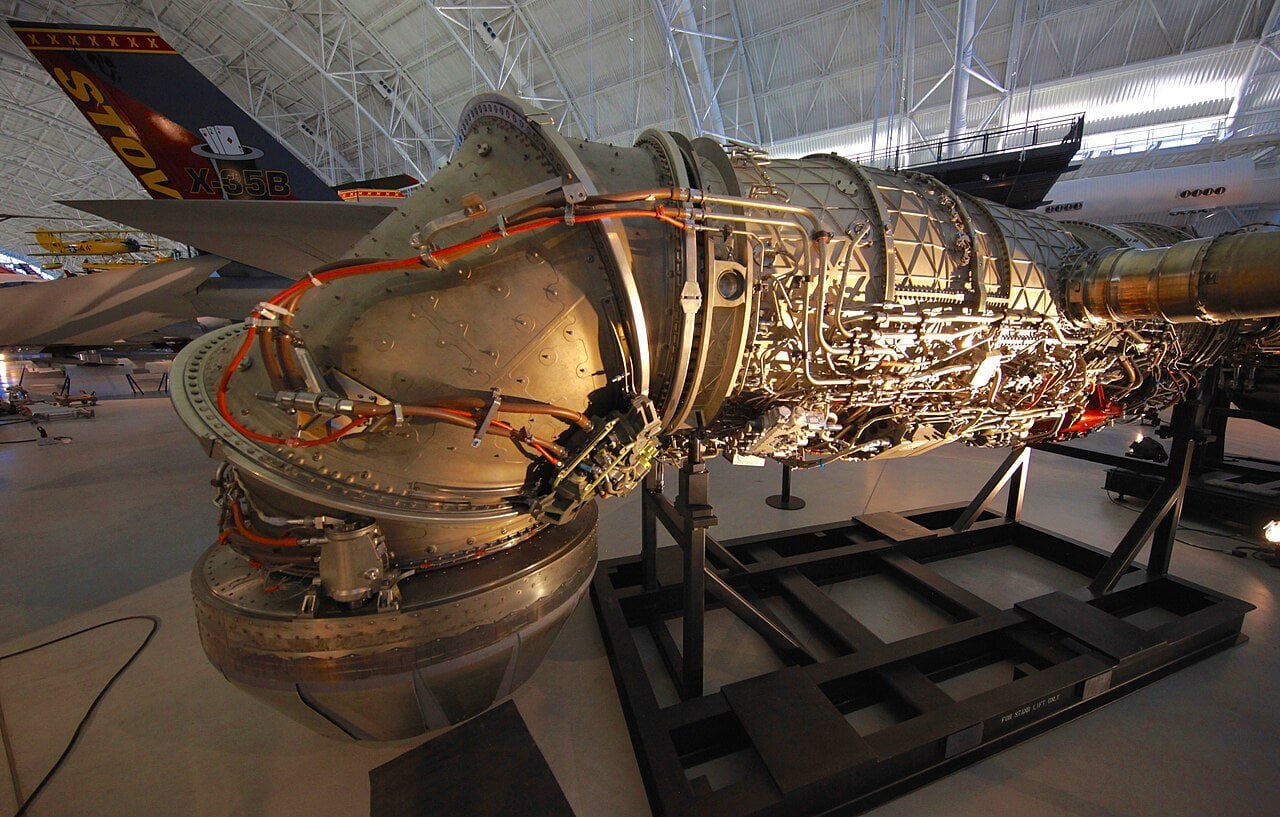
Lift engines and lift fans share one drawback: they are dead weight in cruise. Rolls-Royce's argument is that the fan's extra lift thrust increases take-off payload by more than the weight it adds. The rear swivel nozzle itself was not new. Code One traces it to Pratt & Whitney work in the 1960s and a Convair design for the US Navy in the early 1970s.
Hover, Supersonic, Hover
On 20 July 2001 the X-35B became the first aircraft to make a short take-off, a level supersonic dash and a vertical landing on a single flight. The LiftSystem won the Collier Trophy that year. The first production-standard F-35B, BF-1, hovered for the first time on 17 March 2010 and landed vertically the next day.
Today the F-35B flies with the US Marine Corps, IL Royal Air Force and the Royal Navy, and with Italy and Japan. The Royal Navy added a further trick, the shipborne rolling vertical landing, which lets the jet arrive on deck while still moving fast enough for the wing to carry some of the weight. That raises the weight at which it can come aboard; Harriers landing vertically had to dump unused fuel and weapons first.
Rolls-Royce's Alison Bacon explains how the LiftSystem lets the F-35B hover.
Fifty years apart, the Harrier and the F-35B answer the same question in opposite ways. One bends a single jet into four. The other turns a fighter engine into a helicopter gearbox for the final minutes before a vertical landing.
Both obey the same unforgiving rule. Put enough thrust under the centre of gravity and the jet stands on air. Get the balance wrong by a few inches and it falls out of the sky.
Sources: Rolls-Royce (LiftSystem and Pegasus product pages), Code One Magazine (Lockheed Martin), NASA Ames Research Center image archive, Wikipedia (Rolls-Royce Pegasus, Rolls-Royce LiftSystem, Hawker Siddeley Harrier, Lockheed Martin F-35 Lightning II, Shipborne rolling vertical landing)
0 Comments