

Shortly after midday on 7 May 1942, a radio crackled in the flag plot of a US carrier task force somewhere south of the Louisiade Archipelago. The voice belonged to Lieutenant Commander Robert E. Dixon, leading the dive bombers of Lexington’s Scouting Squadron Two. His message was four words long: Scratch one flat top!
Behind him the Japanese light carrier Shōhō was going under, torn apart by bombs and torpedoes. It was the first Japanese aircraft carrier the United States had sunk in the war. And it had been found, hit and destroyed by men who had flown more than a hundred miles from their own ships to do it. No American sailor on a surface ship ever laid eyes on her.
That was the shape of the whole Battle of the Coral Sea. For four days in May 1942 two fleets hunted each other across a stretch of ocean the size of a small country, mistook oilers for carriers and cruisers for battleships, and traded blows without either side’s ships ever coming within sight of the other. It was the first naval battle fought entirely by aircraft, and it set the stage for Midway a month later.
Informazioni rapide
Date: 4–8 May 1942 (carrier-versus-carrier action on 7 and 8 May)
Dove: Coral Sea, between New Guinea, the Solomon Islands and north-east Australia
Japanese objective: Operation MO: seize Tulagi and invade Port Moresby by sea
Allied commander at sea: Rear Admiral Frank Jack Fletcher (Task Force 17), carriers Yorktown E Lexington
Japanese carriers: Shōkaku E Zuikaku (Fifth Carrier Division) plus the light carrier Shōhō
Ships sunk: Japan: light carrier Shōhō, a destroyer and smaller vessels. US: carrier Lexington, destroyer Sims, oiler Neosho
Lexington losses: 216 of a 2,951-man crew killed; the rest were taken off before she was scuttled on the evening of 8 May
Primo: Naval battle in which the opposing ships never sighted or fired directly at each other
Risultato: Japanese tactical success, Allied strategic victory: the Port Moresby invasion was called off and Shōkaku E Zuikaku missed Midway
Operation MO and the codebreakers
By April 1942 Japan had swept across South-East Asia and the western Pacific almost without a check. The next step, Operation MO, was meant to push the defensive perimeter further south: a small landing at Tulagi in the Solomons for a seaplane base, then an amphibious assault on Port Moresby on the southern coast of New Guinea. From Port Moresby, Japanese bombers could reach north-eastern Australia.
Vice Admiral Shigeyoshi Inoue ran the operation from Rabaul. Because Allied land-based bombers had already mauled a Japanese invasion force off Lae and Salamaua in March, he asked for carrier cover, and Admiral Isoroku Yamamoto lent him the Fifth Carrier Division, the big fleet carriers Shōkaku E Zuikaku, plus the light carrier Shōhō to escort the invasion convoys.
What Inoue did not know was that the United States was reading a substantial part of the Imperial Japanese Navy’s main operational code, known to the Americans as JN-25B. By late April, Admiral Chester Nimitz at Pearl Harbor had the outline of MO, its targets and its rough timetable. He sent everything he could: Yorktown’s Task Force 17 under Rear Admiral Frank Jack Fletcher, Lexington’s Task Force 11 under Rear Admiral Aubrey Fitch, and an Australian-American cruiser squadron under Rear Admiral John Crace of the Royal Navy. Halsey’s Enterprise E Calabrone, just back from the Doolittle Raid, raced south too, but arrived too late.

Blind man’s buff across the Coral Sea
The first blow fell on 4 May. Aircraft from Yorktown caught the Tulagi invasion force at anchor and sank the destroyer Kikuzuki and several minesweepers. It was a useful raid with an expensive side effect: Tokyo now knew an American carrier was in the area.
For the next two days both fleets groped for each other under a band of heavy weather. On the evening of 6 May the carrier forces were only about 70 nautical miles apart, and neither knew it. Then, on the morning of 7 May, both sides launched full strikes at the wrong targets.
A Japanese scout reported a carrier and a cruiser to the south. It was actually the fleet oiler Neosho and the destroyer Sims, detached from the task force for a refuelling rendezvous. Seventy-eight aircraft went after them. When the Japanese realised their mistake, the dive bombers took it out on what they had found: Sims broke in two and sank, and Neosho was left burning and adrift.
Fletcher’s scouts made an error of their own. A coding slip turned a sighting of cruisers into two carriers, and Fletcher threw more than 90 aircraft at it. Through sheer luck the strike found Shōhō instead, escorting the Port Moresby convoy. Lexington’s air group, led by Commander William B. Ault, struck first with bombs and torpedoes; Yorktown’s followed. Shōhō sank in minutes, and Dixon made the radio call that became one of the most famous lines of the Pacific War.
The Operations Room’s animated reconstruction tracks every task force, search plane and strike across the Coral Sea, which is the clearest way to follow who was looking for whom.
That evening, Rear Admiral Chūichi Hara gambled. He sent 27 dive and torpedo bombers, flown by his most experienced crews, on a dusk strike towards where he thought the Americans were. Lexington’s radar picked them up, and Wildcats fell on the formation under the cloud. The survivors jettisoned their weapons and turned back in the dark. Some of them, lost and low on fuel, tried to join the landing pattern of the American carriers before gunfire drove them off.
By the end of 7 May the Coral Sea carrier battle had produced one sunk carrier, one sunk destroyer, one wrecked oiler and a great deal of confusion. Decades later Vice Admiral H. S. Duckworth, after reading the Japanese records, judged the day the most confused battle area in world history.
8 May: the strikes cross in mid-air
The next morning there was no confusion left. At about 08:20 a Lexington Dauntless found the Japanese carriers through a gap in the cloud; two minutes later a Shōkaku search plane found the Americans. The fleets were roughly 210 nautical miles apart. Both launched everything, and the two strike forces passed each other on the way out.
Yorktown’s dive bombers reached the enemy first, around 10:30. Zuikaku had slipped under a rain squall, so they went for Shōkaku. Two 1,000 lb bombs tore open her forecastle and wrecked her flight deck; a third hit from Lexington’s group added to the damage. The American torpedo bombers, slow TBD Devastators with notoriously unreliable torpedoes, scored nothing.

Lexington’s own strike paid a price in the weather. Many of her dive bombers never found the Japanese carriers at all. Ault, the air group commander who had led the attack on Shōhō the day before, became lost in the cloud on the way home. The ship’s radar could not see him. At 14:54 he was told he was on his own and should try to find land. His reply was taken down by the radio log.
Neither Ault nor his radioman was ever found. Meanwhile the Japanese strike, 69 aircraft strong, had arrived over the American carriers at about 11:13. Yorktown, smaller and handier, combed the torpedoes aimed at her but took a 250 kg bomb that punched through four decks before it exploded. Lexington, a converted battlecruiser hull with a wide turning circle, was caught in a classic pincer by the torpedo bombers and hit by two torpedoes on the port side, then by two bombs.
By noon it looked survivable. Lexington had a list, but her fires were out, her flight deck was working and she was recovering aircraft. That was the trap.
The slow death of Lady Lex
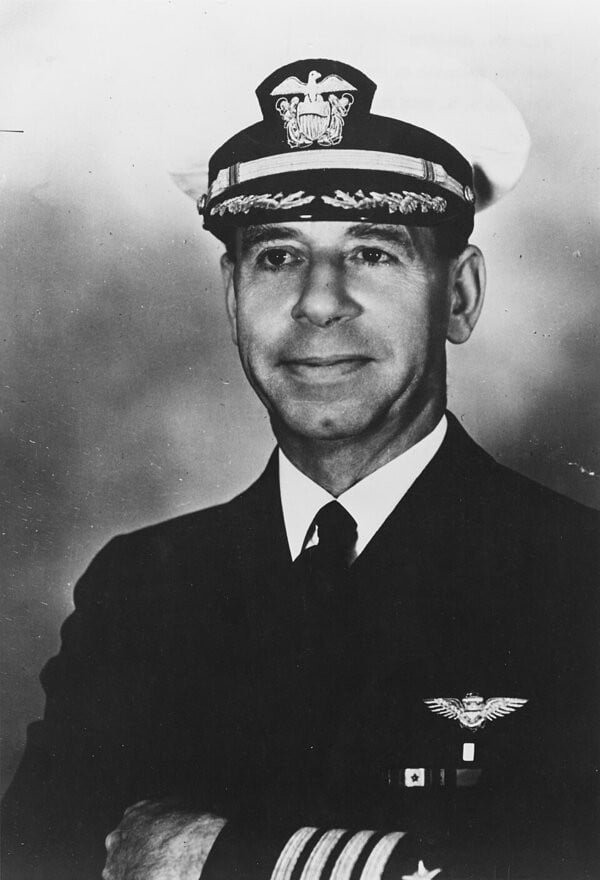
The first torpedo had cracked Lexington’s port aviation-gasoline stowage. Vapour spread silently into the compartments around it. At 12:47 sparks from electric motors ignited it, and an explosion deep in the ship killed 25 men and knocked out the central damage-control station. Her commanding officer later wrote the obituary of his own ship in one line.
For four more hours her crew fought it anyway. Hoses were led in from aft as the forward fire main lost pressure. Further explosions followed at 14:42 and 15:25. Torpedo warheads in the hangar were reported to be at 1,400 degrees Fahrenheit. When the engineering plant was finally secured, all water pressure went with it, and destroyers came alongside to pass over hoses and take off the wounded.
At 17:07 Rear Admiral Fitch ordered Sherman to abandon ship. It was an orderly evacuation. Men slid down lines into the water and onto destroyer decks; some gun crews had to be ordered to leave their mount. Sherman and his executive officer, Commander Morton T. Seligman, were among the last to go, sliding down a line over the stern.

That evening the destroyer Phelps fired torpedoes into the burning hulk, and shortly before 8 p.m. Lexington slipped under. Of her 2,951 men, 216 were lost. Fletcher later noted that the decision to keep the task force together had saved the great majority of her crew, who would otherwise have been in the water with no ships nearby.
British Pathé’s 1942 newsreel of the end of the USS Lexington: period footage of the burning carrier and her crew going over the side.
Who won the Coral Sea?
Counted in tonnage, Japan won. The United States lost a big fleet carrier, roughly a quarter of its carrier strength in the Pacific at the time, plus a destroyer and a precious oiler. Japan lost a light carrier and some small ships. The Japanese announced that they had sunk two American carriers; American newspapers were told of a much bigger victory than had occurred. Both sides exaggerated.
Counted in what each side set out to do, the Allies won. With Shōkaku crippled and Zuikaku’s air group shredded, Inoue had no carrier cover left for the Port Moresby convoy, and on the afternoon of 8 May he turned it back. It was the first time in the war that a major Japanese advance had been stopped short of its objective. Japan would later try to take Port Moresby overland, along the Kokoda Track, and fail there too.
The aircrew arithmetic was worse for Japan than the ship count suggests. The Japanese lost far more trained carrier aviators than the Americans did, in a navy that had no system for replacing them quickly. That attrition began at the Coral Sea carrier battle and never stopped.
The road to Midway ran through the Coral Sea
The most important consequence showed up four weeks later, far to the north in the central Pacific. Shōkaku limped home to Kure, almost capsizing in a storm on the way, and needed months in dockyard hands. Zuikaku was undamaged, but her air group was so depleted that the Japanese did not try to make her ready in time. Neither ship sailed for Midway.
Yorktown had been hit too, and the damage estimate was measured in months. Nimitz gave Pearl Harbor’s yard three days. She sailed for Midway with patched compartments and a borrowed air group made up largely of Saratoga’s squadrons, and her aircraft helped sink Sōryū E Hiryū. Two Japanese carriers missing on one side, one American carrier present against all expectation on the other: the margin at Midway was shaped in the Coral Sea.
The tactical lessons fed straight into the next battles. The Americans had seen that their fighter direction, strike coordination and torpedoes all needed work, and that aviation fuel in a damaged ship could kill her hours after the attackers had gone. Damage-control and fuel-handling procedures changed as a result.
Lady Lex, found two miles down
Lexington stayed lost for 76 years. On 4 March 2018 the research vessel Petrel, funded by Microsoft co-founder Paul Allen, found the wreck in the Coral Sea, roughly 3,000 metres down and more than 800 kilometres off the Queensland coast. The remotely operated vehicle’s cameras showed something extraordinary: aircraft that had gone down with the ship still sitting on the seabed, star insignia and squadron markings readable after three-quarters of a century.
Those aircraft include Devastators, SBD Dauntlesses E F4F Wildcats, the same types that had found Shōhō and fought off the dusk strike on 7 May. Their opponents, the A6M Zero, IL Aichi D3A Val e il Nakajima B5N Kate, would meet them again at Midway.
National Geographic’s report on the 2018 discovery of the Lexington wreck, with footage of the aircraft still resting on the floor of the Coral Sea.
The Coral Sea carrier battle is often treated as Midway’s warm-up act. It deserves better. It was the first time carriers fought carriers, the first time the war’s most dangerous navy was turned back, and the reason two of its best flight decks were empty on 4 June. Ault’s last message got one thing exactly right: the hit on the flat top mattered more than anyone could see at the time.
Sources: Wikipedia, Battle of the Coral Sea, USS Lexington (CV-2), Robert E. Dixon and William B. Ault; Office of Naval Intelligence, Combat Narrative: The Battle of the Coral Sea (1943, via HyperWar); Naval History and Heritage Command, H-Gram 005 (Battle of the Coral Sea) and Online Library of Selected Images, Battle of the Coral Sea; Dictionary of American Naval Fighting Ships, Lexington (CV-2); National Geographic and USNI News on the 2018 discovery of the wreck.


0 Comments