

Almost everything that flies in the United States is wrapped in paperwork. A certificate for the pilot. A medical for the pilot. A registration for the aeroplane. An airworthiness certificate for the aeroplane, and an annual inspection to keep it. Then there is one small corner of the regulations where all of that simply stops.
Open 14 CFR Part 103 and you find thirteen short sections, about a thousand words including the visibility table. It has not been substantially rewritten since it took effect on 2 September 1982. And it says, in plain language, that the machine it describes needs no airworthiness certificate, no registration and no markings, and that the person flying it needs no knowledge test, no age minimum, no experience and no medical.
There is a catch, and it is a big one. Part 103 buys that freedom with four numbers so tight that almost nothing you would actually want to own can meet them. This is what the freest flying in America actually looks like, and what it costs.
Quick Facts — 14 CFR Part 103
Title: Ultralight Vehicles
In force since: 2 September 1982 (47 FR 38776, Docket 21631)
Lunghezza: thirteen sections, roughly 1,000 words
Occupants: one, always
Powered empty weight: less than 254 lb, excluding floats and emergency safety devices
Capacità serbatoio: 5 US gallons maximum
Velocità massima: 55 kt CAS at full power in level flight
Power-off stall: 24 kt CAS maximum
Unpowered weight: less than 155 lb
Not required: pilot certificate, medical certificate, registration, airworthiness certificate
The shortest rulebook in American aviation
Section 103.7 is the one people cannot quite believe when they read it. It is worth reading in the FAA's own words rather than anybody's summary, because every paraphrase on the internet softens it.
The two paragraphs around it do the same work for the machine. Section 103.7(a) says ultralight vehicles and their parts are not required to meet airworthiness certification standards or to hold certificates of airworthiness. Section 103.7(c) says they are not required to be registered or to bear markings of any type. No N-number. No logbook the FAA will ever ask to see.
Notice the word the regulation uses throughout. Not aircraft. Vehicle. That choice is the whole architecture of the rule: the FAA decided in 1982 that a class of very small, very slow machines sat below the threshold where certification was worth the cost, and wrote a definition narrow enough that nothing dangerous could slip through it.
The four numbers that decide everything
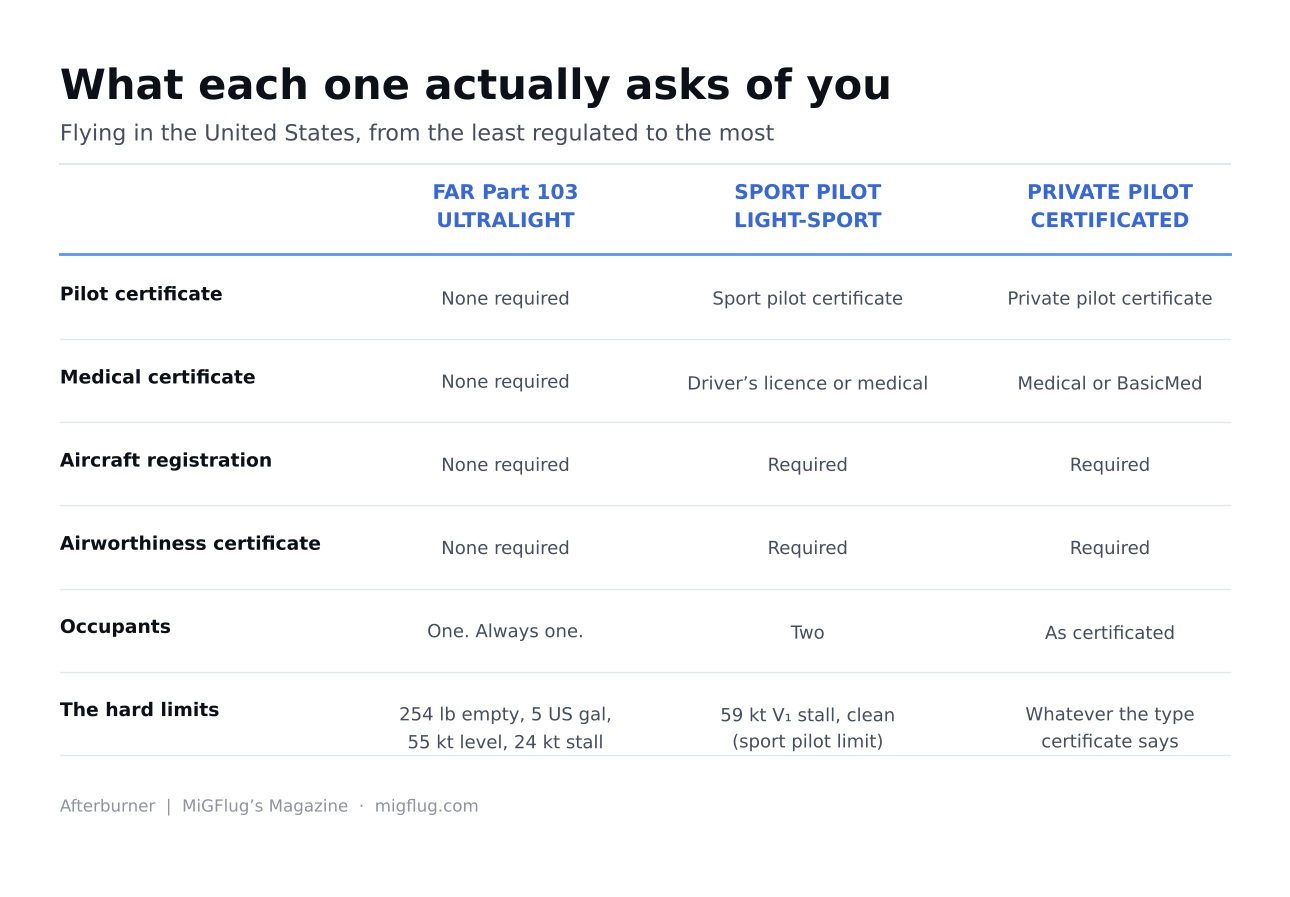
Section 103.1 is where the price is paid. To be an ultralight vehicle, a machine must be used for manned flight by a single occupant, used for recreation or sport only, hold no US or foreign airworthiness certificate, and then clear four hurdles if it is powered.
It must weigh less than 254 pounds empty. It must have a fuel capacity not exceeding 5 US gallons. It must not be capable of more than 55 knots calibrated airspeed at full power in level flight. And its power-off stall speed must not exceed 24 knots calibrated airspeed. If it is unpowered, one number replaces all four: less than 155 pounds.
Read those again as an engineer would. A 254-pound empty weight is less than a large motorcycle, and it has to include the engine, the fuel system, the structure, the controls and the seat. Five gallons of avgas weighs about 30 pounds and buys perhaps two hours. A 24-knot stall means a wing so large and so lightly loaded that a gust is a genuine event. And the 55-knot ceiling is not a recommendation about how you fly — the words are “is not capable of”, which means the airframe itself has to be unable to do it.
There is one generous detail buried in 103.1(e)(1), and it matters more than its length suggests. The 254 pounds excludes “floats and safety devices which are intended for deployment in a potentially catastrophic situation”. A ballistic recovery parachute — the rocket-deployed canopy that lowers the whole aircraft under silk — does not count against your weight. The FAA built in a standing incentive to carry the one piece of equipment most likely to save a life.
It started on a frozen lake in Wisconsin
Part 103 did not appear because the FAA wanted to liberalise anything. It appeared because a problem had already landed on the agency's desk.
In the mid-1970s a Milwaukee man called John Moody bolted a 12.5-horsepower two-stroke McCulloch engine and a small propeller to an Icarus II hang glider. According to the EAA, which now holds the aircraft, he flew it for the first time on 15 March 1975 from the frozen surface of Long Lake in Wisconsin. In the summer of 1976 he trailered it to Oshkosh and flew it in front of the crowd.
That demonstration is the hinge. Within a few years thousands of people were flying powered hang gliders and purpose-built tube-and-fabric machines, bought by mail order, assembled in garages and flown from farm strips, entirely outside any regulatory category that existed. The FAA's choice was to certificate them, ban them, or draw a box around them. In September 1982 it drew the box.

What the rule still will not let you do
The freedom in Part 103 is entirely about certification. The operating rules in Subpart B are conventional, and there are more of them than the headline suggests.
Flight is limited to the hours between sunrise and sunset under 103.11, with one exception: the half-hour of twilight at each end is allowed if the vehicle carries an anticollision light visible for at least 3 statute miles and every part of the flight stays in uncontrolled airspace. Section 103.13 puts the ultralight at the bottom of the right-of-way order — it yields to all aircraft, and a powered ultralight yields to an unpowered one. Section 103.15 bans flight over any congested area of a city, town or settlement, and over any open-air assembly of people.
Section 103.17 keeps ultralights out of Class A, B, C and D airspace, and out of the surface area of Class E designated for an airport, without prior authorisation from the controlling ATC facility. Section 103.19 does the same for prohibited and restricted areas, and 103.20 for areas designated by NOTAM. Section 103.21 is a single sentence that quietly rules out a great deal: “No person may operate an ultralight vehicle except by visual reference with the surface.” Section 103.23 then sets flight visibility and cloud clearance by airspace class, running from one statute mile and clear of clouds low down in Class G to five miles at and above 10,000 feet.
Which brings us to the most common question about Part 103, and the most commonly wrong answer. The rule sets no altitude limit at all. There is no ceiling written anywhere in it. What holds an ultralight down is the combination of three other rules: Class A airspace begins at 18,000 feet and needs an ATC authorisation you will not get, 103.21 requires you to keep visual reference with the surface, and 103.23 requires you to stay out of the cloud. Every website that confidently states a number is quoting something that is not in the regulation.
The part nobody solved: how do you learn?
A rule that lets a complete beginner fly solo with no training has an obvious problem, and the industry spent decades working around it rather than fixing it.
Because 103.1(a) allows exactly one occupant, a two-seat ultralight is not an ultralight. For years the FAA issued exemptions that let two-seat trainers operate anyway, administered through the ultralight organisations. Those exemptions ended with the 2004 sport pilot and light-sport rules. As the EAA's government relations director Tom Charpentier set out in January 2026, the exempted trainers were folded into the experimental light-sport category and were then barred from training use after 2010, on the assumption that factory-built light-sport aircraft would take over the job. Few light enough ones ever appeared.
The route back has been rebuilt piece by piece. A 2025 rule change lets experimental light-sport aircraft be used for compensated flight training under a letter of deviation authority, and experimental “low mass, high drag” machines — under 650 pounds empty and 87 knots or less — can now take a sport pilot from start to finish. Instruction runs through a sport pilot certificated flight instructor rather than an organisation-issued ultralight instructor rating.
Why so many “ultralights” are not ultralights
Walk a light aviation flightline and you will hear the word applied to machines that are nowhere near Part 103. Some of it is loose language — in Europe and Australia the same word covers a far heavier class. Much of it is the American phenomenon of the so-called fat ultralight: a design sold as Part 103 compliant that, once it has an electric starter, a bigger engine, brakes, a windscreen, instruments and paint, is simply over 254 pounds.
That matters, because compliance attaches to the individual airframe and not to the model name. Section 103.3 gives the FAA the right to inspect the vehicle on request and requires the operator to furnish satisfactory evidence that it is subject only to Part 103. A machine that is over weight is not a lightly non-compliant ultralight; it is an unregistered aircraft without an airworthiness certificate, flown by someone with no certificate, and every one of those is a separate problem.
The legal tier above has just moved, which changes the calculation for anyone shopping. The FAA's MOSAIC final rule was published on 24 July 2025. It removes the old weight and airspeed limits on the aircraft a sport pilot may fly, sets a maximum stalling speed of 59 knots CAS clean instead, permits four-seat airplanes while still limiting sport pilots to two occupants, and adds night privileges. The pilot certification changes took effect 90 days after publication; the airworthiness certification changes followed a year later. Part 103 itself was untouched.
The freest flying in America, and what it costs
It is genuinely remarkable that in 2026 a person can buy a machine, teach themselves within whatever limits their nerve allows, and fly it legally over open country without ever meeting a federal official. No other developed aviation system leaves a door that wide open.
But the door is exactly 254 pounds wide. What fits through it is one seat, two hours of fuel, a cruise slower than highway traffic, daylight only, nowhere near a city, nowhere near controlled airspace, and nothing in the way of a safety net except the parachute the rule politely declines to weigh. Part 103 is not a loophole that lets you skip the paperwork on a real aeroplane. It is a different, smaller, more honest kind of flying, and the absence of regulation is the thing the pilot has to make up for personally, every single flight.
Sources: 14 CFR Part 103 (eCFR, current text); FAA MOSAIC final rule fact sheet and 90 FR 35034 (24 July 2025); US Department of Transportation press release, 22 July 2025; EAA Hangar Flying, “The Current Regulatory State of Ultralight Training” and “John Moody's Icarus II”; FAA Advisory Circular 103-7.


0 Comments