
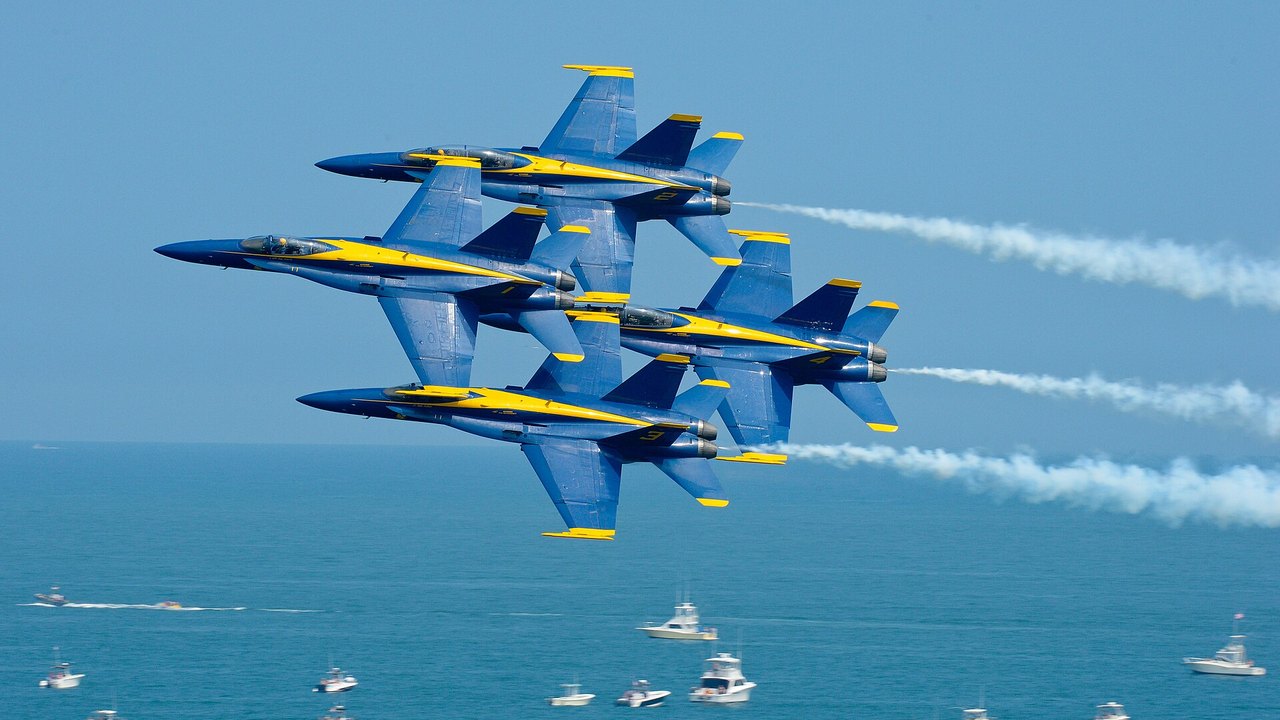
Over Baltimore’s Inner Harbor on 15 June 2012, a US Navy photographer captured an image most people would rather not think about. The canopy of the Blue Angels’ left wingman’s F/A-18 Hornet sat approximately 18 inches from the leader’s wingtip, according to the official US Department of Defense caption. Both jets were in the middle of a turn.
That is the extreme end of formation flying. But every military pilot learns the same basic skill, usually in their first training aircraft, and it rests on a surprisingly simple trick. Wingmen do not judge distance. They line things up.
Informazioni rapide
- Che cos'è: Two or more aircraft operating as one for navigation and position reporting (FAA definition)
- Standard formation: Wingmen within 1 mile of lead laterally or longitudinally and within 100 ft vertically
- How wingmen hold position: By keeping fixed reference points on the lead aircraft lined up, not by judging distance
- Basic shapes: Fingertip (finger-four), echelon, trail, line abreast
- Finger-four origin: Adopted by Finland in 1934–35; developed by German pilots in Spain, Mölders among them, in 1938
- Blue Angels: About 18 inches wingtip to canopy in the Diamond 360
- Red Arrows: Typically about 6 feet apart in close formation, nine Hawk T1s
- Silent signals: Gear, frequency, fuel and formation changes signalled by hand or by rocking wings
To the controller, a formation is one aircraft
The US Federal Aviation Administration defines formation flight as two or more aircraft that, by prior arrangement between the pilots, operate as a single aircraft with regard to navigation and position reporting. A standard formation keeps every wingman within one mile of the leader laterally or longitudinally, and within 100 feet vertically.
That definition contains the whole idea. Air traffic control sees one blip and talks to one pilot, the leader. Keeping the aircraft apart inside the formation is the pilots’ job, not the controller’s, and US regulations forbid formation flight at all except by arrangement with the pilot in command of each aircraft.
The sight picture: flying by references
Here is the aha. A wingman in close formation is not estimating metres. He is holding a picture. In US Navy primary training on the T-6B Texan II, the parade position is defined by three alignments on the lead aircraft. For height, the leader’s inboard exhaust stack must be fully visible and tangent to the bottom leading edge of the wing. For angle, the lower UHF antenna sits over the inboard aileron cutout on the far wing. For distance, the edge of the leader’s propeller arc rests on the pitot tube.
Each axis has its own control. Elevator moves the wingman up and down, aileron moves him sideways, and power moves him forward and back. A wingman ahead of the correct bearing line is “acute”, one behind it is “sucked”. The corrections are tiny and constant, and the Navy’s own supplement admits the perfect parade position is transitory.
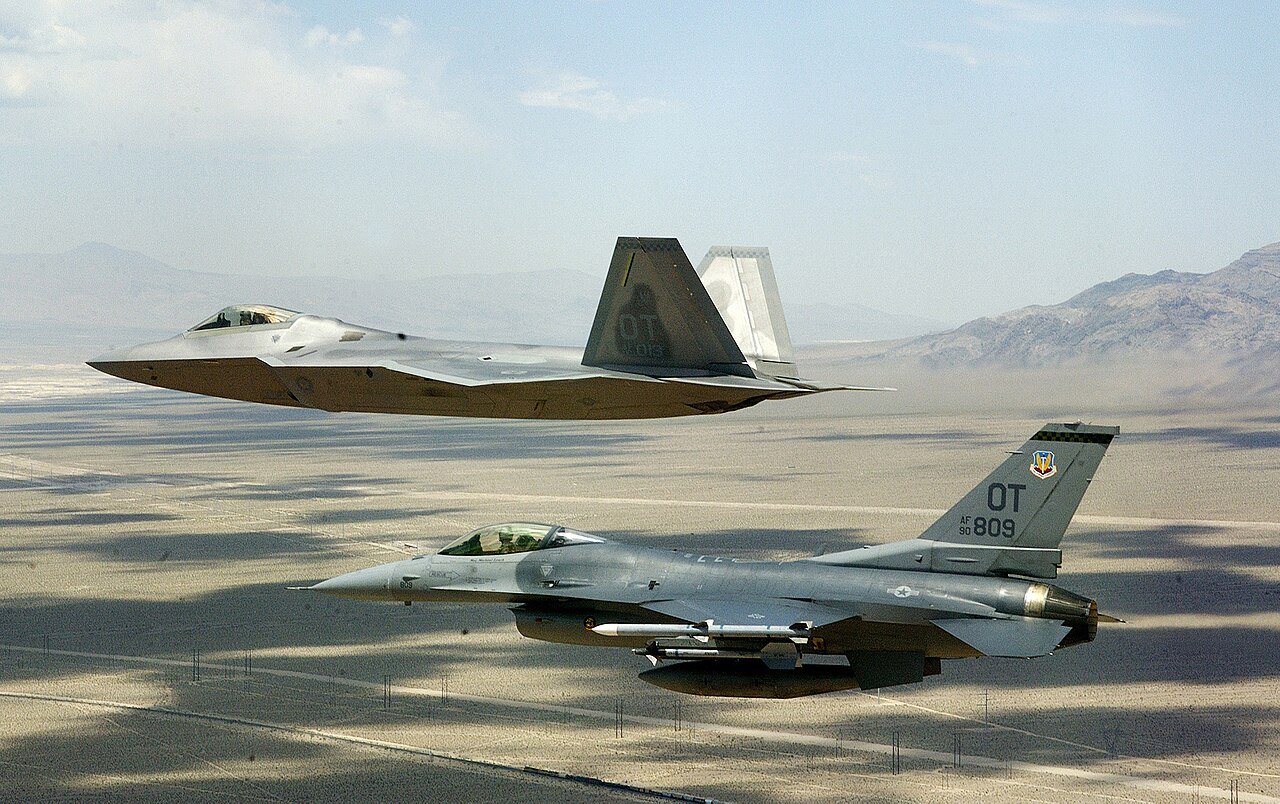
The leader’s half of the bargain is smoothness. Formation manuals all say the same thing: lead must provide a stable platform. Every jerky input up front is multiplied down the line, because each wingman is flying off the aircraft in front of him.
Fingertip, echelon, trail and line abreast
The basic shapes are few. In echelon, each aircraft sits behind and to one side of the one ahead, like rungs on a ladder, which is where the French word comes from. In trail, aircraft follow one behind the other. In line abreast, they fly side by side, which gives every pilot a clear view of the sky behind his neighbour.
The most famous is the four-ship fingertip, or finger-four: seen from above, the four aircraft sit like the tips of the fingers of a right hand. It was developed independently in the 1930s. The Finnish Air Force adopted pairs and fours in 1934 and 1935, while German pilots in the Spanish Civil War, Werner Mölders among them, developed it in 1938 with their new Bf 109 and were the first to use it in combat. We covered the tactical logic of the pair in why fighter pilots fly in pairs.
US Navy footage from inside the Blue Angels diamond during winter training near El Centro, California, in January 2015.
Lead, wing and the language of hands
The jobs are clearly split. US Navy formation instructions put it plainly: lead navigates the flight and makes all external radio calls, and must know where the wingman is at all times. The wingman’s primary responsibility is to maintain safe separation from lead, while backing up navigation and radio calls.
Much of the conversation happens without radios. The US Air Force’s formation signals pamphlet, AFPAM 11-205, says the signals reduce radio traffic and let pilots talk during radio silence. A thumb jabbed downward means gear down. Tapping the helmet near the ear means change frequency, followed by the digits on the fingers. A thumb tipped to the oxygen mask in a drinking motion asks for a fuel check. Dipping a wing sends the wingman into echelon on that side, and slowly rocking the wings means reform or tighten up. Often the only reply is a nod.
How display teams fly inches apart
Display teams take the same technique and remove the margin. The Blue Angels’ own description of the Diamond 360 says the diamond pilots fly at minimum wingtip-to-canopy separation, just 18 inches apart. Their Super Hornets have control sticks tensioned with 40 lb of spring force to leave minimal room for uncommanded movement, and pilots fly 120 training missions at El Centro each winter as the separation is gradually reduced.
Margins that small are not theoretical. In August 2019, Military.com reported, the No. 3 jet’s canopy touched the underside of the No. 1 jet’s wing during a Diamond 360 practice at Naval Air Station Pensacola. Nobody was hurt, the damage was a scratch, and the team stood down for a safety review before flying in Chicago that weekend.
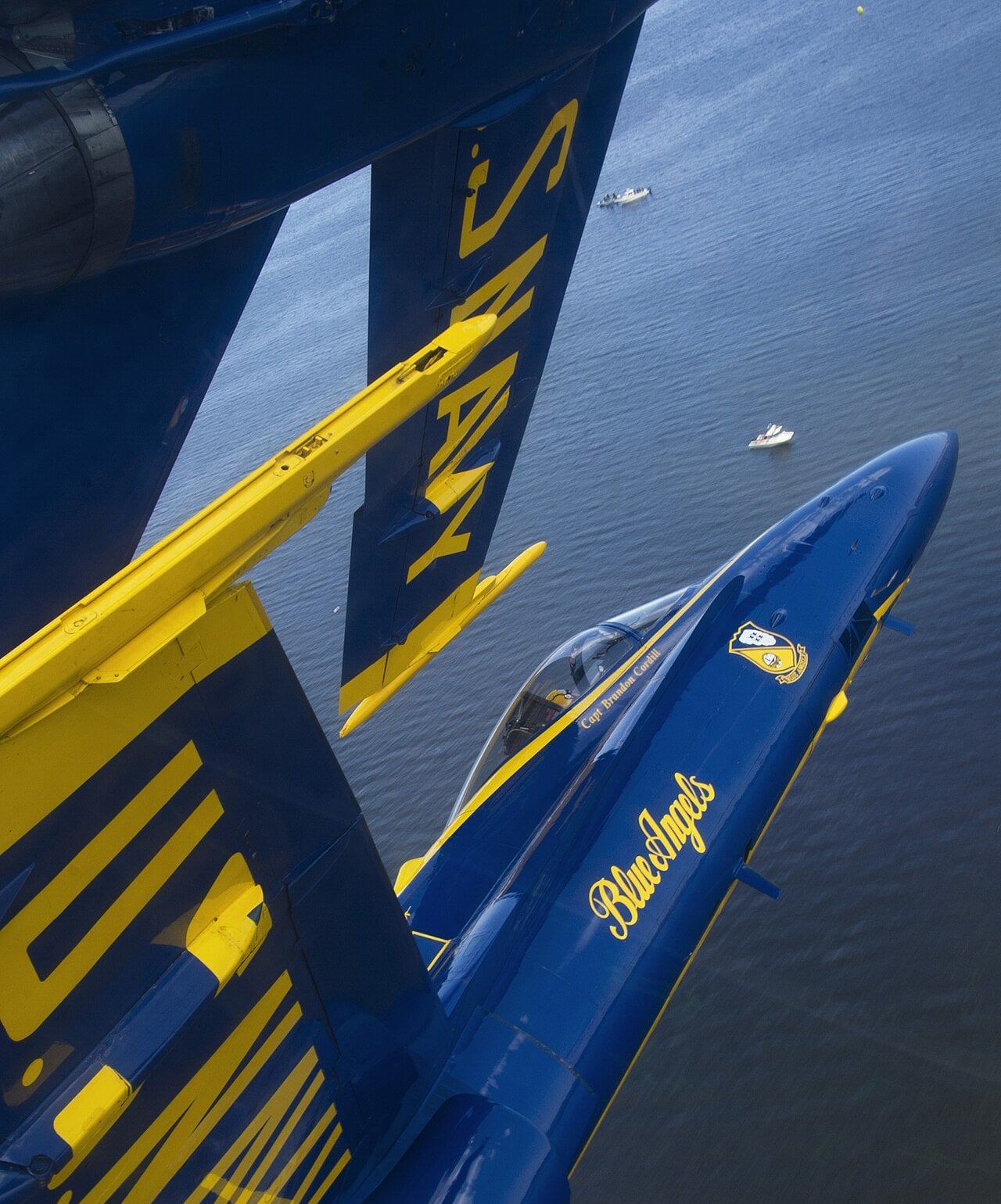
IL Red Arrows work slightly further apart and do something unusual. Front-line formation is flown purely by eye, each pilot reacting to the aircraft in front. The nine Hawk T1 pilots of the Royal Air Force team instead move on the leader’s voice, so that nine aircraft respond together rather than in a ripple. Each pilot keeps the same position for a whole season, and first-year pilots fly near the front, close to the leader.
Tom Scott flies with the Red Arrows and explains the surprisingly familiar skill behind holding a close formation.
Formation takeoffs and landings
Taking off together is a power problem. If both aircraft used full thrust, the wingman would have nothing left to correct with. So lead sets a briefed power setting below full, which gives the wingman a reserve. In the civil formation guide published by the Formation And Safety Team, the wingman lines up on the opposite side of the runway, slightly ahead of the normal bearing line, with at least 10 feet of wingtip clearance.
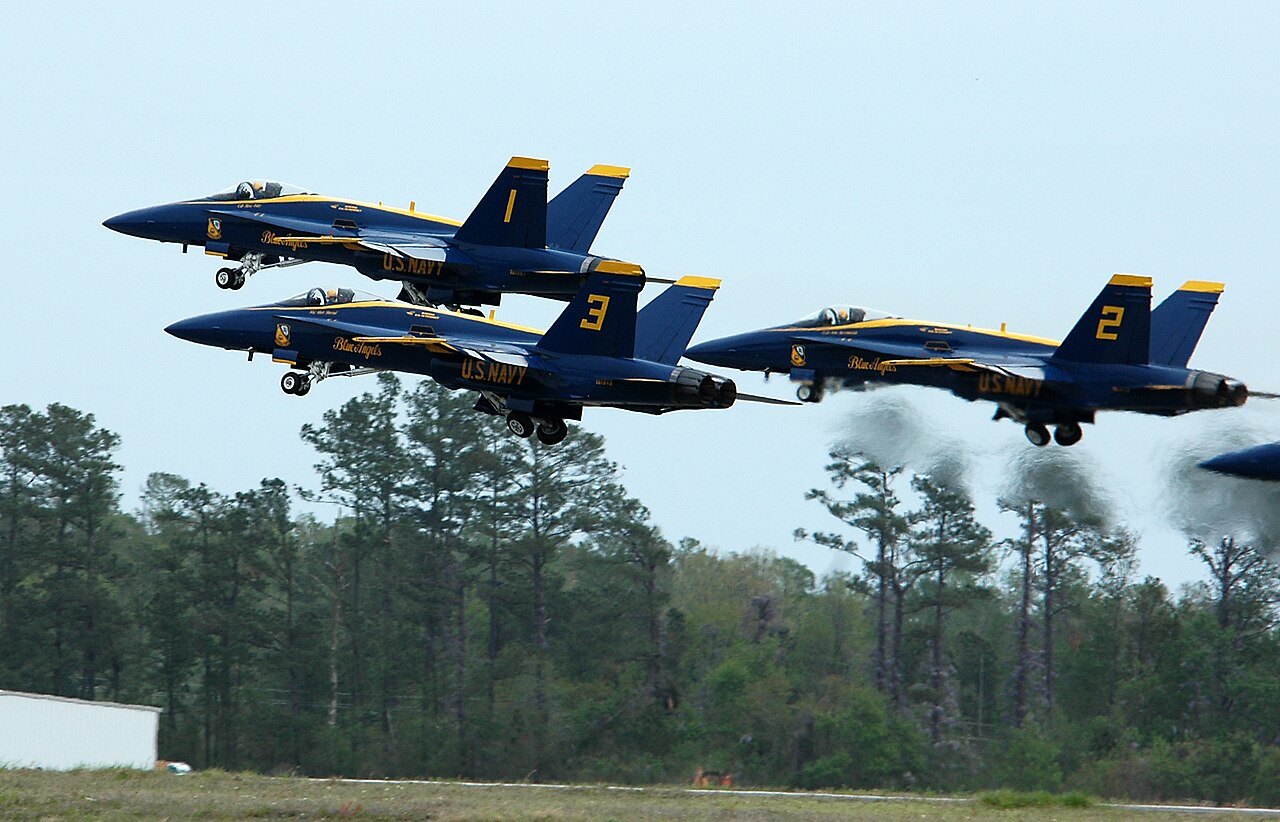
Landing works the same way in reverse. The wingman stays in position until fully configured and then keeps flying formation on lead all the way down, using the runway edge as a side reference. In Navy T-6B training, once below 80 knots on the runway, the wingman confirms “good brakes” on the radio.
Rejoins: getting back together
Formations split up for landing patterns, aerobatics or a solo pass, and then have to come back together. A rejoin can be flown in a turn, straight ahead, or a mix of both. In a turning rejoin the wingman cuts inside the leader’s circle, using geometry rather than raw speed to close the gap, and lines up a reference such as the top of lead’s fin against the outboard wingtip to stay on the bearing line.
The danger is closure. A wingman who is too acute or too fast arrives with energy he cannot kill, and the FAST guide says that in that case an underrun, passing safely below and behind lead, may be the only safe escape. Display teams make rejoins look instant. The Red Arrows’ pilots pull up to 6 g just to get back in position before the next manoeuvre.
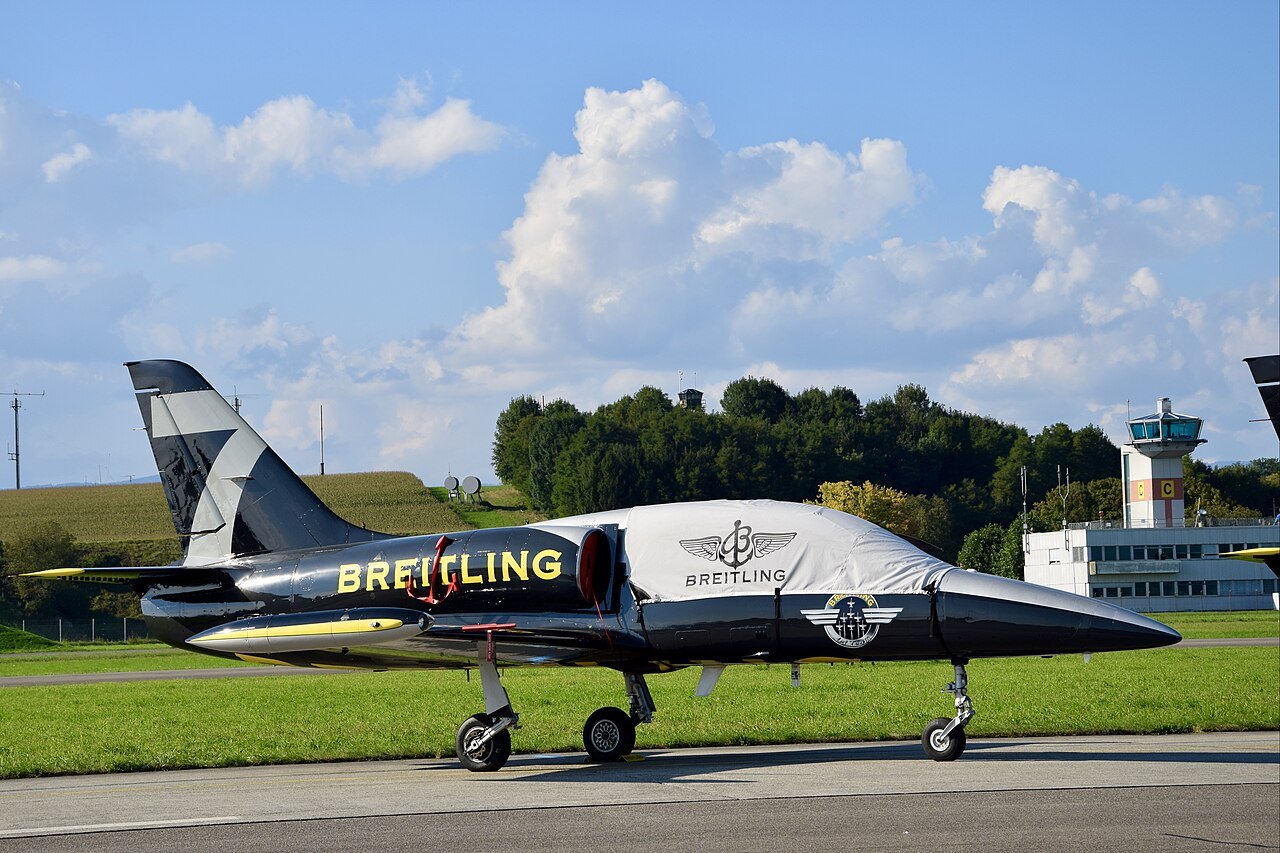
Civilian teams fly the same way. From 2003 the Breitling Jet Team, based at Dijon in France, flew seven L-39 Albatros jets in close formation and was the largest civilian aerobatic display team in Europe, until Breitling withdrew its sponsorship in 2019. The L-39 was designed in Czechoslovakia as a jet trainer, and close formation is one of the skills a trainer exists to teach.
From the ground, a tight formation looks like magic, or nerve. From the cockpit it is closer to concentration: an exhaust stack on a wing edge, an antenna over a cutout, a wingtip in the corner of the canopy. Hold the picture and the distance takes care of itself.
Sources: FAA Pilot/Controller Glossary (Formation Flight), 14 CFR 91.111, CNATRA VT-6 Formation Supplement (T-6B, 2022), CNATRA P-484, USAF AFPAM 11-205 (2018), Formation And Safety Team Formation Guide 2.0, US Department of Defense, US Navy Blue Angels, Smithsonian Air & Space Quarterly, How It Works, Military.com, Wikipedia (Finger-four; Werner Mölders; Echelon formation; Blue Angels; Red Arrows; Breitling Jet Team)
0 Comments