
Every fighter pilot knows the uneasy moment when the radar warning receiver lights up: someone, somewhere, is looking. Now imagine being tracked with no warning at all. No radar emission to detect, no tone in the headset, nothing for a jammer to fight. Just a sensor in an enemy jet quietly following the heat of your engines.
That is the job of infrared search and track, or IRST. It is one of the oldest ideas in fighter avionics and, after decades in the shadow of radar, one of the most fashionable again. Stealth is the reason: shaping and coatings can make a fighter hard for radar to see, but every aircraft that flies still has hot engines and a skin warmed by the air rushing past it.
Informazioni rapide
- Che cos'è: A passive sensor that finds and tracks aircraft by their infrared (heat) signature
- Emits: Nothing, so it cannot be detected or jammed like a radar
- First fitted: US interceptors of the late 1950s and 1960s: F-101, F-102 and F-106
- Revival: 1980s Soviet fighters: the MiG-29 and Su-27 sensor ball
- Modern examples: PIRATE (Typhoon), OSF (Rafale), Skyward-G (Gripen E), IRST21 and Legion Pod (Super Hornet, F-15, F-16), EOTS and DAS (F-35)
- Strengths: Passive, immune to radar jamming, precise angle measurement
- Limits: Shorter range than radar, degraded by cloud and weather, no direct range measurement
A camera that hunts
An IRST is, at heart, a very sensitive heat camera with a brain. Instead of staring at one spot like a thermal imager, it scans a volume of sky much as a radar does, picks out warm points against a cold background, and turns them into tracks that the pilot sees on a display. The crucial word is passive. The sensor sends out nothing, so it adds nothing to the aircraft’s own signature and gives the target no clue that it is being watched.
That passivity buys two things radar struggles with. An IRST cannot be blinded by radar jamming, because it does not use radio waves at all. And because infrared wavelengths are far shorter than radar wavelengths, it can measure the direction to a target very precisely. Leonardo, which builds IRSTs for the Eurofighter Typhoon e il Gripen, sums up the appeal plainly: the sensor detects other aircraft’s heat but cannot be detected in return.
The heat comes from two places. Engine exhaust is the obvious one, which is why a target seen from behind shows up much further away than one approaching head-on. But a fast jet’s skin is also warmed by friction with the air, so even the nose of an aircraft pointed straight at you is warmer than the frigid sky around it. At high altitude, where the air is thinner and colder, both effects work in the sensor’s favour.
Born on the interceptors
The first IRSTs appeared on American interceptors built to stop Soviet bombers: the F-101 Voodoo, the F-102 Delta Dagger and the F-106 Delta Dart, which received a production retractable mount in 1963. Early F-4 Phantom carried one in a bulge under the nose. In Sweden, the Saab 35 Draken got an American-made Hughes unit.
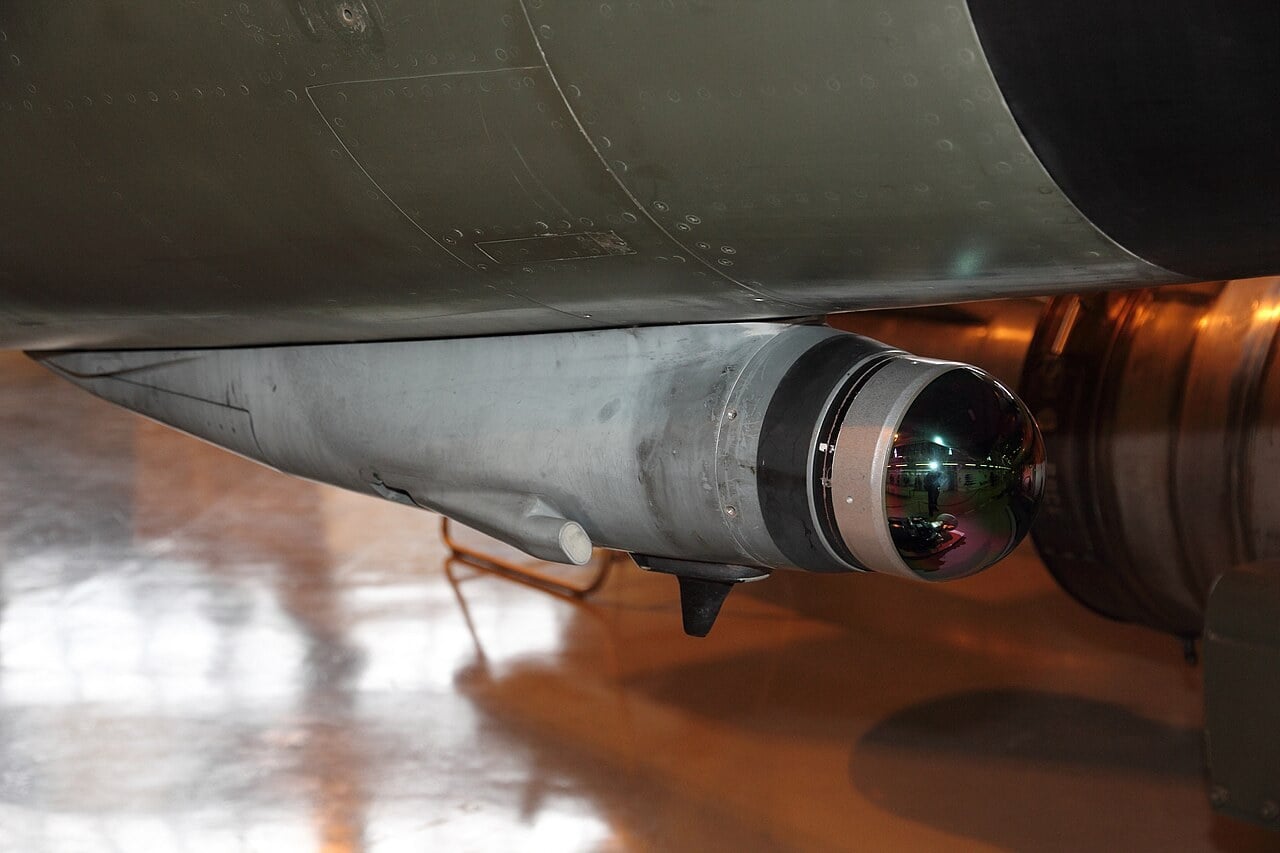
These were simple devices. A sensor behind a rotating shutter produced a “pip” on a small scope, and its main use was to tell the radar operator roughly where to point a radar that still had to be locked on by hand. Once radars could lock on by themselves, the early IRSTs looked like dead weight, and many designs dropped them.
IL F-14 Tomcat shows the arc. The first F-14As carried the AN/ALR-23 infrared sensor under the nose, but it proved unreliable and was replaced by a television camera set. The later F-14D brought the idea back with the new AN/AAS-42 IRST, mounted side by side with the camera in the twin chin fairing.
Millennium 7 asks whether infrared detection can replace radar, from the early interceptors to today’s IRST pods.
The Soviet ball in front of the canopy
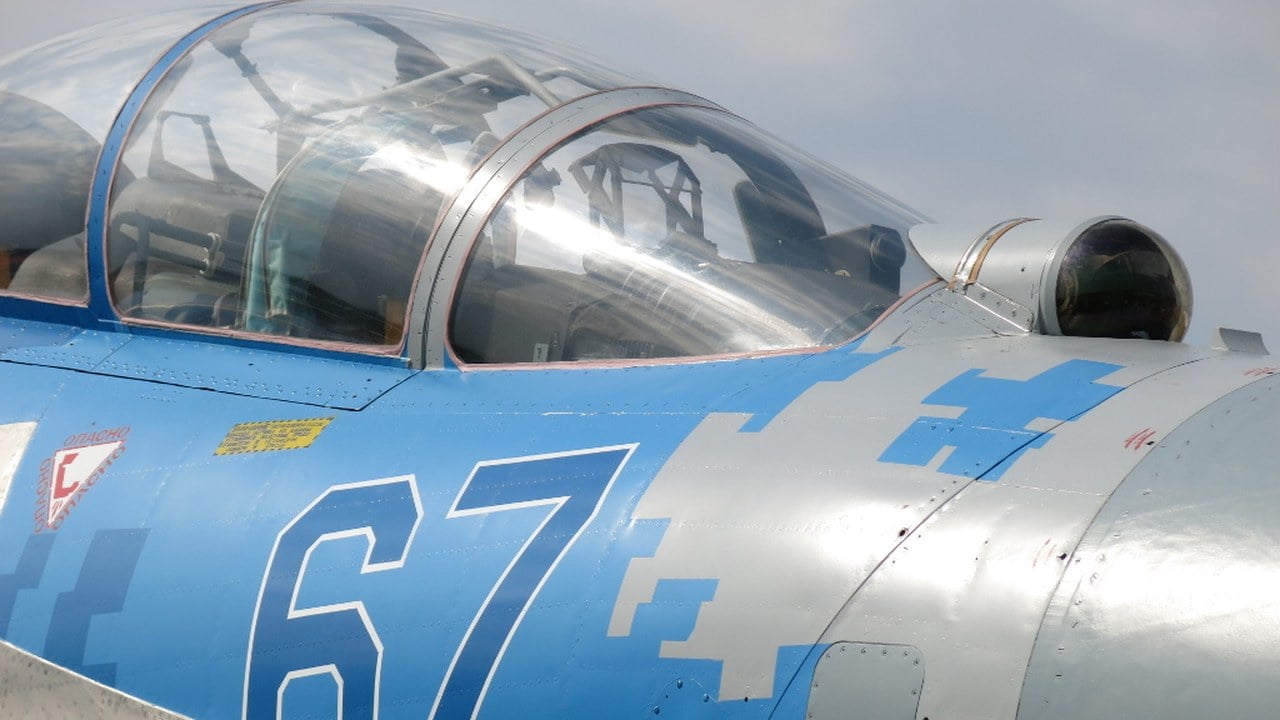
While Western designers drifted away from IRST, Soviet designers built it into their new fighters. The MiG-29 E Su-27 of the 1980s carried a glass ball just ahead of the windscreen. On the Su-27 it is the OLS-27; on the MiG-29 the infrared sensor sits together with a laser rangefinder, and both work with a helmet-mounted sight.
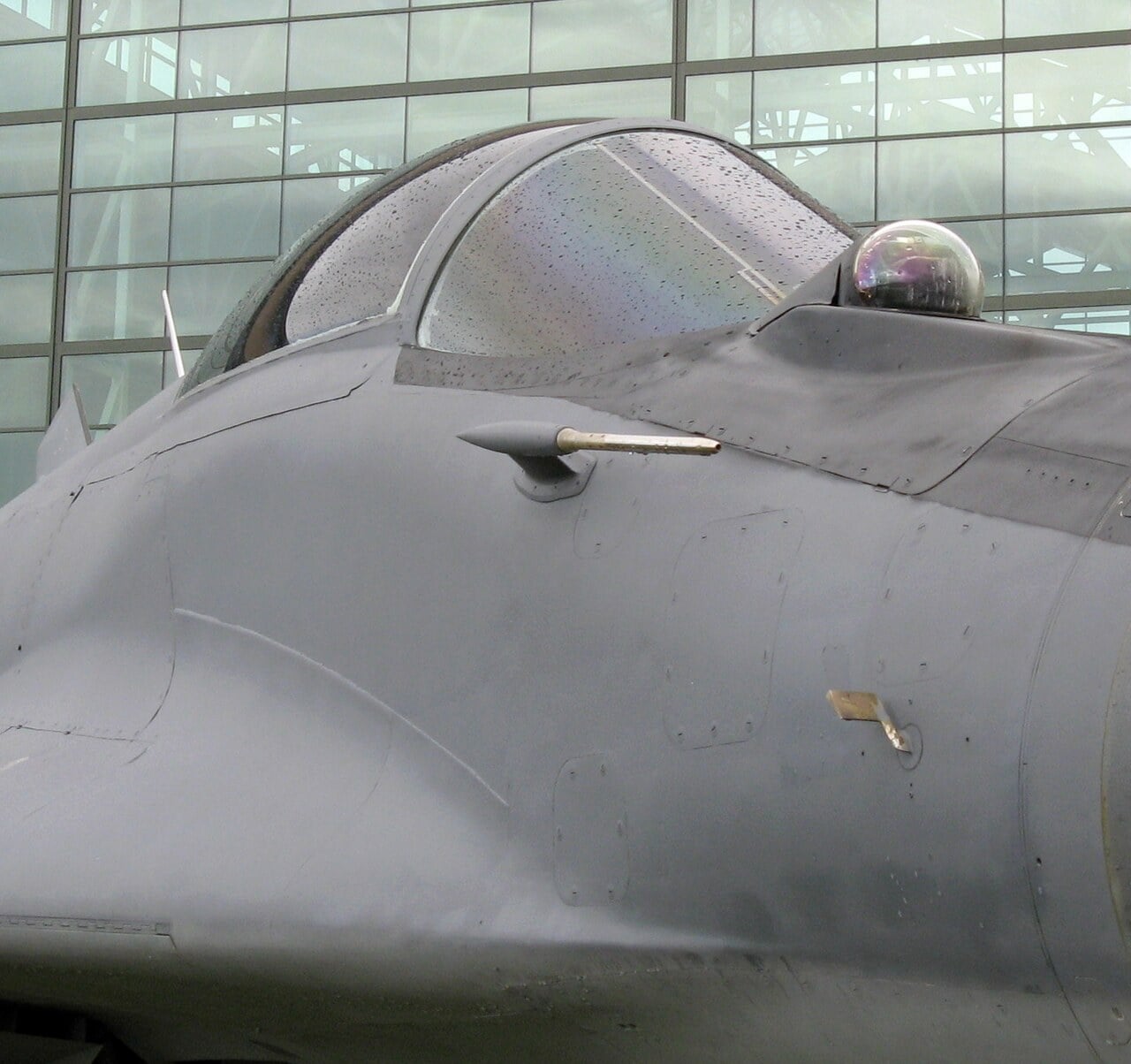
The idea was tactical as much as technical. A Soviet pilot under the direction of a ground controller could be steered towards a target by radar on the ground, then pick it up with his own IRST and fire a heat-seeking missile without ever switching on his own radar. Even when the radar did come on, it could be locked on just before the shot, cutting the warning the target received to seconds.
Europe and America catch up
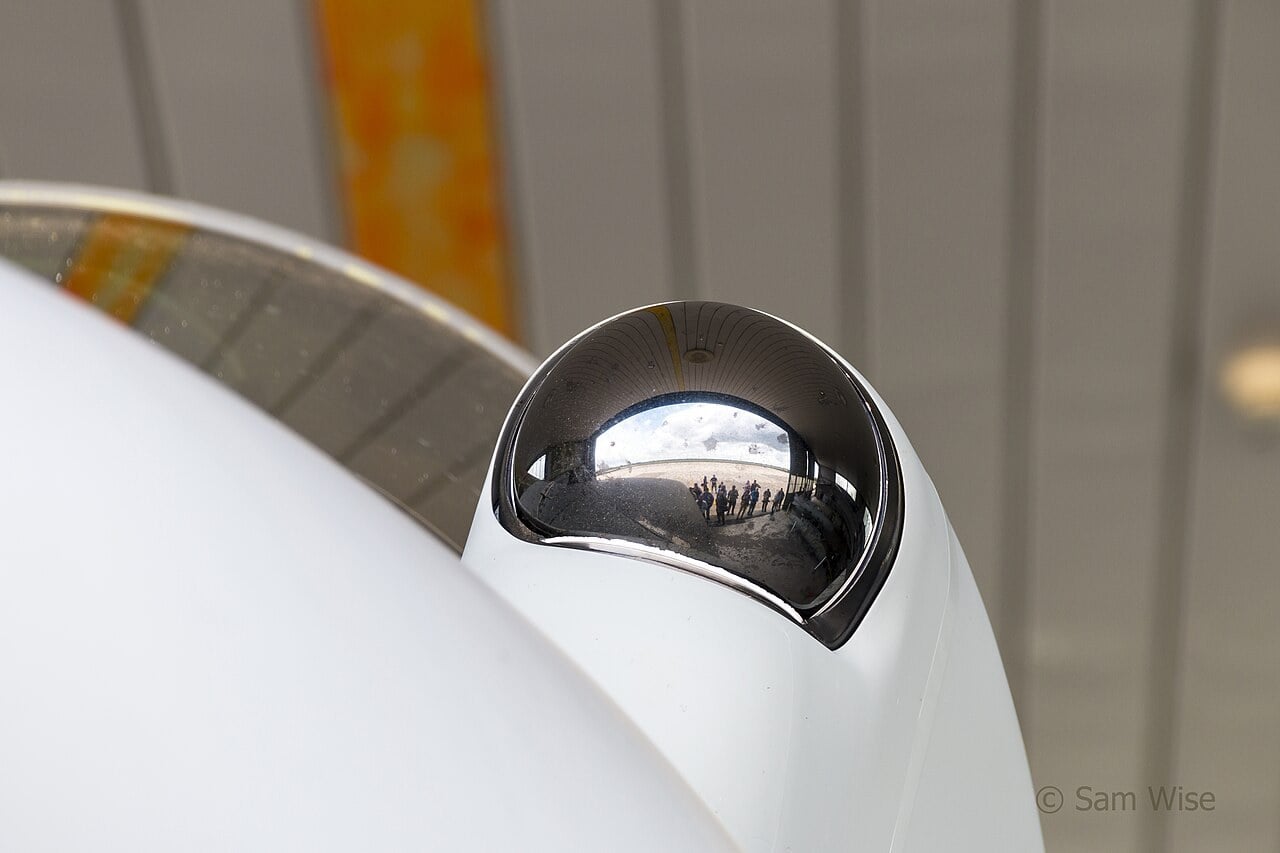
The new generation of European fighters treated passive sensing as a core feature. The Typhoon’s PIRATE, built by a consortium led by Leonardo with Thales and Tecnobit, sits on the port side of the nose ahead of the windscreen. Dassault’s Rafale carries the OSF, which pairs an infrared search channel with a second sensor and a laser rangefinder for identifying targets. The Gripen E for the Swedish Air Force uses Leonardo’s Skyward-G.
The United States came back to IRST through pods. Lockheed Martin’s IRST21 sensor went into the Block III Super Hornet, and the podded version, the Legion Pod, now flies on the F-15 E F-16. In 2020, an F-15C fired an AIM-9X using the Legion Pod for targeting.
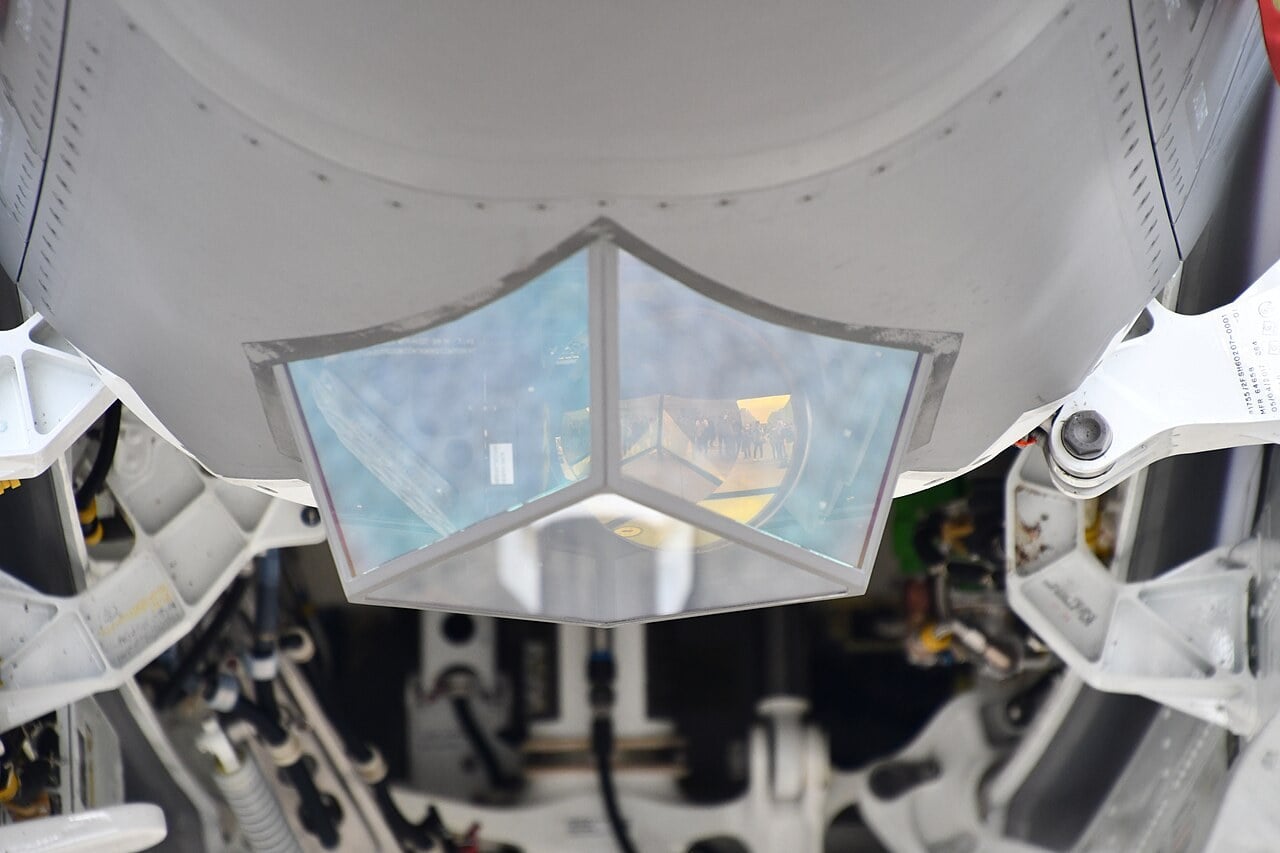
IL F-35 takes the idea furthest. Its chin-mounted EOTS was the first sensor to combine a forward-looking infrared camera with IRST functions, and its Distributed Aperture System uses six infrared sensors around the airframe to watch in every direction at once, detecting aircraft and missiles. How those feeds merge with the radar is a story of its own, told in our piece on F-35 sensor fusion.
Lockheed Martin’s overview of the F-35’s Electro-Optical Targeting System, which combines a FLIR camera with IRST.
What an IRST cannot do
Infrared has hard limits. Clouds, rain and humid air soak up heat radiation, so an IRST’s range is shorter than a radar’s and it suffers in bad weather. Detection range also swings with altitude, air temperature and the target’s aspect and speed. And spotting a warm dot is not the same as knowing what it is: the range at which a target can be identified confidently is well short of the range at which it is first seen.
The biggest catch is distance. A radar measures range directly by timing its echo. An IRST only knows direction. Engineers work around this in several ways: a laser rangefinder, as on the MiG-29 and Rafale, at shorter distances; kinematic ranging, in which the system watches how the target’s bearing changes as both aircraft move and estimates distance from the geometry; or several sensors looking at the same target from different places.
That last approach is where IRST is heading. In September 2026, Lockheed Martin announced flight tests in which two F-16s with Legion pods shared data over a new pod-to-pod link. The company says this gives aircrews near-instant range to multiple targets, a kind of depth perception, without relying on radar.
The quiet hunter’s comeback
IRST is not a radar killer. It sees less far, hates clouds and needs help with range. But it is the one long-range sensor that never gives its owner away, and it looks for the one thing no stealth aircraft can completely hide. It pairs naturally with the heat-seeking missiles that grew up alongside it.
Northrop Grumman footage of the F-35’s Distributed Aperture System, the six infrared sensors that watch all around the jet.
Sixty years after the first IRSTs drew pips on interceptor scopes, the glass eye in front of the canopy is back on almost every new fighter. In a sky full of jammers and stealthy shapes, the quietest sensor may be the one that gets the first look.
Sources: Wikipedia (Infrared search and track; EuroFIRST PIRATE; Grumman F-14 Tomcat; Sukhoi Su-27; Optronique secteur frontal; AN/AAQ-37), Lockheed Martin, Leonardo, Breaking Defense, GlobalSecurity, Military Periscope, AvGeekery


0 Comments