
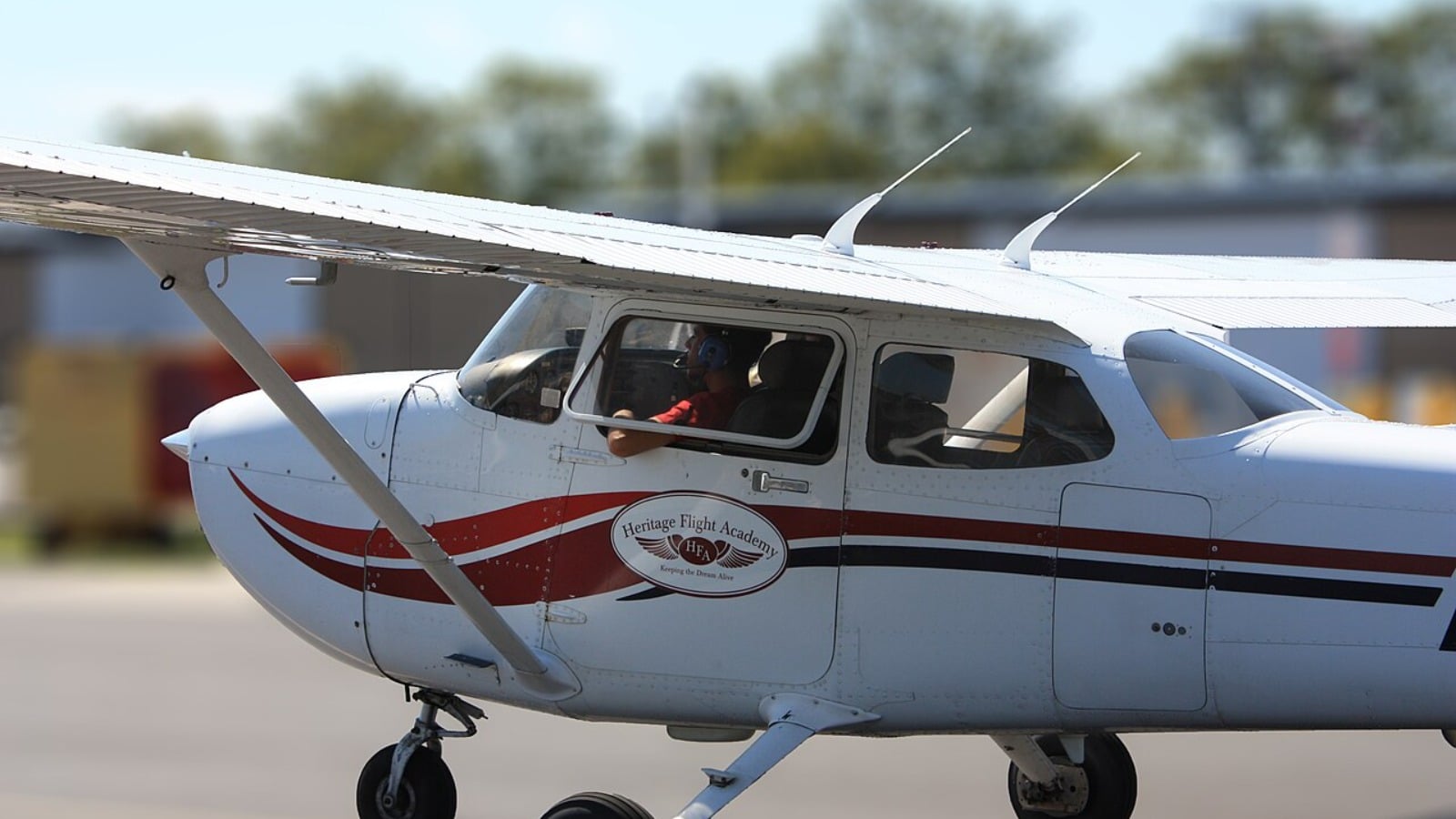
Every brochure for an American flight academy has the same photograph in it. Blue sky, a white Cessna, a young person with a headset and an expression of enormous good fortune. The copy underneath explains how many months it takes and how much it costs, and both numbers are honest.
What the brochure does not explain is that if the reader is not American, roughly half of the system that makes those numbers work is closed to them.
The United States trains a very large share of the world’s airline pilots, and it does it cheaply by global standards because of one structural fact: nearly everybody pays for the expensive middle of their career by working as a flight instructor. That is the engine. And for a foreign student on the obvious visa, instructing is employment, employment is almost entirely prohibited, and the engine will not start.
Quick Facts
Visa for a standalone flight academy: M-1, the vocational student visa
Visa for a university aviation degree: F-1, the academic student visa
School must be: certified by the Student and Exchange Visitor Program (SEVP) and able to issue a Form I-20
I-901 SEVIS fee: $350 for F and M applicants, paid before the visa interview
TSA security threat assessment: required of every non-US citizen before any flight training, under 49 CFR Part 1552
TSA fee: $140 standard, $125 reduced, valid up to five years
M-1 employment: prohibited, except practical training after the course ends — one month earned per four months of study, six months maximum
F-1 practical training: 12 months per educational level, plus curricular practical training during the course
US federal student loans: not available (34 CFR 668.33)
The TSA Checks You Before the Instructor Does
Before a non-US citizen may sit in a training aircraft in the United States — or in a simulator, or in many cases anywhere in the world with an FAA-certificated provider — the Transportation Security Administration has to say yes.
The programme used to be called the Alien Flight Student Program. Since a final rule published on 1 May 2024 it is the Flight Training Security Program, and 49 CFR Part 1552 was rewritten around it. The rule is blunt about the sequence: no flight training provider may provide flight training to anyone before establishing that the individual is a US citizen, a US national, a Department of Defense endorsee, or a candidate holding a valid Determination of Eligibility from TSA.
Getting that determination means biographic and biometric data, identity documents, an immigration check and an FBI fingerprint-based criminal history records check. TSA says it will process a complete application within 30 days.
The 2024 rule did make it dramatically cheaper. The old system charged per training event and per category of aircraft; TSA’s own analysis of a five-year window found that most candidates paid for between three and twelve separate assessments and event notifications, a combined total of $350 to $840. The replacement is a single time-based assessment: $140, or $125 if you already hold a comparable US government background check, valid for up to five years.
One caveat that catches people out. If your permission to be in the United States expires before the five years are up, so does the determination. The rule ties them together explicitly.
M-1 or F-1, and Why the Choice Decides Everything
A standalone flight academy is, in immigration terms, a vocational school. The visa that matches it is the M-1. A university that teaches an aeronautical science degree with flight training inside it is an academic institution, and its students come in on an F-1.
Either way the school has to be certified by the Student and Exchange Visitor Program and able to issue a Form I-20, and either way the student pays the I-901 SEVIS fee of $350 before the visa interview. On paper the two look like near-neighbours.
They are not. The difference is in what you may do afterwards, and it is severe.
| M-1 (vocational) | F-1 (academic) | |
|---|---|---|
| Typical school | Part 141 flight academy | University aviation degree |
| Work during the course | None | Curricular practical training, where the curriculum requires it |
| Work after the course | Practical training only: one month earned per four months studied, six months maximum, in the aggregate | 12 months of practical training, and another 12 at a higher educational level |
| Changing schools | Not within the first six months, absent circumstances beyond the student’s control | Standard transfer procedure |
| US federal student aid | No | No |
Sources: 8 CFR 214.2(f) and 214.2(m); 34 CFR 668.33. Compiled by Afterburner — MiGFlug’s Magazine.
The six-month ceiling is the whole story, and the regulation says it in one line.
And in case there is any doubt about the baseline, paragraph (m)(13) is twelve words long: except as provided in the practical training paragraph, a student may not accept employment.
Now put that next to the American career ladder. A commercial certificate takes roughly 190 to 250 hours, depending on whether the school trains under Part 141 or Part 61. An airline wants 1,500, or 1,000 to 1,250 with the right degree. Almost nobody rents an aeroplane for the gap; our own arithmetic on hour building put the rental cost of the 1,250-hour version at between $131,250 and $289,125 in aircraft alone. The way out, for an American, is to become a flight instructor and be paid to accumulate the hours.
An M-1 graduate gets six months of that, at most, and only if the Designated School Official certifies the job is related to the course and that comparable work is not available at home. Six months of instructing does not get anyone to 1,500 hours.
A first-person account of making the jump from student to a US regional airline, covering both visa routes. It is the clearest explanation of why so many international students pick the university path even though it costs more.
The Money, and the Door That Is Bolted
American students borrow. The federal loan system is the reason a $100,000 training bill is survivable at twenty-two years old. That system is defined by Title IV of the Higher Education Act, and the eligibility rule is short enough to read in one breath.
A student visa is, by definition, a temporary purpose. An F-1 or M-1 holder cannot satisfy that paragraph, which means no Pell, no Direct Loan, and no Direct PLUS. The published sticker prices at the big academies — and they are published, which is more than can be said for much of this industry — therefore have to be met from family money, a loan raised in the student’s own country, a sponsoring airline, or a cadet programme.
That last option is why so much international training in the United States is bought wholesale rather than retail. An airline in Asia, the Gulf or Europe contracts with an American academy, sends a cohort, pays the bill, and takes the graduates home. The student never personally faces the financing question, and never needs the instructing ladder either, because the job is waiting.
For the individual arriving on their own money, the arithmetic is unforgiving, and it is worth being honest that the brochure number is not the whole number. On top of tuition sit the I-901 fee, the visa application fee, the TSA assessment, the FAA medical, the written and practical test fees, and living costs in a part of Florida or Arizona chosen for its weather rather than its rents.
A breakdown of what flight training actually costs in the United States, written for domestic students. Read it as the floor, not the total, if you are coming in on a visa.
The Interview Nobody Prepares For
There is one more obstacle, and it is the least technical and the most decisive. A student visa is a nonimmigrant visa, and the applicant has to persuade a consular officer that they intend to leave the United States when the course ends.
That is an awkward thing to be asked by someone training for a career in a country that is short of pilots. The honest answer for a lot of applicants — that they would like to fly for an American airline — is the wrong answer at the window. The correct and usually truthful one is that the FAA certificate is the most portable qualification in aviation and that it converts, with paperwork, almost anywhere.
TSA has its own version of the same scrutiny. Under 49 CFR 1552.35, any history of a denied United States visa may count against a candidate’s eligibility for flight training, and the rule says so regardless of where the training will take place.
One Change That Caught Americans Too
A footnote worth knowing, because it surprised a lot of US instructors. The 2024 rule does not only cover foreign nationals. Section 1552.1 lists four groups within scope, and the fourth is United States citizens and US nationals who participate in flight training.
Americans do not need a TSA security threat assessment. But a provider must now examine government-issued proof of citizenship before training them, and keep a record of having done so — which can be a logbook endorsement naming the document and its number. A student who claims to be a US citizen and cannot produce acceptable identification must be refused training. For the first time, the paperwork that used to be the foreign student’s alone now touches everybody at the airfield.
Scholarships are the one financing route that is genuinely open to people the federal loan system excludes, and there are more of them than most applicants realise.
What It Adds Up To
None of this makes the United States a bad place for a foreign student to learn to fly. The weather is good, the airspace is busy enough to teach something, the aircraft are plentiful and the certificate travels. Thousands of people do it every year and it works.
What it means is that the American system cannot be copied wholesale. The domestic route — train cheaply, instruct for two years, walk into a regional cockpit — rests on a right to work that a visa does not confer. A foreign student has to buy outright what an American earns back. Either the family finds the whole sum, or an airline does, or the student picks the longer, costlier university route for the sake of twelve months of practical training instead of six.
The brochure photograph is true. It just leaves out which door the reader is standing at.
Sources: 49 CFR Part 1552, read from the GPO Code of Federal Regulations XML on govinfo; Flight Training Security Program final rule, 89 FR 35580, 1 May 2024; 8 CFR 214.2(f) and 214.2(m); 34 CFR 668.33; US Immigration and Customs Enforcement, I-901 SEVIS fee.

0 Comments