
In 1945 Japan’s aircraft industry was not just defeated, it was switched off. The post-war restrictions banned Japanese firms from aircraft research and from making aircraft materials and equipment. The country that had built the Zero spent the next two decades flying American fighters.
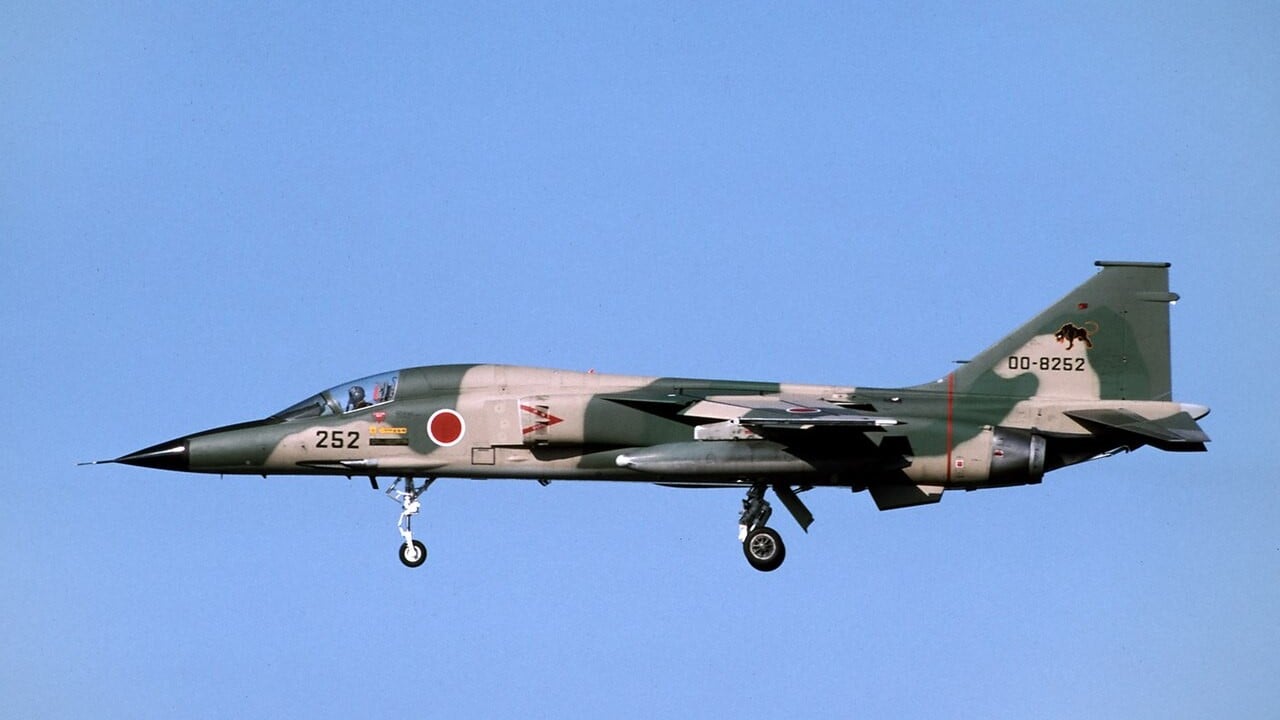
The Mitsubishi F-1 was the way back. First flown on 3 June 1975, it was Japan’s first domestically developed supersonic combat aircraft and the first Japanese-developed jet combat aircraft since the Second World War. It was also, quite literally, a trainer with the back seat taken out.
Quick Facts
- Aircraft: Mitsubishi F-1 single-seat support fighter
- Derived from: Mitsubishi T-2 supersonic trainer (first flight 20 July 1971)
- First flight: 3 June 1975 (FS-T2kai prototype)
- Engines: Two Ishikawajima-Harima TF40-IHI-801A (licence-built Adour) afterburning turbofans
- Armament: 20 mm JM61A1 cannon; ASM-1/ASM-2 anti-ship missiles, AIM-9 Sidewinders, bombs and rockets on seven stations
- Built: 77 (planned 160)
- Operator: Japan Air Self-Defense Force only
- Retired: 9 March 2006, 6th Squadron, Tsuiki
A trainer first
The story starts with a gap in the training syllabus. In the 1960s the Japan Air Self-Defense Force trained its pilots on the subsonic Fuji T-1, then sent them on to Mach 2 fighters such as the F-104J Starfighter and the F-4EJ Phantom. The jump was too big. The JASDF wanted a supersonic trainer, and one that could later be turned into a single-seat attack aircraft.
It looked abroad first. The Northrop T-38 Talon was considered, and so was the Anglo-French SEPECAT Jaguar, which could do both jobs; Japan reportedly negotiated over licence production. Instead it chose to design its own. In September 1967 Mitsubishi’s proposal, led by designer Dr. Kenji Ikeda, beat rival designs from Fuji and Kawasaki.
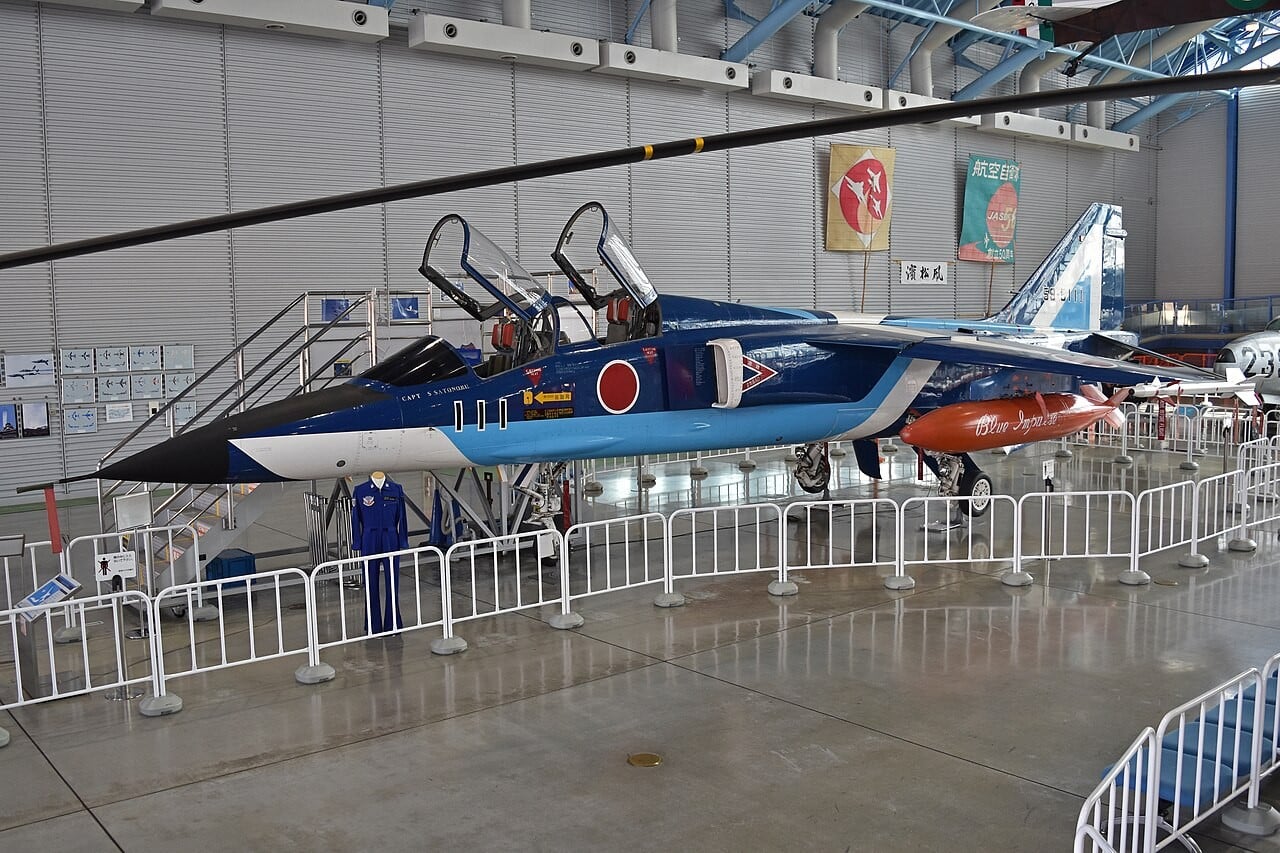
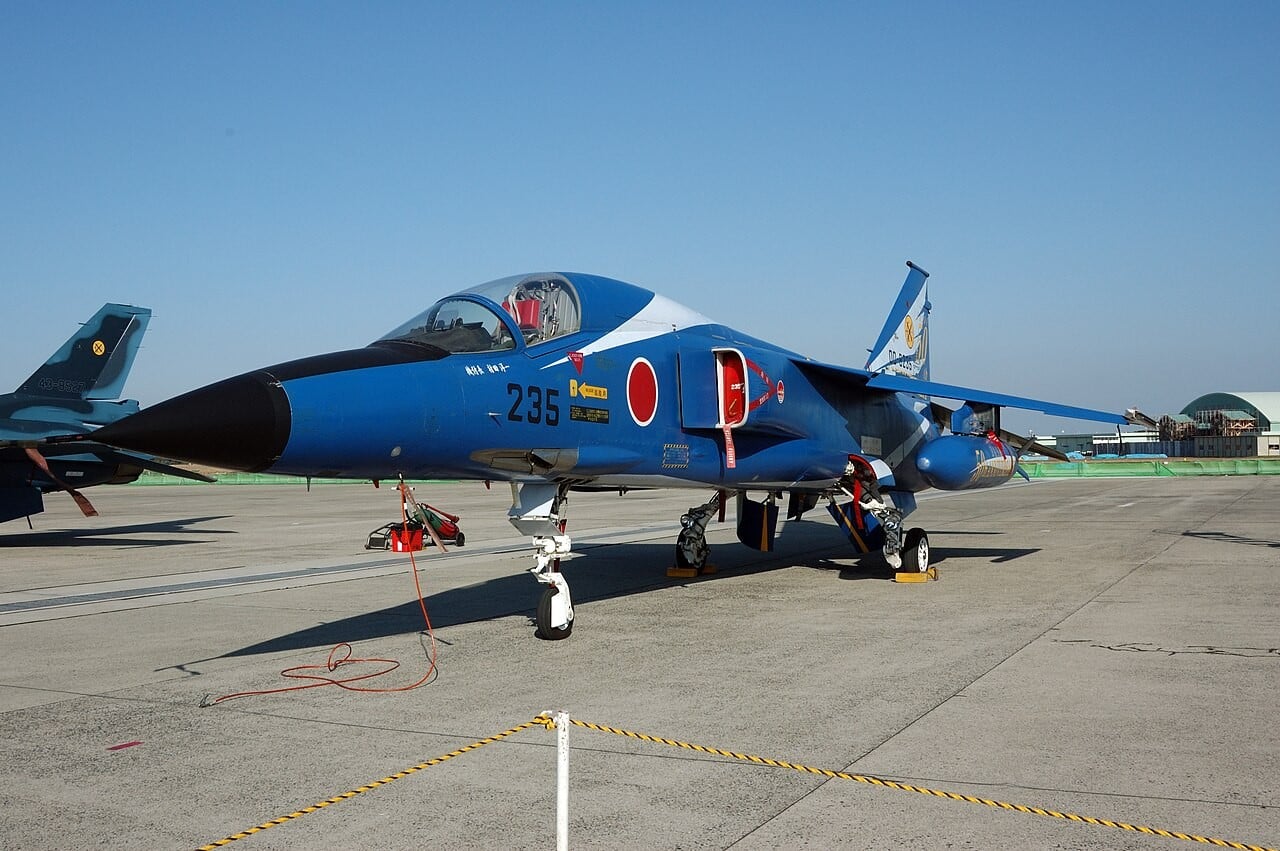
The XT-2 prototype rolled out on 28 April 1971 and flew on 20 July 1971. It became the first aircraft of Japanese design to break the sound barrier in level flight. Production T-2s reached the JASDF in the mid-1970s, and from the early 1980s the type also flew with the Blue Impulse display team.
“A Japanese Jaguar”?
Put a T-2 next to a two-seat Jaguar and the family resemblance is hard to miss: high-mounted swept wings, twin engines, spoilers instead of ailerons, a fixed ventral fin under each exhaust. Both even used the same engine, the Rolls-Royce Turbomeca Adour, built under licence in Japan by Ishikawajima-Harima as the TF40-IHI-801A.
It was not a copy. The T-2 is noticeably longer with a shorter wingspan, giving it a more dart-like shape, and since the JASDF had no rough-field requirement it uses conventional single-wheel landing gear rather than the Jaguar’s heavy-duty undercarriage. Each engine produced about 32.5 kN in afterburner, and the Japanese engines never received the uprated Adours later fitted to RAF Jaguars, so the type stayed somewhat underpowered.
Weapon Detective compares the Mitsubishi T-2 and F-1 with the SEPECAT Jaguar they are so often likened to.
Taking the back seat out
In 1972 the JASDF announced that a strike derivative of the T-2 would replace its ageing F-86 Sabres. Cost overruns on the T-2 nearly killed the idea. What saved it was another cancellation: when the Kawasaki P-XL maritime patrol aircraft was dropped, funds were released and Japan’s industry needed the work. Development contracts for the FS-T2kai followed in 1973, and two T-2s were converted as prototypes.
The conversion was deliberately minimal. The rear cockpit became an avionics bay under an unglazed access hatch. The airframe was strengthened, two extra underwing hardpoints were added for a total of seven stations, and the avionics gained a Ferranti inertial navigation system, a Thomson-CSF head-up display, a J/ASQ-1 bombing computer and a J/AWG-12 radar. A 20 mm JM61A1 Vulcan cannon with 750 rounds sat in the fuselage.
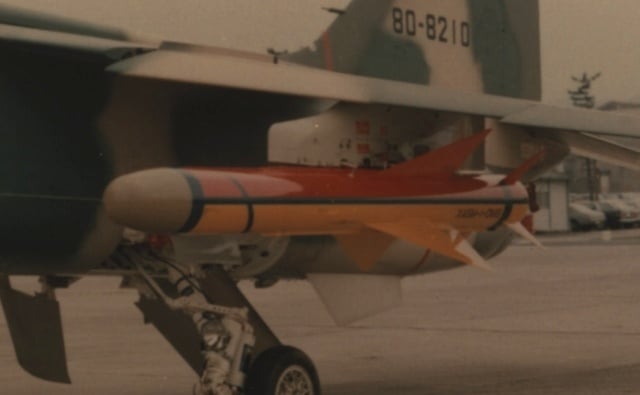
The result was a long, slim dart: 17.86 metres from nose to tail but only 7.88 metres across the wings, with a maximum take-off weight of 13,674 kg. Fully loaded with weapons and fuel tanks, it was considered underpowered, but budget limits ruled out new engines.
The first FS-T2kai flew on 3 June 1975. Redesignated F-1, the first production aircraft flew on 16 June 1977 and was delivered on 16 September 1977, according to the aviation reference site MILAVIA.
Built to sink ships
The F-1 was never meant to dogfight. Its primary weapon was the ASM-1, a Japanese anti-ship missile in roughly the same class as the Harpoon or Exocet, later joined by the improved ASM-2. Its job was to meet an invasion fleet at sea, with AIM-9 Sidewinders on the wingtips for self-defence and a secondary air-defence role.
Archive footage of JASDF Mitsubishi T-2s flying with the Blue Impulse aerobatic team.
Its limits as a fighter were well understood. It was not especially manoeuvrable, and the JASDF counted on better radar, discipline, training and missiles to make up the difference. Budget cuts trimmed the planned order of 160 aircraft to 77.
The F-1 went operational in April 1978 with the 3rd Squadron of the 3rd Air Wing at Misawa Air Base. The 8th Squadron at Misawa followed, and the 6th Squadron of the 8th Air Wing at Tsuiki became the third and final F-1 unit on 1 March 1981. The last of the 77 was delivered on 9 March 1987.
Thirty years at the front line
Replacement talks began in the mid-1980s, but the successor programme took years. In the 1990s, 70 F-1s went through a service life extension that raised airframe life from 3,500 to 4,000 hours. Its eventual replacement was the Mitsubishi F-2, developed from the F-16, with upgraded F-4EJ Kai Phantoms filling the gap.
The 3rd Squadron at Misawa completed its switch to the F-2 by early 2001. The 6th Squadron at Tsuiki kept going until 9 March 2006, when it retired the last six F-1s, their airframes having reached the 4,000-hour limit. The T-2 trainers were withdrawn the same year, replaced by the Kawasaki T-4.
The F-1 support fighter’s last flight at Tsuiki Air Base.
The F-1 never fired a shot in anger, which for an anti-invasion aircraft is not a failure. It proved Japan could again design, build and support its own supersonic combat jet, and the line it started runs straight through the F-2 to the GCAP fighter Japan is now building with Britain and Italy.
Sources: Wikipedia (Mitsubishi F-1; Mitsubishi T-2), MILAVIA, Japan Air Self-Defense Force
0 Comments