
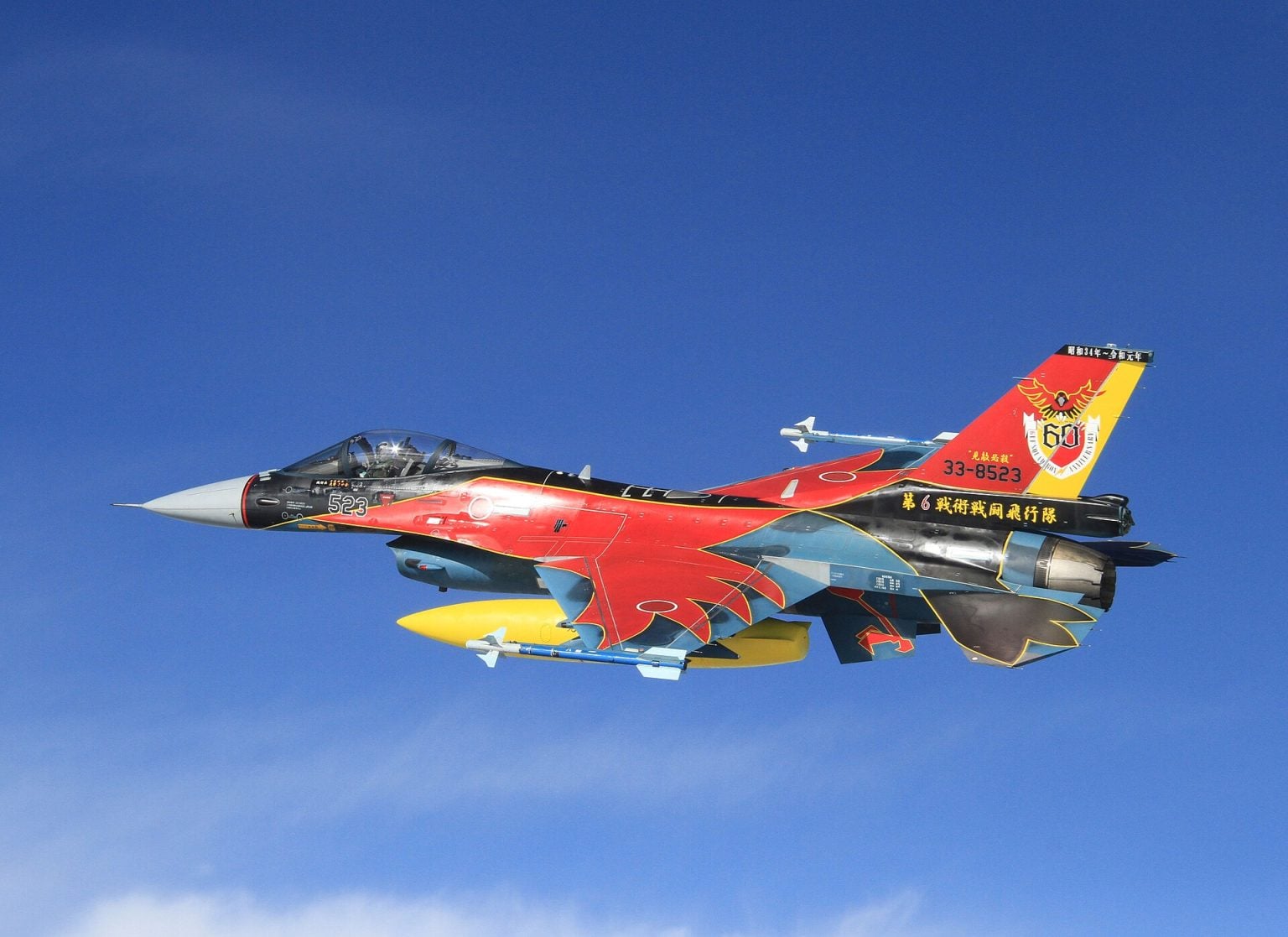
Mitsubishi F-2
“Viper Zero”
Japan’s F-16-derived multirole fighter — an enlarged, composite-winged Fighting Falcon built to hunt ships over the sea, and one of the first fighters in the world to enter service carrying an active electronically scanned array radar.
Japan’s F-16, remade for the sea
In the 1980s Japan set out to replace its ageing Mitsubishi F-1 strike jets with a modern fighter, and it wanted to build that aircraft itself. The programme was called FS-X, and Japanese industry pushed hard for a wholly indigenous design. Washington objected. What followed was one of the most politically charged defence deals of the decade: amid intense US–Japan trade friction, the two governments agreed in the late 1980s that the new fighter would instead be developed from an American design — the General Dynamics (later Lockheed Martin) F-16, specifically the enlarged “Agile Falcon” study. Mitsubishi Heavy Industries became prime contractor, with an American share of the work and a transfer of F-16 technology in one direction and Japanese know-how flowing back the other way.
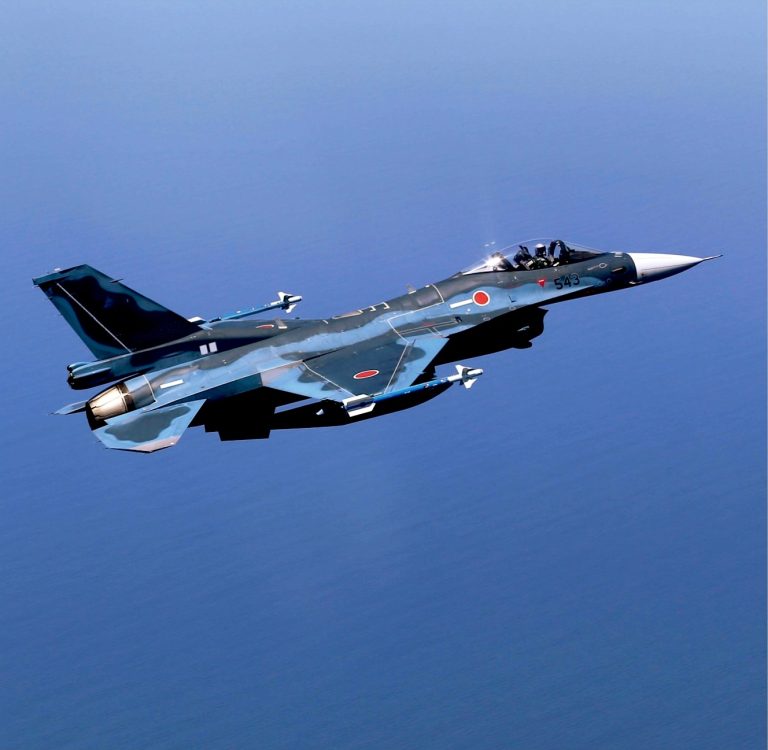
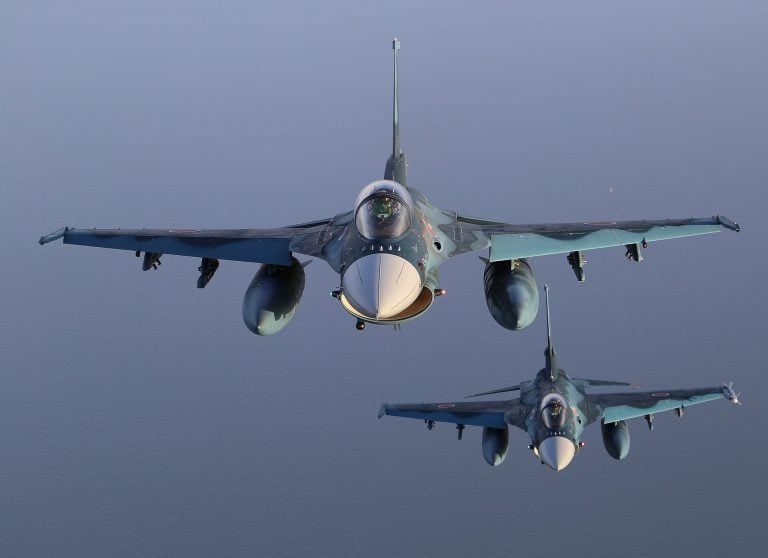
The result, the F-2, looks like an F-16 but is not one. The wing is roughly 25% larger in area, made largely from co-cured graphite-epoxy composite; the fuselage is longer, the nose reshaped, and the whole aircraft optimised for a mission the F-16 was never built for — long-range anti-ship strike over the ocean approaches to the Japanese archipelago, carrying up to four indigenous ASM-2 sea-skimming missiles. Its distinctive ocean-blue camouflage is a working choice, not a cosmetic one.
Under the reshaped nose sat the aircraft’s biggest technical leap: the Mitsubishi Electric J/APG-1, an active electronically scanned array (AESA) radar. When the F-2 entered service in 2000 it was among the very first operational fighters anywhere to fly with an AESA — a technology that would not become standard on American and European fighters until years later. The programme was not cheap: co-developing a bespoke fighter drove unit costs far above a stock F-16, and Japan eventually capped production at 94 aircraft (plus four prototypes) rather than the larger fleet once planned. The line closed in 2011, and the F-2 remains in front-line JASDF service today.
01The Mitsubishi F-2’s origins: how FS-X and US–Japan trade friction turned an F-16 into a Japanese fighter
The FS-X requirement of the mid-1980s set off a hard argument. Japanese planners and industry wanted a domestically designed fighter; the United States, worried about both the strategic implications and the trade balance, pressed Tokyo to buy or adapt an American aircraft. The 1987–88 compromise — formalised in a Memorandum of Understanding — made the new jet an F-16 derivative co-developed by Mitsubishi Heavy Industries and General Dynamics, with a workshare commonly reported at around 60% Japanese to 40% American.
The deal was controversial on both sides of the Pacific: American critics feared handing advanced aerospace technology to a commercial rival, while many in Japan resented being pushed off an indigenous design. Contested figures and framings persist to this day, so treat exact workshare and cost numbers as widely-cited estimates rather than settled facts. What is not in doubt is the outcome — a fighter that is visibly F-16-descended yet substantially Japanese in wing, radar, avionics and mission.
What makes it special
An enlarged F-16, built for the ocean
The F-2 takes the F-16’s layout and stretches it. The wing is about 25% larger in area than a standard Fighting Falcon’s, the fuselage is lengthened and the airframe is stressed for a heavier, longer-ranged anti-ship load — up to four ASM-2 sea-skimming missiles. More wing means more fuel, more range and more stores for the maritime-strike mission that defines the type.
One of the world’s first AESA fighters
The Mitsubishi Electric J/APG-1 active electronically scanned array radar made the F-2, on its 2000 service entry, among the first operational fighters anywhere to carry an AESA — years ahead of most Western types. Early J/APG-1 sets drew criticism over range and reliability; the improved J/APG-2 was later retrofitted across much of the fleet.
A co-cured composite wing
The F-2’s wing is built largely from graphite-epoxy composite using a co-curing process — cutting-edge for a production fighter wing in the 1990s and a genuine Japanese contribution to the design. Paired with indigenous avionics and mission systems, it makes the F-2 far more than a licence-built Viper.
02The Mitsubishi F-2’s J/APG-1 radar: one of the first fighter AESAs in service
An AESA radar replaces a single moving antenna with hundreds of tiny transmit-receive modules, steering the beam electronically. It offers faster scanning, better multi-target tracking and greater resistance to jamming and failure. When the F-2 fielded the J/APG-1 in 2000, that technology was still exotic on fighters — the United States would not field the F-22’s and Super Hornet’s AESAs in numbers until the following years. That makes the F-2 a genuine pioneer, even if the first-generation set was widely reported to underperform its promised detection range. Mitsubishi Electric addressed this with the upgraded J/APG-2, retrofitted to a large part of the fleet to extend range and improve performance with newer air-to-air missiles.
03The Mitsubishi F-2’s composite wing and Japanese avionics: what makes it more than a Viper
Beyond the bigger wing, the F-2’s Japanese content is substantial. The wing’s co-cured graphite-epoxy structure was an ambitious piece of manufacturing for its era; the aircraft carries indigenous mission computers, an integrated electronic-warfare suite, and Japanese weapons such as the AAM-3 and later AAM-4 air-to-air missiles and the ASM-1/ASM-2 anti-ship missiles. The F110 engine is licence-built in Japan by IHI as the F110-IHI-129. The net effect is an aircraft that shares the F-16’s DNA but is tailored, sensor to weapon, to Japan’s maritime defence needs.
Full specifications
Figures are for the single-seat F-2A; the two-seat F-2B is combat-capable but seats a second crew member. Contested values are hedged.
Baseline note: the figures below describe the single-seat Mitsubishi F-2A as delivered to the Japan Air Self-Defense Force from 2000 onwards and as flown today in the upgraded J/APG-2 radar standard; deltas for the two-seat F-2B are given in grey. Figures are current to September 2026. Four cautions before the numbers. First, the engine designation is routinely written wrongly. The F-2 uses the General Electric F110-GE-129, the same engine as the F-16C Block 40 it descends from, but Japanese production aircraft fly behind engines licence-built by IHI Corporation and correctly designated F110-IHI-129; the two are the same engine made in two countries, and the thrust ratings are identical. Second, the JASDF publishes almost nothing about this aeroplane. There is no official rate of climb, no published g limit, no take-off or landing run, and the commonly reproduced English-language specification tables omit even the aircraft’s height. Where a figure is absent it is said so here rather than filled in from an F-16 table. Third, the wing is not an F-16 wing with more area bolted on; it is a different structure, co-cured in one piece from graphite-epoxy, and comparisons that treat the F-2 as an F-16 with a bigger wing understate how much of the airframe was redesigned. Fourth, the F-2 is one of the most expensive fighters ever bought per airframe, and the reason the numbers look strange is that Japanese procurement prices are quoted per-aircraft in yen including a share of a development bill that was borne by fewer than a hundred machines.
Dimensions & weights
- Crew
- 1 — the F-2B carries two in tandem under the same three-piece canopy, and unlike most conversion trainers it is a fully combat-capable aeroplane. That mattered on 11 March 2011, when the tsunami reached Matsushima and the aircraft it drowned were all F-2Bs
- Length
- 15.52 m (50 ft 11 in). The F-16C Block 40 is 15.03 m. The extra half-metre is nose: the forward fuselage was lengthened and widened to take the J/APG-1 array, which is physically larger than the mechanically scanned APG-68 it replaced
- Wingspan
- 10.80 m (35 ft 5 in) at the wingtips; 11.125 m (36 ft 6 in) measured over the wingtip missile launch rails. The F-16C spans 9.45 m, so Japan added 1.35 m of span outright
- Height
- 4.69 m (15 ft 5 in). This is the one basic dimension the standard reference tables disagree on or simply leave out; some widely used English-language entries omit height entirely, and secondary tables that do quote it give the metric and imperial conversions inconsistently. Treat it as approximate
- Wing area
- 34.84 m² (375 sq ft) against 27.87 m² (300 sq ft) for the F-16C — the 25 per cent increase that defines the aeroplane. It buys sustained turn, four heavy underwing stations instead of two, and the internal volume for a genuine anti-ship warload
- Aspect ratio
- 3.3 — slightly lower than the F-16’s, because the span grew less in proportion than the chord did. The planform is a stretched version of the F-16 cropped delta, not a new geometry
- Wing structure
- One-piece co-cured graphite-epoxy composite — skin, spars, ribs and cap cured together in a single autoclave cycle. This was the first application of co-cured composite technology to a production tactical fighter anywhere, and it was the crown jewel Japan brought to the table in 1988. Radar-absorbent material was worked into the leading edges
- Empty weight
- 9,527 kg (21,003 lb). F-2B: 9,633 kg (21,237 lb), the second cockpit costing about 106 kg
- Gross weight, clean
- 13,459 kg (29,672 lb) with full internal fuel and no external stores
- Maximum take-off weight
- 22,100 kg (48,722 lb) — some 2,300 kg above the F-16C Block 40, which is what the larger wing and heavier structure were for
- Maximum landing weight
- 18,300 kg (40,300 lb). A drag chute in a fairing at the base of the fin gives margin on short, wet or icy Japanese runways — a feature the F-16 does not have and one of the visible tells of an F-2 from behind
- Wing loading
- 634.3 kg/m² (129.9 lb/sq ft) at maximum weight; roughly 386 kg/m² (79 lb/sq ft) at clean gross weight. The F-16C at the same clean condition sits near 430 kg/m², so the F-2 turns better than its parent when both are light and is far less penalised when both are loaded
Performance
- Maximum speed, altitude
- 2,124 km/h (1,320 mph, 1,147 kn), Mach 2.0 at height. This is a clean-configuration number and effectively a paper one; an F-2 carrying four anti-ship missiles is a transonic aeroplane
- Maximum speed, low level
- Mach 1.1 — about 1,350 km/h (840 mph) at sea level. The low-level dash figure is the one that describes the mission: run in low over the Sea of Japan, launch, and leave
- Service ceiling
- 18,000 m (59,000 ft)
- Combat radius
- ~830 km (~450 nmi). Published as a combat range of 833 km by one authority and as a combat radius of 835 km by another, which cannot both be true; the figure is best read as a radius on a strike profile with external tanks, and it is roughly half again what the F-1 it replaced could manage
- Ferry range
- Not officially published — with three drop tanks and a boom receptacle for the JASDF’s KC-767J tankers the aircraft can cross the whole of the Japanese archipelago and loiter, but no authoritative figure exists in the open literature and the ones that circulate are extrapolations from the F-16
- Thrust-to-weight ratio
- 0.994 at clean gross weight in full reheat — just under unity, against roughly 1.09 for a comparably loaded F-16C Block 40. The F-2 grew heavier without gaining thrust, and pilots have consistently described it as the less energetic of the two
- Design load factor
- Not published by the JASDF — the airframe is generally taken to hold the F-16’s +9 g limit, and the 30-degree reclined seat and sidestick are inherited unchanged, but Japan has never confirmed the number and the heavier composite wing has its own life-management rules
- Rate of climb
- Not published — unusually for a modern fighter, no official or well-sourced figure exists. Estimates in circulation are derived from F-16C data adjusted for weight and should be treated as guesses
- Deceleration
- Drag chute in the tail-base fairing, plus an emergency arrester hook — Japanese air bases are short, coastal and frequently wet, and the chute is used routinely rather than in emergency. It is one of the few visible additions that is purely a national requirement rather than a mission one
- Typical anti-ship sortie
- Four ASM-2 anti-ship missiles, two air-to-air missiles and external fuel — a warload no single-engine F-16 variant carries, and the reason the wing was enlarged in the first place. The F-1 it replaced could manage two missiles and had barely the radius to reach a target
- Against the F-16C Block 40
- Bigger, heavier, slower to accelerate, longer-legged, better armed and far better sensed — the honest summary. As a dogfighter the F-2 is a slightly blunted F-16; as a maritime strike aircraft it is in a different class, and that is the trade Japan deliberately made
Propulsion & systems
- Powerplant
- One General Electric F110-GE-129 afterburning turbofan — licence-built in Japan by IHI Corporation as the F110-IHI-129, which is the designation carried by every production F-2. The engine was one of the few large items the 1988 agreement left wholly American in origin, and Japan bought the right to build it rather than the right to redesign it
- Thrust
- 75.6 kN dry (17,000 lbf); 131 kN with afterburner (29,500 lbf). Identical to the F-16C Block 50 installation. Nothing was added to compensate for the F-2’s extra 2,300 kg of maximum weight, and the single-engine thrust margin is the aircraft’s clearest inherited weakness
- Intake
- Fixed-geometry ventral normal-shock inlet — taken from the F-16 with the larger Block 30-onward mouth. It is the reason Mach 2.0 is a nominal rather than a useful figure; a fixed inlet is optimised for the transonic band where the aircraft actually works
- Internal fuel
- ~4,637 litres (1,225 US gal) maximum, about 4,588 litres usable. F-2B: ~3,948 litres, roughly 685 litres less, the tank volume given up to the rear cockpit. The two-seater is therefore a shorter-legged aeroplane as well as a heavier one, which is why the training squadron rather than a strike squadron held most of them
- External fuel
- Up to ~5,678 litres (1,500 US gal) in drop tanks on the inboard and centreline stations — more than the internal load, and normally carried on any sortie that matters
- Aerial refuelling
- Dorsal boom receptacle — usable with the JASDF’s KC-767J tankers, in service from 2008, and later the KC-46A. Japan had no tanker force at all when the F-2 was designed; the capability sat unused for most of a decade
- Radar
- Mitsubishi Electric J/APG-1 active electronically scanned array, upgraded fleet-wide to J/APG-2 — the headline claim. The F-2 entered service in 2000 as the first production fighter fielded with an AESA, essentially simultaneously with a single USAF squadron of F-15Cs carrying the APG-63(V)2; Japan got there first as a production standard on a whole type, the Americans as a retrofit on a handful of airframes. The J/APG-1 was criticised in Japanese service for disappointing detection range against small targets, and the J/APG-2 upgrade, which also enabled carriage of the AAM-4B, is as much a correction as an enhancement
- Flight controls
- Digital fly-by-wire developed jointly by Japan Aviation Electronics and Honeywell — the sharpest point of the technology-transfer quarrel. The April 1989 renegotiation denied Japan access to the F-16’s flight-control and weapons-control source code, so Mitsubishi wrote its own control laws for a wing that was not the F-16’s. The resulting system worked, but it consumed years and money that the original plan had not allowed for
- Navigation & mission systems
- Japan Aviation Electronics ring-laser gyro inertial reference set, Mitsubishi Electric mission computer, Toshiba digital map display, Rockwell Collins TACAN, Toshiba VOR/ILS, Have Quick UHF and NEC V/UHF radios — the mission computer and the map system are Japanese, the radios largely American. A data link, the JDCS(F), was added later to tie F-2 formations together for co-ordinated anti-ship attack
- Electronic warfare
- Mitsubishi Electric integrated electronic warfare system — radar warning, jamming and dispensing developed in Japan and unusually well integrated for the period. Alongside the radar and the wing, the EW suite is the third area where Japanese content is genuinely leading rather than derivative, and it is the part of the aircraft about which the least is published
04The Mitsubishi F-2’s operating costs: why a “Japanese F-16” ended up so expensive
The F-2 is one of the clearest cases of how a bespoke national fighter can cost far more than the aircraft it is based on. Co-developing an enlarged, composite-winged, AESA-equipped derivative — then building it in small numbers on a dedicated line — pushed the flyaway price to a level commonly quoted well above US$100 million per aircraft, several times the cost of a contemporary stock F-16. That expense is the main reason Japan capped production at 94 aircraft rather than the larger fleet once envisaged, and closed the line in 2011.
No official cost-per-flight-hour figure is published for the type, and any precise dollar number attached to the F-2 should be read as an estimate rather than an audited figure.
Armament & payload
The F-2 exists to put four anti-ship missiles into an invasion fleet, and every other capability is secondary to that
Japan built this aeroplane for one job. The threat that justified it was a Soviet amphibious force moving on Hokkaido; the threat that justifies it now is a Chinese one moving on the south-western islands. Either way the answer is the same: a single-seat fighter carrying four indigenous sea-skimming missiles, launched from low level at the edge of the escort screen. That requirement is what forced the 25 per cent larger wing, because four heavy stores on the wings plus tanks plus air-to-air missiles is a load no F-16 wing carries. The ten underwing hardpoints are advertised but only four per wing are operationally usable, which is precisely enough for the anti-ship fit.
The weapons themselves are the more interesting half of the story. The Type 80 ASM-1 was Japan’s first indigenous air-launched anti-ship missile; the Type 93 ASM-2 that followed swapped the active radar seeker for imaging infrared, which is harder to jam and harder to see coming. Then came the Type 17 ASM-3, a ramjet-powered supersonic weapon flying at around Mach 3 — a genuinely advanced missile, and one whose original 200 km reach proved too short for a Pacific in which the escorting warships shoot further every year. The ASM-3A that entered procurement from 2021 pushes that out towards 300 to 400 km. Air-to-air, the F-2 moved from the American AIM-7 and AIM-9 to the Japanese AAM-3, AAM-4B and AAM-5 family, and the AAM-4B specifically drove the J/APG-2 radar upgrade because the older array could not support it. Japanese stores clearances are among the least documented in the world: the JASDF publishes no loadout tables, several fits below are attested only in secondary Japanese-language sources, and pod and reconnaissance equipment in particular should be treated as less certain than the missile inventory.
Gun
- One 20 mm JM61A2 six-barrel rotary cannon, internally mounted in the port wing root fairing — the M61A1 Vulcan family built under licence in Japan
- Ammunition load is not published by the JASDF; the F-16C drum from which the installation derives holds about 510 rounds, roughly five seconds of firing at the nominal rate
- Aimed through the head-up display with ranging from the J/APG-1 or J/APG-2, in the standard F-16 fashion
- Against small craft, landing barges and targets ashore the gun is a real weapon, and strafing has stayed in the syllabus — but nobody bought the F-2 for its cannon
Air-to-air
- AAM-4 and AAM-4B (Type 99) — the Japanese active-radar medium-range missile, roughly in the AMRAAM class. The AAM-4B carries its own active seeker and is the weapon that required the J/APG-2 radar upgrade; the original J/APG-1 could not support it
- AAM-5 and AAM-5B (Type 04) — imaging infrared, high off-boresight, cued through the helmet. The modern short-range fit
- AAM-3 (Type 90) — the earlier Japanese short-range infrared missile, still carried, and a considerable advance on the Sidewinder it replaced
- AIM-9L Sidewinder and AIM-7F/M Sparrow — the American weapons the type entered service with, now largely displaced by the Japanese equivalents
- Two wingtip rails plus underwing stations; four medium-range rounds is the practical maximum. The F-2 is a competent secondary interceptor and has stood alert, but it was never bought as an air-superiority fighter
Air-to-surface guided
- Type 80 ASM-1 — the original mission weapon, solid-propellant, inertial mid-course with active radar terminal homing, sea-skimming. The missile the whole Japanese anti-ship industry grew from
- Type 93 ASM-2 — the successor, with an imaging infrared seeker in place of active radar, drawing on Type 88 coastal-battery technology; harder to decoy, and the standard fit for most of the F-2’s career
- Type 17 ASM-3 — ramjet-powered, around Mach 3, roughly 900 kg, developed specifically for this aircraft. The baseline weapon’s 200 km reach was judged too short against modern shipborne defences and deployment slipped; the longer-ranged ASM-3A entered procurement from 2021, with an ASM-3 Kai following
- JDAM-series GPS-guided bombs — Japan bought JDAM kits for the F-2, giving it an all-weather land-attack capability its predecessor never had
- No anti-radiation missile and no long-range land-attack cruise weapon in the type’s original fit — Japan’s post-war constitutional politics kept strike weapons of that kind off the aircraft for most of its life
Bombs
- Up to 18 × Mk 82 500 lb general-purpose bombs, or 6 × Mk 84 2,000 lb — the theoretical maxima; nothing like them is carried in practice
- Up to 6 × CBU-87/B combined-effects cluster munitions in the published fit, though Japan acceded to the Convention on Cluster Munitions in 2009 and destroyed its stocks
- Total external stores capacity 8,085 kg (17,824 lb) across eleven stations — two wingtip rails, eight underwing and one under-fuselage
- Japanese-built equivalents of the American iron bomb family are used alongside the American-marked rounds; the JASDF does not distinguish them in public documents
Rockets
- JLAU-3/A 70 mm rocket pods — the licence-built Japanese version of the American LAU-3, nineteen tubes per pod
- Retained from the close-support role the F-2 inherited from the F-1, and exercised against ground targets in support of the Ground Self-Defense Force
- Marginal in any modern threat environment: unguided rockets require the aircraft to fly a predictable dive within reach of anything that shoots
- In practice the least-used category in the aircraft’s inventory, and the one most likely to be quietly dropped from the clearance list
Pods & other stores
- Drop tanks on the inboard wing and centreline stations, up to about 5,678 litres total — essentially standard on any operational sortie
- A Japanese-developed infrared targeting pod, the J/AAQ-2, was fielded to give the type a self-designation capability it originally lacked — poorly documented in English and worth treating with caution
- JDCS(F) tactical data link, added in service, allowing a formation of F-2s to share a target picture and co-ordinate a multi-axis anti-ship attack rather than each aircraft fighting its own radar
- Chaff and flare dispensers integrated with the Mitsubishi Electric electronic warfare suite rather than carried externally
- No buddy refuelling store, no reconnaissance pod in general service, and no external jamming pod — the electronic warfare fit is internal by design
Three typical loadouts
- Anti-ship strike, the design case
- Four ASM-2 anti-ship missiles on the outboard and mid underwing stations, two AAM-5 on the wingtip rails for self-defence, drop tanks inboard and on the centreline, full gun. Flown low, in a formation sharing targets over the JDCS(F) link, with the missiles released from beyond the escorts’ effective envelope. This is the load the aeroplane exists for, and the one that justified enlarging the wing.
- Air defence alert
- Four AAM-4B active-radar missiles on the underwing stations, two AAM-5 on the tips, two drop tanks, full gun. Requires the J/APG-2 radar standard. A capable enough interceptor for scrambles against probing aircraft in the East China Sea, though the F-15J and now the F-35A carry the weight of that mission.
- Land attack and close support
- JDAM-guided bombs or a mixed load of Mk 82s, a targeting pod, two AAM-5 for self-defence and external fuel. The secondary role inherited from the F-1, exercised regularly with the Ground Self-Defense Force but never the reason the type was bought.
Sourcing caveat: the JASDF publishes no stores clearance list in any language, and the English-language literature on Japanese weapons integration is thin and often circular. Missile designations and roles above are well attested; specific station assignments, pod fits and maximum bomb counts come from manufacturer and reference-work tables that describe what the airframe could carry rather than what squadrons actually load. Cluster munition entries are retained because they appear in the published specification, but Japan ratified the Convention on Cluster Munitions and completed destruction of its stockpile in 2015.
Variants
Ninety-eight aircraft were built, four of them prototypes, and not one was ever exported
The F-2’s variant list is short because its production run was short, and its production run was short because of what it cost. Japan began in the early 1980s intending to design a wholly national successor to the F-1. Washington objected, loudly, at a moment when American anxiety about Japanese industrial power was at its height and the Toshiba-Kongsberg affair had poisoned the atmosphere. The Reagan and Nakasone governments announced a joint programme in October 1987; a memorandum of understanding in November 1988 made General Dynamics the American partner with up to 45 per cent of the development work; and the Bush administration reopened the whole thing in early 1989, producing a revised agreement in April that split costs 60 per cent Japan and 40 per cent the United States, guaranteed American industry at least 40 per cent of production, denied Japan the F-16’s flight-control and weapons-control source code, and gave the United States access to any new technology Japan developed. Shintaro Ishihara’s summary was blunt: Japan gave away its most advanced defence technology and paid licence and patent fees for the privilege.
The bill that followed was extraordinary. Denied the source code, Mitsubishi had to write its own flight-control laws for a wing nobody had flown before, and microscopic cracks found in the composite structure during flight testing pushed service entry from the mid-1990s to 2000. Procurement prices settled at roughly ¥11.2 to ¥11.9 billion per production aircraft — on the order of US$100 million each at the exchange rates of the day, three to four times the cost of a contemporary F-16 and about the price of a twin-engined F-15J. A planned 141 aircraft became 130, and in 2004 the order was curtailed at 98 including the four prototypes. The tragedy of the arithmetic is circular: the development cost was fixed, so cutting the buy raised the price of every remaining aircraft, which strengthened the argument for cutting the buy further. The last of the 94 production machines was handed over on 27 September 2011.
What Japan got for the money is easy to undersell. The co-cured one-piece composite wing was a world first on a production fighter. The J/APG-1 made the F-2 the first fighter type fielded with an active electronically scanned array radar, ahead of the American fleet as a production standard. The electronic warfare suite, mission computer and missile family were all national. Whether that was worth roughly the price of an F-15 for an aeroplane in the F-16 class is the argument that has followed the F-2 for thirty years, and both sides of it are honest.
- FS-X (1982–1990, study and negotiation)
- The requirement for an F-1 replacement, begun as a national programme and turned by American pressure into a joint one. Four candidates were weighed: a clean-sheet Japanese design, the F-16, the F/A-18 and a Tornado derivative. The F-16C Block 40 was selected as the baseline in October 1987.
- F-16 Agile Falcon (1984–1989, not built)
- General Dynamics’ proposal for an F-16 with a 25 per cent larger wing, offered to the USAF and rejected. Japan effectively built it. The F-2 is the only place the enlarged-wing Falcon concept reached production, which is a strange kind of monument to an American design study.
- XF-2A (1995–1999, 2 built)
- Single-seat prototypes. The first flew on 7 October 1995. Flight testing exposed the composite wing cracking and flutter issues that delayed service entry by several years.
- XF-2B (1995–1999, 2 built)
- Two-seat prototypes, flown alongside the XF-2As. Four prototypes in total, all counted within the eventual 98.
- F-2A (2000–2011, the majority of 94 production aircraft)
- The single-seat production fighter and the baseline for everything above. Deliveries began in 2000 to the 3rd Squadron. The exact single-seat and two-seat split of the 94 production machines is reported inconsistently in the open literature and no authoritative English-language breakdown exists; roughly two-thirds were F-2As.
- F-2B (2000–2011, the remainder of the 94)
- Two-seat, fully combat-capable, with about 685 litres less internal fuel and 106 kg more empty weight. The rear cockpit has no head-up display. Most were concentrated in the training unit at Matsushima, which is why one natural disaster was able to destroy or damage eighteen of them at once.
- J/APG-2 capability upgrade (from the early 2010s, fleet-wide)
- Replacement of the J/APG-1 array with the improved J/APG-2, correcting the original radar’s disappointing range and enabling the AAM-4B missile, alongside the JDCS(F) data link and JDAM integration. This is the upgrade that keeps the F-2 relevant into the 2030s.
- Tsunami rebuild (2011–2018, 13 aircraft)
- On 11 March 2011 the tsunami that followed the Tohoku earthquake inundated Matsushima Air Base and submerged 18 F-2Bs of the 21st Fighter Training Squadron. Five were written off and scrapped. Japan chose to rebuild the other 13 — salt-water immersion of an aircraft is normally a death sentence — at an estimated ¥80 billion, with the last aircraft returned to Matsushima in 2018. It was cheaper than buying replacements, because the production line was closing and there would be no replacements to buy.
- F-2 Super Kai (proposed early 2010s, not built)
- A further-developed F-2 with conformal fuel tanks along F-16C Block 60 lines, offered as the F-4EJ Kai replacement. Rejected when Japan chose the F-35A. The line closed in 2011 and has not reopened.
- Export and licence versions (none, ever)
- There are none, and there could not have been. Japan’s post-war ban on arms exports made the F-2 unsellable abroad, which removed the one mechanism — volume — that might have brought the unit price down. Every one of the 98 aircraft was paid for by, and flown by, one air force.
Fleet and replacement, current to September 2026. Japan is the only operator the F-2 has ever had, so no fleet chart is offered here: a single bar conveys nothing that a sentence does not. The JASDF listed 91 F-2A and F-2B on charge as of March 2025; an F-2A was lost in the Pacific off Ibaraki Prefecture on 7 August 2025, leaving about 90. Attrition has otherwise been light for a type in service since 2000: an F-2B destroyed by fire on take-off at Nagoya on 31 October 2007, traced to reversed wiring in the flight-control system; an F-2B lost over the Sea of Japan on 20 February 2019; a minor mid-air collision between two aircraft over Yamaguchi Prefecture in April 2021 from which both recovered; and the five airframes scrapped after the 2011 tsunami. The survivors serve with the 3rd Squadron, the 6th and 8th Squadrons at Tsuiki, the 21st Fighter Training Squadron at Matsushima and the test unit at Gifu. Replacement is the Global Combat Air Programme, the trilateral British, Japanese and Italian sixth-generation fighter formed in December 2022 and put under treaty in December 2023, delivered through the Edgewing joint venture launched in June 2025 with each partner holding a third. A design contract worth £686 million was awarded in April 2026, the demonstrator is targeted to fly by the end of 2027, and the production aircraft is planned to enter service in 2035. The F-2 will therefore have to serve at least another decade, which is what the J/APG-2 and data-link upgrades were bought to make possible.
From FS-X controversy to front-line fighter
The FS-X debate
Japan launches the FS-X programme to replace the Mitsubishi F-1, with industry pushing for an indigenous design.
An F-16 compromise
Amid US–Japan trade friction, the two governments agree the fighter will be developed from the F-16 by Mitsubishi and General Dynamics.
First flight
The first XF-2 prototype flies on 7 October 1995, showing its enlarged composite wing and reshaped nose.
Enters JASDF service
The F-2 joins the Japan Air Self-Defense Force — among the first operational fighters anywhere with an AESA radar.
Production trimmed
Rising costs lead Japan to cap the buy at 94 production aircraft, well short of earlier plans.
Tsunami and the last airframe
The March 2011 Tohoku tsunami wrecks F-2s at Matsushima Air Base; the production line closes that September.
Back from the water
Rebuilt F-2s from Matsushima return to flying status, alongside J/APG-2 radar upgrades across much of the fleet.
The successor
The F-2 is due to retire from the mid-2030s, replaced by the Japan–UK–Italy Global Combat Air Programme (GCAP) fighter.
Twelve F-2 stories
The fighter Japan wanted to build alone
FS-X began as a bid for a wholly indigenous Japanese fighter.
Read the full story
A fighter caught in a trade war
The FS-X deal became a flashpoint in 1980s US–Japan trade tensions.
Read the full story
Why the wing grew
The F-2’s wing is about a quarter larger than the F-16’s — for a reason.
Read the full story
A radar ahead of its time
The F-2 flew an AESA radar before almost any other fighter in service.
Read the full story
The radar that had to grow up
Early J/APG-1 sets were criticised, then substantially improved.
Read the full story
A wing cured in one piece
The F-2’s co-cured composite wing was a real manufacturing gamble.
Read the full story
Built to sink ships
The F-2 exists above all to strike ships approaching Japan.
Read the full story
The wave that drowned a squadron
The 2011 tsunami submerged eighteen F-2s in a single afternoon.
Read the full story
Raised from the salt water
Most of the drowned F-2s were painstakingly rebuilt and flew again.
Read the full story
No shots fired in anger
In more than two decades of service, the F-2 has never seen combat.
Read the full story
The price of building your own
The F-2’s expense capped its own production.
Read the full story
From Viper Zero to sixth generation
The F-2’s replacement is a joint European-Japanese stealth fighter.
Read the full story
The F-2 in pictures
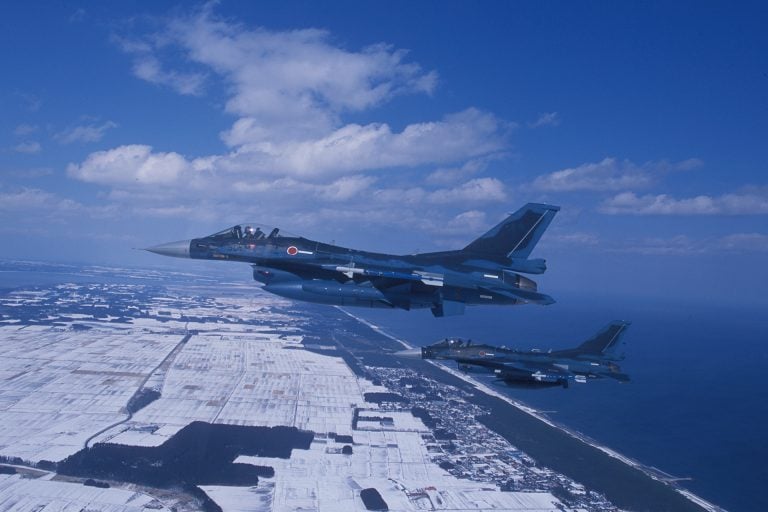
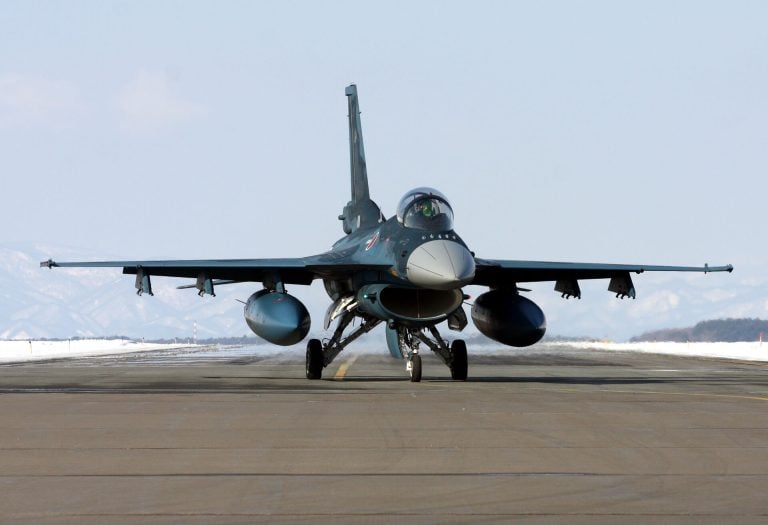
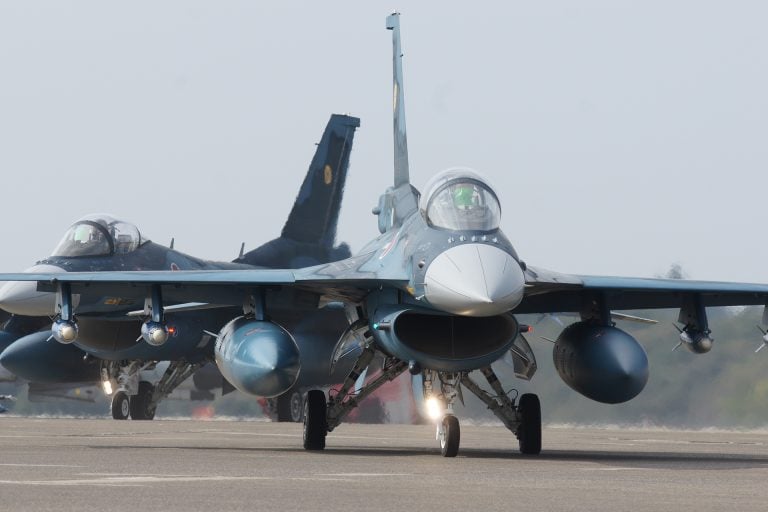
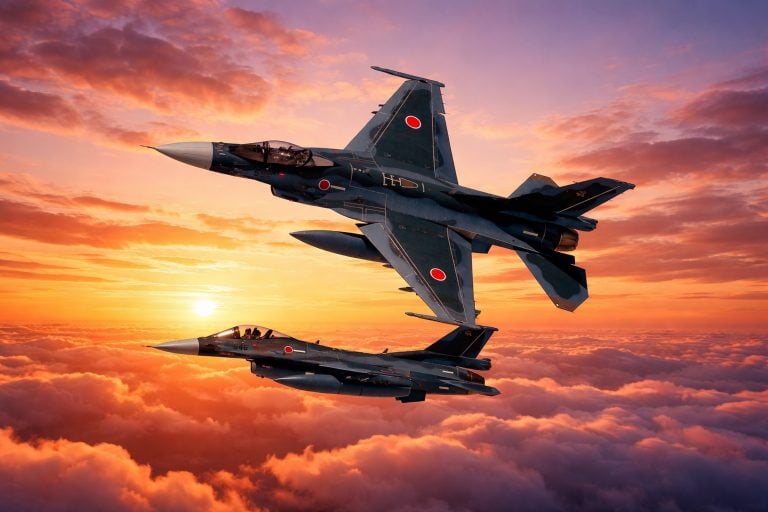
The F-2 in motion
A curated video feature for the Mitsubishi F-2 is coming soon. In the meantime, explore the photo gallery above and the operator map below.
Where the F-2 flies
The record that defines it
The F-2 has never been used in combat. More than two decades into its service life, its record is one of deterrence and readiness rather than kills: standing quick-reaction alert (QRA) against intruding aircraft around Japan’s vast air-defence zones, training relentlessly for the anti-ship mission, and supporting disaster relief at home. Its most dramatic day was not a battle but a natural disaster — the 2011 tsunami that swept eighteen F-2s from Matsushima Air Base, most of which were later rebuilt.
Compare the combat record of every military aircraft. Figures as of July 2026.
Everything people ask about the F-2
Can I fly in a Mitsubishi F-2?
Is the F-2 just a Japanese F-16?
What is the F-2’s main role?
Does the F-2 really have an AESA radar?
What happened to the F-2s in the 2011 tsunami?
How many F-2s were built, and why so few?
Is the F-2 still in service, and what will replace it?
You can’t fly the F-2.
These, you can.
Some legends only live in museums — others are fuelled and waiting. MiGFlug has put civilians in real military jet cockpits since 2004.
 Fly the L-39 AlbatrosThe world’s most-flown jet trainer — aerobatics included
 Fly the F-104 Starfighter“The missile with a man in it”
 Fly the MiG-21The Cold War’s most-produced jet
 Fly the T-33 Shooting StarAmerica’s first jet trainer
 Fly the DH VampireA piece of early jet history
 Fly the S.211Agile Italian jet trainer
 Fly the MB-326The classic Aermacchi jet
 Fly the MiG-15The Soviet legend of the Korean War
Continue the tour
Every fact, checked
- The Aviationist — Mitsubishi F-2 “Viper Zero”Overview of the F-16 derivation, enlarged wing and AESA radar.
- Military Factory — Mitsubishi F-2Specification baseline, armament and production figures.
- Lockheed Martin — F-2 Support FighterThe US industrial partner’s account of the co-development.
- Mitsubishi Heavy Industries — F-2 FighterThe prime contractor’s programme page.
- The EurasianTimes — Japan’s highly modified F-16FS-X politics and the US–Japan trade friction.
- UPI — Japan’s damaged F-2s returning to serviceThe 2011 tsunami losses at Matsushima and the rebuild.
- 19FortyFive — the F-2 and the anti-ship missionThe maritime-strike role and current service context.
- Forecast International — Mitsubishi F-2 reportProgramme history, cost drivers and production cap.