
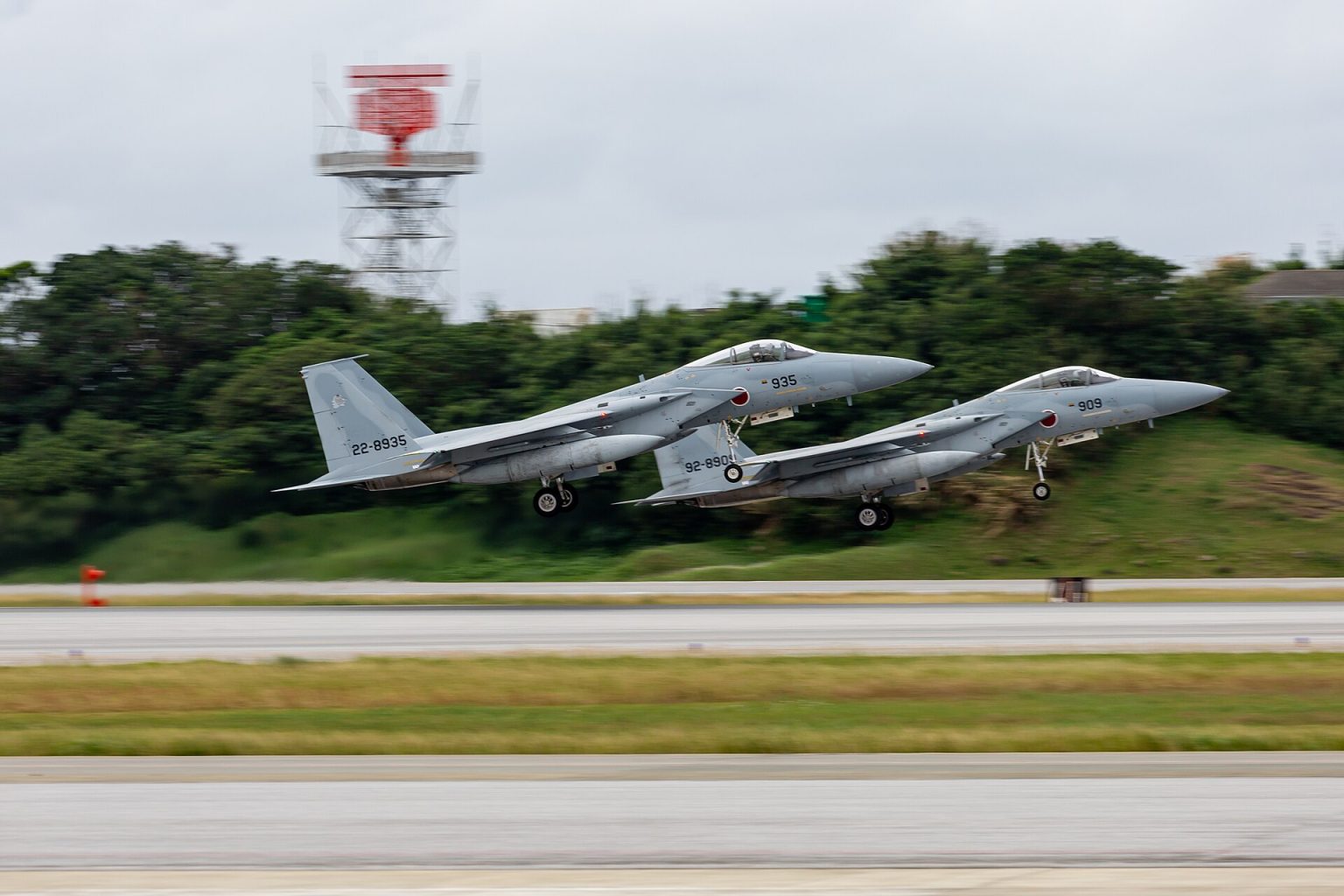
Mitsubishi F-1
Japan’s first home-grown post-war fighter
Developed from the Mitsubishi T-2 — Japan’s first supersonic aircraft — the F-1 became the country’s first domestically designed jet fighter since 1945: a Jaguar-like strike aircraft built to defend Japan’s coasts with the home-grown ASM-1 anti-ship missile.
A trainer that grew fangs
After 1945, Japan was barred from building military aircraft during the Allied occupation, and its aviation industry was dismantled. When the Japan Air Self-Defense Force (JASDF) stood up in 1954, it flew licensed American types — the F-86 Sabre, and later the F-104J Starfighter and F-4EJ Phantom II. But Japanese industry wanted to design combat aircraft again, and in the mid-1960s the government launched the T-X programme for a home-grown supersonic trainer to prepare pilots for those fast jets.
Mitsubishi Heavy Industries won the contract, and on 20 July 1971 the resulting T-2 made its first flight — the first domestically designed Japanese aircraft to exceed the speed of sound. Twin-engined, sharply swept and powered by license-built Rolls-Royce Turboméca Adour turbofans, the T-2 bore a strong external resemblance to the Anglo-French SEPECAT Jaguar, which shared the same engine and era. The two aircraft were designed independently, but the family likeness is unmistakable.
Almost from the start, planners saw that the T-2’s airframe could carry weapons. When a separate Kawasaki project was cancelled, funding freed up for a single-seat close-support derivative. The prototype — designated FS-T2-Kai — first flew on 3 June 1975, and the type entered JASDF service in April 1978 as the Mitsubishi F-1: Japan’s first domestically developed fighter since the Second World War.
The F-1 was built for a specific job. Its primary mission was anti-ship strike and close air support in defence of the Japanese home islands, and its signature weapon was the indigenous Mitsubishi ASM-1 (Type 80) anti-ship missile. Facing the Soviet Pacific Fleet across the northern seas, Japan needed an aircraft that could help repel an amphibious invasion by sinking ships offshore — and the F-1, with two ASM-1s, a 20 mm cannon and short-range air-to-air missiles for self-defence, was its answer.
It was never a world-beater. Range and payload were modest, the radar was limited, and only 77 were built by Mitsubishi and Fuji Heavy Industries before production ended in 1987. The F-1 served only with the JASDF and was never exported. Yet its real significance was industrial: it proved Japan could design and field a supersonic combat aircraft on its own, a stepping stone that led directly to the F-2 that replaced it. The last F-1s were withdrawn in March 2006.
01The Mitsubishi F-1’s origins: how a jet trainer became Japan’s first post-war fighter
The F-1 began life as the T-2, a supersonic trainer built to the JASDF’s T-X requirement of the mid-1960s. Once the T-2 was flying, Mitsubishi proposed a single-seat close-support variant using the same airframe with the rear cockpit faired over and replaced by avionics and fuel. The special-support-fighter prototype, the FS-T2-Kai, flew on 3 June 1975 and was evaluated at Gifu. Because it reused a proven, already-tooled airframe, the F-1 could be fielded quickly and relatively cheaply — entering service in April 1978. It is commonly described as Japan’s first indigenous post-war fighter, though it is more accurately a home-grown attack derivative of a home-grown trainer.
What makes it special
Built from the T-2 trainer
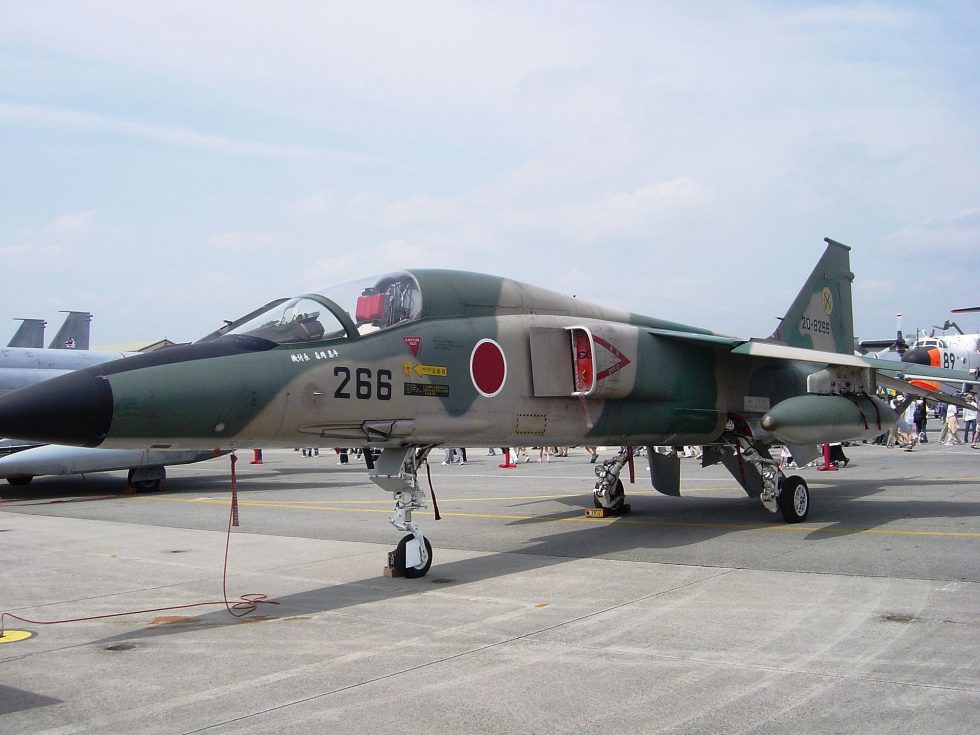
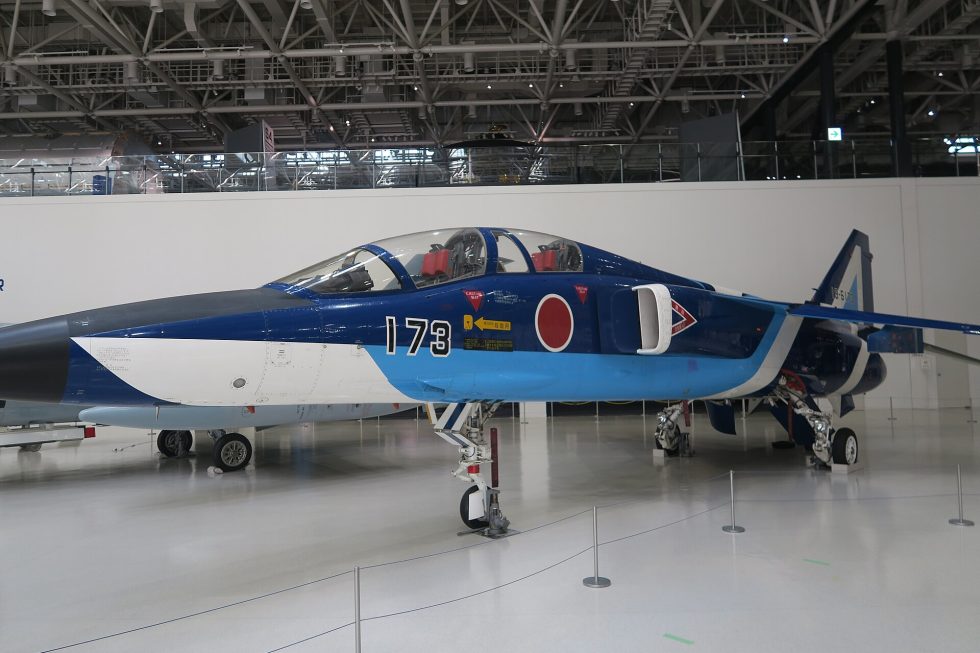
The F-1 shares the airframe of the Mitsubishi T-2 supersonic trainer — a swept-wing, twin-engined design with a high-set tailplane. The single-seat F-1 faired over the T-2’s rear cockpit to make room for avionics and an internal fuel tank. Reusing a proven, already-tooled airframe let Japan field a domestic fighter far faster and cheaper than a clean-sheet design would have allowed.
Adour engines, built under licence
Power came from two Ishikawajima-Harima TF40-IHI-801A afterburning turbofans — license-built versions of the Rolls-Royce Turboméca Adour that also powers the SEPECAT Jaguar and the Hawk. Each produced roughly 32 kN (about 7,300 lbf) in reheat. The Adour gave the F-1 supersonic dash without afterburner-hungry fuel penalties, but total thrust was modest, capping speed at around Mach 1.6.
The ASM-1 anti-ship mission
The F-1’s reason for being was coastal defence. Its signature weapon, the indigenous Mitsubishi ASM-1 (Type 80) anti-ship missile, gave it a stand-off punch against warships — inertial mid-course guidance and active-radar terminal homing out to roughly 50 km. Carrying two ASM-1s, the F-1 was tasked with helping to break up an amphibious assault on the Japanese home islands.
02The Mitsubishi F-1 and the SEPECAT Jaguar: two Adour-powered lookalikes
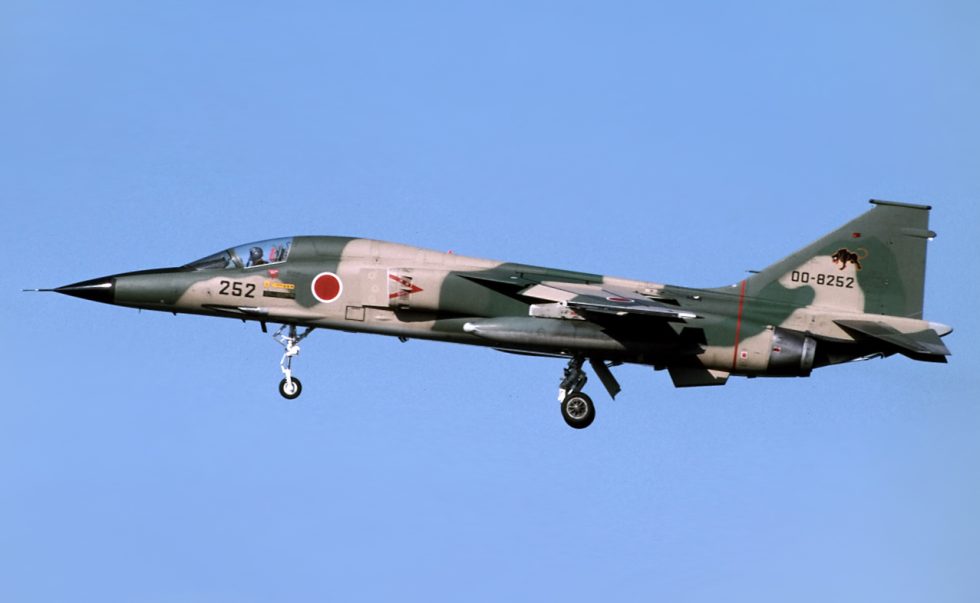
Observers often note how much the F-1 resembles the Anglo-French SEPECAT Jaguar: both are compact, twin-engined, shoulder-winged strike fighters of the same generation, and both are powered by the Rolls-Royce Turboméca Adour. The similarity is real but largely convergent — the two were designed independently to meet broadly similar requirements with the same engine, which tends to drive similar proportions. The F-1 traces its shape to the T-2 trainer rather than to any Jaguar blueprint, and the aircraft differ in detail, but the family likeness has made the comparison a fixture of the F-1’s story.
03The Mitsubishi F-1’s ASM-1: Japan’s home-grown anti-ship missile
The ASM-1, or Type 80 air-to-ship missile, was developed by Mitsubishi and entered service with the JASDF around 1980. Roughly comparable in concept to the American Harpoon or French Exocet, it uses inertial guidance for the cruise phase and active radar homing for terminal attack, with a range commonly cited at about 50 km and a warhead of around 150 kg. Pairing the F-1 with the ASM-1 gave Japan a wholly domestic air-launched anti-ship capability — a deliberate hedge against reliance on imported weapons, and the core of the F-1’s coastal-defence role. Later ground- and ship-launched members of the same family remain in Japanese service.
Full specifications
Baseline note: the figures below describe the production Mitsubishi F-1 as delivered between 1977 and March 1987 and flown until the type was withdrawn in 2006 — the single-seat support fighter, not the two-seat T-2 trainer it was cut down from. Deltas for the T-2 and for the service-life-extended airframes of the 1990s are given in grey. Three cautions before the numbers. First, the F-1 and the T-2 share a fuselage, a wing and a pair of engines, so published tables for the two are constantly mixed up; the F-1 is roughly 160 kg heavier empty, carries two more wing pylons, and has avionics where the T-2 has an instructor. Second, thrust figures disagree, and the disagreement matters for an aeroplane whose defining complaint was that it had too little of it: several English-language online references quote 35.6 kN (8,000 lbf) in reheat, which is the rating of the later Adour Mk 811 sold with export Jaguars, not the Mk 801A that Japan built. The Mk 801A figures of 22.75 kN dry and 32.49 kN in reheat are used throughout here. Third, the Japan Air Self-Defense Force published almost nothing about the aircraft’s operational performance in any language, and nothing at all about the ASM-1’s; radius and missile figures are best-attested open estimates rather than official data.
Dimensions & weights
- Crew
- 1 — the T-2’s rear cockpit was deleted, the second seat removed and the rear canopy replaced by a solid unglazed hatch over an avionics bay. That single change is most of what makes an F-1 an F-1, and it is the quickest way to identify one in a photograph
- Length
- 17.86 m (58 ft 7 in), nose probe included. The T-2 is 17.85 m — the same aeroplane to within a centimetre
- Wingspan
- 7.88 m (25 ft 10 in). Compare the SEPECAT Jaguar, which Japan considered building under licence and did not: 8.69 m of span on a 16.83 m fuselage. The Japanese aircraft is longer and narrower — more dart, less aeroplane
- Height
- 4.48 m (14 ft 8 in)
- Wing area
- 21.18 m² (228 sq ft). Small for the weight, which is the root of the type’s handling character and of its reputation in air combat
- Aspect ratio
- 2.93 — very low, in the manner of aircraft designed to go fast at low level through rough air rather than to turn
- Wing planform
- Shoulder-mounted, sharply swept, set with marked anhedral, with high-lift devices along most of the leading and trailing edges — the Jaguar family resemblance is not an accident of styling; both aircraft were laid out for the same low-level job with the same Anglo-French engine, though the two designs share no structure
- Empty weight
- 6,358 kg (14,017 lb). The T-2 is 6,197 kg; the difference is strengthening, the extra pylons and the avionics that replaced the back-seater
- Maximum take-off weight
- 13,674 kg (30,146 lb). The T-2 is cleared to 12,800 kg
- Maximum external stores
- 2,721 kg (6,000 lb) across all stations — modest, and one of the aircraft’s real limits. A Jaguar carried around 4,500 kg, an F-4EJ Phantom far more, and the F-2 that replaced the F-1 lifts more than three times as much
- Wing loading
- 645 kg/m² (132 lb/sq ft) at maximum take-off weight — among the highest of any aircraft of its generation and weight class, and the number that explains why nobody claimed the F-1 could dogfight
- Internal fuel
- ~3,823 litres (about 1,010 US gal), essentially the T-2’s tankage. The rear cockpit volume went to electronics, not to fuel, which is why the single-seater gained no useful radius over the trainer
- External fuel
- Up to three 833-litre tanks (one centreline, two inboard wing). Carrying all three left almost nothing for weapons, and carrying weapons left almost no fuel — the trade that defined every F-1 mission plan
Performance
- Maximum speed
- 1,700 km/h (1,056 mph, 918 kn) at 11,000 m, Mach 1.6
- Supersonic capability
- Clean and light only — with two ASM-1 missiles and a tank the aircraft was, for practical purposes, a high-subsonic attack aeroplane. Mach 1.6 was a trainer’s number that the strike variant inherited rather than used
- Service ceiling
- 15,240 m (50,000 ft)
- Time to height
- 11,000 m in 2 min — an average of about 92 m/s. Published initial rate-of-climb figures for the type, some as high as 35,000 ft/min, cannot be reconciled with this and should be treated with suspicion
- Combat radius, anti-shipping
- ~556 km (300 nmi) on a high-low-high profile with two ASM-1 and one 830-litre tank. This is the quoted figure for the aircraft’s primary mission, and it is the number every critic of the F-1 reached for first
- Combat radius, low level
- Not published — and conspicuously so. A fully low-level profile with bombs would have been very much shorter still. The JASDF never released the figure, which in the political climate of the time was itself a statement
- Ferry range
- 2,870 km (1,780 mi, 1,550 nmi) with external tanks and nothing else. Useful for deploying between Japanese bases; irrelevant to combat
- In-flight refuelling
- None — no probe, no receptacle, no provision. The JASDF had no tanker aircraft at all until the KC-767 arrived in 2008, two years after the F-1 retired. This was policy as much as economy: an aeroplane that cannot be refuelled in the air cannot reach anyone else’s territory
- Design g limits
- +7.33 g — the standard military structural factor of the period; reported rather than officially confirmed. The SLEP airframes were monitored against fatigue rather than re-rated
- Airframe life
- 3,500 hours as designed, 4,000 hours after SLEP — 70 of the 77 aircraft received the extension in the 1990s. Reaching 4,000 hours is literally what ended the type: the last aircraft were not replaced because something better arrived, they were retired because the airframes were used up
- Landing
- Brake parachute in the tail cone — the approach speeds that go with 645 kg/m² make one necessary, and Japanese runways are not long
Propulsion & systems
- Engines
- 2 × Ishikawajima-Harima TF40-IHI-801A afterburning turbofans
- Origin of the design
- Licence-built Rolls-Royce/Turboméca Adour Mk 801A — the same engine family as the SEPECAT Jaguar and the BAE Hawk. Japan’s first domestically designed combat aircraft since 1945 flew on an Anglo-French engine, and that is worth stating plainly rather than glossing
- Dry thrust
- 22.75 kN each (5,115 lbf)
- Afterburning thrust
- 32.49 kN each (7,305 lbf). The 35.6 kN / 8,000 lbf figure that circulates belongs to the later Adour Mk 811, which Japan never adopted — the T-2 and F-1 kept the original mark to the end and were, in the words of more than one Japanese account, underpowered because of it
- Total installed thrust
- 64.98 kN (14,610 lbf) in reheat. Against a maximum take-off weight of 13,674 kg that is a thrust-to-weight ratio of 0.48; clean and light it approaches 0.68
- Intakes
- Fixed-geometry, shoulder-mounted, without variable ramps — cheap, robust and a hard ceiling on high-Mach performance. The aeroplane was never going to fly faster than about Mach 1.6 whatever engine was fitted
- Radar
- Mitsubishi Electric J/AWG-12 — a Japanese set in the lineage of the AN/AWG-12 fitted to the Royal Air Force’s F-4M Phantom FGR.2, giving search, air-to-ground and air-to-sea ranging. A search range of about 72 km in the sea-search mode is quoted, which is theoretical rather than tactical. The T-2 carried the simpler J/AWG-11; the radar is the other major difference between the two aircraft
- Attack system
- J/ASQ-1 bombing computer with inertial navigation and a head-up display — the inertial platform was Ferranti-derived and the HUD Thomson-CSF, both built in Japan under licence by Mitsubishi Electric. For 1977 this was a genuinely capable low-level attack fit, and it was the F-1’s best feature: the aeroplane was ordinary, the system in it was not
- Self-protection
- Radar warning receiver with chaff and flare dispensing — no jamming pod is normally listed in the F-1’s standard fit, and the type had no electronic-attack capability of its own
- Structure
- Aluminium alloy with titanium in the hot and highly loaded areas — the F-1 added local strengthening over the T-2 to take the extra stores stations and the low-level fatigue spectrum
- Stations
- Seven — one centreline, four underwing, two wingtip rails, plus the internal gun. The two extra wing stations over the T-2 are what turned a trainer into a strike aircraft
04The Mitsubishi F-1’s operating costs: why no reliable price exists
The F-1 was a domestic Japanese product built only for the JASDF and never offered for export, so no open-market flyaway price or published cost-per-flight-hour figure exists in the public record. Any dollar or yen figure attached to it should be treated as an estimate. What can be said is that the F-1 was deliberately designed to be affordable: by reusing the already-developed T-2 airframe and a license-built engine, Japan avoided the cost of a clean-sheet fighter programme. Its economy was in its engineering approach rather than in any documented price tag.
Armament & payload
The F-1 was built around two anti-ship missiles, and everything else it carried was a secondary consideration
Strip away the airframe argument and the F-1 was a launch platform for the ASM-1. Japan wanted a way to hit a Soviet amphibious force in the approaches to the home islands without owning anything that could be described as an offensive weapon, and the answer was a small aeroplane carrying two indigenous sea-skimming missiles. The Type 80 ASM-1, developed by Mitsubishi Heavy Industries and in service from 1980, was Japan’s first home-grown guided anti-ship missile of its class — solid-propellant, inertially guided in the cruise, active radar homing at the end, flying low over the sea in the manner of a Harpoon or an Exocet. It mattered far beyond the F-1: the same weapon became the truck-mounted Type 88 coastal battery, the ship-launched Type 90, and the later Type 91 and Type 93 air-launched missiles, which is to say that Japan’s entire anti-ship missile industry grew out of the weapon this aeroplane was built to carry.
Everything else in the inventory was conventional and, by the standards of the 1980s, thin. One internal 20 mm Vulcan. Two Sidewinders on the wingtips for self-defence and for the secondary air-defence tasking. Iron bombs and rocket pods for close support of ground forces defending Japanese soil. The one Japanese innovation among them was the GCS-1, an infrared homing seeker kitted onto standard Mk 82 and M117 bombs to produce a cheap guided anti-shipping weapon — precision arrived at by domestic ingenuity rather than by purchase. What is absent from the list is as informative as what is on it: no anti-radiation missile, no laser designator or targeting pod, no stand-off land-attack weapon, and no aerial refuelling. Fits varied over three decades of service and the JASDF never published a stores clearance list in English; some late-service associations, particularly with the ASM-2, are asserted in secondary sources more confidently than the evidence supports.
Gun
- One 20 mm JM61A1 Vulcan — the M61A1 six-barrel rotary cannon built in Japan under licence — mounted internally in the forward fuselage with 750 rounds
- At the nominal 6,000 rounds per minute that magazine lasts about seven and a half seconds; in practice the gun was fired in short bursts and the ammunition load was adequate rather than generous
- Aimed through the Thomson-CSF head-up display licence-built by Mitsubishi Electric, with ranging supplied by the J/AWG-12
- The armed T-2(K) trainer carried the same gun, so F-1 squadrons could work up gunnery on the two-seater before converting — a deliberate economy of the whole T-2/F-1 scheme
- Against landing craft, small vessels and soft targets ashore the gun was a serious weapon, and strafing remained a real part of the syllabus to the end
Air-to-air
- Two AIM-9 Sidewinder on the wingtip rails — the marks changed across the type’s life, from early AIM-9 variants to the AIM-9L and AIM-9P generation
- Purely for self-defence and for a secondary air-defence tasking; the F-1 was categorised as a support fighter, not an interceptor, and no Japanese planner pretended otherwise
- No radar-guided missile capability. The J/AWG-12 as installed gave search and ranging, not the continuous-wave illumination a semi-active weapon such as the AIM-7 Sparrow requires
- The Type 90 AAM-3 that replaced the Sidewinder on the F-15J and F-4EJ Kai is not part of the F-1’s normally listed fit; the aeroplane finished its career on the American missile it started with
- Survivability in air combat was the acknowledged weakness: 645 kg/m² of wing loading, 0.48 thrust-to-weight at maximum weight and a poor view aft add up to an aircraft that had to avoid fighters rather than meet them
Air-to-surface guided
- Two ASM-1 (Type 80) anti-ship missiles on the inboard wing pylons — the aircraft’s reason for existing. In JASDF service from 1980, developed by Mitsubishi Heavy Industries
- Solid-propellant, high-subsonic, sea-skimming; inertial mid-course guidance with active radar terminal homing. Roughly 600 kg at launch with a warhead of about 150 kg and a range of the order of 50 km — all of these are open estimates, as Japan never published official figures
- GCS-1 guidance kits: an infrared seeker fitted to standard Mk 82 and M117 bombs, turning free-fall stores into homing anti-ship weapons. A characteristically Japanese solution, cheap and domestic
- The later ASM-2 (Type 93), turbojet-powered with an imaging infrared seeker, is associated with the F-1 in some late-service accounts; it is principally an F-2 weapon and the F-1 link should be treated as unconfirmed
- Nothing else was ever cleared: no anti-radiation missile, no laser-guided bomb, no targeting pod, no cruise or stand-off land-attack weapon of any kind. That gap was a deliberate national choice and not a technical failure
Bombs
- Mk 82 227 kg (500 lb) low-drag bombs, quoted at up to twelve on multiple ejector racks, which is exactly the 2,721 kg external limit and therefore a paper maximum rather than a normal load
- M117 340 kg (750 lb) bombs, the heavier general-purpose store of the era
- GCS-1 infrared-guided versions of both, used against shipping rather than land targets
- Practice bombs and dispensers for range work — the everyday load in peacetime, and the one most often photographed
- The whole bomb load was small by contemporary standards. This aeroplane could not carry what a Jaguar or a Phantom carried, and everyone involved knew it
Rockets
- JLAU-3/A 70 mm (2.75 in) rocket pods, the Japanese-built equivalent of the American LAU-3 nineteen-tube launcher
- The close-support weapon of choice against landing craft, light vehicles and troops in the open — that is, against an invasion force already at or over the beach
- No large-calibre rocket and no guided rocket ever entered the F-1’s inventory
- By the 1990s rockets had largely given way to bombs and to the missile; the close-support half of the aircraft’s role quietly withered as anti-shipping absorbed the training effort
Pods & other stores
- Up to three 833-litre drop tanks on the centreline and inboard wing stations — in practice the most commonly carried store of all, and a standing admission of how little fuel the aeroplane had
- No aerial refuelling probe or receptacle was ever fitted, in any configuration, at any point in the type’s life
- No reconnaissance pod: that work belonged to the RF-4E, and the F-1 never had a camera fit
- No targeting pod, no designator pod, no electronic-attack pod in the standard fit; self-protection was a radar warning receiver with chaff and flares
- The wingtip rails carried missiles and nothing else, which is why an F-1 photographed with empty tips is carrying its full ground-attack load and no air-to-air weapons at all
Three typical loadouts
- Anti-shipping strike
- Two ASM-1 on the inboard wing pylons, one 833-litre tank on the centreline, two AIM-9 Sidewinder on the wingtips, 750 rounds of 20 mm. High-low-high radius around 556 km. This is the mission the aircraft was designed, procured and trained for, and the one JASDF publicity photographs almost always show
- Close support and interdiction
- Mk 82 or M117 bombs on the wing and centreline stations, or a mix of bombs and JLAU-3/A rocket pods, with two Sidewinders and the gun. Radius far shorter than the anti-shipping profile, which limited the aircraft to targets close to its own bases — acceptable when the assumed battlefield was a Japanese beach
- Air-defence alert and training
- Two AIM-9 and the gun with two or three drop tanks, flown as a secondary air-defence contribution and in the everyday training cycle. In this fit the F-1 was a fast, hard-to-see aeroplane with modest energy and no radar missile — useful for presence, not for interception
Sourcing caveat: the JASDF never issued an English-language stores clearance for the F-1, and Japanese-language references, museum placards and squadron photographs are the practical evidence. ASM-1 weight, warhead and range figures are open estimates; Japan has never published official performance data for the Type 80. Bomb-count maxima are theoretical loads at the airframe stores limit rather than fits observed in service.
Variants
The F-1 has almost no variants of its own — its family tree is the T-2 trainer on one side and the F-2 on the other
The aircraft was a minimum-change derivative of a trainer, and it stayed that way for thirty years. There was no F-1A, no re-engined mark, no export version, no reconnaissance conversion. To describe the F-1’s variants honestly is to describe the whole T-2 programme, because the F-1 is one branch of it: Japan set out in the mid-1960s to build a supersonic trainer with an attack derivative designed in from the start, having examined and rejected licence production of the Northrop T-38 and the SEPECAT Jaguar. Mitsubishi’s design was chosen in September 1967, the XT-2 flew on 20 July 1971 and became the first Japanese-designed aircraft to pass Mach 1 in level flight, and the attack version — designated FS-T2改, FS-T2-Kai — was contracted in 1973 after cancellation of the Kawasaki P-XL maritime patrol programme released the money.
The political framing deserves stating exactly, because it shaped the machine. Under Article 9 of the constitution and the exclusively defence-oriented policy that followed from it, Japan held that it could not possess weapons whose character was offensive — intercontinental missiles, long-range strategic bombers, attack aircraft carriers. Fighters were therefore sorted into two official categories: the interceptor, and the 支援戦闘機 or support fighter, of which the F-1 was the first. "Support" meant support of Japanese ground and naval forces repelling an invasion of Japanese territory. The aeroplane was built to match that description and not to exceed it: no refuelling capability, a combat radius that could not reach a foreign coast, no stand-off land-attack weapon, and a primary armament aimed at ships in Japanese waters. Its numbers were shaped by the same politics — the 1976 decision to cap defence spending at one per cent of GNP, and the arms export ban, which meant that not one F-1 was ever sold abroad and that the programme could never spread its costs. Plans for 160, later restated as 126, ended at 77 aircraft.
Whether that made a good aeroplane is a separate question, and the honest answer is: not really, but it made a good industry. The F-1 was heavy, short-legged, underpowered and blind astern — the standing Japanese criticisms are short range, limited payload and a cockpit view aft that was frankly bad. What it did superbly was keep a design and production capability alive between the Zero and the F-2, and prove out an indigenous attack system and an indigenous missile that outlived the aircraft by decades.
- T-X / SF-X studies (1966–1967)
- Requirement for a supersonic trainer to bridge from the subsonic Fuji T-1 to the F-104J and F-4EJ, with an attack derivative specified from the outset. Fuji, Kawasaki and Mitsubishi competed; Mitsubishi’s design under Kenji Ikeda was selected in September 1967
- XT-2 (4 prototypes, 1971–1972)
- First flight 20 July 1971 at Nagoya; first Japanese-designed aircraft to exceed Mach 1 in level flight. Two of the four were armed. Redesignated T-2 on 29 August 1973
- T-2(Z) early type (28 aircraft, from 1975)
- Unarmed advanced trainer without radar; the basic conversion machine for the F-104J and F-4EJ force
- T-2(K) late type (62 aircraft)
- Armed weapons trainer with the JM61A1 gun, Sidewinder provision and the J/AWG-11 search and ranging radar. Ninety production T-2s were built in all, deliveries running to 1988; T-2s also served as conversion trainers for the F-1 squadrons
- FS-T2改 (2 conversions, first flight 3 June 1975)
- Two T-2 airframes rebuilt as attack prototypes: rear seat removed and the canopy replaced by an avionics bay hatch, two extra wing hardpoints, local strengthening, the J/AWG-12 radar and the J/ASQ-1 attack system. The F-1 in all essentials
- F-1 (77 built, delivered 1977–March 1987)
- The production single-seat support fighter and the only F-1 model. In service from late 1977 with 3 Hikotai at Misawa, then 8 Hikotai at Misawa, then 6 Hikotai at Tsuiki from 1981 — three squadrons, which was exactly what the plan had been reduced to
- F-1 SLEP (1990s, 70 aircraft)
- Service life extension raising airframe life from 3,500 to 4,000 flying hours. It bought roughly a decade; withdrawals began on 17 January 1997 and the fleet was flown out to the new limit rather than replaced early
- T-2 CCV (1 aircraft, flown from 1983)
- The third production T-2 rebuilt as a control-configured vehicle with three canard surfaces and fly-by-wire, used to explore relaxed static stability. Not an F-1, but the most consequential offshoot of the family: its results fed directly into the flight control work on the F-2
- Never built (various proposals)
- No export F-1 — the arms export ban forbade it and no foreign air force ever evaluated one. No two-seat F-1, because the T-2 already was one. No reconnaissance version, that role staying with the RF-4E. No re-engined mark, despite the more powerful Adour Mk 811 being available from the late 1970s
- Mitsubishi F-2 (98 built, first flight 7 October 1995, in service from 2000)
- The successor, and the F-1’s answer to every criticism: an F-16 derivative co-developed with the United States after the bruising FS-X negotiations, with a bigger composite wing, a modern radar, four ASM missiles instead of two, and the range the F-1 never had. Studies for an F-1 replacement had begun as early as 1981 — four years after the aircraft entered service
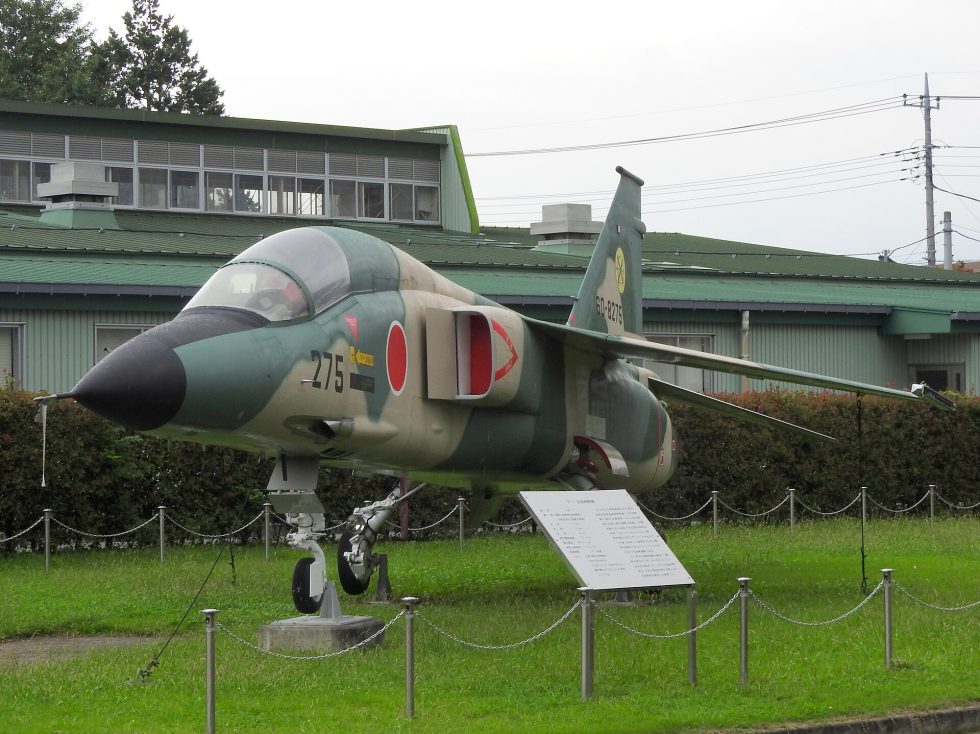
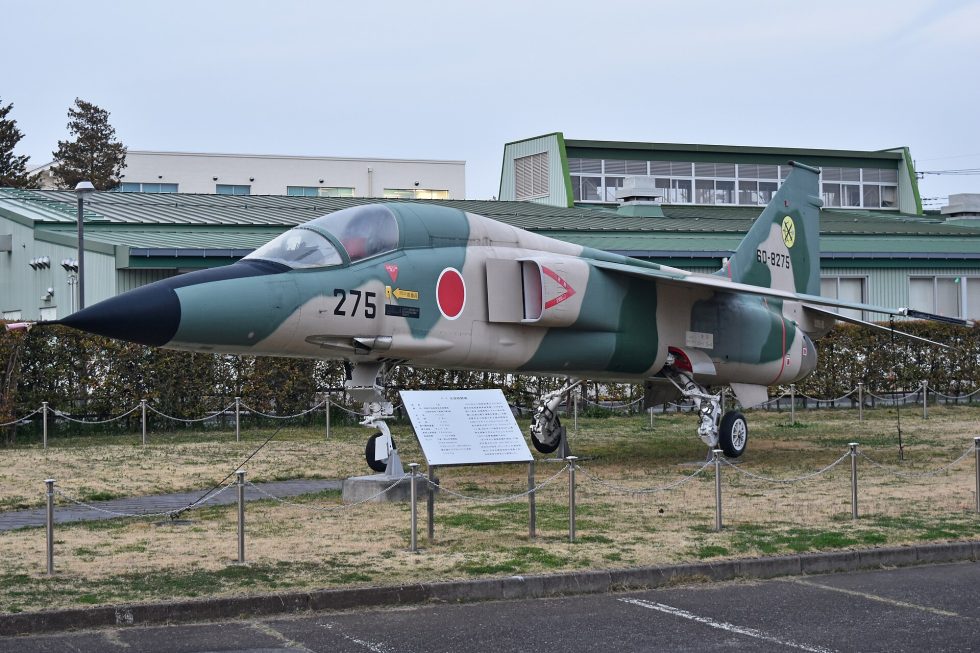
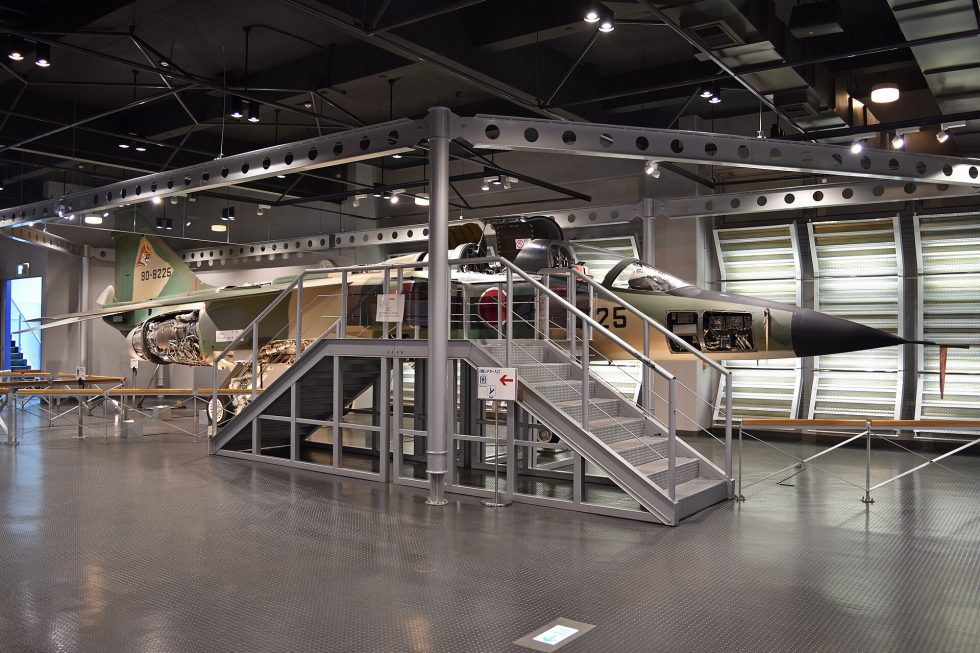
Retirement and survivors. Withdrawals began on 17 January 1997 and the last aircraft flew on 9 March 2006, when the final six were retired at their 4,000-hour airframe limit; sources differ on which unit flew them out, with the English-language account placing the last aircraft at Tsuiki, although 6 Hikotai there had already begun converting to the F-2 in August 2004, which points instead to 8 Hikotai at Misawa. At least 23 F-1s survive in Japan, every one of them an original production airframe — no replica or reproduction F-1 has ever been built, and because the export ban meant not one was ever sold abroad, there is no F-1 anywhere outside Japan. None is airworthy and none ever will be. Complete aircraft on public or semi-public display include 00-8247 at the Misawa Aviation and Science Museum, 90-8225 and 90-8227 at the Hamamatsu Public Relations Centre, 20-8263 at the National Defense Academy at Yokosuka, 60-8275 at Fuchu, 60-8274 at Hyakuri, 70-8201 at Iruma, 70-8277 at Tsuiki, 90-8234 at Kasuga, 10-8256 and 50-8270 at Hofu, 20-8260 at Miho, 70-8276 at Nara, 30-8268 at Yokota, 10-8257 at Fukue, 90-8232 at the Otsu army base, 70-8207 at an industrial site in Hyogo, and gate or sub-base examples at Kamo (00-8249), Erimo (00-8242) and Sado (00-8246). Two survive only as nose sections — 00-8241 at Misawa and 90-8231 at a cafe near Mount Fuji — and 80-8219 exists as a fire-training hulk at Ashiya, which is a survivor in the letter rather than the spirit. The count is a floor rather than a ceiling: base gate guardians are moved, repainted and scrapped without announcement.
From licensed jets to a home-grown fighter
JASDF stands up
Japan’s post-war air arm forms, flying licensed American jets while its aviation industry rebuilds.
T-X to Mitsubishi
The government selects Mitsubishi to build a domestic supersonic trainer under the T-X programme.
The T-2 flies
On 20 July the T-2 becomes the first domestically designed Japanese aircraft to break the sound barrier.
FS-T2-Kai prototype
The single-seat close-support prototype — the future F-1 — first flies on 3 June.
F-1 enters service
In April the JASDF fields the Mitsubishi F-1: Japan’s first indigenous post-war fighter.
ASM-1 in service
The indigenous Type 80 anti-ship missile enters service, giving the F-1 its signature stand-off weapon.
Production ends
The 77th and final F-1 is delivered by Mitsubishi and Fuji Heavy Industries.
Retired for the F-2
The F-16-derived Mitsubishi F-2 replaces the F-1, which flies its last frontline missions in March 2006.
Twelve stories of Japan’s F-1
Banned from building fighters
After 1945 Japan’s aircraft industry was dismantled; the F-1 marked its return to fighter design.
Read the full story
The trainer that had to be supersonic
Japan needed a home-grown jet to train pilots for the F-104 and F-4 — and chose to build it itself.
Read the full story
The supersonic first
On 20 July 1971 the T-2 became the first Japanese-designed aircraft to break the sound barrier.
Read the full story
The Japanese Jaguar?
The F-1 looks strikingly like the SEPECAT Jaguar — a convergence, not a copy.
Read the full story
Turning a trainer into a fighter
The single-seat FS-T2-Kai reworked the trainer into a close-support strike aircraft.
Read the full story
Japan’s first post-war fighter
In April 1978 the F-1 entered service — the country’s first indigenous fighter since 1945.
Read the full story
A missile to break an invasion fleet
The home-grown ASM-1 gave the F-1 a stand-off punch against warships.
Read the full story
Guarding Japan’s coasts
The F-1 existed to help repel an amphibious assault on the home islands.
Read the full story
Cannon, missiles and bombs
Beyond the ASM-1, the F-1 carried a 20 mm cannon, air-to-air missiles and conventional stores.
Read the full story
Adour power, made in Japan
Two license-built Adour turbofans gave the F-1 supersonic dash on modest thrust.
Read the full story
Where the F-1 flew
F-1 squadrons were based in northern and southern Japan, guarding the approaches to the home islands.
Read the full story
From F-1 to F-2
The F-1’s retirement in 2006 handed its mission to the larger, F-16-based F-2.
Read the full story
The F-1 in pictures
The F-1 in motion
A verified, high-authority video feature on the Mitsubishi F-1 is coming soon. We only embed footage from established, reputable channels — and we would rather leave this space empty than fill it with a low-quality clip. Check back for a documentary-grade feature on Japan’s first home-grown fighter.
Where the F-1 flew
The record that defines it
The F-1 never fired a shot in anger. Japan’s post-war constitution restricts its forces to self-defence, and the F-1 spent its entire career training for a war that never came — practising anti-ship strikes and coastal defence against a hypothetical amphibious invasion. Its record is one of deterrence and industrial achievement rather than combat.
Compare the combat record of every military aircraft. Figures as of July 2026.
Everything people ask about the Mitsubishi F-1
Can I fly in a Mitsubishi F-1?
What was the Mitsubishi F-1?
Was the F-1 based on the T-2 trainer?
Why does the F-1 look like the SEPECAT Jaguar?
What is the ASM-1, and what weapons did the F-1 carry?
How fast was the Mitsubishi F-1?
When was the F-1 retired, and what replaced it?
Was the Mitsubishi F-1 exported?
You can’t fly the F-1.
These, you can.
Some legends only live in museums — others are fuelled and waiting. MiGFlug has put civilians in real military jet cockpits since 2004.
 Fly the L-39 AlbatrosThe world’s most-flown jet trainer — aerobatics included
 Fly the F-104 Starfighter“The missile with a man in it”
 Fly the MiG-21The Cold War’s most-produced jet
 Fly the T-33 Shooting StarAmerica’s first jet trainer
 Fly the DH VampireA piece of early jet history
 Fly the S.211Agile Italian jet trainer
 Fly the MB-326The classic Aermacchi jet
 Fly the MiG-15The Soviet legend of the Korean War
Continue the tour
Every fact, checked
- Military Factory — Mitsubishi F-1Development from the T-2, service dates, dimensions, engines and armament.
- Vintage Aviation News — First flight of the Mitsubishi T-2The T-2 as Japan’s first domestically designed supersonic aircraft, and the F-1 lineage.
- AeroCorner — Mitsubishi F-1Technical data, production totals and operator history.
- Global Military — ASM-1 (Type 80)Range, guidance, warhead and the F-1’s anti-ship coastal-defence role.
- The Aviation Geek ClubBackground on the T-2/F-1 programme and JASDF service.
- 19FortyFiveAnalysis of Japan’s post-war fighter development and the F-1’s place in it.
- The National InterestContext on the F-1, the F-2 successor and Japanese anti-ship doctrine.
- Japan Air Self-Defense Force (JASDF)Official operator of the F-1 throughout its 1978–2006 career.