
Messerschmitt Me 262
“Schwalbe”
The world’s first operational jet fighter — a machine a full generation ahead of its contemporaries, undone by unreliable engines, shortages and its own late-war arrival, but whose swept-wing, axial-turbojet design helped shape every jet that followed.
A generation ahead, and too late
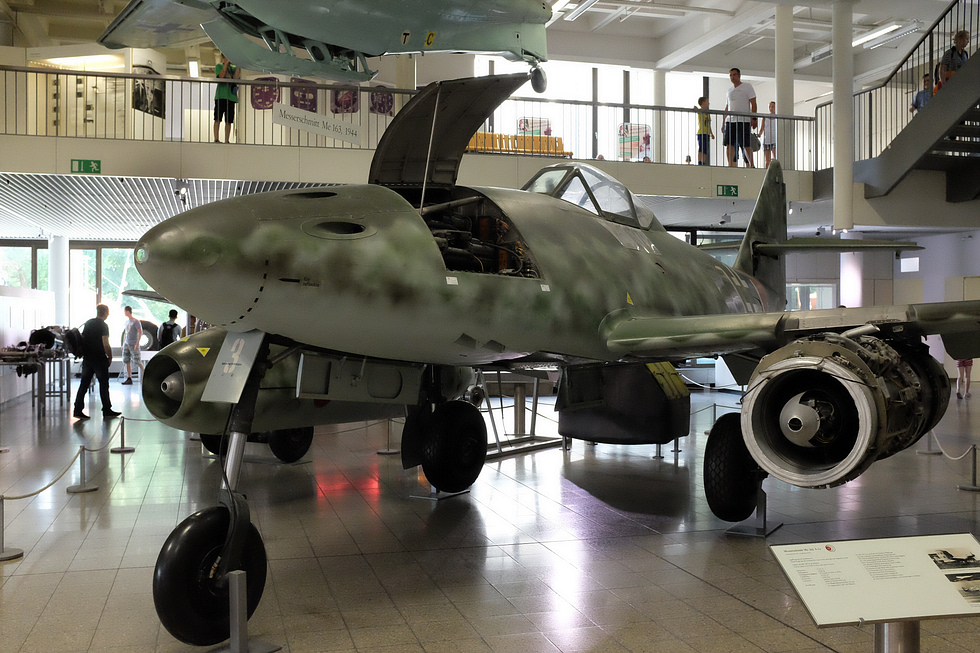
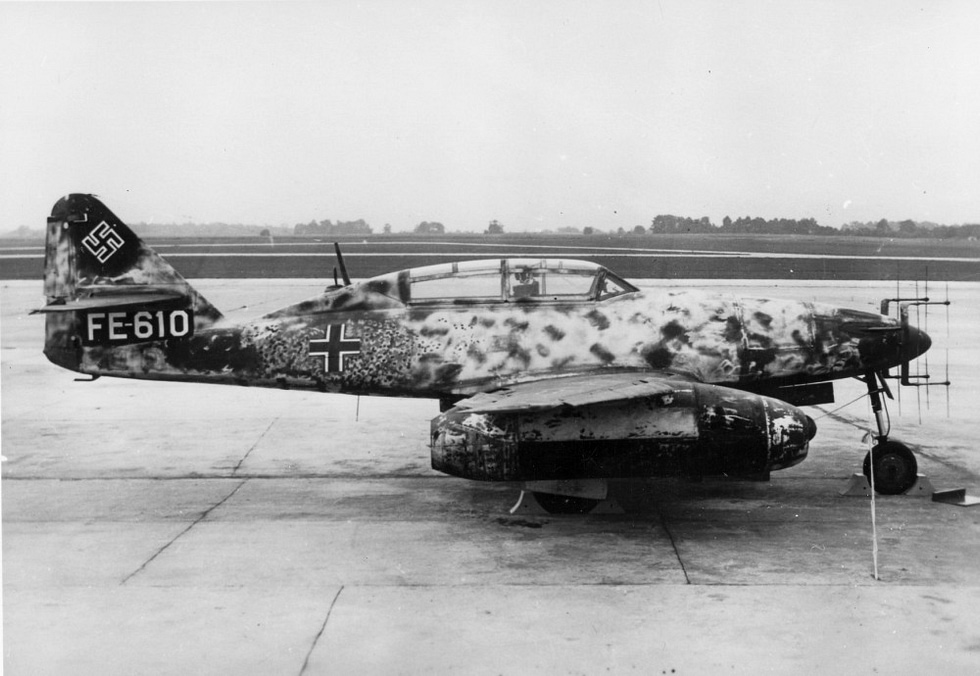
The Messerschmitt Me 262 was the first jet aircraft anywhere to reach operational fighter service. Design study began in the late 1930s under a team led by Woldemar Voigt; the prototype first flew on piston power in April 1941 while its turbojets were still being developed, and made its first flight on jet power alone on 18 July 1942, with Fritz Wendel at the controls. With a top speed around 870 km/h it outran the best Allied piston fighters — such as the P-51 Mustang — by roughly 150 km/h, and a nose battery of four 30 mm cannon gave it the punch to tear into bomber formations.
Yet it arrived too few and too late to change the war. Roughly 1,400 airframes were built, but only a few hundred ever reached operational units and fewer still flew combat at any one time. Its Junkers Jumo 004 engines were revolutionary but fragile, lasting only a handful of flying hours; fuel was scarce, airfields were bombed, and trained jet pilots were rare. Development was slowed further by engine troubles and by political interference — including insistence from the Nazi leadership that the design be adapted as a fast bomber, which historians generally regard as having delayed its deployment in the fighter role.
Its lasting significance was technological. On the ground and in the landing pattern the jet was vulnerable, and it could not turn the war. But after 1945 both the United States and the Soviet Union studied captured Me 262s and their swept-wing data closely, and the design helped shape the first generation of postwar jet aircraft on both sides of the emerging Cold War.
01The Me 262’s numbers: why 1,400 built rarely meant more than a handful in the sky
Production totals for the Me 262 commonly cluster around 1,400–1,440 airframes completed. But the paper figure never translated into strength in the air. Only a few hundred ever reached front-line units, and at any given moment engine failures, fuel shortages and battle damage meant only a fraction were serviceable.
The reasons were structural: bombed factories and dispersed production, chronic shortages of fuel and strategic metals, a shortage of pilots trained on jets, and engines that needed overhaul after only about 10–25 hours. The Me 262 is a case study in how a technological lead can be squandered by an industrial base and a strategic situation that cannot support it.
What makes the Me 262 special
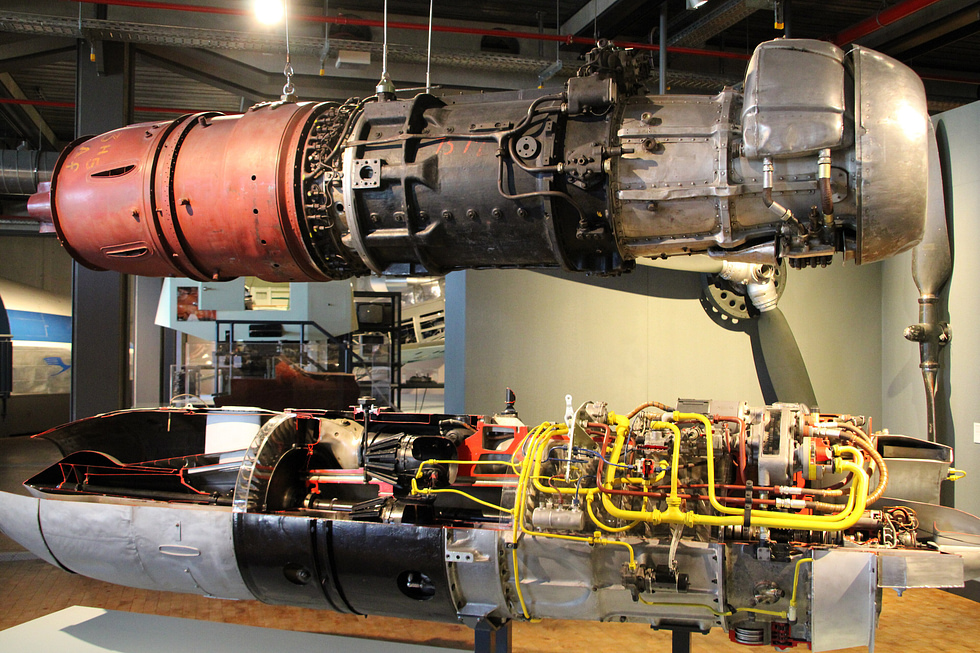
Twin Jumo 004 axial turbojets
The Me 262 was powered by two Junkers Jumo 004 engines — the first mass-produced axial-flow turbojets in operational service, each giving roughly 8.8 kN of thrust. Revolutionary in concept, they were built with substitute low-alloy steels because of wartime shortages of nickel and chromium, which cut their service life to only about 10–25 hours and demanded gentle throttle handling to avoid flame-outs or turbine failure.
A slightly swept wing
The Me 262 carried a modest leading-edge sweep. It was adopted mainly to keep the aircraft’s centre of gravity correct after engine and equipment changes, rather than deliberately to delay compressibility effects. Whatever the reason, the configuration proved highly influential: captured aircraft informed postwar swept-wing research in both the United States and the Soviet Union.
Concentrated nose armament
Four 30 mm MK 108 cannon were grouped in the nose, delivering a devastating short-range punch well suited to destroying heavy bombers. Late in the war some aircraft added underwing R4M unguided rockets, fired in a salvo to break up bomber “boxes” from beyond the range of their defensive guns.
02The Me 262’s engines: why the Jumo 004 lasted only a handful of hours
The Jumo 004 was a genuine breakthrough — the first axial-flow turbojet built in quantity and put into operational service. But it was designed and produced under wartime blockade, without the nickel, chromium and cobalt that a jet engine’s hot section really needs. Engineers substituted low-alloy steels and coatings, and the result was an engine that worked but wore out fast: overhaul life on the order of 10–25 hours, with turbine blades prone to creep and failure. Pilots were trained to move the throttle slowly, because a rapid advance could starve or overheat the engine into a flame-out. The 004 proved that the axial turbojet was the future — and also how much metallurgy the future would demand.
03The Me 262’s R4M rockets: breaking the bomber box from stand-off range
A tight Allied bomber formation — the “combat box” — relied on massed defensive machine-gun fire for mutual protection, which made close firing passes costly. Late-war Me 262s answered with the R4M, a small unguided folding-fin rocket carried in underwing racks. Fired as a salvo from beyond the bombers’ effective gun range, a spread of rockets could tear open the formation before the jet closed in with its cannon. It was an early glimpse of air-to-air rocketry, and a preview of tactics that guided missiles would later refine.
Full specifications
Airframe & Performance
- طاقم
- 1 (two-seat trainer & night-fighter variants)
- طول
- ~10.6 m
- طول الجناحين
- ~12.6 m (12.5–12.6 by source)
- ارتفاع
- ~3.8 m
- Max speed
- ~870 km/h (some sources ~900 km/h)
- سقف الخدمة
- ~11,500 m
- يتراوح
- ~1,050 km
- First jet flight
- 18 July 1942
- Number built
- ~1,400 (only a few hundred operational)
Propulsion & Systems
- محرك
- 2 × Junkers Jumo 004B axial turbojet
- Thrust
- ~8.8 kN (1,984 lbf) each
- Engine life
- ~10–25 hr between overhauls
- Cannon
- 4 × 30 mm MK 108 (nose)
- Rockets
- Optional R4M unguided air-to-air
- Main variants
- A-1a fighter, A-2a Sturmvogel, B-1a trainer / night-fighter
- Service entry
- 1944 (Luftwaffe)
- Unit cost
- No reliable secondary-source figure
04The Me 262’s figures: why the specifications vary between sources
Published Me 262 figures differ slightly depending on the source and the exact variant. Top speed is commonly cited around 870 km/h but appears up to about 900 km/h; wingspan is quoted at 12.5–12.6 m; and the number built is usually given as roughly 1,400 but sometimes up to 1,440. The values here use the commonly cited round figures for the A-1a fighter. No reliable open-source unit-cost figure exists — it was a wartime state programme, and credible secondary sources do not give a dependable price — so no cost is stated rather than repeating an unverifiable number.
From project study to postwar copy
Project study begins
Messerschmitt begins design study for a jet-powered fighter, with a team led by Woldemar Voigt.
First prototype flight
The first prototype flies under piston power, using a nose-mounted Jumo 210G, while its turbojets are still in development.
First flight on jet power
Fritz Wendel makes the first flight on jet power alone, with two Junkers Jumo 004 turbojets.
Development amid delays
Work continues amid engine problems and debate over whether the aircraft should be a fighter or a fast bomber.
Enters service
The Me 262 enters Luftwaffe service; the test unit Erprobungskommando 262 scores the type’s first aerial victories.
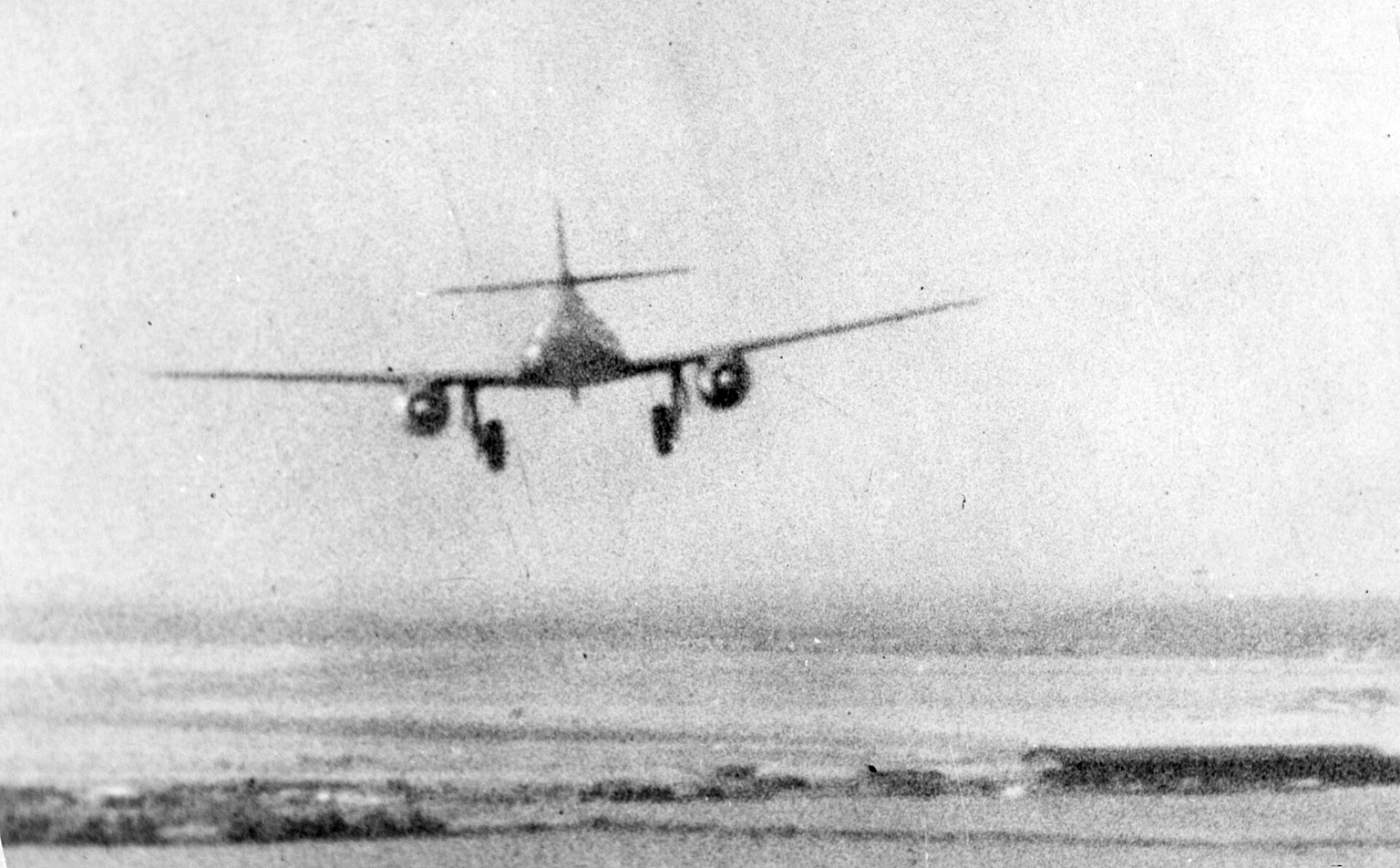
Caught on final approach
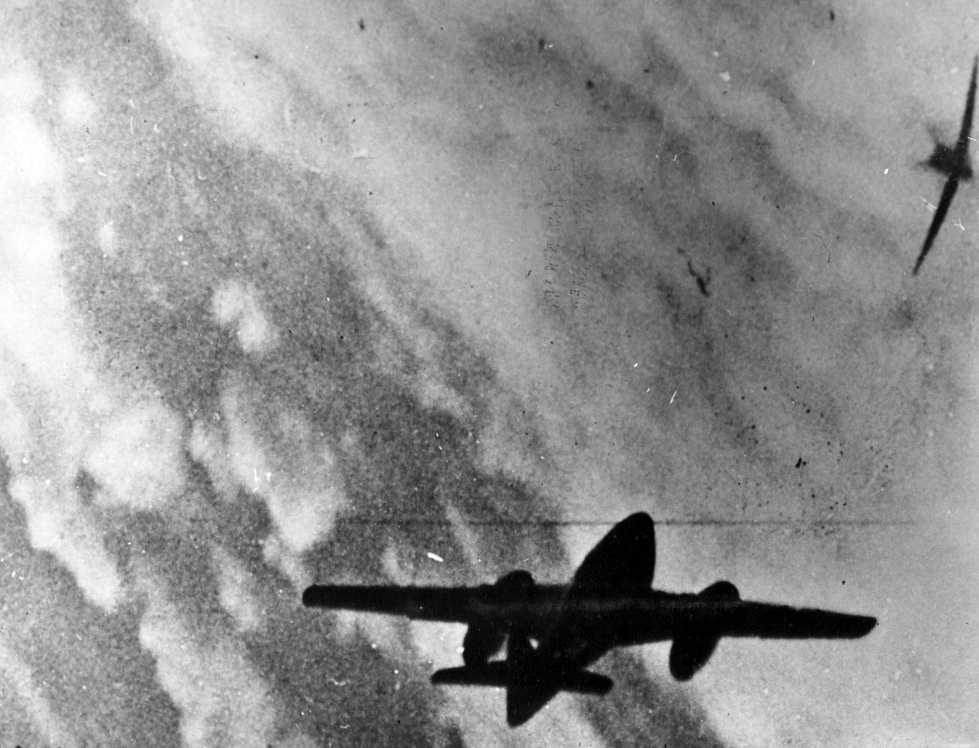
USAAF pilot Chuck Yeager reports downing an Me 262 on its landing approach — an early example of the jet’s low-speed vulnerability.
JV 44 formed
Jagdverband 44 is formed under Adolf Galland, gathering experienced pilots; R4M rockets are used against bomber formations.
War in Europe ends
Hundreds of Me 262s are captured or abandoned; the Allies begin detailed evaluation of the airframe and engines.
Avia S-92 flies
The Czechoslovak Avia S-92 — a postwar continuation of Me 262 production from leftover parts — makes its first flight.
Twelve stories from the first jet age
The first jet in a dogfight
A generation ahead of its time.
Read the full story
The bomber that shouldn’t have been
A fighter forced into another job.
Read the full story
The 25-hour engines
Revolutionary, and fragile.
Read the full story
JV 44: the squadron of experts
An elite gathered too late.
Read the full story
R4M: breaking the bomber box
A preview of air-to-air rocketry.
Read the full story
Caught on final
Fast in the air, exposed near the ground.
Read the full story
The jet everyone wanted to study
A war prize for both sides.
Read the full story
Avia S-92: built after the war
A jet reborn in Czechoslovakia.
Read the full story
The Stormbirds fly again
Modern-build Me 262s in the air.
Read the full story
The ones that lasted
From battlefield to museum hall.
Read the full story
Swept for balance, famous for sweep
An accidental icon.
Read the full story
1,400 built, a handful in combat
Mass production that never mattered.
Read the full story
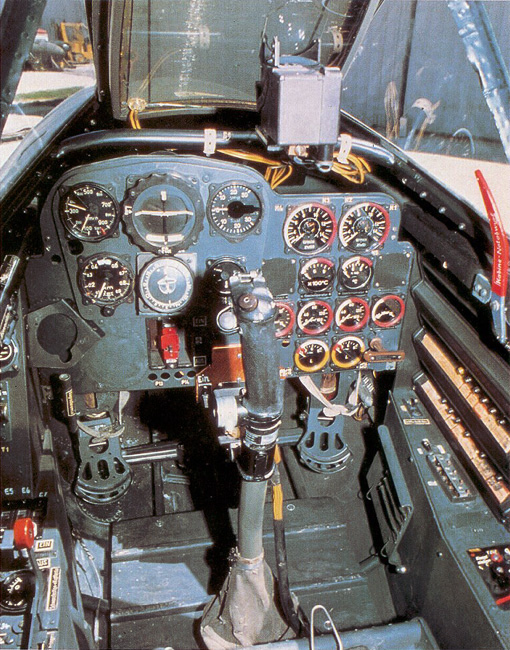
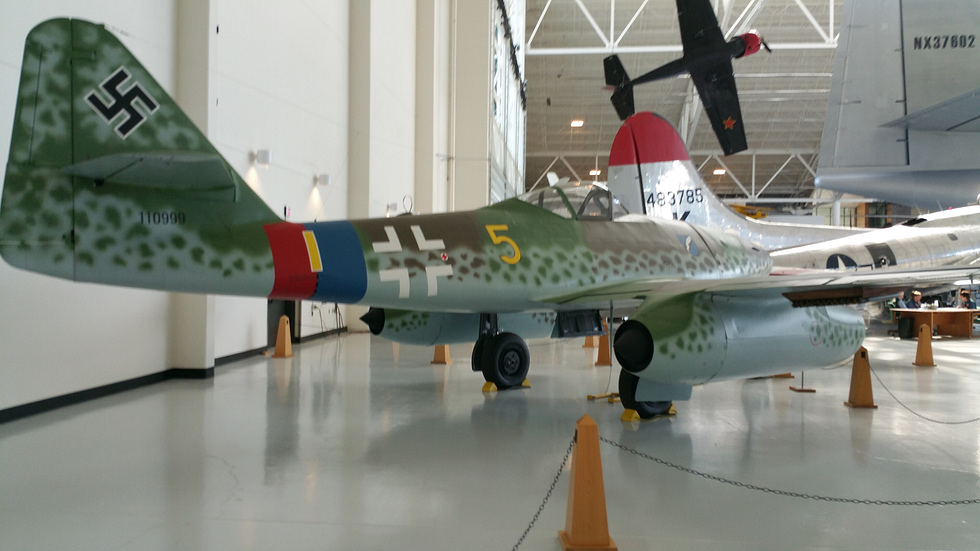
The Me 262 in pictures
The Me 262 in motion
A documentary segment on the first operational jet fighter will be added here.
The Me 262 in motion
DroneScapes — one of the most-watched Me 262 films on YouTube.
Where the Me 262 flew
A contested combat record
The Me 262 operated chiefly as a bomber-destroyer over Germany from mid-1944 into 1945. Overall claims for the type run to more than 500 Allied aircraft destroyed for on the order of 100 Me 262s lost in air combat — but these figures are contested and vary widely between sources, and wartime claims in general were often overstated. They should be read as disputed claims, not verified records.
The jet’s key tactical weakness was its vulnerability at low speed — on takeoff, in the landing pattern and while climbing away it could be caught by patrolling Allied escorts. Compare the combat record of every military aircraft. Figures as of July 2026.
Everything people ask about the Me 262
Can I fly in a Me 262?
How fast was the Me 262?
Was it really the first jet fighter?
How did it compare to the P-51 Mustang?
How many were built?
Why did so few fight if 1,400 were built?
Are any still flyable?
You can’t fly the Me 262.
These, you can.
Some legends only live in museums — others are fuelled and waiting. MiGFlug has put civilians in real military jet cockpits since 2004.
 Fly the L-39 AlbatrosThe world’s most-flown jet trainer — aerobatics included
 Fly the F-104 Starfighter“The missile with a man in it”
 Fly the MiG-21The Cold War’s most-produced jet
 حلّق بطائرة تي-33 شوتينغ ستارAmerica’s first jet trainer
 Fly the DH VampireA piece of early jet history
 Fly the S.211Agile Italian jet trainer
 Fly the MB-326The classic Aermacchi jet
 Fly the MiG-15The Soviet legend of the Korean War
Continue the tour
Every fact, checked
- Smithsonian National Air and Space MuseumMe 262 A-1a Schwalbe — collection record and history.
- Naval History and Heritage Command (US Navy)Me 262 overview and technical background.
- MilitaryFactorySpecifications and variant summary for the Schwalbe / Sturmvogel.
- Osprey Publishing blogThe Me 262 and the R4M air-to-air rocket.
- The Chuck Yeager FoundationThe 1944 Me 262 shootdown on final approach.
- autoevolutionThe postwar Czechoslovak Avia S-92 continuation.
- Warbirds NewsModern-build Me 262 replicas (the Me 262 Project).
- Military Aviation Museum“Stormbird Resurrection” — an Me 262 restored to fly.