
Tupolev Tu-95
“Bear”
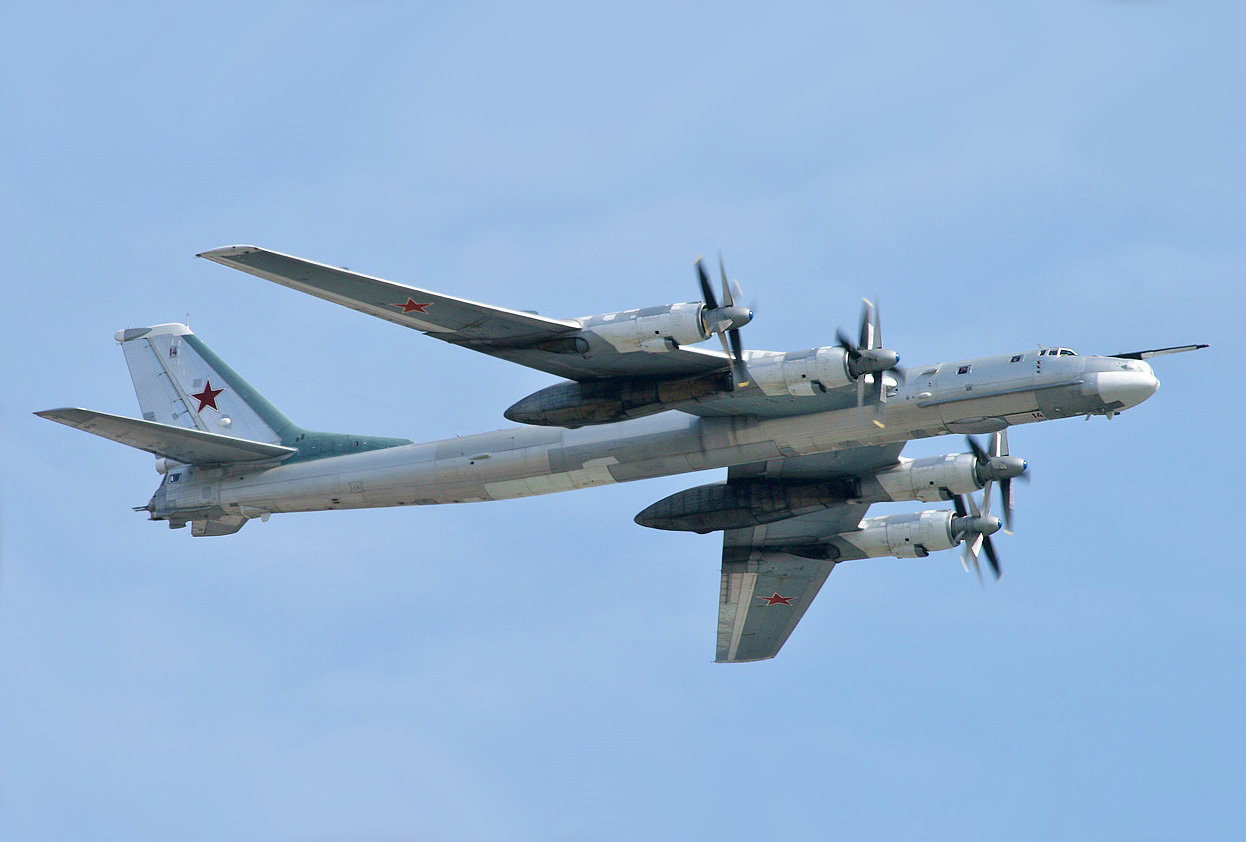
A Cold-War strategic bomber that broke the rules of aeronautics — swept wings driven by four huge turboprops — to fly almost as fast as a jet, reach halfway round the world, and become one of the loudest aircraft ever built. Seventy years on, a modernised version still flies for Russia as a cruise-missile carrier.
The bomber that shouldn’t work — and still flies
In the early 1950s the Soviet Union needed a bomber that could reach the United States and return — a range of roughly 12,000 to 15,000 km. The obvious answer was jet power, but the turbojets of the day drank fuel far too quickly for that kind of distance. Andrei Tupolev’s bureau made an unusual bet: combine a modern swept wing, normally the mark of a jet, with four enormous turboprop engines that were far thirstier-efficient over long distances. Most Western engineers thought the combination would never deliver near-jet speed. It did.
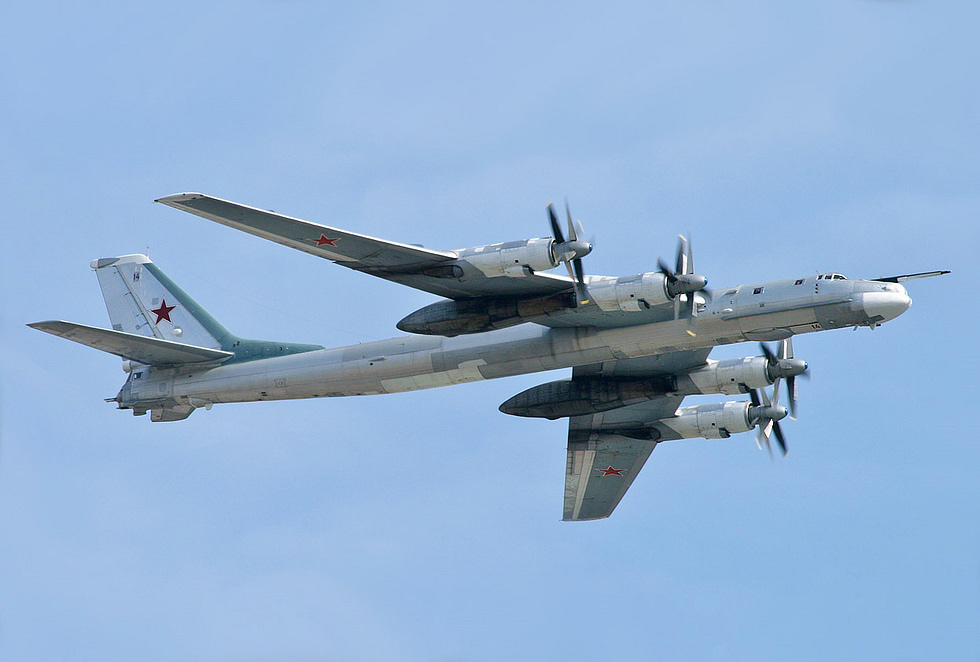
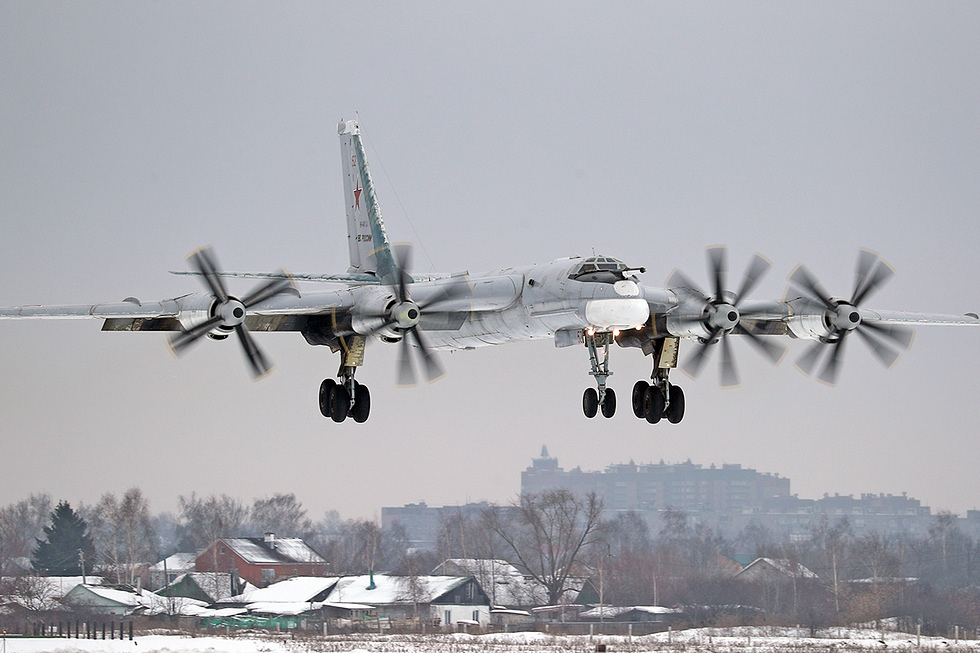
The prototype first flew on 12 November 1952. An early aircraft was lost in 1953 to an engine failure, but with the definitive Kuznetsov NK-12 engine the design matured, and the Tu-95 entered Soviet service around 1956. NATO gave it the reporting name “Bear.” Its four NK-12s — still among the most powerful turboprops ever built — each spin a pair of contra-rotating propellers whose blade tips run supersonic. The result is a machine that cruises near 900 km/h and is famously, punishingly loud; the noise is often said to be detectable by the sonar of submerged submarines, a claim frequently repeated but hard to verify.
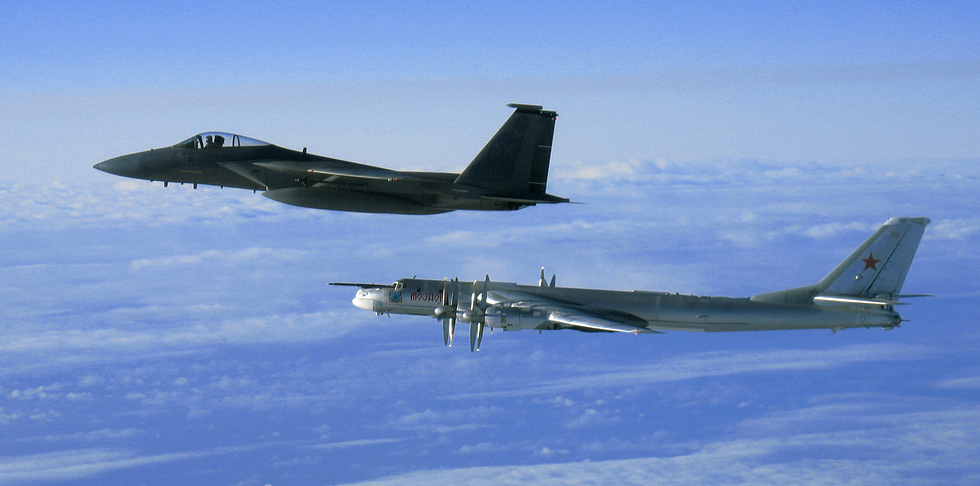
Through the Cold War the Bear became the aircraft NATO fighter pilots met most often — shadowing it over the Atlantic, the Arctic and the Pacific in countless intercepts. Unlike almost every contemporary, it never went out of service. A heavily rebuilt version, the Tu-95MS, was fielded from the 1980s as a launch platform for long-range cruise missiles, and it is in that standoff role — firing missiles from hundreds of kilometres away rather than flying over its targets — that Russia still operates it today, including in strikes on Ukraine since 2022. Those recent operations, and the losses the fleet has taken on the ground, are covered factually and with the usual caveats further down this page.
01Why the Tu-95 used propellers when the West was building jet bombers
When the Tu-95 was designed, contemporary turbojets simply could not combine high speed with intercontinental range — they burned fuel far too fast. The American B-52, developed at the same time, only made the jet approach work by being enormous and carrying vast fuel loads. Tupolev took the opposite path: turboprops, which convert most of their energy into propeller thrust and are markedly more fuel-efficient at long range, married to a thin swept wing for speed. The gamble produced an aircraft that is slower than a jet bomber in absolute terms but sips fuel by comparison, giving the Bear its trademark reach. The trade-off is noise and vibration: to push a propeller aircraft toward 900 km/h, the blade tips must turn supersonic, which is the source of the Tu-95’s extraordinary din.
What makes the Tu-95 special
The most powerful turboprops ever — and contra-rotating props
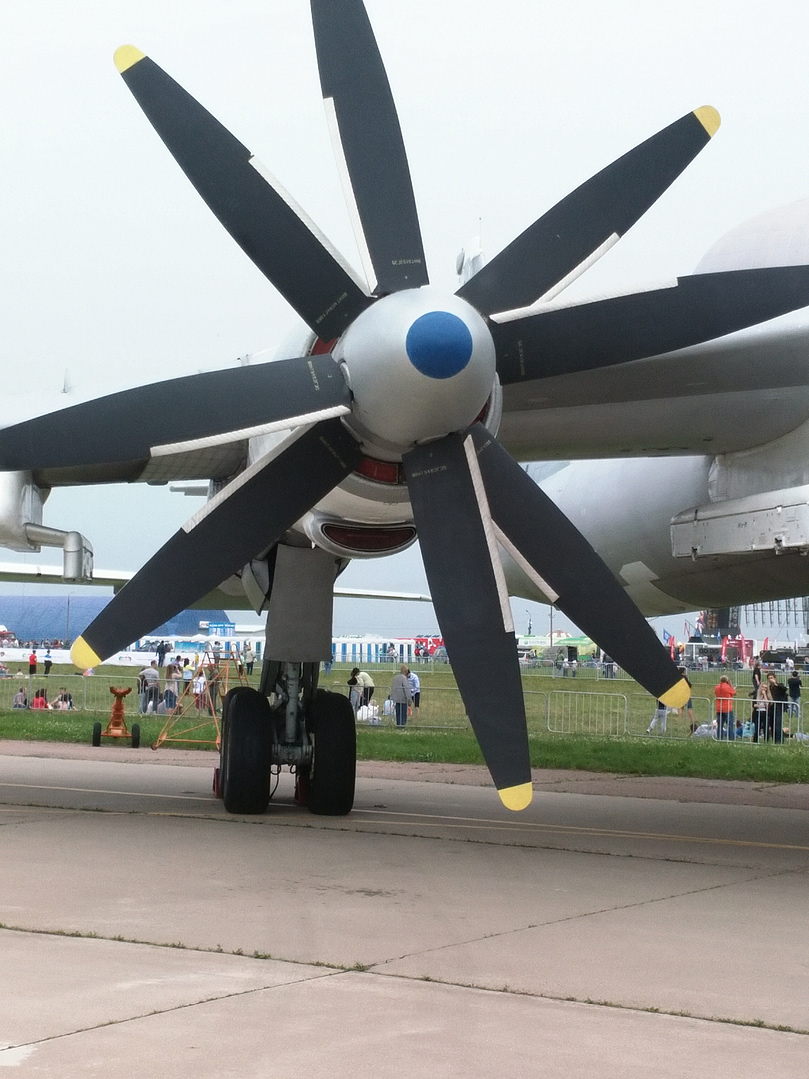
Each of the Tu-95’s four Kuznetsov NK-12 engines produces on the order of 15,000 shaft horsepower, making it among the most powerful turboprop engines ever put into service. Each drives two large contra-rotating propellers turning in opposite directions, which recovers energy that a single propeller would waste and lets the aircraft approach jet-like speeds. It is this arrangement, with the blade tips going supersonic, that makes the Bear one of the loudest aircraft ever flown.
Intercontinental reach — and the ‘Bear’ intercepts
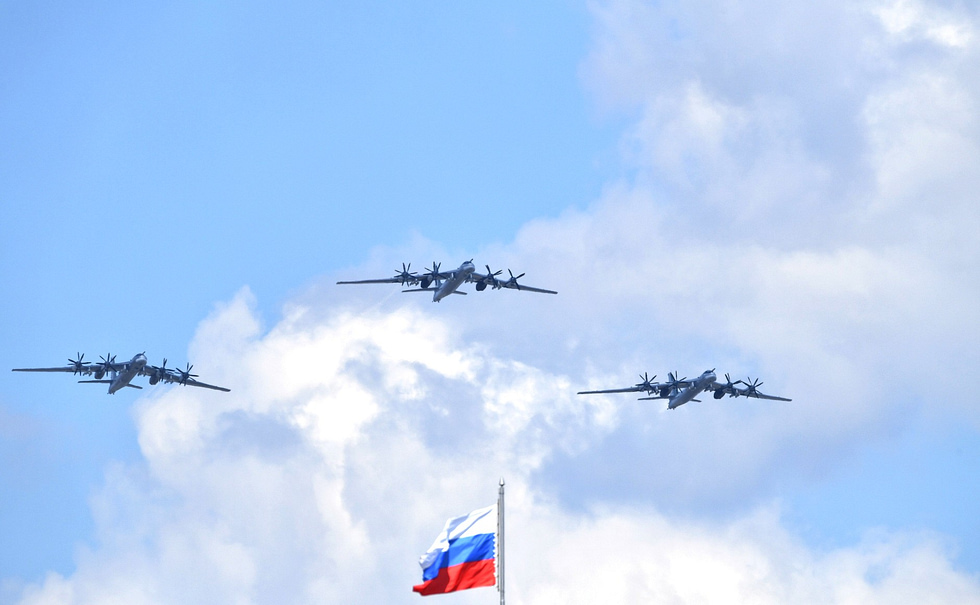
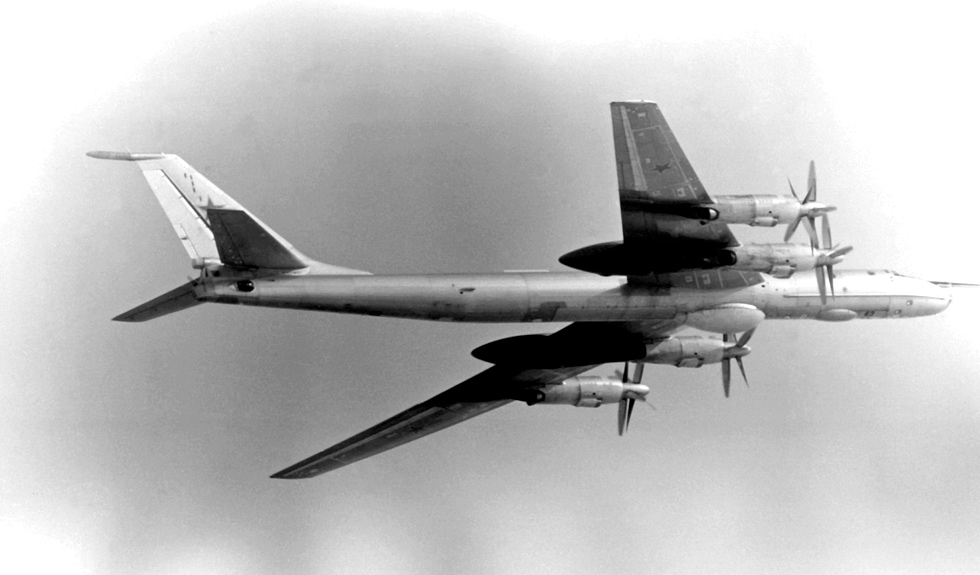
The swept wing plus efficient turboprops give the Tu-95 an unrefuelled range around 15,000 km, enough to patrol the edges of NATO airspace across the Atlantic, Arctic and Pacific. For decades those patrols were routinely met and escorted by Western fighters — RAF, US, Norwegian and other interceptors — making the Bear the single most-photographed shape of the Cold War standoff. The maritime Tu-142 derivative extended the type into long-range naval patrol and anti-submarine work.
From free-fall bombs to a standoff missile truck
The Bear began as a nuclear free-fall bomber, but its most enduring modern form is the Tu-95MS, a rebuilt version that carries long-range cruise missiles — originally the Kh-55, later the Kh-101/102 family — on an internal rotary launcher and wing pylons. In this standoff role the aircraft need never enter defended airspace: it launches from long range and turns for home, which is how the type remains militarily relevant seventy years after its first flight.
02The Tu-95’s noise: the propeller bomber you can reportedly hear underwater
Driving propellers toward the speed of sound makes their tips generate shockwaves, and the Tu-95’s eight contra-rotating blades per side produce a sound so intense it is part of the aircraft’s legend. It is widely reported — including in Western accounts — that the noise could be picked up by the passive sonar of submerged submarines and by airborne detection equipment. This is a much-repeated claim rather than a precisely documented figure, and it should be read as illustrative of the aircraft’s din rather than a verified sensor specification. What is not in doubt is that crews and ground staff describe the Bear as brutally loud, and that its acoustic signature is unmistakable.
03The Tu-95MS: how an old airframe became a cruise-missile carrier
The modern Tu-95MS is not the original 1950s bomber but a later production aircraft derived from the Tu-142 maritime airframe, built into the 1990s. Rather than penetrating enemy air defences to drop bombs — a near-impossible task for a slow, huge, loud propeller aircraft against modern fighters and missiles — it was reconfigured to launch cruise missiles from well outside defended airspace. That standoff concept is why a design from the Stalin era still has a role: the airframe is essentially a long-range, long-endurance truck for precision missiles, and Russia has stated it intends to keep upgraded Tu-95MS aircraft in service for years to come. Capability and modernisation claims from Russian sources should be treated with appropriate caution.
Full specifications
Airframe & Performance
- طاقم
- ~7
- طول
- ~49.5 m
- طول الجناحين
- ~50.1 m
- ارتفاع
- ~12.1 m
- Max takeoff weight
- ~188,000 kg
- Max speed
- ~925 km/h
- سرعة الإبحار
- ~710 km/h
- سقف الخدمة
- ~12,000 m
- يتراوح
- ~15,000 km (unrefuelled)
- Wing sweep
- 35°
Propulsion & Systems
- Engines
- 4 × Kuznetsov NK-12
- Power (each)
- ~11,000 kW (~15,000 shp)
- Propellers
- Contra-rotating, 8 blades per engine
- Main armament (Tu-95MS)
- Kh-55 / Kh-101 cruise missiles
- Defensive gun
- Tail-mounted cannon (23 mm)
- First flight
- 12 November 1952
- Introduced
- ~1956
- Unit cost
- No reliable public figure
- Cost per flight hour
- No reliable public figure
04The Tu-95’s cost: why no reliable dollar figure exists
The Tu-95 has always been a Soviet and then Russian state product, never traded on an open market, so no credible flyaway unit price or cost-per-flight-hour exists in the public record — and any precise dollar figure attached to the type should be treated as guesswork. What can be said with confidence is strategic rather than financial: Russia is understood to operate only a few dozen Tu-95MS aircraft, production of new airframes ended decades ago, and the tooling to build more no longer exists. That scarcity, rather than any published price, is what makes each aircraft valuable — and is why losses on the ground, discussed below, matter disproportionately. Figures here are drawn from open-source estimates and should be read as approximate.
Seven decades of the Bear
Requirement issued
The Soviet leadership orders an intercontinental bomber able to reach the United States; Tupolev proposes a swept-wing turboprop design.
First flight
The prototype flies on 12 November. An early aircraft is lost in 1953 to an engine fire, delaying the programme.
Enters service
With the definitive Kuznetsov NK-12 engine, the Tu-95 joins Soviet Long-Range Aviation. NATO names it “Bear.”
Tsar Bomba
A specially modified Tu-95V drops the ~50-megaton AN602 — the largest man-made explosion in history — over Novaya Zemlya on 30 October.
Cold War patrols
Bears range the Atlantic, Arctic and Pacific and are routinely intercepted and escorted by NATO fighters. The Tu-142 maritime variant enters naval service.
The missile carrier
The rebuilt Tu-95MS enters service as a cruise-missile platform, giving the ageing design a standoff role.
First combat launches
Russia reports using Tu-95MS aircraft to fire Kh-101 cruise missiles in Syria — the type’s first offensive combat use.
Ukraine war & drone strikes
Tu-95MS bombers launch cruise missiles at Ukraine; in return, Ukrainian long-range drones reportedly strike Russian bomber bases, damaging or destroying several Tu-95s.
Twelve Bear stories
A contradiction that flew
Western engineers doubted a swept-wing turboprop could reach near-jet speed. Tupolev proved it could.
Read the full story
The loudest bomber
The Bear’s contra-rotating propellers spin their tips past the speed of sound, producing a legendary noise.
Read the full story
Tsar Bomba
A single modified Tu-95V dropped the largest bomb ever detonated — and only just escaped the blast.
Read the full story
The intercept ritual
For decades the Bear was the aircraft NATO pilots met most often, shadowed wingtip to wingtip.
Read the full story
The Bear at sea
The Tu-142 turned the bomber into a long-range naval patrol and submarine-hunter.
Read the full story
Halfway round the world
The Bear’s roughly 15,000-km range let it probe the far edges of NATO airspace and beyond.
Read the full story
From bombs to missiles
The Tu-95MS abandoned overflight bombing for launching cruise missiles from a safe distance.
Read the full story
First shots fired
Russia reported the Tu-95MS’s first offensive combat use in Syria — nearly sixty years after entering service.
Read the full story
A cruise-missile platform
Since 2022 Tu-95MS bombers have been used to launch cruise missiles at Ukraine, in strikes documented by Ukrainian and Western sources.
Read the full story
Struck on the ground
Ukrainian long-range drones have reportedly hit Russian bomber bases, damaging or destroying Tu-95s that cannot be replaced.
Read the full story
The bomber that would not retire
Almost every contemporary of the Tu-95 is long gone; the Bear keeps flying.
Read the full story
A Cold War icon
Instantly recognisable by shape and sound, the Bear became shorthand for Soviet strategic power.
Read the full story
The Bear in pictures
The Bear in motion
Video coming soon. We are still sourcing a clear, rights-appropriate clip of the Tu-95 in flight — the unmistakable drone of its contra-rotating propellers really has to be heard. Check back shortly.
The Tu-95 Bear in motion
vaso opel — one of the most-watched Tu-95 Bear films on YouTube.
Where the Bear flies
The record, stated plainly
For most of its life the Tu-95 never dropped a weapon in anger. Its Cold War role was deterrence and reconnaissance, not battle, and its single most famous act was a nuclear test, not a combat mission. Only in the modern standoff-missile role has the type been used offensively — in Syria from 2015 and against Ukraine since 2022. The figures below are drawn from open sources; recent wartime claims from all sides should be treated with caution.
Compare the combat record of every military aircraft. Figures as of July 2026 and, for the ongoing war, provisional.
Everything people ask about the Tu-95
Can I fly in a Tu-95?
Is the Tu-95 a jet or a propeller aircraft?
Why is the Tu-95 so loud?
Is the Tu-95 still in service?
Did a Tu-95 drop the Tsar Bomba?
Has the Tu-95 been used against Ukraine?
Have any Tu-95s been destroyed in the war?
What does “Bear” mean?
You can’t fly the Tu-95.
These, you can.
Some legends only live in museums — others are fuelled and waiting. MiGFlug has put civilians in real military jet cockpits since 2004.
 Fly the L-39 AlbatrosThe world’s most-flown jet trainer — aerobatics included
 Fly the F-104 Starfighter“The missile with a man in it”
 Fly the MiG-21The Cold War’s most-produced jet
 حلّق بطائرة تي-33 شوتينغ ستارAmerica’s first jet trainer
 Fly the DH VampireA piece of early jet history
 Fly the S.211Agile Italian jet trainer
 Fly the MB-326The classic Aermacchi jet
 Fly the MiG-15The Soviet legend of the Korean War
Continue the tour
Every fact, checked
- The War Zone (TWZ)Reporting on Tu-95 operations, cruise-missile strikes and drone attacks on Russian bomber bases.
- The AviationistNATO intercepts of Tu-95 patrols and analysis of the type’s modern role.
- The Aviation Geek ClubDevelopment history, the NK-12 engine and the contra-rotating propeller design.
- CSIS — Operation Spider Web analysisAssessment of Ukraine’s June 2025 drone raid on Russian bomber bases.
- The Washington Post — damage assessmentVisual verification of Tu-95 and other bomber damage after the June 2025 attack.
- The Nuclear Weapon Archive — Tsar BombaTechnical account of the 1961 AN602 test dropped by a Tu-95V.
- سلاح الجو الملكيReference for the recurring QRA intercepts of Russian Bear patrols near NATO airspace.
- IISS — The Military BalanceOrder-of-battle reference for the size and status of Russia’s Tu-95MS fleet.