
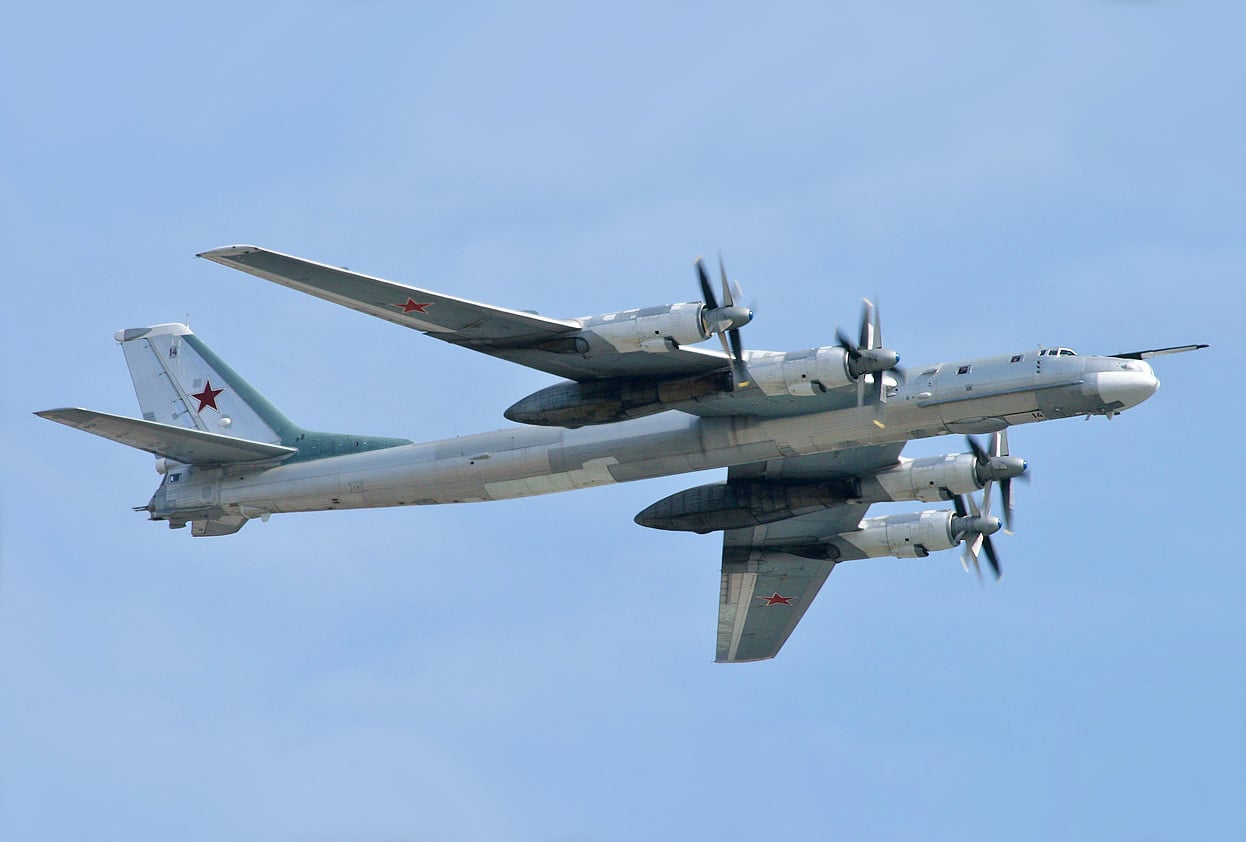
Tupolev Tu-95
“Bear”
A Cold-War strategic bomber that broke the rules of aeronautics — swept wings driven by four huge turboprops — to fly almost as fast as a jet, reach halfway round the world, and become one of the loudest aircraft ever built. Seventy years on, a modernised version still flies for Russia as a cruise-missile carrier.
The bomber that shouldn’t work — and still flies
In the early 1950s the Soviet Union needed a bomber that could reach the United States and return — a range of roughly 12,000 to 15,000 km. The obvious answer was jet power, but the turbojets of the day drank fuel far too quickly for that kind of distance. Andrei Tupolev’s bureau made an unusual bet: combine a modern swept wing, normally the mark of a jet, with four enormous turboprop engines that were far thirstier-efficient over long distances. Most Western engineers thought the combination would never deliver near-jet speed. It did.
The prototype first flew on 12 November 1952. An early aircraft was lost in 1953 to an engine failure, but with the definitive Kuznetsov NK-12 engine the design matured, and the Tu-95 entered Soviet service around 1956. NATO gave it the reporting name “Bear.” Its four NK-12s — still among the most powerful turboprops ever built — each spin a pair of contra-rotating propellers whose blade tips run supersonic. The result is a machine that cruises near 900 km/h and is famously, punishingly loud; the noise is often said to be detectable by the sonar of submerged submarines, a claim frequently repeated but hard to verify.
Through the Cold War the Bear became the aircraft NATO fighter pilots met most often — shadowing it over the Atlantic, the Arctic and the Pacific in countless intercepts. Unlike almost every contemporary, it never went out of service. A heavily rebuilt version, the Tu-95MS, was fielded from the 1980s as a launch platform for long-range cruise missiles, and it is in that standoff role — firing missiles from hundreds of kilometres away rather than flying over its targets — that Russia still operates it today, including in strikes on Ukraine since 2022. Those recent operations, and the losses the fleet has taken on the ground, are covered factually and with the usual caveats further down this page.
01Why the Tu-95 used propellers when the West was building jet bombers
When the Tu-95 was designed, contemporary turbojets simply could not combine high speed with intercontinental range — they burned fuel far too fast. The American B-52, developed at the same time, only made the jet approach work by being enormous and carrying vast fuel loads. Tupolev took the opposite path: turboprops, which convert most of their energy into propeller thrust and are markedly more fuel-efficient at long range, married to a thin swept wing for speed. The gamble produced an aircraft that is slower than a jet bomber in absolute terms but sips fuel by comparison, giving the Bear its trademark reach. The trade-off is noise and vibration: to push a propeller aircraft toward 900 km/h, the blade tips must turn supersonic, which is the source of the Tu-95’s extraordinary din.
What makes the Tu-95 special
The most powerful turboprops ever — and contra-rotating props
Each of the Tu-95’s four Kuznetsov NK-12 engines produces on the order of 15,000 shaft horsepower, making it among the most powerful turboprop engines ever put into service. Each drives two large contra-rotating propellers turning in opposite directions, which recovers energy that a single propeller would waste and lets the aircraft approach jet-like speeds. It is this arrangement, with the blade tips going supersonic, that makes the Bear one of the loudest aircraft ever flown.
Intercontinental reach — and the ‘Bear’ intercepts
The swept wing plus efficient turboprops give the Tu-95 an unrefuelled range around 15,000 km, enough to patrol the edges of NATO airspace across the Atlantic, Arctic and Pacific. For decades those patrols were routinely met and escorted by Western fighters — RAF, US, Norwegian and other interceptors — making the Bear the single most-photographed shape of the Cold War standoff. The maritime Tu-142 derivative extended the type into long-range naval patrol and anti-submarine work.
From free-fall bombs to a standoff missile truck
The Bear began as a nuclear free-fall bomber, but its most enduring modern form is the Tu-95MS, a rebuilt version that carries long-range cruise missiles — originally the Kh-55, later the Kh-101/102 family — on an internal rotary launcher and wing pylons. In this standoff role the aircraft need never enter defended airspace: it launches from long range and turns for home, which is how the type remains militarily relevant seventy years after its first flight.
02The Tu-95’s noise: the propeller bomber you can reportedly hear underwater
Driving propellers toward the speed of sound makes their tips generate shockwaves, and the Tu-95’s eight contra-rotating blades per side produce a sound so intense it is part of the aircraft’s legend. It is widely reported — including in Western accounts — that the noise could be picked up by the passive sonar of submerged submarines and by airborne detection equipment. This is a much-repeated claim rather than a precisely documented figure, and it should be read as illustrative of the aircraft’s din rather than a verified sensor specification. What is not in doubt is that crews and ground staff describe the Bear as brutally loud, and that its acoustic signature is unmistakable.
03The Tu-95MS: how an old airframe became a cruise-missile carrier
The modern Tu-95MS is not the original 1950s bomber but a later production aircraft derived from the Tu-142 maritime airframe, built into the 1990s. Rather than penetrating enemy air defences to drop bombs — a near-impossible task for a slow, huge, loud propeller aircraft against modern fighters and missiles — it was reconfigured to launch cruise missiles from well outside defended airspace. That standoff concept is why a design from the Stalin era still has a role: the airframe is essentially a long-range, long-endurance truck for precision missiles, and Russia has stated it intends to keep upgraded Tu-95MS aircraft in service for years to come. Capability and modernisation claims from Russian sources should be treated with appropriate caution.
Full specifications
Baseline note: the figures below describe the Tu-95MS — the cruise-missile carrier built at Kuibyshev between 1981 and 1992 on the Tu-142 airframe, with four Kuznetsov NK-12MP turboprops driving eight-blade contra-rotating propellers, and the only version still flying. Deltas for the free-fall bomber Tu-95M of 1957–1958, the Tu-95K-22 anti-shipping conversion, the Tu-95MSM upgrade and the naval Tu-142 are given in grey. Four warnings before a single number is quoted. First, the English-language tables in general circulation mix marks: a length of 46.2 m, a maximum speed of 925 km/h, a range of 15,000 km and a maximum weight of 188,000 kg are quoted for the Tu-95MS on dozens of sites, but 46.2 m is the Tu-95M’s length, 905 km/h the Tu-95M’s speed, and no aeroplane in this family has ever flown 15,000 km unrefuelled in service. The figures used here follow the tables in Gordon and Davison (2006) and Moroz (1999) as reproduced in the Russian literature, which are internally consistent mark by mark. Second, even those tables disagree with other reputable sources on overall length by up to 800 mm and on wing area by more than 20 m²; the spreads are given in the rows rather than averaged away. Third, essentially every performance number for this aircraft descends from Soviet manufacturer data that has never been independently verified — treat range, radius and ceiling as claims. Fourth, the Tu-95 is routinely called the loudest aeroplane ever built and is said to be audible to submarine sonar, and while the physics is sound and the anecdotes are numerous, no measured decibel figure for the type has ever been published; that row is written accordingly. Figures current to 3 September 2026.
Dimensions & weights
- Crew
- 7 — pilot and co-pilot, two navigators, flight engineer, communications officer and a tail gunner sitting alone in a separately pressurised compartment at the back. Earlier marks carried 9, with three gun positions to man. There are no ejection seats: the forward crew leave by a powered conveyor belt that runs them down into the nosewheel bay and out, a system which requires the undercarriage to be extended and the aircraft to be more or less level, and the tail gunner has his own hatch
- Length
- 49.13 m (161 ft 2 in). Published values for the Tu-95MS run from 49.09 m to 49.9 m and GlobalSecurity gives 49.6 m; the spread reflects whether the refuelling probe is counted. Tu-95M 46.17 m; Tu-95K-22 about 46.8 m; Tu-142M3 53.08 m, the longest of the family
- Wingspan
- 50.04 m (164 ft 2 in) — unchanged on every production mark from 1955 to the present, and 6.35 m less than a B-52H
- Height
- 13.30 m (43 ft 8 in) to the top of the fin. The figure of 12.12 m printed in most English-language tables belongs to the original Tu-95; three independent sources give 13.2–13.4 m for the Tu-95MS
- Wing sweep
- 35° at quarter chord, and the single most important number on this page. Tupolev chose 35° because it put the main spar through the fuselage forward of the bomb bay; the sweep gives the aircraft a critical Mach number no other propeller aeroplane has ever had
- Wing area
- 289.9 m² (3,120 sq ft). Tu-95 and Tu-95M 283.7 m²; Tu-95MSM 295.0 m². The 310 m² that appears in English tables is not supported by any Russian source and should not be used to derive wing loading
- Aspect ratio
- 8.84 — very high for a swept wing, and the reason the aeroplane cruises so efficiently despite its sweep
- Empty weight
- up to 98,500 kg (217,200 lb), the figure for a fully equipped late Tu-95MS. Tu-95M 84,300 kg; Tu-95MSM 94,400 kg. The 90,000 kg quoted in English sources appears to be an early-build Tu-95MS
- Maximum take-off weight
- 185,000 kg (407,900 lb). Tu-95 172,000 kg; Tu-95M, Tu-95K and Tu-95RTs all 182,000 kg; Tu-95MSM 187,700 kg. The commonly printed 188,000 kg is the MSM figure rounded
- Internal fuel
- ~87,000 kg (~191,800 lb) in integral wing and centre-section tanks, roughly 47 per cent of the maximum take-off weight. Tu-95M carried 89,530 kg — more fuel in a lighter aeroplane, which is why the bomber out-ranged the missile carrier
- Weapon load, normal / maximum
- 7,800 kg / 20,800 kg (17,200 lb / 45,900 lb) for the Tu-95MS16; 9,000 kg / 20,000 kg for the MSM. Tu-95 and Tu-95M carried 5,000 kg normal and 12,000 kg overloaded, and those were bombs. The Tu-95MS cannot carry bombs at all
- Wing loading
- 638 kg/m² (131 lb/sq ft) at maximum weight. Tu-95M 642 kg/m². High for an aeroplane of this vintage, and the reason take-off runs are measured in kilometres
Performance
- Maximum speed
- 830 km/h (516 mph; 448 kn) at altitude, about Mach 0.78. This is slower than the bomber it replaced: the Tu-95M reached 905 km/h and the Tu-95RTs 910 km/h. The missile carrier is heavier, draggier with external pylons, and has no reason to hurry
- Cruising speed
- 700 km/h (435 mph; 378 kn); 710 km/h quoted for the MSM, 720–750 km/h for the Tu-95M. Patrol legs are flown slower still to stretch the fuel
- Range, unrefuelled
- 10,500 km (6,520 mi; 5,670 nmi) with a normal load. Tu-95M 13,200 km, Tu-95RTs 13,460 km, Tu-95 prototype 15,200 km on a test profile. The 15,000 km figure attached to the Tu-95MS in English sources has no basis in any Russian table
- Combat radius
- ~6,500 km (~4,040 mi) for the Tu-95MSM with weapons; 6,340 km quoted for the Tu-95K and Tu-95KM. With a Kh-101 adding another 3,500 km, that is most of the northern hemisphere from Engels or Ukrainka
- Demonstrated endurance
- 43 hours — on 30 July 2010 two Tu-95MS flew roughly 30,000 km over the Atlantic, Arctic and Pacific with four in-flight refuellings, a world record for a series-built aircraft in the class. The limit is crew endurance and engine oil, not fuel
- Service ceiling
- 10,500 m (34,450 ft). Tu-95M 11,900 m; Tu-95MSM 12,000 m; Tu-95RTs 10,300 m. The 13,716 m in English tables corresponds to nothing in the Russian data
- Rate of climb
- 10 m/s (1,970 ft/min) initial, from Western reference works; Russian tables do not publish a climb rate for the Tu-95MS at all, and this figure should be treated as indicative
- Take-off run
- 2,540 m (8,330 ft) at maximum weight. Tu-95M 2,730 m; Tu-95KM 2,780 m. Only a handful of Russian airfields can take a fully loaded Bear, which is precisely why the fleet concentrates at Engels, Ukrainka and Olenya and why those three airfields were worth attacking
- Landing run
- 1,700 m (5,580 ft) — the propellers reverse, which a jet bomber of the same weight cannot do
- In-flight refuelling
- Probe and drogue from Il-78 and Il-78M tankers through a fixed nose probe. The original Tu-95 and Tu-95M had no probe; the Tu-95KD of 1961 was the first mark fitted with one, and every mark since has had it
- Power to mass
- 0.24 kW/kg (0.15 hp/lb) at maximum weight — comparable with a heavily loaded four-engined airliner, and the aircraft accelerates like one
Propulsion & systems
- Engines
- 4 × Kuznetsov NK-12MP turboprop, 11,185 kW (15,000 shp) each — still the most powerful turboprop ever to enter service, unmatched from 1955 until the Europrop TP400 of the A400M, and the TP400 delivers only about 8,200 kW. Tu-95 and Tu-95K used the 8,948 kW NK-12; Tu-95M and Tu-95RTs the NK-12M and NK-12MV; the MSM the NK-12MPM
- Total installed power
- 44,740 kW (60,000 shp) — more shaft power than any other aeroplane ever built, and roughly the output of a small power station
- Propellers
- 8 blades per engine, AV-60K contra-rotating, 5.6 m (18 ft 4 in) diameter — two four-blade units turning in opposite directions on concentric shafts through a differential reduction gearbox. Contra-rotation was forced on Tupolev by geometry: a single propeller absorbing 15,000 shp would have needed a disc more than 7 m across, which would not fit under the wing. The MSM uses AV-60T blades said to cut vibration by about half
- Propeller tip speed
- Supersonic in normal operation — the blade tips of a 5.6 m propeller turning at roughly 750 rpm pass Mach 1 on their own, before any forward speed is added, and each tip then sheds a shock wave 32 times a revolution across eight blades and four engines. That, not the exhaust, is where the noise comes from
- Noise
- No published measurement — and the honest answer is that nobody has released one. The Tu-95 is universally described as the loudest aircraft ever built and is widely said to be detectable by submarine sonar and by the SOSUS hydrophone arrays; the mechanism is plausible, since a supersonic propeller radiates strongly at low frequencies which couple into water far better than jet noise, and intercepting fighter pilots have reported hearing it over their own engines. But the claim circulates without a primary source and it should be repeated as an anecdote, not a measurement
- Specific fuel consumption
- 0.219 kg/kWh (0.360 lb/shp/h) — roughly half what a 1950s turbojet of comparable thrust would have burned, and the whole reason a turboprop was chosen for an intercontinental bomber in 1951
- Attack radar
- Leninets Obzor-MS pulse-Doppler in the chin radome. The Tu-95MSM replaces it with the Novella-NV1.021 passive electronically scanned array, the same family fitted to the Il-38N. Earlier marks carried Rubin-1 and, on the Tu-95K-22, the large Rubin nose radome for Kh-22 guidance
- Navigation
- ANS-2009 astro-inertial and BINS-SP-2M strapdown inertial systems with GLONASS updating on modernised aircraft. Astro-navigation survives on this aeroplane because polar routes degrade magnetic compasses and, until GLONASS, star sights were the only fix available over the Arctic
- Weapon control
- K-016 Sprut on the Tu-95MS16, K-012 Osina on the Tu-95MS6 — and this is the dividing line of the whole modernisation programme. Only Sprut aircraft, meaning those built from 1986 onwards, can be brought to MSM standard; the roughly 28 Osina aircraft cannot, and are the part of the fleet with no future
- Defensive systems
- Meteor-NM electronic countermeasures, SPS-160 Geran jammers, Mak-UT infrared missile-approach warning, SPO-32/L-150 radar warning receiver and APP-50 chaff and flare dispensers — upgraded to Meteor-NM2 on the MSM. Against a modern fighter with a long-range missile none of it would be enough, which is the argument for launching from 3,000 km away
- Tail turret
- DK-12 barbette with 2 × 23 mm cannon — the last manned tail gun position in front-line service anywhere in the world. Deleted on the Tu-95MSM, which ends a line running unbroken from the B-17
04The Tu-95’s cost: why no reliable dollar figure exists
The Tu-95 has always been a Soviet and then Russian state product, never traded on an open market, so no credible flyaway unit price or cost-per-flight-hour exists in the public record — and any precise dollar figure attached to the type should be treated as guesswork. What can be said with confidence is strategic rather than financial: Russia is understood to operate only a few dozen Tu-95MS aircraft, production of new airframes ended decades ago, and the tooling to build more no longer exists. That scarcity, rather than any published price, is what makes each aircraft valuable — and is why losses on the ground, discussed below, matter disproportionately. Figures here are drawn from open-source estimates and should be read as approximate.
Armament & payload
The Tu-95MS cannot carry a bomb — it carries sixteen cruise missiles and one tail gun
The Tu-95MS cannot drop a bomb. Not will not — cannot: the rotary launcher and its hoisting gear fill the bay, the shackles for free-fall stores were never fitted, and Russian technical descriptions of the mark state flatly that free-fall munitions of any kind cannot be carried. What it does instead is hold six cruise missiles on an MKU-6-5 drum inside and up to ten more on four underwing pylons, fly for a day and a half, and release them two to three thousand kilometres short of anything that could shoot back. Everything else on the aeroplane — the swept wing, the enormous propellers, the astro-navigator, the tail gunner — exists to get that drum to a launch point.
It was not always so. The first Tu-95 and Tu-95M were straightforward free-fall nuclear bombers carrying 5,000 kg normally and 12,000 kg overloaded, and they delivered the RDS-4, the RDS-37 and, in one uniquely modified airframe, the largest weapon ever detonated. The Tu-95K generation swapped bombs for the huge Kh-20 stand-off missile; the Tu-95K-22 for three Kh-22 anti-ship missiles. Each generation gave up flexibility for reach, and the Tu-95MS is the end point of that trade: an aeroplane with exactly one kind of weapon and no fallback. The MS6 and MS16 sub-variants differ so much in stores capacity that quoting a single payload figure for the Tu-95MS is meaningless, and Russian and Western sources disagree on which missiles the MSM has actually been cleared to carry.
The combat record began late and has been entirely one-sided. The type first fired in anger on 17 November 2015, when Tu-95MS and Tu-160s launched 34 cruise missiles at 14 targets in Syria — a 59-year gap between service entry and first shot, which must be some kind of record. Since 24 February 2022 the Tu-95MS has been the principal launcher of Kh-101s against Ukraine, flying from Engels-2, Olenya and Ukrainka and releasing over Russian territory or the Caspian, usually in mixed packages with Tu-160s, Kalibrs and Iranian-design Shahed drones. The strikes have hit the power grid through three winters; on 8 July 2024 a Kh-101 from one such package struck the Okhmatdyt children’s hospital in Kyiv. In every case the aircraft launched from outside the reach of Ukrainian air defences and went home. The Bears that have been destroyed were destroyed on the ground.
Gun
- 2 × 23 mm GSh-23 twin-barrel cannon in the DK-12 tail barbette, radar and optically directed, on the Tu-95MS. Some airframes retain the older pairing of AM-23 single-barrel guns.
- Earlier marks carried the PV-23 system: six AM-23 cannon in three twin barbettes — dorsal DT-V12, ventral DT-N12 and tail DK-12. The Tu-95K-22 gave up its tail guns entirely, the position filled with electronic warfare equipment instead.
- The tail gunner is the last of his trade in front-line service anywhere. He sits in his own pressurised compartment behind the fin fillet, reached along an unpressurised tunnel that cannot be used in flight.
- The Tu-95MSM deletes the turret, saving weight and one crew member. Against a fighter firing from 40 km a pair of 23 mm cannon was decorative long before it was removed.
Air-to-air
- None. No Tu-95 variant has ever carried an air-to-air missile, and none has ever been proposed with one.
- Self-defence is entirely a matter of not being reached: standoff launch, the Meteor-NM jammers, chaff and flares, and fighter escort when the route allows it.
- This has been tested repeatedly and never seriously. NATO interceptors have shadowed Bears for seventy years without either side shooting, and the aircraft has never once been engaged in the air.
- The nearest thing to an air-to-air loss went the other way. Russian accounts record a Royal Air Force Lightning lost in the 1960s while manoeuvring around a Tu-95, a US Navy RF-8G Crusader lost in the Atlantic in 1967, and an F-4 Phantom whose tail struck a Bear’s wing, the crew ejecting.
Air-to-surface guided
- Kh-55 and Kh-55SM (NATO AS-15 Kent) — the weapon the Tu-95MS was built for. Subsonic turbofan cruise missile, 2,500 km and 3,000 km respectively, 200 kT TK66 nuclear warhead, terrain-contour matching guidance. Six internal on the drum, ten more externally on the MS16.
- Kh-555 (AS-22 Kluge) — conventionally armed Kh-55 conversion with improved guidance and about 2,000 km range. Cleared on the fleet from 2003 and used over Syria.
- Kh-101 and Kh-102 — the current weapon. 7.45 m, about 2,400 kg, roughly 3,500 km, shaping and coatings to cut radar cross-section, inertial guidance with GLONASS and Otblesk-U optical terminal correction, 400 kg conventional warhead or a reported 250 kT nuclear one. Eight carried under four twin pylons; a 2024 variant carries two warheads totalling about 800 kg at the cost of range.
- Kh-20 (AS-3 Kangaroo) — the Tu-95K’s weapon of 1959: a manned-fighter-sized missile semi-recessed under the fuselage, 300–600 km, megaton-class, radio-command guided. One per aircraft, and the bomb bay was given over to it.
- Kh-22 (AS-4 Kitchen) — three per Tu-95K-22, two on wing pylons and one semi-recessed. A supersonic anti-ship missile intended for American carrier groups.
Bombs
- None on the Tu-95MS or MSM. The mark cannot carry free-fall stores of any type; there is no bomb-rack provision behind the rotary launcher.
- The Tu-95 and Tu-95M carried 5,000 kg normally and up to 12,000 kg overloaded at the cost of fuel: FAB-series high-explosive bombs, and the RDS-4 Tatyana fission bomb of 42 kT, the RDS-6S, the 2.9 MT RDS-37 and the 200 kT RP-30-32.
- The Tu-95V was a single airframe rebuilt to carry one bomb. Its bomb-bay doors and fuselage fuel tanks were removed and a BD7-95-242 three-lock beam attached directly to the structure, because the 27-tonne, 8 m AN602 would not fit inside. The aeroplane was painted reflective white.
- On 30 October 1961 Major Andrei Durnovtsev dropped it over Sukhoy Nos on Novaya Zemlya from 10,500 m. An 800 kg parachute of 1,600 m² slowed the fall; the weapon fired at 4,200 m, yield about 50 megatons. The Tu-95V was 39 km away and the shock wave still caught it, pushing it from 880 to 980 km/h and 800 m down. It landed with its paint burned black. The crew had been given even odds of survival.
Rockets
- None. No unguided rocket has ever been carried or cleared on any Tu-95 variant.
- There is no plausible use for one. The aircraft has never been intended to attack anything it could see.
- The wing pylons that exist are missile pylons, plumbed and wired for the Kh-55 and Kh-101 and nothing else. They were added to the MS16 in the 1980s and doubled up for the Kh-101 fit.
- The only rocket motors on the aeroplane are in the missiles themselves, and in the Kh-22, which used a liquid-propellant rocket that had to be fuelled with toxic propellants shortly before flight — one reason the Tu-95K-22 was disliked by its ground crews.
Pods & other stores
- MKU-6-5 rotary launcher — a six-station drum in the weapons bay, the defining piece of equipment on the Tu-95MS and the reason it cannot do anything else.
- Four underwing pylons on the MS16, each originally taking a pair of Kh-55s or, after modernisation, a pair of Kh-101s. The MS6 has none.
- APP-50 chaff and flare dispensers and the SPS-160 Geran jammer pods form the whole of the defensive stores fit.
- The naval Tu-142 carries what the bomber does not: RGB-1A, RGB-2, RGB-16 and RGB-26 sonobuoys, AT-1M and AT-2 homing torpedoes, APR-2 rocket-propelled torpedoes, PLAB depth charges and naval mines, with a magnetic anomaly detector boom in the fin on the MK and later marks.
- No reconnaissance or targeting pods: on this family those functions were built into dedicated airframes — the Tu-95MR with cameras, the Tu-95RTs with its enormous belly radome for over-the-horizon targeting of ship-launched missiles.
Three typical loadouts
- Nuclear alert, Tu-95MS16
- Six Kh-55SM on the MKU-6-5 drum plus ten more on four underwing pylons — sixteen missiles, each with a 200 kT warhead and 3,000 km of reach. This is the loadout the aircraft was designed around and the one the arms-control tables count. In practice the external stations have not been seen loaded with Kh-55s for many years.
- Conventional cruise-missile strike, Ukraine 2022–2026
- Eight Kh-101 on four twin underwing pylons, launched over Russian territory, the Caspian or the Volga bend at 9,000–11,000 m, typically eight to twelve aircraft in a package with Tu-160s and sea-launched Kalibrs. Six Kh-555 can be added internally where the aircraft has been modernised. Round trip from Olenya or Engels-2 and home without crossing a defended border.
- Maritime patrol, Tu-142M3
- A mixed load of 60 to 100 sonobuoys, two or three AT-2 or APR-2 torpedoes and a rack of PLAB depth charges, flown at 300–600 m over the Barents or the Norwegian Sea for ten hours or more with the MAD boom deployed. The Indian Navy flew this profile over the Bay of Bengal and the Arabian Sea for 29 years.
Sourcing caveat: no Russian weapons manual for the Tu-95MS has been published, and the loadouts above are reconstructed from Russian-language technical descriptions, arms-control declarations made under START and New START, and photographs of aircraft on the ramp. Missile ranges are manufacturer claims. The number of Kh-101s a modernised aircraft can actually carry is disputed: eight is the figure supported by photographs, while Russian sources have claimed fourteen for a future Kh-50 fit that has not been seen. Nuclear warhead yields are Western estimates and have never been confirmed by Russia.
Variants
The Tu-95 outlived the jet bomber that was supposed to replace it, and the man who refused to build it
The Tu-95 is the only swept-wing propeller-driven aeroplane ever built in quantity, and the only turboprop strategic bomber in service anywhere. Both facts follow from one decision taken in July 1951. Stalin wanted an intercontinental bomber; Vladimir Myasishchev promised to build a jet one and did, and the resulting M-4 could not reach America and come back. Andrei Tupolev refused the jet, argued that no available turbojet was economical enough, and was told — the exchange is recorded — “if you cannot, we will help you; if you will not, we will make you.” He built a turboprop instead, and put a 35-degree swept wing on it because the engines were powerful enough to push it to a speed where sweep mattered. Myasishchev’s jet was retired as a bomber within a decade. Tupolev’s propeller aeroplane is still flying combat missions in its seventy-first year of service.
The family divides cleanly into three. The bombers of 1955–1958 dropped free-fall weapons and are all gone. The missile carriers of 1956–1969 — the K, KD, KM and K-22, and the naval RTs — carried one or three enormous missiles and shaped the Cold War at sea; they are all gone too. The third group is the Tu-142 of 1968 and the Tu-95MS of 1981, both built on a new wing and a reworked airframe at Kuibyshev and Taganrog, and both still in service. Nothing that flies today shares much more than a planform with the aeroplane that first flew in 1952.
Production totals for this family are unusually slippery. More than 500 airframes were built between 1952 and 1992 across every variant including the Tu-114 airliner and the Tu-126 radar aircraft, but the Tu-95MS alone is quoted as 34 serial aircraft in one Russian source, 56 in another, and 88 in the Western literature by adding 32 MS6 to 56 MS16. The Kuibyshev works also converted six early Tu-142Ms into Tu-95MS standard, and the production line was physically dismantled in 1995. Whatever the true total, no more can ever be built, which is the fact that gives every airframe destroyed on the ground since 2022 its weight.
- Tu-95/1, Tu-95/2 and Tu-95 "Bear-A" (1952–1957 / 2 prototypes and 30 built)
- The first prototype, with four coupled 2TV-2F engines, flew on 12 November 1952 under Alexey Perelet and was lost on its seventeenth flight on 11 May 1953 when a reduction gear failed and set the aircraft alight; Perelet and three others died. The investigation found the same failure had occurred on the test bench and been concealed, and Tupolev argued successfully against prosecuting the engine designer Nikolai Kuznetsov on the grounds that it would kill the aeroplane. The NK-12-powered second prototype flew on 16 February 1955. The production Bear-A was the free-fall nuclear bomber and the only mark never fitted with a refuelling probe: six AM-23 cannon in three barbettes, 12,000 kg of bombs overloaded. Western intelligence called it the Tu-20 for years, from a designation the Soviets had already abandoned.
- Tu-95M (1957–1958 / 18–19 built)
- The same aeroplane with NK-12M engines, more fuel and a higher weight: 905 km/h and 13,200 km, the fastest and longest-ranged Bear ever built. One became the Tu-95LAL nuclear-propulsion testbed with a live reactor in the fuselage, another a Tu-116 VIP transport, and four were converted to Tu-95MR "Bear-E" photographic reconnaissance aircraft.
- Tu-95K, Tu-95KD and Tu-95KM "Bear-B/C" (1956–1965 / 50 K and 23 KM)
- Carriers for the single huge Kh-20 stand-off missile, with a Rubin radar in a reprofiled nose. The Tu-95KD of 1961 introduced the nose refuelling probe that every subsequent Bear has worn; the KM added better reconnaissance equipment. All were eventually rebuilt as Tu-95K-22.
- Tu-95K-22 "Bear-G" (1970s–1980s / conversions of 24 K and all 23 KM)
- Rebuilt to carry three supersonic Kh-22 anti-ship missiles, two under the wings and one semi-recessed, with new avionics and a large guidance radome. The tail turret was deleted and replaced with electronic warfare equipment. It could not carry bombs. Withdrawn in the 1990s.
- Tu-95RTs "Bear-D" (1963–1969 / 52–53 built)
- Naval reconnaissance and over-the-horizon targeting for ship- and submarine-launched P-6 missiles, with a vast radome under the fuselage. The defining Cold War image of the type: detachments flew from Cuba, Conakry in Guinea, Berbera and Hargeisa in Somalia, Luanda in Angola and Cam Ranh Bay in Vietnam, and shadowed US carrier groups from the Philippines to Australia. Retired 1993–1994.
- Tu-95V (1961 / 1 converted)
- A single Tu-95, works number 5800302, stripped of its bomb-bay doors and fuselage fuel tanks and fitted with a BD7-95-242 beam to carry the AN602 Tsar Bomba semi-externally. It dropped the weapon on 30 October 1961 and was later scrapped.
- Tu-95MS6 and Tu-95MS16 "Bear-H" (1981–1992 / 32 and 56 by Western counts)
- The current aircraft: a new build on the Tu-142 airframe with a shorter fuselage, carrying six Kh-55 on an internal rotary launcher (MS6, K-012 Osina fire control) or six internal plus ten on four underwing pylons (MS16, K-016 Sprut). US intelligence called it a Tu-142 through much of the 1980s before the real designation emerged. Individual aircraft are named after Russian cities — Moskva, Saratov, Kaluga, Irkutsk, Vorkuta.
- Tu-95MSM (2013 onwards / roughly 35 airframes eligible, 22 delivered by December 2025)
- The deep upgrade, and only the Sprut-equipped MS16 can take it. Novella-NV1.021 radar, SOI-021 displays, Meteor-NM2 defensive suite, GLONASS navigation, NK-12MPM engines with AV-60T propellers claimed to halve vibration, tail turret removed, and four twin pylons for eight Kh-101. First flight of the fully modernised standard on 22 August 2020. Overhaul contracts signed in March 2025 for six aircraft came to about $317 million, roughly $53 million an airframe.
- Tu-142 "Bear-F", Tu-142MR "Bear-J" and the export Tu-142MK-E (1968–1994 / about 100 built, 8 exported)
- The naval branch: a new high-lift wing, a lengthened forward fuselage on the M and later marks, Berkut and then Korshun search systems, a magnetic anomaly detector, and a bay full of sonobuoys and torpedoes. The Tu-142MR is a submarine communications relay trailing several kilometres of very-low-frequency aerial. Around 29 remain with the Russian Navy at Kipelovo and Fedotovo. The Tu-142MK-E was the only export Bear of any kind: eight downgraded aircraft for the Indian Navy, delivered from 30 March 1988 to INAS 312 at Goa and later INS Rajali at Arakkonam, flown in Operation Cactus in July 1988 and retired on 29 March 2017 after 29 years, replaced by the Boeing P-8I.
- Tu-114, Tu-116 and Tu-126 (1957–1968 / 32, 2 and 9 built)
- The civil and radar derivatives. The Tu-114 airliner used the Tu-95 wing and engines with a new wide fuselage and remains the fastest propeller-driven airliner ever flown; two Tu-95s were converted to Tu-116 VIP transports as insurance against it being late; and the Tu-126 "Moss" airborne early warning aircraft was built on the Tu-114.
Closing note, and why there is no operators chart on this page: Russia is the only operator of the Tu-95 today, and the only export customer the family ever had was the Indian Navy, whose eight Tu-142MK-Es retired in 2017. A fleet chart would be a single bar, so the numbers are given here instead. The IISS Military Balance 2026, using data as at December 2025, credits Russia with 29 Tu-95MS and 22 Tu-95MSM, 51 aircraft in total, split between the 22nd Guards Heavy Bomber Division at Engels-2 in Saratov oblast and the 326th Heavy Bomber Division at Ukrainka in Amur oblast, with Olenya on the Kola peninsula used as a forward operating base. The FAS and Bulletin of the Atomic Scientists Nuclear Notebook counted 52 Bear-H in May 2025 and put the whole Russian heavy bomber inventory at roughly 60 aircraft in its March 2026 assessment. Losses on the ground now matter more than losses in the air, and the record needs separating carefully. On 5 December 2022 Tu-141 drones struck Engels-2 and satellite imagery showed one Tu-95MS on fire. On 1 June 2025 Ukraine’s Operation Spiderweb attacked five bases with 117 quadcopters launched from trucks: the SBU claimed more than 40 aircraft hit and later revised this to at least 13 destroyed of all types, while Ukrainian officials put the value at $7 billion. What imagery corroborates is smaller and firmer. Maxar, Airbus and Planet Labs pictures analysed by The War Zone showed three Tu-95MS destroyed at Belaya and three at Olenya, with a seventh probable, alongside four Tu-22M3 and an An-12; the Nuclear Notebook settled on seven Tu-95 destroyed and one damaged. Nothing was hit at Dyagilevo, the A-50 damage at Ivanovo remains unresolved, and the claimed Ukrainka strike has never been corroborated by imagery. So: six to seven Tu-95MS destroyed, corroborated; the wider claim of 41 aircraft, not corroborated. A further Tu-95 was destroyed at Engels-2 by an SBU drone on 17 July 2026, its tail section torn off, confirmed by Planet Labs imagery dated 19 July and published by RFE/RL’s Schemes project. Earlier attrition: Ukraine inherited 23 Tu-95MS in 1993, transferred three to Russia in 1999–2000 together with eight Tu-160s and 581 Kh-55s against a $285 million gas debt, and scrapped the remaining nineteen by spring 2002 along with five Russian aircraft sitting in the Bila Tserkva repair works. In-service accidents have been rare: a Tu-95RTs near Vologda in 1971 with eleven dead, an engine fire on take-off at Ukrainka on 8 June 2015 with two dead, and a crash near Khabarovsk on 14 July 2015 with two dead. The production line at Kuibyshev was dismantled in 1995, so every airframe lost is permanent.
Seven decades of the Bear
Requirement issued
The Soviet leadership orders an intercontinental bomber able to reach the United States; Tupolev proposes a swept-wing turboprop design.
First flight
The prototype flies on 12 November. An early aircraft is lost in 1953 to an engine fire, delaying the programme.
Enters service
With the definitive Kuznetsov NK-12 engine, the Tu-95 joins Soviet Long-Range Aviation. NATO names it “Bear.”
Tsar Bomba
A specially modified Tu-95V drops the ~50-megaton AN602 — the largest man-made explosion in history — over Novaya Zemlya on 30 October.
Cold War patrols
Bears range the Atlantic, Arctic and Pacific and are routinely intercepted and escorted by NATO fighters. The Tu-142 maritime variant enters naval service.
The missile carrier
The rebuilt Tu-95MS enters service as a cruise-missile platform, giving the ageing design a standoff role.
First combat launches
Russia reports using Tu-95MS aircraft to fire Kh-101 cruise missiles in Syria — the type’s first offensive combat use.
Ukraine war & drone strikes
Tu-95MS bombers launch cruise missiles at Ukraine; in return, Ukrainian long-range drones reportedly strike Russian bomber bases, damaging or destroying several Tu-95s.
Twelve Bear stories
A contradiction that flew
Western engineers doubted a swept-wing turboprop could reach near-jet speed. Tupolev proved it could.
Read the full story
The loudest bomber
The Bear’s contra-rotating propellers spin their tips past the speed of sound, producing a legendary noise.
Read the full story
Tsar Bomba
A single modified Tu-95V dropped the largest bomb ever detonated — and only just escaped the blast.
Read the full story
The intercept ritual
For decades the Bear was the aircraft NATO pilots met most often, shadowed wingtip to wingtip.
Read the full story
The Bear at sea
The Tu-142 turned the bomber into a long-range naval patrol and submarine-hunter.
Read the full story
Halfway round the world
The Bear’s roughly 15,000-km range let it probe the far edges of NATO airspace and beyond.
Read the full story
From bombs to missiles
The Tu-95MS abandoned overflight bombing for launching cruise missiles from a safe distance.
Read the full story
First shots fired
Russia reported the Tu-95MS’s first offensive combat use in Syria — nearly sixty years after entering service.
Read the full story
A cruise-missile platform
Since 2022 Tu-95MS bombers have been used to launch cruise missiles at Ukraine, in strikes documented by Ukrainian and Western sources.
Read the full story
Struck on the ground
Ukrainian long-range drones have reportedly hit Russian bomber bases, damaging or destroying Tu-95s that cannot be replaced.
Read the full story
The bomber that would not retire
Almost every contemporary of the Tu-95 is long gone; the Bear keeps flying.
Read the full story
A Cold War icon
Instantly recognisable by shape and sound, the Bear became shorthand for Soviet strategic power.
Read the full story
The Bear in pictures
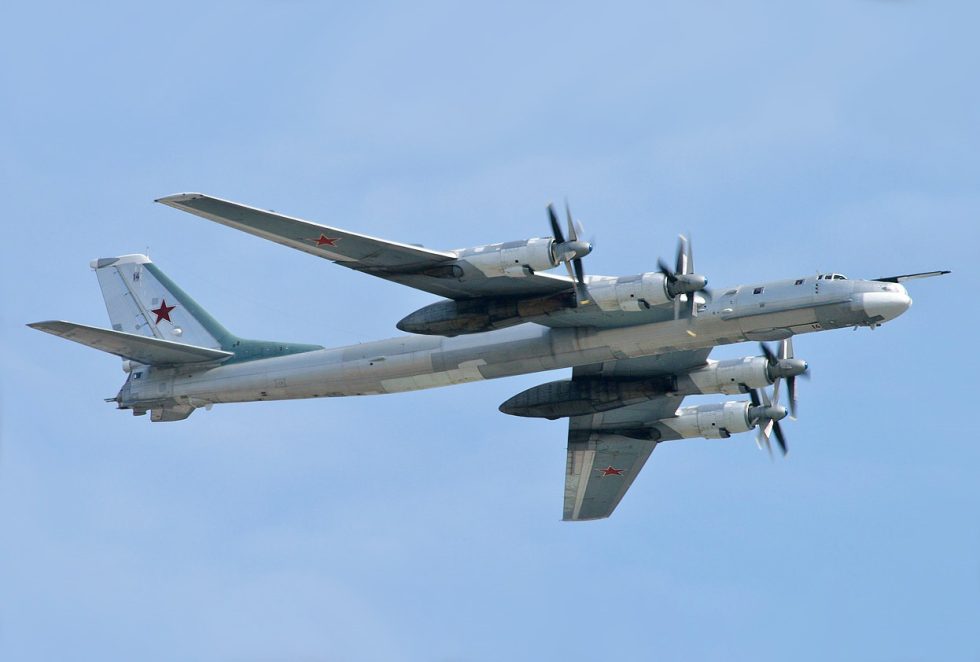
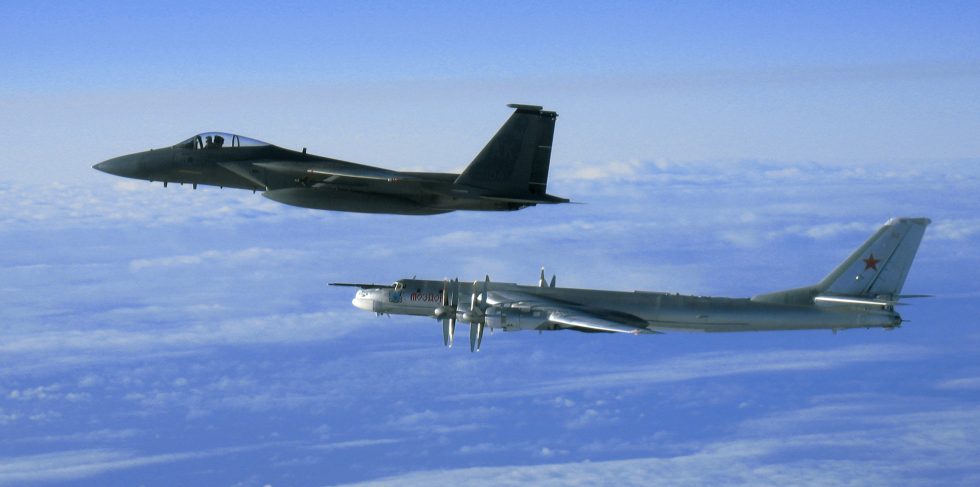
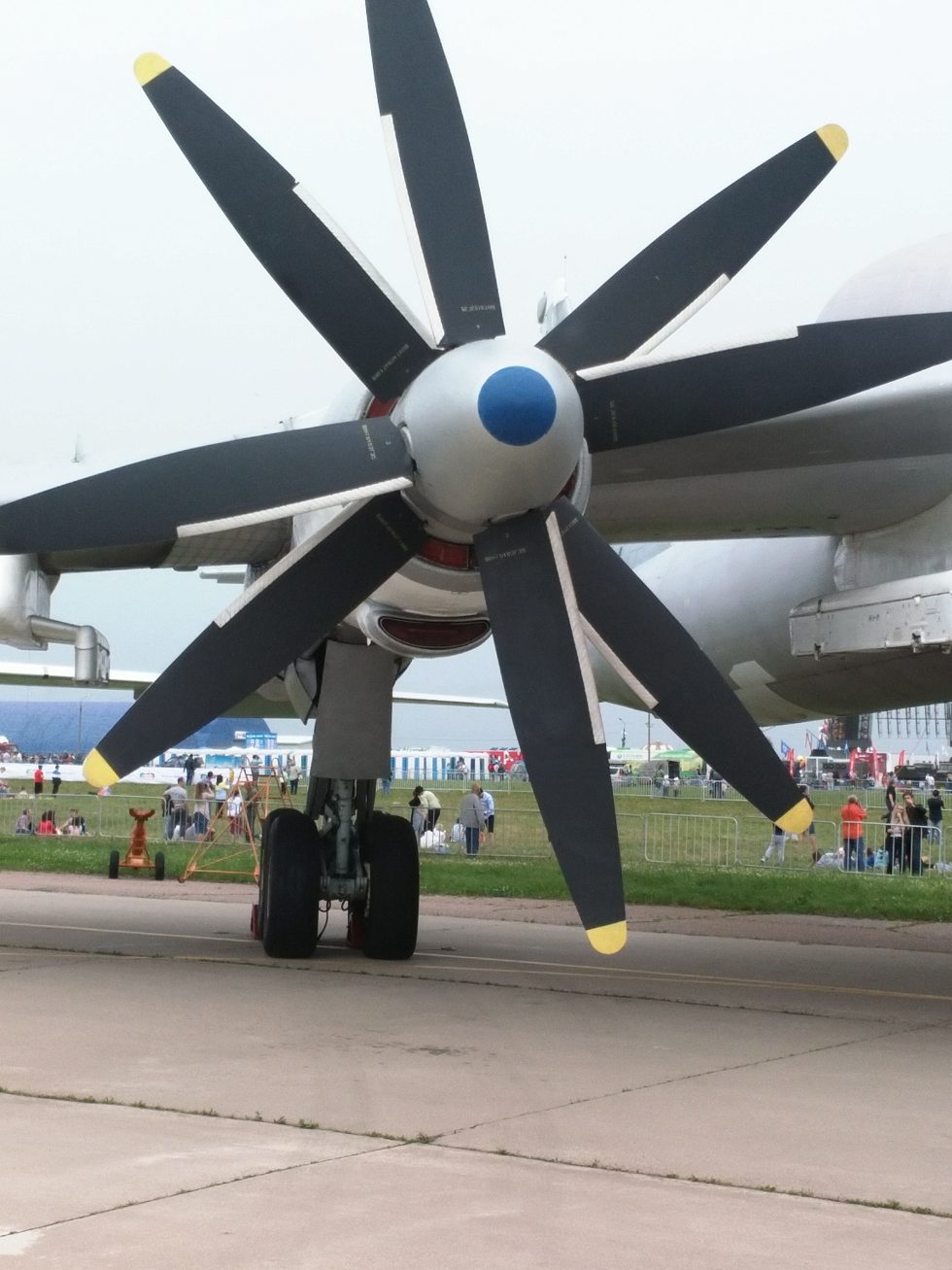
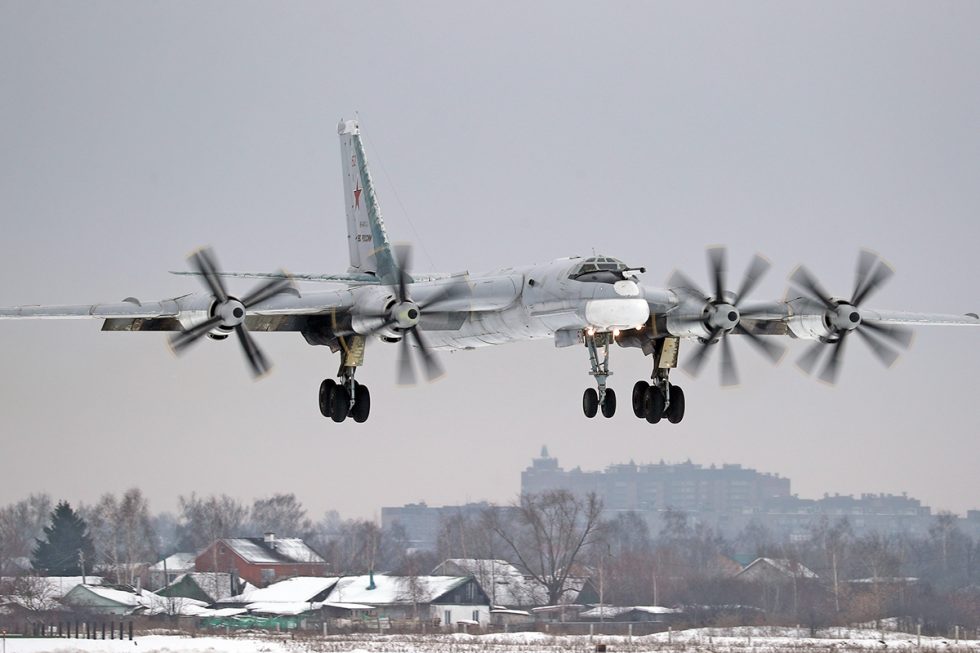
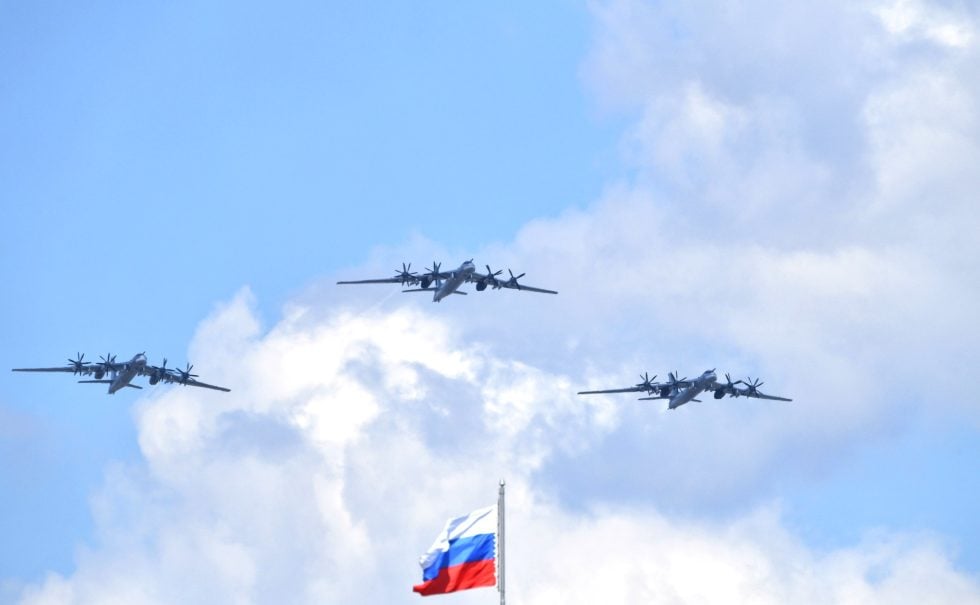
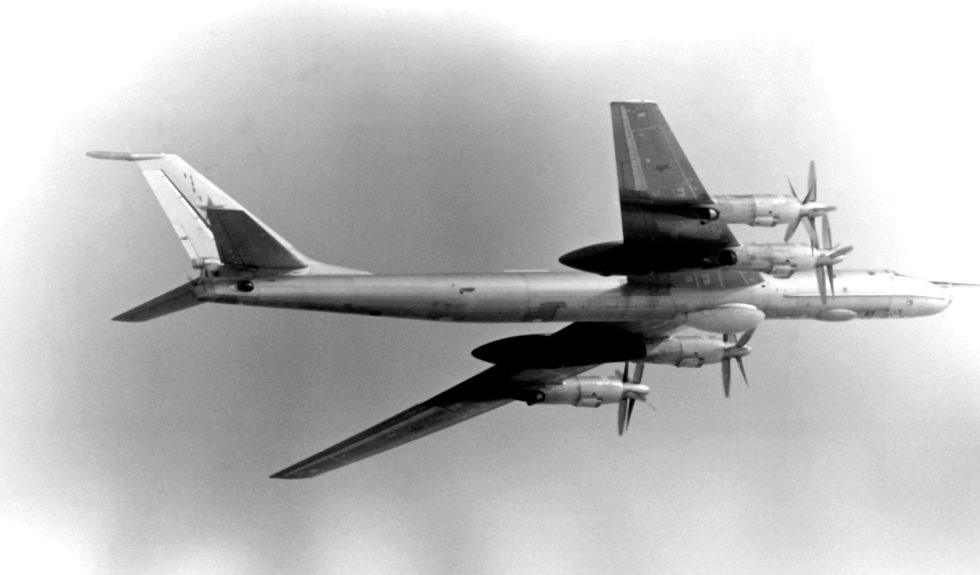
The Bear in motion
Video coming soon. We are still sourcing a clear, rights-appropriate clip of the Tu-95 in flight — the unmistakable drone of its contra-rotating propellers really has to be heard. Check back shortly.
The Tu-95 Bear in motion
vaso opel — one of the most-watched Tu-95 Bear films on YouTube.
Where the Bear flies
The record, stated plainly
For most of its life the Tu-95 never dropped a weapon in anger. Its Cold War role was deterrence and reconnaissance, not battle, and its single most famous act was a nuclear test, not a combat mission. Only in the modern standoff-missile role has the type been used offensively — in Syria from 2015 and against Ukraine since 2022. The figures below are drawn from open sources; recent wartime claims from all sides should be treated with caution.
Compare the combat record of every military aircraft. Figures as of July 2026 and, for the ongoing war, provisional.
Everything people ask about the Tu-95
Can I fly in a Tu-95?
Is the Tu-95 a jet or a propeller aircraft?
Why is the Tu-95 so loud?
Is the Tu-95 still in service?
Did a Tu-95 drop the Tsar Bomba?
Has the Tu-95 been used against Ukraine?
Have any Tu-95s been destroyed in the war?
What does “Bear” mean?
You can’t fly the Tu-95.
These, you can.
Some legends only live in museums — others are fuelled and waiting. MiGFlug has put civilians in real military jet cockpits since 2004.
 Fly the L-39 AlbatrosThe world’s most-flown jet trainer — aerobatics included
 Fly the F-104 Starfighter“The missile with a man in it”
 Fly the MiG-21The Cold War’s most-produced jet
 Fly the T-33 Shooting StarAmerica’s first jet trainer
 Fly the DH VampireA piece of early jet history
 Fly the S.211Agile Italian jet trainer
 Fly the MB-326The classic Aermacchi jet
 Fly the MiG-15The Soviet legend of the Korean War
Continue the tour
Every fact, checked
- The War Zone (TWZ)Reporting on Tu-95 operations, cruise-missile strikes and drone attacks on Russian bomber bases.
- The AviationistNATO intercepts of Tu-95 patrols and analysis of the type’s modern role.
- The Aviation Geek ClubDevelopment history, the NK-12 engine and the contra-rotating propeller design.
- CSIS — Operation Spider Web analysisAssessment of Ukraine’s June 2025 drone raid on Russian bomber bases.
- The Washington Post — damage assessmentVisual verification of Tu-95 and other bomber damage after the June 2025 attack.
- The Nuclear Weapon Archive — Tsar BombaTechnical account of the 1961 AN602 test dropped by a Tu-95V.
- Royal Air ForceReference for the recurring QRA intercepts of Russian Bear patrols near NATO airspace.
- IISS — The Military BalanceOrder-of-battle reference for the size and status of Russia’s Tu-95MS fleet.