
Two jets, one name: the straight-wing FJ-1 that put the U.S. Navy on carrier decks in the jet age — and the swept-wing FJ-2/-3/-4, navalised F-86 Sabres that flew the fleet through the 1950s.North American FJ Fury
The two jets the U.S. Navy called “Fury”
There is no single North American FJ Fury. The name covers two genuinely different aeroplanes, born a decade and a design philosophy apart, and the story of how they connect is one of the most quietly interesting in early jet aviation.
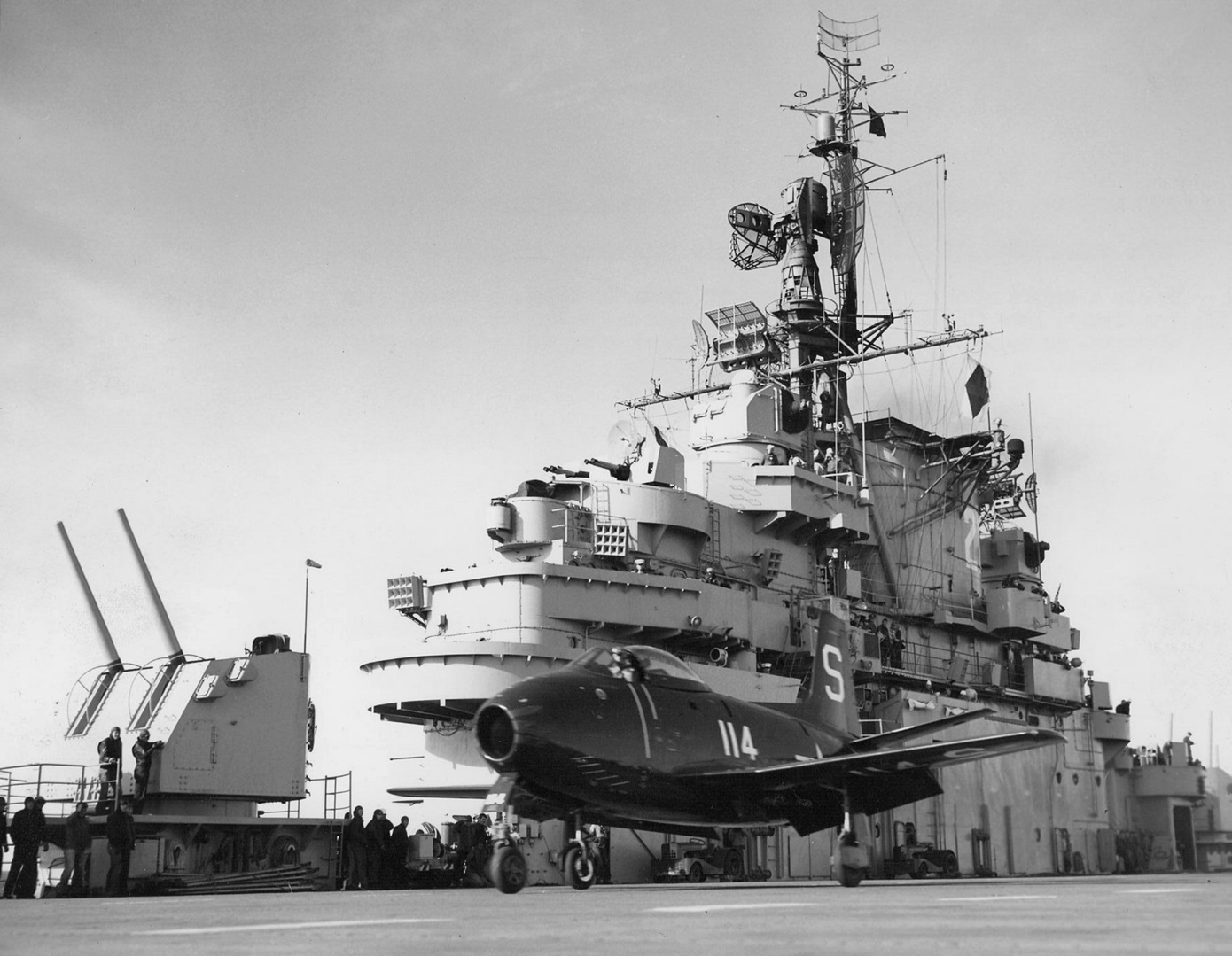
The first was the FJ-1 Fury — North American Aviation’s first jet fighter, a stubby, straight-winged, single-engine machine that first flew in November 1946 and reached the fleet in 1948. It was a stopgap, built in tiny numbers, and it is remembered less for what it did in the air than for where it did it: aboard aircraft carriers, at a moment when almost nobody had yet flown jets off a moving deck at sea.
The second was a family — the FJ-2, FJ-3 and FJ-4 Fury — and here the plot turns. These were not developments of the FJ-1 at all. They were, in essence, navalised versions of the F-86 Sabre, the swept-wing fighter North American built for the U.S. Air Force and made famous over “MiG Alley” in Korea. The Navy, whose early straight-wing jets were slower than the swept Sabre and the MiG-15 it duelled, came back to North American and bought carrier-capable Sabres of its own. By the FJ-4 the aeroplane had been redesigned so thoroughly that little of the original Sabre remained — but the DNA, and the name, ran straight back through the family.
The FJ-1 and the swept-wing XP-86 were drawn up in parallel in the mid-1940s. One kept its straight wing and became a footnote; the other got a swept wing and became the Sabre. Then the Navy came back for a Sabre of its own — and called it Fury.
To keep the two straight in your head: the straight-wing FJ-1 is the pioneer, one of the first jets the U.S. Navy ever operated from a carrier. The swept-wing FJ-2/-3/-4 are the workhorses — the naval Sabres that actually equipped fighter and attack squadrons across the fleet through the 1950s and into the early 1960s. Everything below keeps them clearly apart, because conflating them is the single most common mistake people make with the Fury.
01The FJ Fury’s split identity: why one name covers two aircraft+
North American gave the U.S. Navy designation “FJ” (F for fighter, J for North American in the old Navy system) to its naval fighters. The FJ-1 of 1946 and the FJ-2 of 1951 shared that designation and the name Fury, but almost nothing else — different wings, different engines, different fuselages, different eras. Reference works and museums treat them as two separate types for exactly this reason, and Wikipedia even splits them across separate articles (FJ-1; FJ-2/-3; FJ-4).
The confusion is understandable and worth stating plainly: the FJ-1 is straight-winged; the FJ-2, FJ-3 and FJ-4 are swept-winged. If a “Fury” in a photograph has a wing swept sharply back like a Sabre, it is one of the later three. If the wing sticks out straight, it is the rare early FJ-1. We flag this throughout the page rather than blurring the family into one machine.
There is a neat symmetry to it. North American built the Navy a straight-wing jet (the FJ-1) and the Air Force a straight-then-swept jet (the XP-86 becoming the F-86). The swept one won. So when the Navy wanted the winning formula, it went back to the same company and bought the swept design in naval clothing — and, to keep continuity with its first jet, called it Fury again. The name is really the only thread that runs unbroken from 1946 to 1964.
What made the FJ Fury family distinctive
Three ideas define the Fury story: a straight-wing carrier pioneer, a swept-wing Sabre sent to sea, and a final long-legged attack version that could carry a nuclear bomb.
The FJ-1: a straight-wing carrier pioneer
North American’s first jet reached the fleet in 1948 and, with squadron VF-5A/VF-51, carried out some of the U.S. Navy’s earliest carrier jet operations. Only about 30 were built — but it helped teach the Navy how to fly jets from a deck.
The FJ-2/-3: the Sabre goes to sea
Folding wings, an arrestor hook, catapult gear, a longer nose strut and four 20 mm cannon turned the Air Force’s F-86 into a carrier fighter. The swept wing finally gave Navy pilots Sabre-class speed over the fleet.
The FJ-4: redesigned for range and strike
A new thin wing, more internal fuel and, in the FJ-4B, six weapons stations, Bullpup missiles and a nuclear-strike capability. By now it was a Sabre in name only — a genuine long-range naval attack jet.
02The FJ-1 Fury’s carrier firsts: teaching a navy to fly jets from a deck+
The production FJ-1 was powered by a single Allison J35 turbojet of about 4,000 lbf and armed with six 0.50-inch machine guns — it was, in fact, the last U.S. Navy fighter ordered with the old half-inch guns as primary armament rather than cannon. Its straight wing limited it to around 880 km/h, already slower than the swept jets appearing elsewhere.
What mattered was the deck. Squadron VF-5A (soon redesignated VF-51) took the FJ-1 to sea, and on 10 March 1948 carried out carrier landings aboard USS Boxer — among the very first operational U.S. Navy carrier jet operations. VF-51 also famously swept the jet division of the 1948 Bendix Trophy race, taking the first several places. The type was quickly overtaken by the Grumman F9F Panther and left front-line service after only a couple of years, its ~30 airframes never intended for a long career.
03Navalising the Sabre: how the F-86 became the FJ-2 and FJ-3 Fury+
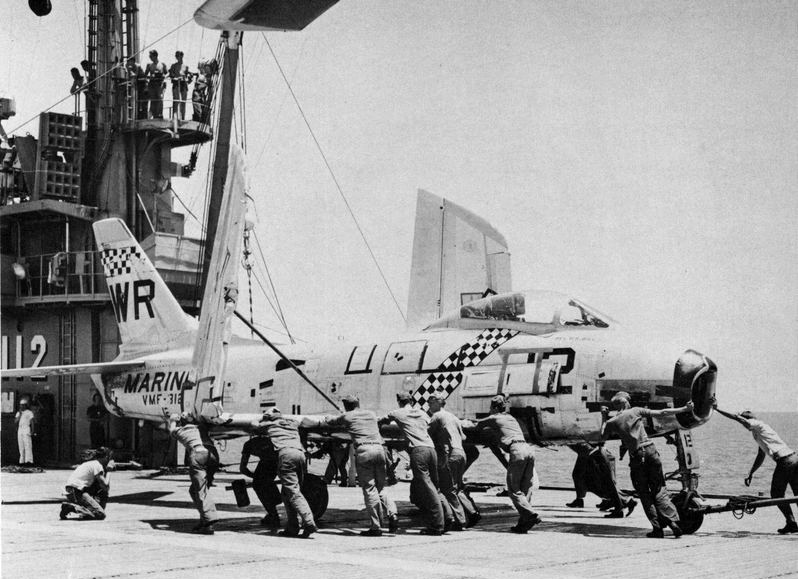
The FJ-2 began as an effort to put the F-86 Sabre on carriers. North American added the equipment a jet needs to survive naval flying: folding wings to fit below deck, a wider-track landing gear, a lengthened nose oleo to raise the angle of attack for catapult launches and cushion hard arrested landings, an arrestor hook and catapult fittings, and a revised windscreen. Armament was changed from the Sabre’s six machine guns to four 20 mm cannon, the Navy’s preferred fighter battery.
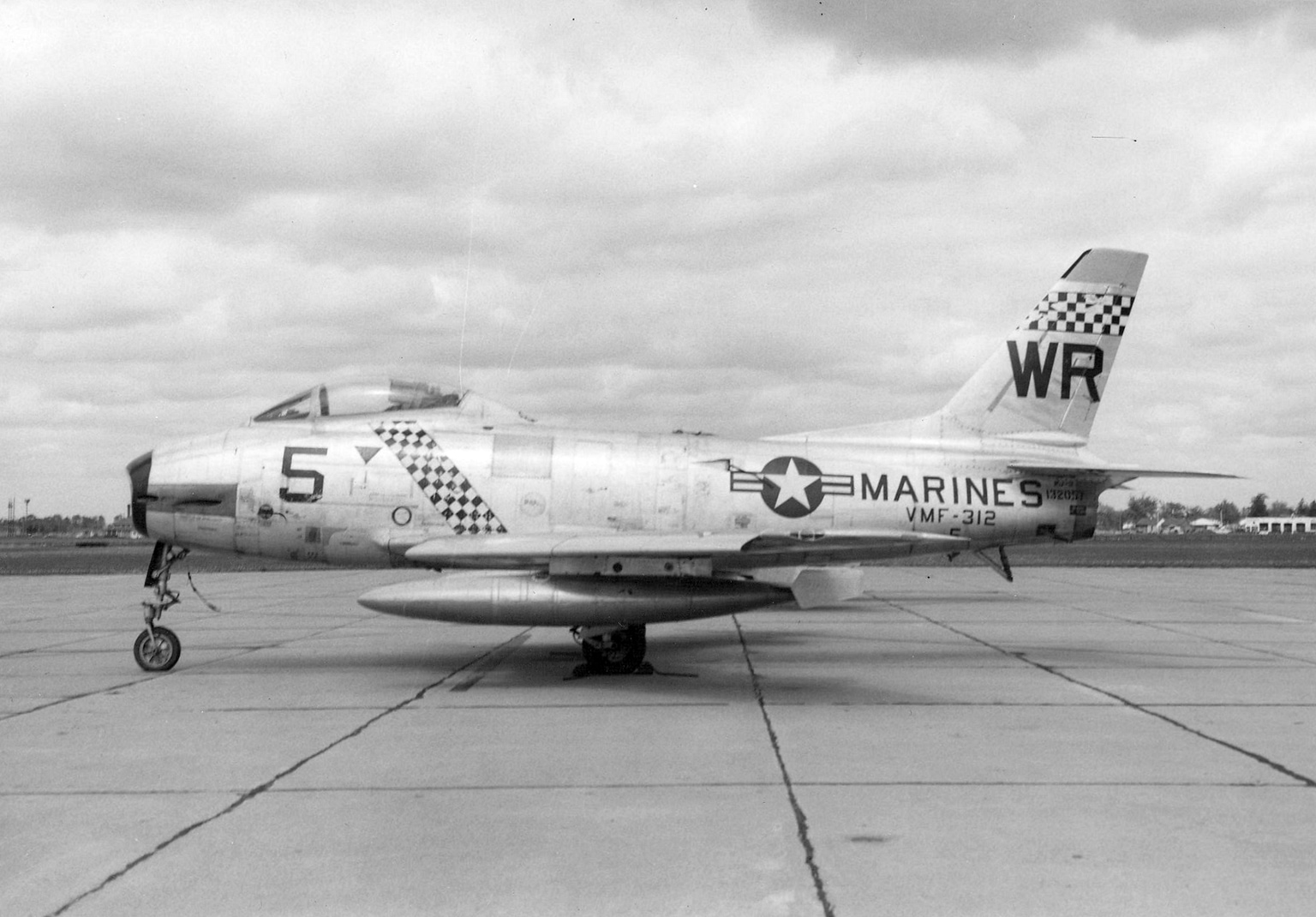
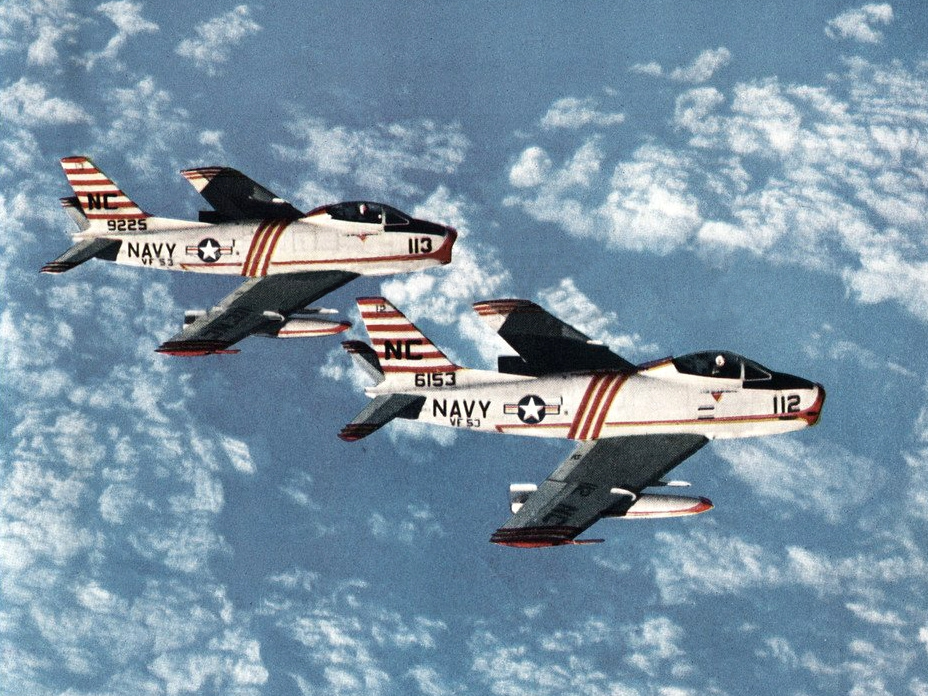
The FJ-2 (General Electric J47 engine) went largely to U.S. Marine Corps squadrons from 1954; the improved FJ-3 (Wright J65 — a licence-built Armstrong Siddeley Sapphire with roughly a quarter more thrust) reached Navy fleet squadrons from 1955 and was the more satisfactory carrier aeroplane. The FJ-3M could carry AIM-9 Sidewinder missiles, and FJ-3s were among the first Navy fighters retrofitted with probe-and-drogue air-to-air refuelling.
04The FJ-4B Fury’s attack role: Bullpup missiles and a nuclear mission+
The FJ-4 was a much deeper redesign than its number suggests. It kept the general layout and J65 engine of the FJ-3 but introduced an entirely new, thinner wing of greater area with milled skin panels, plus far more internal fuel — giving a ferry range commonly quoted around 3,200 km with external tanks.
The dedicated attack version, the FJ-4B, added extra underwing stations (six rather than four) and a low-altitude bombing system (LABS). It was cleared to carry a nuclear weapon on an inboard station and to launch the AGM-12 Bullpup air-to-surface missile, making it a genuine carrier strike aircraft rather than just a fighter. Around 220 FJ-4Bs were built; roughly ten Navy attack squadrons and several Marine squadrons flew them before the A-4 Skyhawk and F-8 Crusader took over.
North American FJ Fury full specifications
Figures below separate the straight-wing FJ-1 from the swept-wing FJ-3 and the redesigned FJ-4. Early-jet data varies between sources; treat these as representative, and note the FJ-1’s guns versus the later cannon.
| FJ-1 (straight wing) | FJ-3 (swept) | FJ-4 (swept, redesigned) | |
|---|---|---|---|
| Wing | Straight, unswept | Swept ~35° | Swept, new thin wing (6% t/c) |
| Posádka | 1 | 1 | 1 |
| Délka | ~10.5 m | ~11.4 m | ~11.1 m |
| Rozpětí křídel | ~11.6 m | ~11.3 m | ~11.9 m |
| Motor | 1 × Allison J35-A-2 | 1 × Wright J65 (Sapphire) | 1 × Wright J65-W-16A |
| Tah | ~17.8 kN (4,000 lbf) | ~34 kN (7,700 lbf) | ~34 kN (7,700 lbf) |
| FJ-1 | FJ-3 | FJ-4 / FJ-4B | |
|---|---|---|---|
| Max speed | ~880 km/h (547 mph) | ~1,090 km/h (~680 mph) | ~1,090 km/h (~680 mph) |
| Servisní strop | ~9,750 m | ~14,000 m | ~14,000 m |
| Rozsah | ~980 km combat | ~1,400 km | up to ~3,200 km (tanks) |
| Vyzbrojení | 6 × 0.50-in machine guns | 4 × 20 mm cannon (+Sidewinder on FJ-3M) | 4 × 20 mm cannon; rockets, Sidewinder, Bullpup, nuclear (FJ-4B) |
| First flight | Nov 1946 (XFJ-1) | Jul 1953 | Oct 1954 |
| Built | ~30 (+3 prototypes) | 538 | 150 + 222 (FJ-4B) |
| Unit cost | Not reliably recorded | ||
| Cost per flight hour | Not reliably recorded | ||
05The North American FJ Fury’s variants: FJ-1 through FJ-4B at a glance+
FJ-1 — straight-wing pioneer, Allison J35, six machine guns, ~30 built. FJ-2 — first navalised Sabre, GE J47, four 20 mm cannon, 200 built, mostly U.S. Marine Corps. FJ-3 — Wright J65, the definitive fleet fighter, 538 built; FJ-3M added Sidewinder capability. FJ-4 — redesigned thin wing and extra fuel, 150 built. FJ-4B — dedicated attack version, six stations, Bullpup and nuclear capability, 222 built. Across all variants roughly 1,100 or more were delivered to the Navy and Marine Corps — exact totals vary between sources.
06The FJ Fury’s operating costs: what the record does and doesn’t show+
Unlike modern types, the FJ Fury has no reliably published unit fly-away cost or cost-per-flight-hour in the open record; 1950s naval procurement accounting was not reported the way later programmes were, and figures that circulate are not well sourced. We therefore mark both the unit cost and the cost-per-flight-hour rows as “not reliably recorded” rather than repeat an unverifiable number. What is clear is that the Fury was a relatively conventional, single-engine fighter of its day — cheaper to buy and run than the twin-engine and supersonic types that soon replaced it.
07The 1962 redesignation: how the Fury became the F-1+
When the U.S. armed forces adopted the unified Tri-Service designation system in 1962, the surviving Furies were renamed. The FJ-3 became the F-1C (the Sidewinder-capable FJ-3M becoming MF-1C), the FJ-4 became the F-1E, and the attack FJ-4B became the AF-1E. By then the type was already leaving front-line service, but AF-1Es soldiered on with Naval Reserve units into the late 1960s. It is a useful memory aid: any “F-1” in U.S. Navy service is a redesignated Fury.
The rename is a small window onto a bigger tidy-up: before 1962 the Air Force and Navy ran incompatible designation systems, which is exactly how the same manufacturer’s swept fighter could be an “F-86” for one service and an “FJ” for the other. The Tri-Service system ended that, and the handful of Furies still flying quietly slipped under new labels for their last few years.
08FJ Fury versus F-86 Sabre: how to tell the naval cousin apart+
At a glance an FJ-2 or FJ-3 Fury and an F-86 Sabre look almost identical — same swept wing, same slab-sided fuselage, same nose intake. The differences are naval: the Fury carries an arrestor hook under the tail, folding wings with a visible fold line, a beefier and wider-track undercarriage, catapult attachment points, and four 20 mm cannon in place of the Sabre’s six machine guns. The nose leg is longer, to cock the aircraft nose-up for a catapult shot.
The FJ-4 is easier still: its wing and tail were redesigned, the fuselage deepened to hold more fuel, and the whole aircraft looks visibly “fuller” than a Sabre. By that point the family resemblance is a matter of ancestry rather than shape — the FJ-4 is its own aeroplane, related to the Sabre the way a later model in a car line relates to the original.
09Surviving FJ Fury airframes: where to actually see one+
Because the Fury served only with the U.S. Navy and Marine Corps, essentially every survivor stayed in the United States. Airframes are preserved or displayed at institutions such as the National Naval Aviation Museum in Pensacola, the Planes of Fame Air Museum in California, and a scattering of other aviation collections and gate guardians. Surviving examples span the family — there are FJ-3s and FJ-4s in museums, while the rare straight-wing FJ-1 is far scarcer given how few were built.
We’d strongly suggest confirming a specific aircraft’s location and condition before making a trip: museum collections rotate, aircraft move between sites for restoration, and no FJ Fury is known to be maintained in regular airworthy flying condition today. Treat any “flying Fury” claim with healthy scepticism until verified.
The North American FJ Fury timeline: 1944–1964
North American develops a straight-wing naval jet (the FJ-1) and a land-based fighter (the XP-86) in parallel. Captured German swept-wing research pushes the XP-86 toward a swept wing.
27 November — the XFJ-1 makes its first flight. Its swept-wing cousin, the XP-86, follows in 1947 and becomes the F-86 Sabre.
10 March — VF-5A/VF-51 conducts early carrier operations with the FJ-1 aboard USS Boxer. In September, VF-51 sweeps the jet division of the Bendix Trophy race.
With its straight-wing jets outclassed, the Navy orders navalised swept-wing Sabres. The XFJ-2B flies in December 1951; production FJ-2s follow in 1952.
The FJ-2 enters Marine service; the improved FJ-3 reaches the fleet the following year. 28 October — the redesigned FJ-4 makes its first flight.
FJ-3s gain probe-and-drogue refuelling and Sidewinder capability; the FJ-4B attack version enters service with a nuclear-strike and Bullpup capability.
Tri-Service redesignation: FJ-3→F-1C, FJ-4→F-1E, FJ-4B→AF-1E.
The Fury leaves front-line service, replaced by the A-4 Skyhawk and F-8 Crusader. Reserve AF-1Es fly on into the late 1960s.
The last Reserve AF-1E Furies are withdrawn. From here the type’s story becomes one of museums and preservation rather than active service.
A modest number of Furies survive in U.S. museums — a straight-wing pioneer and its swept-wing descendants preserved side by side, telling the two-jets-one-name story in metal.
From the flight line: twelve FJ Fury stories
Swipe through episodes and details from the Fury’s career — carrier firsts, the Sabre connection, and the jet’s quiet second life in museums. Contested points are flagged as such.
One name, two aeroplanesThe core of the Fury story
Ask an aviation buff to picture a Fury and half will describe a straight-wing 1948 carrier jet and half a swept naval Sabre. Both are right — they are simply describing different aircraft that happened to share a name.
Parallel bloodlinesFJ-1 and XP-86
North American drew the straight-wing FJ-1 and the land-based XP-86 up side by side. The XP-86 gained a swept wing and became the Sabre; years later the Navy bought its own swept Sabres and called them Fury.
Deck pioneerUSS Boxer, March 1948
VF-5A/VF-51 took the FJ-1 to sea aboard USS Boxer, carrying out some of the U.S. Navy’s earliest operational carrier jet flying — at a time when jets and carrier decks were a nerve-wracking combination.
Bendix clean sweep1948 air race
In September 1948 VF-51’s FJ-1s took the leading places in the jet division of the Bendix Trophy race — a rare competitive moment of glory for an aeroplane otherwise built in tiny numbers.
The last of the fiftiesGuns, not cannon
The FJ-1 was the last U.S. Navy fighter ordered with six 0.50-inch machine guns as its primary armament. The swept Furies that followed switched to four 20 mm cannon.
A Sabre with a hookNavalising the F-86
Folding wings, a beefier undercarriage, a longer nose leg for catapult shots and an arrestor hook turned the Air Force’s Sabre into a fleet fighter — while keeping the swept wing that gave it its speed.
Marines firstFJ-2 to the Corps
Many of the first navalised Sabres, the FJ-2, went to U.S. Marine Corps squadrons from 1954. The improved FJ-3 became the dominant Navy carrier version a year later.
Buddy tankingProbe and drogue
FJ-3s were among the earliest Navy fighters fitted for probe-and-drogue air-to-air refuelling — a capability that would define carrier aviation for decades afterward.
The bomb-truck FuryFJ-4B attack
The FJ-4B carried a low-altitude bombing system, the Bullpup guided missile and, on an inboard station, a nuclear weapon — turning the fighter’s bloodline into a carrier strike aircraft.
Long legsThe FJ-4 redesign
A new thin wing and much more internal fuel gave the FJ-4 a range its Sabre ancestor never had — the point at which the aeroplane really stopped being “just a naval Sabre”.
Becoming the F-11962 rename
The 1962 Tri-Service system renamed the survivors: FJ-3 to F-1C, FJ-4 to F-1E, FJ-4B to AF-1E. Any “F-1” on a 1960s Navy ramp is a Fury under a new label.
Where they rest nowMuseum survivors
A modest number of Furies survive, essentially all in U.S. museums — the National Naval Aviation Museum, Planes of Fame and others. No example is known to be in regular airworthy flying condition today (worth verifying before you travel).
The FJ Fury in pictures
A visual tour across both designs — the straight-wing FJ-1 pioneer and the swept-wing FJ-2/-3/-4 naval Sabres. Click any photograph to enlarge. All images are U.S. Navy, public domain.
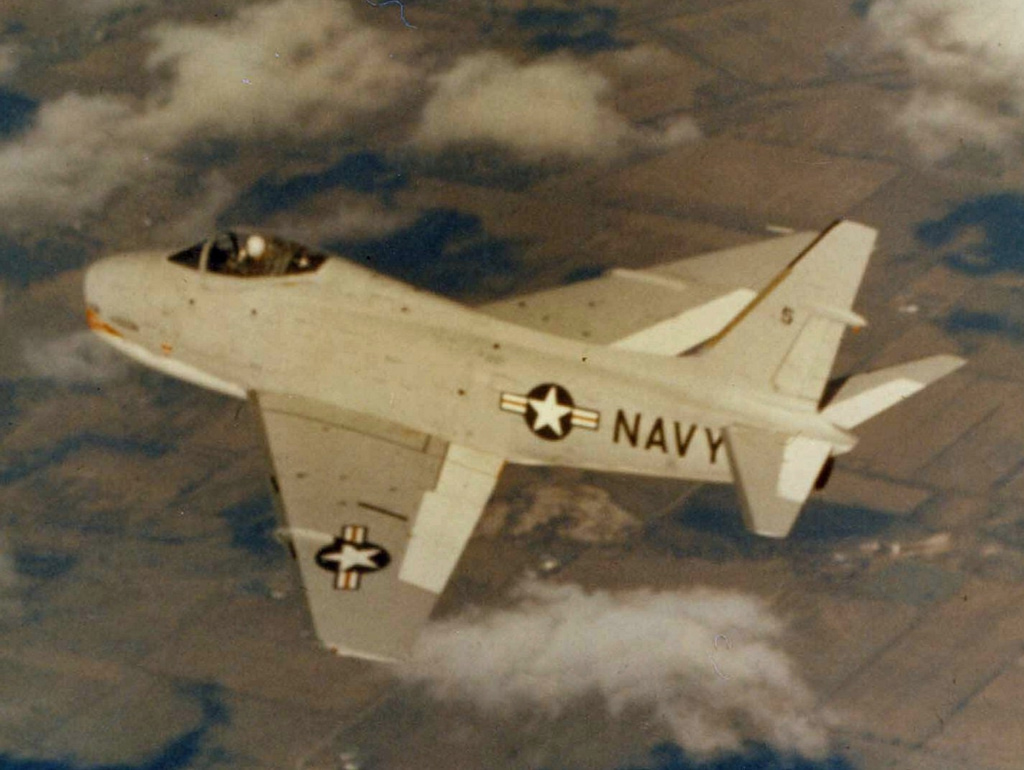
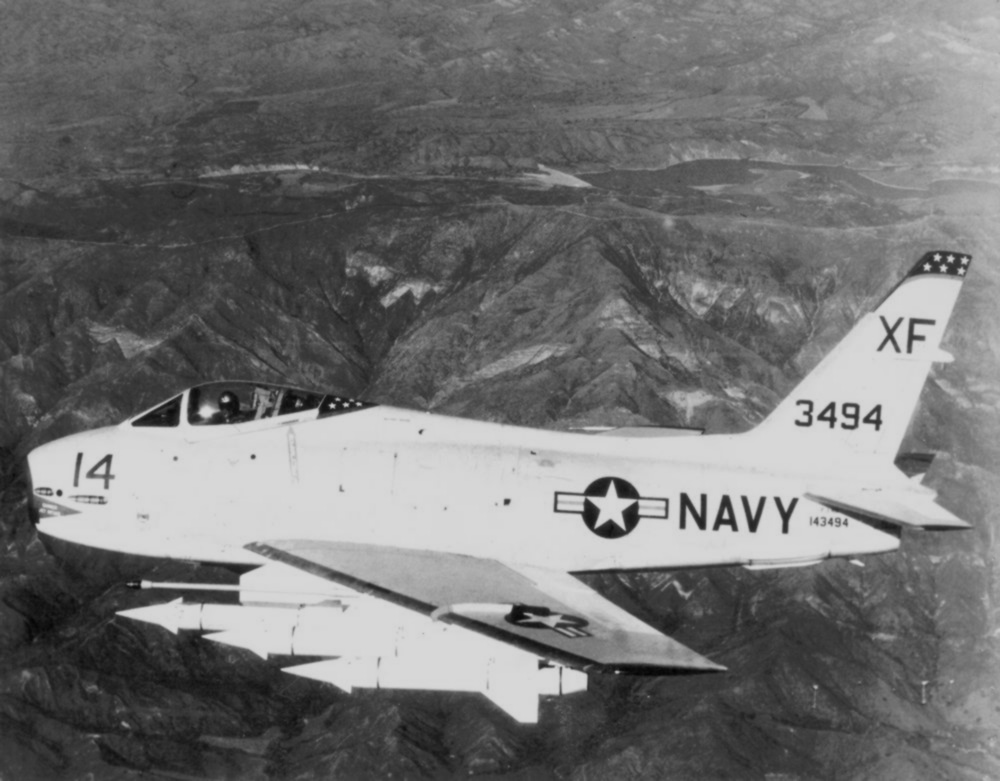
The FJ Fury in motion
Period U.S. Navy film of the FJ-4 Fury — the redesigned, long-range attack member of the family. It is archival primary-source footage rather than a modern documentary, so viewing figures are modest, but it shows the aeroplane as the Navy presented it.
“US Navy FJ-4 Fury presentation” — archival U.S. Navy film via the Aviation video archive channel. A primary-source period presentation of the FJ-4; modest view count reflects how rarely this obscure naval jet is covered.
Where the FJ Fury came from — and the Sabre family around it
The FJ Fury served with only one nation — the United States, with the Navy and Marine Corps. This map shows its American origin, service and surviving airframes, plus the global reach of the F-86 Sabre, the swept-wing family the Fury was navalised from. The Sabre-lineage layer is context: those countries flew the Sabre, not the naval Fury.
The FJ Fury’s service record in numbers
The Fury never saw the aerial combat its Sabre cousin did over Korea — the swept Furies arrived just after that war and were retired before Vietnam. Its record is one of fleet service, deterrence and pioneering carrier jet operations rather than dogfights.
Everything people ask about the North American FJ Fury
Can I fly in an FJ Fury?+
No — the North American FJ Fury is a retired 1950s U.S. Navy jet, and the small number of survivors are static museum exhibits; there is no known airworthy example offering rides, and MiGFlug does not operate the Fury. However, you can fly in several genuine military jets today. MiGFlug flies real fighters and jet trainers — from the L-39 Albatros to the MiG-29 Fulcrum. See what is currently bookable at migflug.com/flights-prices.
Why are there two completely different FJ Fury aircraft?+
Because the U.S. Navy reused the name. The straight-wing FJ-1 of 1946–48 was North American’s first jet fighter and a completely separate design. The later FJ-2, FJ-3 and FJ-4 of 1951 onward were navalised versions of the swept-wing F-86 Sabre. They share the “FJ” designation and the name Fury but are two different aeroplanes — which is exactly why they are usually treated as separate types.
Is the FJ Fury the same as the F-86 Sabre?+
Not the same, but closely related for the swept versions. The FJ-2/-3/-4 Fury were carrier-capable adaptations of the Air Force’s F-86 Sabre, with folding wings, an arrestor hook, catapult gear and four 20 mm cannon. The FJ-4 was redesigned so heavily — new wing, more fuel, attack capability — that it became a distinct aircraft. The straight-wing FJ-1, by contrast, is not a Sabre relative at all.
Did the FJ Fury ever see combat?+
Not in air-to-air combat. The swept Furies entered service just after the Korean War and were retired before the Vietnam War escalated, so the type has no confirmed aerial kills. Its career was spent on fleet fighter and attack duty, including the FJ-4B’s nuclear-strike role, rather than in a shooting war.
What was the FJ-4B Fury’s nuclear role?+
The FJ-4B was a dedicated carrier attack version with six underwing stations and a low-altitude bombing system (LABS). It was cleared to carry a nuclear weapon on an inboard station and to launch the AGM-12 Bullpup guided missile, giving the Navy a single-seat carrier strike aircraft in the late 1950s before purpose-built attack jets like the A-4 Skyhawk fully took over.
How fast was the FJ Fury?+
It depends which one. The straight-wing FJ-1 topped out around 880 km/h (about 547 mph). The swept FJ-3 and FJ-4 reached roughly 1,090 km/h (about 680 mph) near sea level — the swept wing was the whole point of the later versions. None was supersonic; that came with the Fury’s successors.
What happened to the Fury — and why is it now called F-1?+
Under the 1962 Tri-Service designation system the survivors were renamed: FJ-3 to F-1C, FJ-4 to F-1E and FJ-4B to AF-1E. The type was replaced in front-line service by the A-4 Skyhawk and F-8 Crusader; Reserve AF-1Es flew into the late 1960s. So an “F-1” in Navy records is simply a redesignated Fury.
How many FJ Furies were built, and how many survive?+
Across all variants roughly 1,100 or more were delivered — about 30 FJ-1s, 200 FJ-2s, 538 FJ-3s and around 370 FJ-4/FJ-4Bs (exact totals vary between sources). A modest number survive today, essentially all in U.S. museums such as the National Naval Aviation Museum and Planes of Fame. We’d suggest verifying a specific airframe’s location and condition before travelling to see it.
Who flew the FJ Fury — and did any other country operate it?+
The Fury served only with the United States, flown by U.S. Navy and U.S. Marine Corps fighter and attack squadrons and, later, Naval Reserve units. Unlike its F-86 Sabre cousin — which was exported to dozens of air forces around the world — the naval Fury was never sold abroad. Any global “Sabre family” footprint you see belongs to the Air Force F-86, not the carrier Fury.
Why did the U.S. Navy buy a navalised Sabre instead of its own design?+
Timing and speed. In the early 1950s the Navy’s straight-wing jets were slower than the swept-wing F-86 and the MiG-15 it was meeting over Korea. Rather than wait for an all-new swept naval fighter, the Navy took the fast, proven Sabre and had North American make it carrier-capable. It was a pragmatic shortcut to Sabre-class performance over the fleet — and it is why the swept Furies exist at all.
Some legends only live in museums — others are fuelled and waiting. MiGFlug has put civilians in real military jet cockpits since 2004.You can’t fly the FJ Fury.
These, you can. Fly the L-39 AlbatrosThe world’s most-flown jet trainer — aerobatics included
 Fly the F-104 Starfighter“The missile with a man in it”
 Fly the MiG-21The Cold War’s most-produced jet
 Leťte s T-33 Shooting StarAmerica’s first jet trainer
 Fly the DH VampireA piece of early jet history
 Fly the S.211Agile Italian jet trainer
 Fly the MB-326The classic Aermacchi jet
 Fly the MiG-15The Soviet legend of the Korean War
Continue the tour
The Fury’s relatives and rivals — the Air Force Sabre it was navalised from, the Panther that pushed it aside, and the Crusader that replaced it.