
Saab 29
“Tunnan”
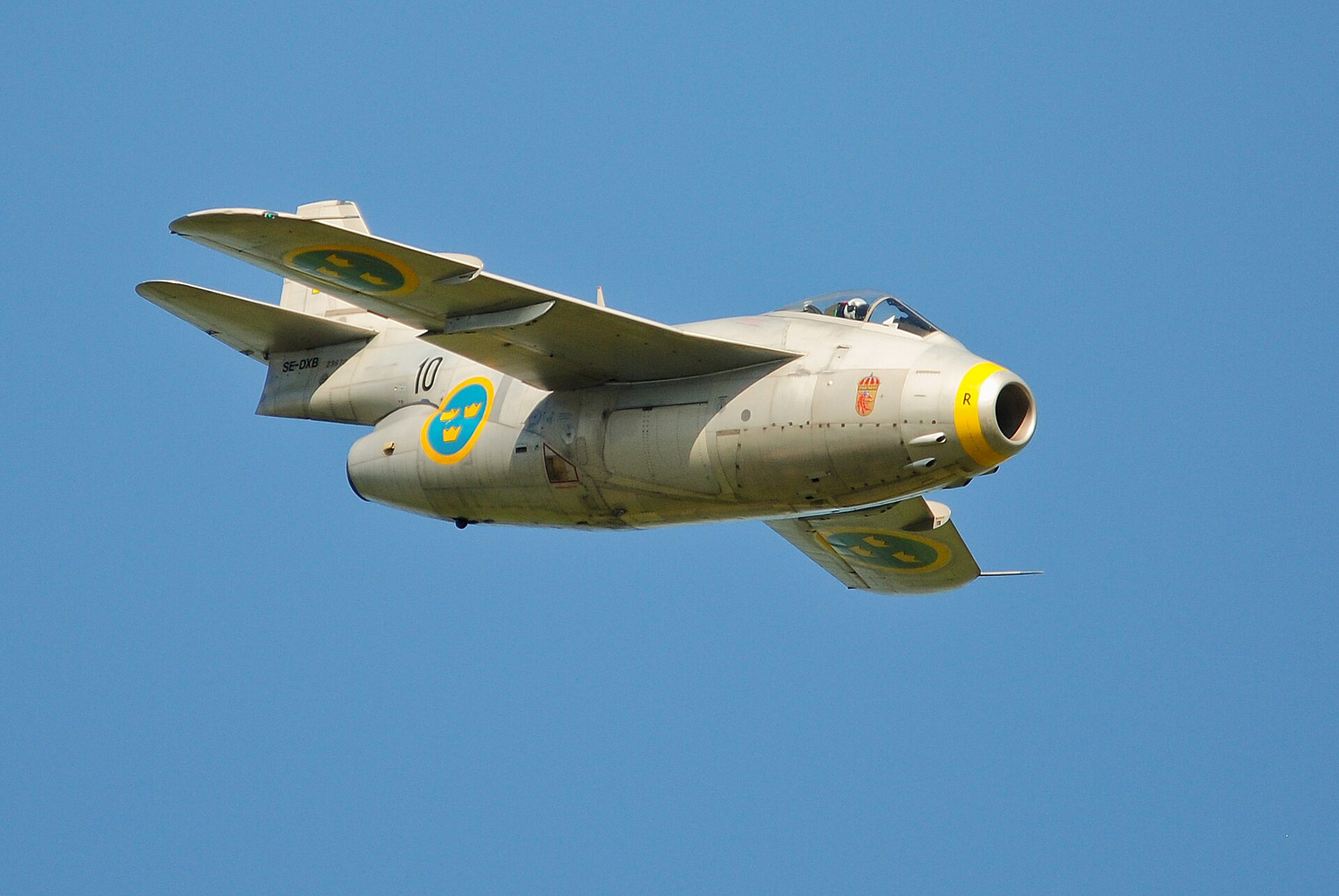
Sweden’s first swept-wing jet fighter — a portly, barrel-shaped machine nicknamed the “Flying Barrel” that was one of the fastest fighters in the world when it flew in 1948, and the only jet the Swedish Air Force ever took into combat.
The barrel that made Sweden a jet power
In 1945 Sweden emerged from the war neutral, isolated and determined never to depend on anyone else for its air defence. Saab had already built the piston-engined J 21, but the jet age had arrived and the country had nothing to match it. When Swedish engineers got their hands on captured German swept-wing research — obtained via Switzerland in 1945 — Saab tore up its straight-wing jet studies and started again around a 25-degree swept wing.
The result, first flown on 1 September 1948, looked nothing like a thoroughbred. To fit a large centrifugal-flow de Havilland Ghost turbojet, the designers wrapped a short, fat fuselage around the engine — and the shop floor promptly christened it the flygande tunnan, the “Flying Barrel.” British test pilot Bob Moore called it an ugly duckling on the ground. In the air it was anything but: on entering service in 1951 it was among the fastest fighters in the world.
Over roughly 660 aircraft — still the most Saab has ever built of one type — the Tunnan served as interceptor, attacker and photo-reconnaissance platform. It set closed-circuit world speed records, was exported to Austria, and in 1961 went to war under a blue UN flag over the Congo, the only time Sweden has ever used a jet in combat. Not bad for a barrel.
01How captured German research gave the Saab 29 Tunnan its swept wing
Saab’s early jet studies used a conventional straight wing. That changed when the company’s research chief, Frid Wänström, returned from Switzerland in 1945 with German aerodynamic data showing the drag-reducing benefits of wing sweep at high speed. Sweden’s Royal Institute of Technology and its aeronautical research institute ran the numbers and wind-tunnel tests, and Saab committed to a 25-degree swept wing — a bold choice for a country building only its second jet.
The gamble paid off. The Tunnan became the first swept-wing fighter to enter service in Western Europe, beating Britain’s Hawker Hunter and France’s Mystere into squadron use. It was inspired by German work — the unbuilt Messerschmitt P.1101 is often cited — but it was designed, tested and manufactured entirely in Sweden, and it put a small neutral nation at the leading edge of jet fighter design.
What makes the Saab 29 Tunnan special
A swept wing on a barrel body
The Tunnan paired a thin 25-degree swept, laminar-flow wing with one of the most compact fuselages of any early jet. There was no room in the slim wing for the landing gear, so it retracts inward into the fuselage. Interconnected leading-edge slots and flaps tamed the low-speed handling that swept wings are notorious for — and later E and F models added a “dog-tooth” leading edge that pushed the usable limit from about Mach 0.86 to 0.89.
Built around the de Havilland Ghost
Power came from a single de Havilland Ghost centrifugal-flow turbojet, license-built by Svenska Flygmotor as the RM2. That engine’s large diameter is exactly why the fuselage is so fat — the airframe was quite literally wrapped around it, fed by a simple nose intake. The later RM2B added a Swedish-designed afterburner (EBK), lifting thrust from roughly 2,270 to about 2,800 kg and giving the J 29F its extra punch.
One airframe, three jobs
The same barrel did fighter, attack and reconnaissance duty. The J 29A and B carried four 20 mm cannon and a heavy load of underwing rockets and bombs; the J 29C swapped the guns for cameras to become the first jet photo-reconnaissance aircraft of a non-aligned nation. Rugged and simple, the Tunnan proved able to absorb heavy ground fire and keep flying — a quality that mattered over the Congo.
02Why the Saab 29 Tunnan is shaped like a barrel
The nickname was an engineering consequence, not a styling choice. The de Havilland Ghost was a centrifugal-flow turbojet — a design that is short but wide, because air is flung outward through the compressor before combustion. Wrapping a slim, streamlined fuselage around such an engine was impossible, so Saab built a short, deep, rounded body with a circular nose intake feeding straight into the engine face. The workers called the resulting shape the flygande tunnan, the flying barrel, and the name stuck. Fatter axial-flow engines would later let designers slim fighters down, but in 1948 the barrel was simply the honest shape for the powerplant available.
03The Saab 29 Tunnan’s world speed records
For a supposedly ungainly aircraft, the Tunnan was genuinely fast. On 6 May 1954 Captain Anders Westerlund set an international 500 km closed-circuit record at 977 km/h in a standard J 29. The following year, on 23 March 1955, Hans Neij and Birger Eriksson took a two-aircraft flight to a 1,000 km closed-circuit record of 900.6 km/h. These were not stunt machines but production fighters, and the records were a pointed reminder to the great aviation powers that a small neutral country could build a jet fully competitive with their own.
Full specifications
Airframe & Performance
- Multitud
- 1
- Longitud
- ~10.1 m
- Envergadura
- ~11.0 m
- Altura
- ~3.75 m
- Peso vacío
- ~4,845 kg
- Max takeoff weight
- ~8,000 kg
- Max speed
- ~1,060 km/h (J 29F)
- Techo de servicio
- ~15,500 m
- Rango
- ~1,100 km (varies by fuel/load)
- Wing sweep
- 25°
Propulsion & Armament
- Motor
- 1 × de Havilland Ghost (Svenska Flygmotor RM2)
- Empuje
- ~2,270 kg dry · ~2,800 kg with afterburner (RM2B)
- Guns
- 4 × 20 mm Hispano m/47 cannon
- Ordnance
- Rockets (75–180 mm), bombs, drop tanks
- Missiles (late)
- 2 × Rb 24 (AIM-9B Sidewinder)
- First flight
- 1 September 1948
- Built
- ~660 (1950–1956)
- Unit cost
- No reliable public figure
- Cost per flight hour
- No reliable public figure
04What did the Saab 29 Tunnan cost?
The Tunnan was a Swedish state-funded product built for the Flygvapnet, not an item sold on an open export market at a published price, so no reliable flyaway unit cost or cost-per-flight-hour figure exists in the public record. What is documented is scale: with roughly 660 built, it remains the most-produced aircraft in Saab’s history, and its long service — front-line into the mid-1960s and in target-towing and other second-line roles into the mid-1970s — suggests it was cheap and robust to operate by the standards of its day. Any precise dollar or krona figure attached to a Tunnan should be treated as an estimate.
From barrel to Congo and back
Swept-wing turn
Saab obtains German swept-wing research via Switzerland and redesigns its new jet fighter around a 25-degree swept wing.
First flight
The prototype flies on 1 September with British test pilot Bob Moore at the controls — an “ugly duckling” on the ground, fast in the air.
Enters service
The J 29 joins the Swedish Air Force as one of the fastest fighters then in the world.
World speed records
Tunnans set a 500 km closed-circuit record (977 km/h, 1954) and a 1,000 km record (900.6 km/h, 1955).
The J 29F
The dog-tooth wing and RM2B afterburner arrive, producing the definitive high-performance Tunnan variant.
Off to the Congo
Sweden sends J 29Bs to the UN’s ONUC operation as squadron F22 — the only combat deployment of a Swedish jet.
Combat over Katanga
The Tunnans fly ground-attack against Katangese airfields and forces, absorbing heavy ground fire without a combat loss.
Retirement
Austria retires its exported J 29Fs (1972–73); Sweden phases out its last target-towing Tunnans by 1976.
Twelve stories of the Flying Barrel
A wing smuggled home in a briefcase
Sweden’s jet fighter changed shape overnight when German swept-wing data arrived from Switzerland.
Read the full story
Why they called it a barrel
The nickname came from the shop floor, not the marketing department.
Read the full story
The ugly duckling that flew beautifully
Test pilot Bob Moore was unimpressed on the ground — and won over in the air.
Read the full story
No room for the wheels
The wing was so thin the landing gear had to hide in the body.
Read the full story
977 km/h around a circle
A standard production Tunnan set an international speed record in 1954.
Read the full story
A record flown in formation
The 1,000 km record was set by two Tunnans flying together.
Read the full story
Sweden goes to war under a blue flag
For the only time in its history, the Swedish Air Force sent jets into combat.
Read the full story
The UN’s only fighters
In a war of transport planes and improvised air forces, the Tunnans were the real thing.
Read the full story
Rockets over Katanga
The barrel earned its combat record strafing airfields and columns.
Read the full story
The barrel that shrugged off bullets
Tunnans came home peppered with holes and kept flying.
Read the full story
Left behind in Africa
When the mission ended, most of the Tunnans never came home.
Read the full story
The one foreign buyer
Austria flew the only export Tunnans.
Read the full story
The Flying Barrel in pictures
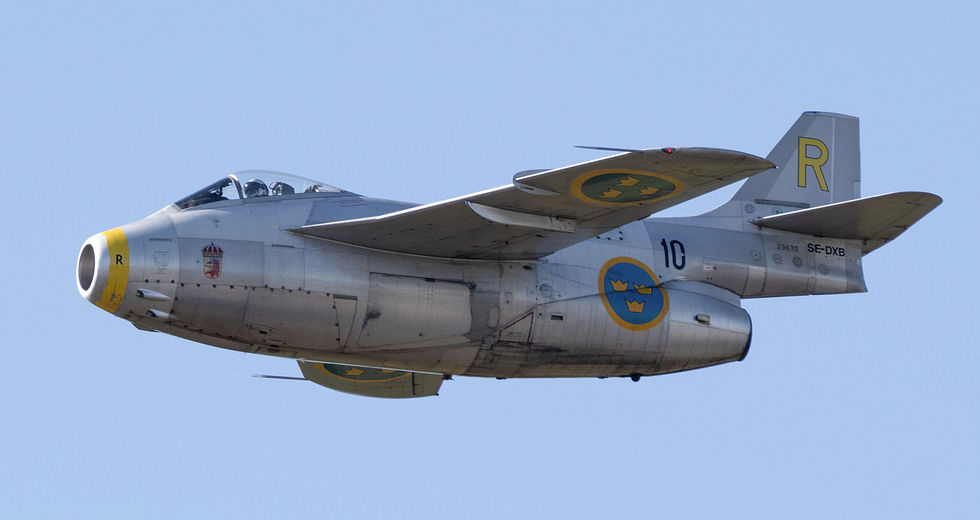
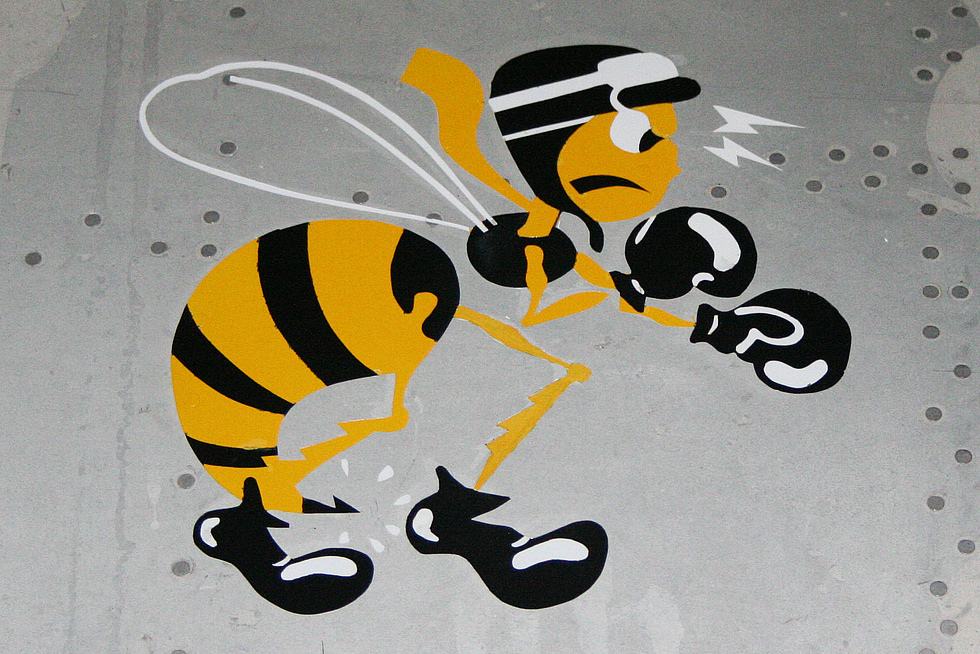
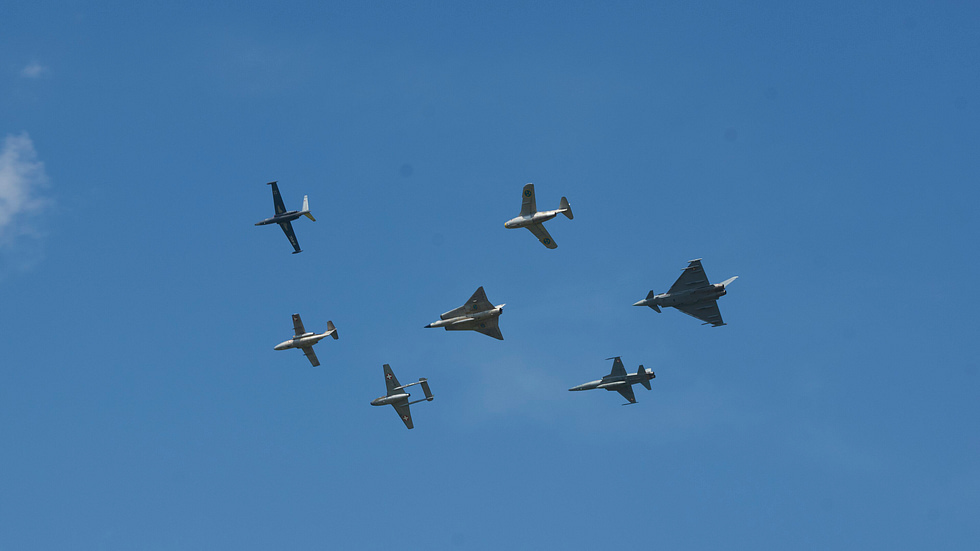
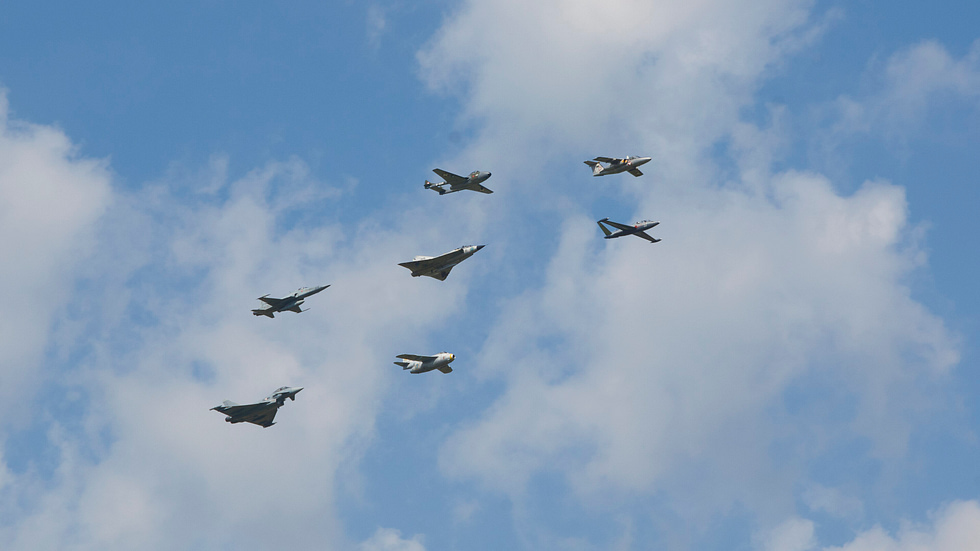
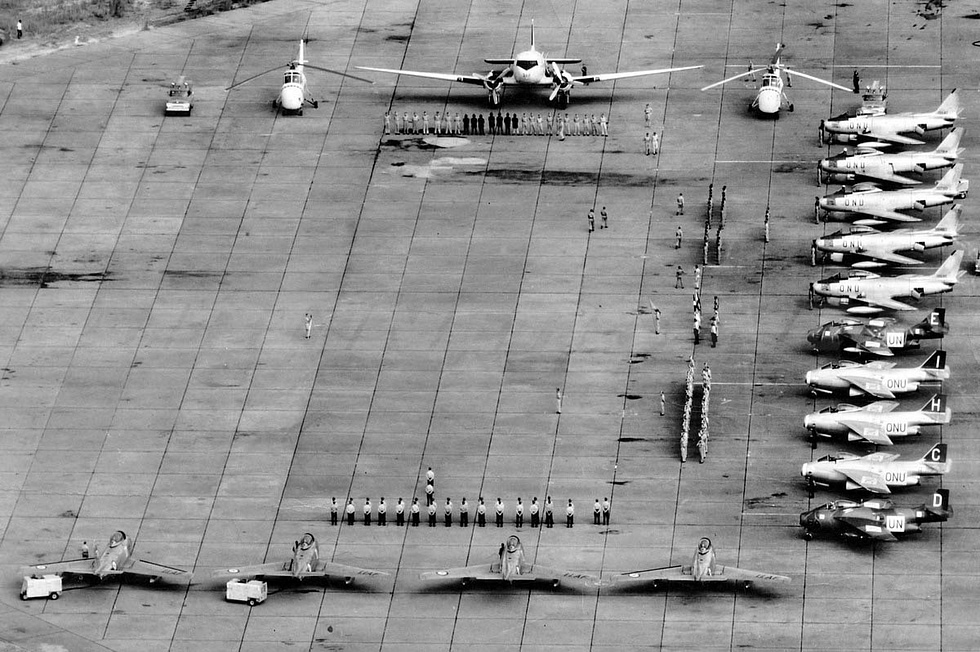
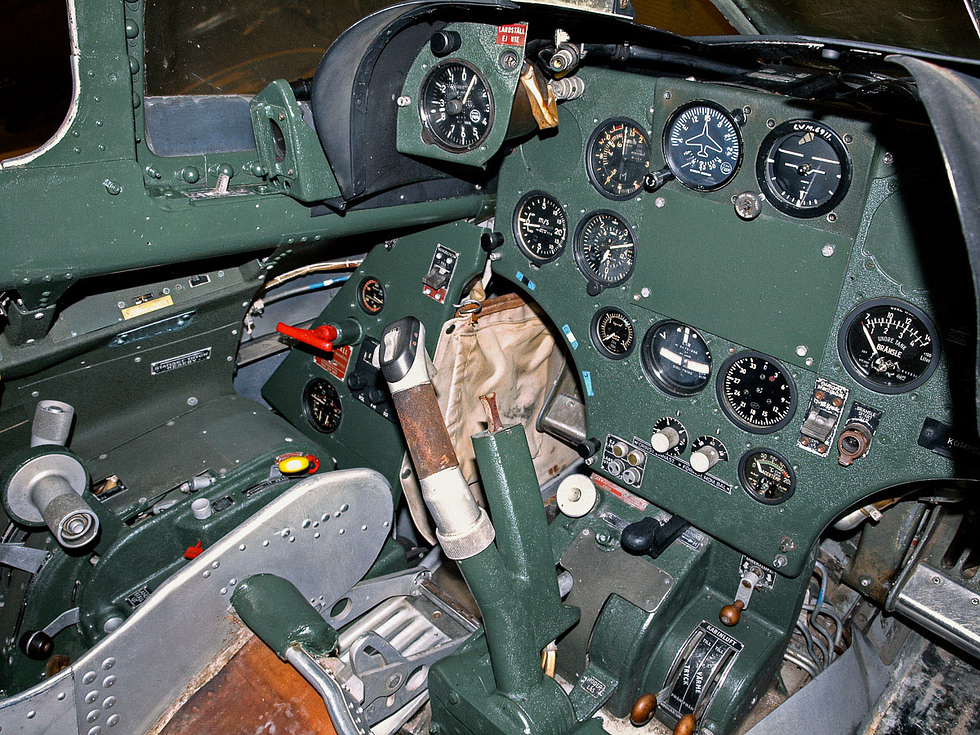
The Saab 29 Tunnan in motion
Video coming soon. We are still sourcing the right footage of the Flying Barrel — a rare flying survivor kept airworthy by the Swedish Air Force Historic Flight. Check back for a full video feature on the Tunnan.
The Tunnan in motion
Not A Pound For Air To Ground — one of the most-watched Tunnan films on YouTube.
Where the Tunnan flew
The score that defines it
The Tunnan’s combat record is unique: it is the only jet the Swedish Air Force has ever taken to war. In 1961 Sweden deployed J 29Bs to the United Nations ONUC operation in the Congo as squadron F22. Flying under the UN flag — the aircraft remained Swedish and Swedish-crewed — they carried out ground-attack sorties against the breakaway State of Katanga, striking airfields at Kolwezi and Jadotville and supporting UN troops, alongside Indian Air Force Canberras. There was no air-to-air fighting; the Tunnan’s war was rockets, cannon and bombs against ground targets, and it came through without a combat loss.
Compare the combat record of every military aircraft. Figures as of July 2026.
Everything people ask about the Saab 29 Tunnan
Can I fly in a Saab 29 Tunnan?
Why is it called the “Flying Barrel”?
Was the Saab 29 the first swept-wing jet fighter?
Did the Saab 29 Tunnan ever see combat?
How fast was the Saab 29 Tunnan?
How many were built, and who flew them?
Is the Saab 29 Tunnan still flying?
Can a civilian fly the Saab 29 Tunnan?
You can’t fly the Saab 29 Tunnan.
These, you can.
Some legends only live in museums — others are fuelled and waiting. MiGFlug has put civilians in real military jet cockpits since 2004.
 Fly the L-39 AlbatrosThe world’s most-flown jet trainer — aerobatics included
 Fly the F-104 Starfighter“The missile with a man in it”
 Fly the MiG-21The Cold War’s most-produced jet
 Vuela el T-33 Shooting StarAmerica’s first jet trainer
 Fly the DH VampireA piece of early jet history
 Fly the S.211Agile Italian jet trainer
 Fly the MB-326The classic Aermacchi jet
 Fly the MiG-15The Soviet legend of the Korean War
Continue the tour
Every fact, checked
- Aeroseum — Saab Tunnan: The Crisis in the CongoSwedish aviation museum account of the F22 UN deployment, dates and combat operations.
- Plane Encyclopedia — Saab 29 TunnanDevelopment, variants, full specifications and the Congo operation.
- GlobalSecurity.org — Saab J29 TunnanFirst flight and test pilot, the RM2 engine and dog-tooth wing, speed records and Austrian export.
- The National Interest — A Fighter Jet Work of ArtDesign, swept-wing origins and the barrel-shaped fuselage.
- Simple Flying — Saab’s Most Numerous FighterProduction totals, armament, service history and UN operations.
- War Thunder Wiki — Development and VariantsVariant breakdown from J 29A to J 29F and reconnaissance versions.
- Military Factory — Saab J29 TunnanDimensions, weights and performance reference figures.