
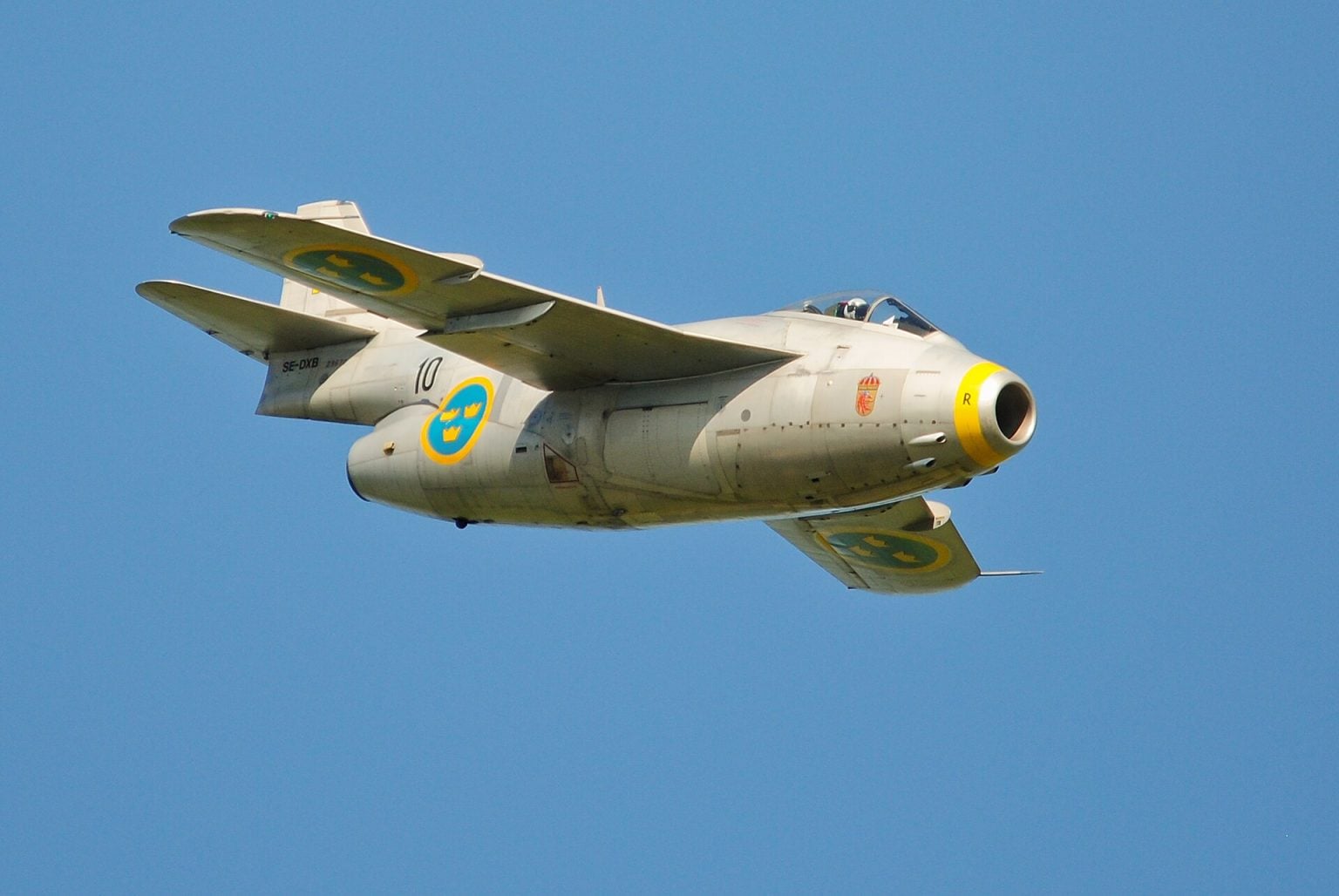
Saab 29
“Tunnan”
Sweden’s first swept-wing jet fighter — a portly, barrel-shaped machine nicknamed the “Flying Barrel” that was one of the fastest fighters in the world when it flew in 1948, and the only jet the Swedish Air Force ever took into combat.
The barrel that made Sweden a jet power
In 1945 Sweden emerged from the war neutral, isolated and determined never to depend on anyone else for its air defence. Saab had already built the piston-engined J 21, but the jet age had arrived and the country had nothing to match it. When Swedish engineers got their hands on captured German swept-wing research — obtained via Switzerland in 1945 — Saab tore up its straight-wing jet studies and started again around a 25-degree swept wing.
The result, first flown on 1 September 1948, looked nothing like a thoroughbred. To fit a large centrifugal-flow de Havilland Ghost turbojet, the designers wrapped a short, fat fuselage around the engine — and the shop floor promptly christened it the flygande tunnan, the “Flying Barrel.” British test pilot Bob Moore called it an ugly duckling on the ground. In the air it was anything but: on entering service in 1951 it was among the fastest fighters in the world.
Over roughly 660 aircraft — still the most Saab has ever built of one type — the Tunnan served as interceptor, attacker and photo-reconnaissance platform. It set closed-circuit world speed records, was exported to Austria, and in 1961 went to war under a blue UN flag over the Congo, the only time Sweden has ever used a jet in combat. Not bad for a barrel.
01How captured German research gave the Saab 29 Tunnan its swept wing
Saab’s early jet studies used a conventional straight wing. That changed when the company’s research chief, Frid Wänström, returned from Switzerland in 1945 with German aerodynamic data showing the drag-reducing benefits of wing sweep at high speed. Sweden’s Royal Institute of Technology and its aeronautical research institute ran the numbers and wind-tunnel tests, and Saab committed to a 25-degree swept wing — a bold choice for a country building only its second jet.
The gamble paid off. The Tunnan became the first swept-wing fighter to enter service in Western Europe, beating Britain’s Hawker Hunter and France’s Mystere into squadron use. It was inspired by German work — the unbuilt Messerschmitt P.1101 is often cited — but it was designed, tested and manufactured entirely in Sweden, and it put a small neutral nation at the leading edge of jet fighter design.
What makes the Saab 29 Tunnan special
A swept wing on a barrel body
The Tunnan paired a thin 25-degree swept, laminar-flow wing with one of the most compact fuselages of any early jet. There was no room in the slim wing for the landing gear, so it retracts inward into the fuselage. Interconnected leading-edge slots and flaps tamed the low-speed handling that swept wings are notorious for — and later E and F models added a “dog-tooth” leading edge that pushed the usable limit from about Mach 0.86 to 0.89.
Built around the de Havilland Ghost
Power came from a single de Havilland Ghost centrifugal-flow turbojet, license-built by Svenska Flygmotor as the RM2. That engine’s large diameter is exactly why the fuselage is so fat — the airframe was quite literally wrapped around it, fed by a simple nose intake. The later RM2B added a Swedish-designed afterburner (EBK), lifting thrust from roughly 2,270 to about 2,800 kg and giving the J 29F its extra punch.
One airframe, three jobs
The same barrel did fighter, attack and reconnaissance duty. The J 29A and B carried four 20 mm cannon and a heavy load of underwing rockets and bombs; the J 29C swapped the guns for cameras to become the first jet photo-reconnaissance aircraft of a non-aligned nation. Rugged and simple, the Tunnan proved able to absorb heavy ground fire and keep flying — a quality that mattered over the Congo.
02Why the Saab 29 Tunnan is shaped like a barrel
The nickname was an engineering consequence, not a styling choice. The de Havilland Ghost was a centrifugal-flow turbojet — a design that is short but wide, because air is flung outward through the compressor before combustion. Wrapping a slim, streamlined fuselage around such an engine was impossible, so Saab built a short, deep, rounded body with a circular nose intake feeding straight into the engine face. The workers called the resulting shape the flygande tunnan, the flying barrel, and the name stuck. Fatter axial-flow engines would later let designers slim fighters down, but in 1948 the barrel was simply the honest shape for the powerplant available.
03The Saab 29 Tunnan’s world speed records
For a supposedly ungainly aircraft, the Tunnan was genuinely fast. On 6 May 1954 Captain Anders Westerlund set an international 500 km closed-circuit record at 977 km/h in a standard J 29. The following year, on 23 March 1955, Hans Neij and Birger Eriksson took a two-aircraft flight to a 1,000 km closed-circuit record of 900.6 km/h. These were not stunt machines but production fighters, and the records were a pointed reminder to the great aviation powers that a small neutral country could build a jet fully competitive with their own.
Full specifications
Baseline note: the figures below describe the J 29F, the definitive Tunnan — a J 29B or J 29E airframe rebuilt with the reheated RM2B engine and the dogtooth outer wing, and the only mark cleared for the Rb 24 Sidewinder. Deltas for the early J 29A, the unarmed S 29C reconnaissance aircraft and the earlier J 29B and J 29E are in grey. One correction worth making at the outset, because it is widely repeated: neither the J 29B nor the J 29E had an afterburner. Reheat was developed on a single converted aircraft designated J 29D in 1954–55 and then fitted, together with the E’s new outer wing, to 308 rebuilt B and E airframes as the J 29F. Swedish designation letters denote the role a unit flies rather than the airframe standard, so the same aeroplane is a J 29F with a fighter wing and an A 29F with an attack wing.
Dimensions & weights
- Crew
- 1. There was never a two-seat Tunnan. Saab offered the SK 29B trainer in 1950 and the air force chose to spend the production capacity on fighters instead. That decision is written into the accident figures below
- Length
- 10.23 m (33 ft 7 in)
- Wingspan
- 11.00 m (36 ft 1 in)
- Height
- 3.75 m (12 ft 4 in)
- Wing area
- 24.15 m² (260.0 sq ft) — 24.00 m² (258.3 sq ft) on the J 29A, J 29B and S 29C, before the dogtooth outer panel
- Wing sweep
- 25°. The R 1001 design began with a straight wing. It was swept only after Saab’s project manager Frid Wänström collected German wartime research from Messerschmitt engineers who had escaped to Switzerland in 1945 — drawings for the P.1101, P.1110, P.1111 and P.1112. The aerodynamicist Hermann Behrbohm came with the papers and stayed at Saab
- Fuselage
- The barrel. The de Havilland Ghost is a centrifugal-flow turbojet, which means a wide engine, and Saab ran the intake duct straight through the fuselage from a nose inlet to the tailpipe to preserve thrust. To keep the wing thin the undercarriage retracts into the fuselage rather than the wing, widening it further. The result was Flygande Tunnan, the flying barrel — a nickname Saab disliked and the air force eventually adopted officially
- Empty weight
- 4,845 kg (10,681 lb) — J 29A 4,580 kg (10,097 lb), J 29B 4,640 kg (10,229 lb), S 29C 4,700 kg (10,362 lb), J 29E 4,600 kg (10,141 lb)
- Maximum take-off weight
- 8,375 kg (18,464 lb) — J 29A 7,530 kg (16,600 lb), J 29B and J 29E 8,170 kg (18,012 lb), S 29C 8,000 kg (17,637 lb)
- Internal fuel
- 2,150 litres (473 imp gal / 568 US gal) — the J 29A carried only 1,430 litres (315 imp gal), and the extra tankage from the B onward is the single most useful change made to the aeroplane
- External fuel
- 2 × 400-litre or 2 × 500-litre drop tanks on the outer hardpoints. These could be filled with napalm before take-off, or ignited as incendiary weapons in the air — a fuel tank and a bomb in one fitting, which is exactly the kind of economy a small air force makes
- Number built
- 661 — 224 J 29A, 332 J 29B, 76 S 29C and 29 J 29E, plus four prototypes. Saab’s largest production run of any aircraft to this day. The 308 J 29Fs are rebuilds of existing B and E airframes and are not additional aeroplanes; some sources give the J 29B as 360 or 361, but only 332 makes the total come to 661
Performance
- Maximum speed
- 1,075 km/h (668 mph, 580 kn) — J 29B, S 29C and J 29E 1,060 km/h (659 mph); J 29A 1,050 km/h (652 mph). The Tunnan is subsonic and knows it: the airframe limit is around Mach 0.86
- Rate of climb
- 32.1 m/s (6,320 ft/min) — the afterburner was fitted mainly for this. It added only a little top speed but transformed the climb, which is what a Swedish interceptor scrambling against high-altitude intruders actually needed
- Service ceiling
- 15,500 m (50,850 ft)
- Range
- 1,100 km (684 mi, 594 nmi)
- World record, 500 km closed circuit
- 977 km/h (607 mph) — Captain Anders Westerlund, J 29B, 6 May 1954, in 30 minutes 42 seconds, beating the American record by 27 km/h. Sweden held it for a year before an F-86H Sabre took it back
- World record, 1,000 km closed circuit
- 900.6 km/h (559.6 mph) — two S 29Cs of F 11, flown by Captain Hans Neij and Sergeant Pilot Birger Eriksson, 23 March 1955, Nyköping to Nätra church at Bjästa and back. The previous mark was 822 km/h, set by the British test pilot Jim Cooksey in a Gloster Meteor in May 1950. Note that the 1954 and 1955 records are two different flights in two different marks and are frequently conflated
- Assisted take-off
- Jettisonable solid rocket bottles from 1951, to shorten the run from Sweden’s dispersed road and field bases
- Air brakes
- Wing-mounted on the first 32 J 29A1s, moved to the fuselage ahead of the main undercarriage doors on the J 29A2 and everything after it
- Handling
- Automatically locking leading-edge slots, interlinked with the flaps, for lateral stability at low speed. The J 29E and J 29F added a dogtooth extension on the outer leading edge to raise the critical Mach number and tame the tip stall. The test pilot Robert A. Moore’s verdict after the first flight has stuck: "on the ground an ugly duckling — in the air, a swift"
- Combat record
- Congo, 1961–63, with F 22 under United Nations command. Ground attack with cannon and rockets against Katangese airfields and positions; one air engagement, on 29 December 1962, when Åke Christiansson damaged a Katangese T-6 Harvard’s rudder near Kolwezi. Two Tunnans were written off in landing accidents at Kamina, both without injury
- Attrition
- 242 of the 661 written off in accidents, and 99 pilots killed. The Swedish air force is candid about why: nobody yet understood swept-wing behaviour, there was no two-seat trainer, training was deliberately flown as realistically as wartime with few restrictions, and air combat was practised in large formations in which collisions were not rare. Austria lost 10 of its 30 aircraft and six pilots. These figures are appalling by modern standards and were not thought remarkable at the time
Propulsion & systems
- Engine
- 1 × Svenska Flygmotor RM2B — the de Havilland Ghost 50 centrifugal-flow turbojet built under licence, with a Swedish-designed afterburner — the earlier J 29A, J 29B, S 29C and J 29E used the unreheated RM2. The Ghost was chosen in December 1945 over the smaller Goblin because it was more powerful and because its circular intake and diameter suited the fuselage Saab had already drawn
- Thrust
- 21.1 kN (4,750 lbf) dry and 27.6 kN (6,200 lbf) with reheat at 10,250 rpm, per the J 29F pilot’s manual — the plain RM2 was rated at about 22 kN (5,000 lbf)
- Afterburner
- Designed in Sweden by Östen Svantesson, proved on the one-off J 29D in 1954–55 and then fitted across the fleet. Some aircraft were converted at Saab and others at their own wings. The S 29C never received it and finished its career on the original engine
- Radar
- None. The Tunnan is a clear-weather, visually aimed day fighter. A radar-equipped J 29D was proposed with a set either above or inside the nose intake and was not built; radar came to the Swedish air force with the J 32B Lansen and the J 35 Draken
- Sights
- A gyro gunsight for the four cannon, with rocket and bombing modes. Nothing more sophisticated existed on the aircraft. Everything it hit, it hit by eye
- Radar warning
- The S 29C carried the PQ17 radar warning receiver — the first Swedish combat aircraft ever fitted with one. It is a small but telling piece of evidence about how seriously Sweden took the reconnaissance mission over the Baltic
- Alloy and structure
- Heavy frames and stressed skin. Sweden could not buy American 75S aluminium alloy, so Svenska Metallverken made its own equivalent — but in significantly larger sections than normal aircraft practice, which is part of why the first flight slipped past the hoped-for date of 1 August 1948
- Structural verification
- A Saab Safir light aircraft was rebuilt as the Saab 201 with a full-scale swept wing to check the aerodynamics before the Tunnan flew — a cheap and characteristically sensible piece of Swedish engineering
- First flight and service entry
- First flight 1 September 1948, flown by the British test pilot Robert A. Moore. First production aircraft to Bråvalla wing (F 13) in May 1951, making the Tunnan the first Western European swept-wing fighter to reach squadron service — ahead of the Hawker Hunter and the Dassault Mystère, though behind the American F-86 and the Soviet MiG-15
- Withdrawal
- Front-line fighter service ended in the 1960s as the Lansen and Draken arrived. From 1967 surviving J 29Fs were converted for target towing and served with the target-towing squadron (Målflygdivisionen) until 1976. Austria retired its aircraft in 1972. The 20 mm cannon from scrapped Tunnans were taken out and used to arm the Pbv 302 armoured personnel carrier, so parts of the aeroplane stayed in Swedish service for decades longer than the aeroplane did
04What did the Saab 29 Tunnan cost?
The Tunnan was a Swedish state-funded product built for the Flygvapnet, not an item sold on an open export market at a published price, so no reliable flyaway unit cost or cost-per-flight-hour figure exists in the public record. What is documented is scale: with roughly 660 built, it remains the most-produced aircraft in Saab’s history, and its long service — front-line into the mid-1960s and in target-towing and other second-line roles into the mid-1970s — suggests it was cheap and robust to operate by the standards of its day. Any precise dollar or krona figure attached to a Tunnan should be treated as an estimate.
Armament & payload
Four cannon, a rack of rockets and, on the F, Sweden’s first air-to-air missile
The Tunnan’s armament is conventional for its generation and unusually well thought out for a small air force. Four 20 mm Hispano cannon sit in the lower nose under the intake, with 180 rounds each — heavy enough to matter, light enough to fit. Eight inner hardpoints carry rockets, and two outer ones carry drop tanks that double as incendiary bombs. There is no attack radar, no guided air-to-surface weapon, and no bombsight worth the name. It is a gun-and-rocket aeroplane.
The J 29F added the Rb 24 — the AIM-9B Sidewinder built under licence — and with it Sweden entered the missile age. Only the F was cleared for it, and the thirty aircraft sold to Austria were never armed with missiles at all, because the 1955 Austrian State Treaty forbade it. Sweden’s own rocket inventory was extensive and locally made: an 8 cm rocket derived from the British RP-3, a 14.5 cm shaped-charge anti-armour rocket, a 15 cm high-explosive rocket and an 18 cm anti-shipping weapon, plus the Bofors 75 mm "Frida" introduced in 1955.
In the Congo the guns and the rockets were what the aircraft actually used, against Katangese airfields, vehicles and positions. Fits varied by mark and operator: the S 29C carried cameras and no weapons at all, the Rb 24 was a J 29F fitting only, the Austrian aircraft flew without missiles by treaty, and Swedish sources differ on precisely which of the heavy rockets went to Africa.
Gun
- 4 × 20 mm akan m/47C — the Hispano-Suiza HS.404 in its British Mark V form, built under licence in Sweden. Mounted in pairs in the lower nose, beneath the intake duct, with 180 rounds per gun and 720 in total.
- Fitted to the J 29A, B, E and F. The S 29C carried no guns whatsoever — cameras only.
- A 30 mm proposal that failed. The J 29D alternative 2 was to carry four 30 mm Hispano HSS 825 cannon, on the reasoning that four 20 mm rounds were not enough to bring down a bomber. A J 29A flew with mock-ups in 1951 or 1952; trestle-mount firing trials around 1953–54 found the weapon unsafe and the project was dropped.
- The guns outlived the aeroplane. When Tunnans were scrapped, their cannon were removed and reused to arm the Pbv 302 armoured personnel carrier.
- In the Congo, cannon fire was the Tunnan’s principal weapon and the one that produced its only air-to-air result — a damaged T-6 Harvard rudder near Kolwezi on 29 December 1962.
Air-to-air
- 2 × Rb 24 — the AIM-9B Sidewinder, licence-built in Sweden, carried on the third hardpoint out from the centreline. J 29F only. Sweden’s first operational air-to-air missile.
- An early rear-aspect infrared weapon with all the limitations of the type: it needs a hot tailpipe, clear air and a stern position, and it will not fire in cloud or against a target ahead.
- Jaktraket — 12 to 24 unguided air-to-air rockets, the interim answer to the bomber-interception problem before the Sidewinder arrived, fired in a salvo at a formation rather than aimed at an aircraft.
- The Austrian aircraft carried no missiles. The 1955 Austrian State Treaty prohibited guided weapons, so Austria’s thirty J 29Fs flew their whole careers as gun-and-rocket fighter-bombers.
- The four cannon remained the primary air-to-air armament throughout, which is why the failed 30 mm project mattered enough to be pursued for three years.
Air-to-surface guided
- None. The Tunnan never carried a guided air-to-surface weapon of any kind.
- There was no laser designator, no television guidance and no anti-radiation capability. Ground attack was flown by eye, in a dive, with cannon and unguided rockets.
- Swedish guided air-to-surface weapons arrived with the Rb 04 anti-ship missile on the A 32A Lansen, the aircraft that replaced the A 29B in the attack wings from 1957.
- This is not a criticism of the design so much as a statement of its date. In 1951 nobody in Western Europe had a guided air-to-ground weapon in squadron service either.
Bombs
- 2 × 200 kg incendiary bomb m/51 on the outer hardpoints — the only purpose-built bomb the Tunnan routinely carried.
- Drop tanks as weapons — the 400-litre and 500-litre external tanks could be filled with napalm on the ground or ignited in the air as incendiary bombs, then released. Both tank types were cleared for the role.
- No conventional high-explosive bomb load and no bombsight for level bombing. The Tunnan was never a bomber; Sweden had the A 21R, the B 18 and later the A 32A Lansen for that.
- Everything is carried on the wing. There is no internal bay, and the fuselage is full of engine, duct and undercarriage.
Rockets
- 15 cm srak m/51 — the heavy Swedish attack rocket, roughly 64 kg with about 4.5 kg of TNT. Two to four per outer pylon. Effective against vehicles and hardened positions on a direct hit and much less so on a near miss, which is a fair description of every unguided rocket of the era.
- 14.5 cm psrak m/49 — the shaped-charge anti-armour rocket. This, rather than the 15 cm, is the true Swedish anti-armour weapon of the period, and the two are frequently confused in English-language accounts of the Congo deployment.
- 8 cm prak m/46C — the British RP-3 with fins of Swedish design, 8 or 14 carried on the inner hardpoints.
- 18 cm srak — the heaviest rocket cleared, one per pylon, intended against shipping.
- 7.5 cm srak m/55 (Bofors "Frida") — two to four per pylon, up to 24 in total, plus ÖRAK practice rounds. The inner hardpoints could each take only one small rocket because of the undercarriage.
Pods & other stores
- Camera installation, S 29C — the nose was rebuilt around the camera bay, the guns removed entirely, and the aircraft flew unarmed reconnaissance for the Swedish air force from 1954 to 1970. Two went to the Congo.
- PQ17 radar warning receiver, S 29C — the first fitted to any Swedish combat aircraft, and the clearest evidence that the reconnaissance Tunnans expected to be tracked.
- Drop tanks — 400 and 500 litres, on the two outer hardpoints, doubling the aircraft’s useful radius or its incendiary load depending on how they were filled.
- Assisted take-off rockets from 1951, to lift the Tunnan out of Sweden’s short dispersed bases.
- Target-towing equipment from 1967 — the J 29F’s last job, and the reason the type stayed on the Swedish air force inventory until 1976, five years after it had ceased to be a combat aircraft in any meaningful sense.
Three typical loadouts
- Air defence intercept (J 29F, Sweden, late 1950s)
- Four 20 mm cannon with 720 rounds, two Rb 24 Sidewinders on the third hardpoints, two drop tanks. Reheat lit for the climb. A short-ranged, fast-climbing, clear-weather interceptor for a country whose defence plan was to be too expensive to invade.
- Ground attack (A 29B, attack wings, 1953–57)
- Cannon, a full load of 8 cm and 14.5 cm rockets on the inner hardpoints, and two drop tanks filled with napalm on the outers. Olive-green wingtips and fin from 1954 to mark the attack role. Replaced by the A 32A Lansen.
- Congo close support (F 22, Kamina, 1961–63)
- Cannon and unguided rockets against Katangese airfields, aircraft on the ground, vehicles and positions. Swedish pilots refused some close-support requests over the risk to civilians, and in November 1962 the Swedish air commander refused a direct order to destroy the Katangese Fouga Magisters on the ground because they were unarmed.
Sourcing caveat: Swedish weapon designations are role-based and change with the unit, which makes cross-referencing English sources treacherous — akan is a cannon, rak a rocket, prak and psrak anti-armour rockets, srak a high-explosive rocket, jrak an air-to-air rocket and örak a practice round. Figures above follow Swedish air force sources and the J 29F pilot’s manual. English accounts of the Congo deployment routinely describe a "150 mm anti-armour rocket": the 15 cm srak m/51 is a high-explosive weapon and the anti-armour rocket of the period is the 14.5 cm psrak m/49. Both were in the Swedish inventory and both are credibly reported in Africa; a single label combining them is not correct.
Variants
One airframe, five service marks, and a rebuild programme that made most of them the same aeroplane
The Tunnan family is simpler than its designation list suggests. There is one airframe, produced in four service standards — A, B, C and E — and then a fleet-wide rebuild that turned most of the B and E aircraft into the J 29F. Swedish prefixes describe the job, not the machine: J for jakt, pursuit; A for attack; S for spaning, reconnaissance; SK for skol, school. The same J 29B flying with an attack wing is an A 29B, painted with olive-green wingtips and fin from 1954 to say so.
What is striking about the programme is how competitive it was. Sweden, neutral, with a population under seven million and no wartime aircraft industry to speak of, produced a swept-wing jet fighter that reached squadrons before the Hunter or the Mystère and that Swedish assessments rated the equal of the F-86 and the MiG-15. It went into service in 1951 and it was still setting closed-circuit world speed records in 1955.
- J 29 prototypes (1948–50, 4 built)
- The first two carried test instrumentation instead of armament; the third was the first to fly with the four 20 mm cannon. First flight 1 September 1948 by Robert A. Moore. Preceded by the R 101 cigarren, a straight-winged design resembling the P-80 that was rejected, and the R 1001, which was chosen and then swept.
- J 29A1 and A2 (1951–54, 224 built)
- The first production fighter, RM2 engine, 1,430 litres of internal fuel. The first 32 A1s had wing-mounted air brakes; the 192 A2s moved them to the fuselage ahead of the main undercarriage doors, where they stayed. Delivered to F 13 Bråvalla from May 1951 and served with F 3, F 9, F 12, F 15 and F 16.
- J 29B and A 29B (1953–55, 332 built)
- The most numerous mark and the first genuinely useful one: internal fuel raised from 1,430 to 2,150 litres and full provision for external stores. Flown as the J 29B by fighter wings and the A 29B by attack wings. This is the aircraft that went to the Congo and the aircraft that set the 500 km world speed record in 1954.
- S 29C (1954–70, 76 built)
- Photographic reconnaissance, with a rebuilt camera nose and no armament at all. Fitted with the PQ17 radar warning receiver, the first in Swedish service. Never received the afterburner. Served with F 11, F 21 and finally the target-towing squadron; two S 29Cs set the 1,000 km closed-circuit world record on 23 March 1955 and two more served in the Congo.
- J 29D (1954–55, 1 converted)
- The afterburner testbed — a single aircraft with Östen Svantesson’s reheat unit on the RM2, raising the top speed to 1,075 km/h and transforming the climb. Everything the J 29F is, it is because of this aeroplane. A separate J 29D proposal to fit four 30 mm HSS 825 cannon was tested with mock-ups and abandoned when the gun proved unsafe.
- J 29E (1955, 29 built)
- A J 29B with a new outer wing carrying a dogtooth leading-edge extension to raise the critical Mach number. No afterburner. Only 29 were built as such, because the far better idea was to combine this wing with the J 29D’s engine. Served with F 4 and F 9.
- J 29F and A 29F (1955–76, 308 rebuilt)
- The definitive Tunnan and the baseline described above: J 29B and J 29E airframes rebuilt with the reheated RM2B and the E’s dogtooth wing, and the only mark cleared for the Rb 24 Sidewinder. Some were converted at Saab and some at their own wings. Modified from 1967 for target towing, and the last in Swedish service.
- SK 29B (offered 1950, none built)
- The trainer that should have existed. A two-seat conversion with duplicate ejection seats, sights and controls, no armament, no armour and less fuel in the upper fuselage tank; a side-by-side layout was also studied. The air force chose to build fighters instead. Given that 242 Tunnans were written off and 99 pilots died, this is the most consequential decision in the programme’s history.
- Austrian J 29F (1961–72, 30 second-hand)
- The only export sale Saab ever made of the type, despite extensive marketing. Thirty used J 29Fs to the Austrian Air Force, flown by 1. Staffel of the Jagdbombergeschwader with yellow A-to-O tail codes and never armed with air-to-air missiles because the 1955 State Treaty forbade guided weapons. Ten were written off and six pilots killed. Retired in 1972.
Retirement chronology and the single flying aircraft. Front-line Swedish fighter service ended through the 1960s as the J 32B Lansen and J 35 Draken arrived; the S 29C left reconnaissance work in 1970; the last J 29Fs, converted for target towing from 1967, served with the target-towing squadron until 1976, twenty-five years after the first delivery. Austria retired its thirty aircraft in 1972. The Congo deployment of 1961–63 was the second occasion on which Swedish combat aircraft were used operationally — the first was the volunteer wing F 19 in the Finnish Winter War of 1939–40 — and it remains the only time Swedish jets have fired in anger. Sweden itself has not been at war since 1814. When the detachment wound up, two J 29Bs and both S 29Cs were flown home and the rest were blown up at Kamina rather than shipped back; J 29B 29398 Vit Filip survives in storage at the Flygvapenmuseum. Roughly thirty airframes are preserved across Sweden, Austria, Britain, France, Italy, Denmark and the United States, and exactly one still flies: J 29F 29670, civil registration SE-DXB. It first flew on 4 March 1955, made its last air force flight on 30 June 1968 with 1,195 hours on the airframe, sat at the Flygvapenmuseum at Malmslätt for twenty-three years, was restored from 1991 by a team at F 10 Ängelholm and returned to the air on 11 July 1995. It is owned by the Flygvapenmuseum, maintained and flown by the Swedish Air Force Historic Flight at F 7 Såtenäs, and as of the 2026 display season it is still flying — the only airworthy Saab 29 in the world.
From barrel to Congo and back
Swept-wing turn
Saab obtains German swept-wing research via Switzerland and redesigns its new jet fighter around a 25-degree swept wing.
First flight
The prototype flies on 1 September with British test pilot Bob Moore at the controls — an “ugly duckling” on the ground, fast in the air.
Enters service
The J 29 joins the Swedish Air Force as one of the fastest fighters then in the world.
World speed records
Tunnans set a 500 km closed-circuit record (977 km/h, 1954) and a 1,000 km record (900.6 km/h, 1955).
The J 29F
The dog-tooth wing and RM2B afterburner arrive, producing the definitive high-performance Tunnan variant.
Off to the Congo
Sweden sends J 29Bs to the UN’s ONUC operation as squadron F22 — the only combat deployment of a Swedish jet.
Combat over Katanga
The Tunnans fly ground-attack against Katangese airfields and forces, absorbing heavy ground fire without a combat loss.
Retirement
Austria retires its exported J 29Fs (1972–73); Sweden phases out its last target-towing Tunnans by 1976.
Twelve stories of the Flying Barrel
A wing smuggled home in a briefcase
Sweden’s jet fighter changed shape overnight when German swept-wing data arrived from Switzerland.
Read the full story
Why they called it a barrel
The nickname came from the shop floor, not the marketing department.
Read the full story
The ugly duckling that flew beautifully
Test pilot Bob Moore was unimpressed on the ground — and won over in the air.
Read the full story
No room for the wheels
The wing was so thin the landing gear had to hide in the body.
Read the full story
977 km/h around a circle
A standard production Tunnan set an international speed record in 1954.
Read the full story
A record flown in formation
The 1,000 km record was set by two Tunnans flying together.
Read the full story
Sweden goes to war under a blue flag
For the only time in its history, the Swedish Air Force sent jets into combat.
Read the full story
The UN’s only fighters
In a war of transport planes and improvised air forces, the Tunnans were the real thing.
Read the full story
Rockets over Katanga
The barrel earned its combat record strafing airfields and columns.
Read the full story
The barrel that shrugged off bullets
Tunnans came home peppered with holes and kept flying.
Read the full story
Left behind in Africa
When the mission ended, most of the Tunnans never came home.
Read the full story
The one foreign buyer
Austria flew the only export Tunnans.
Read the full story
The Flying Barrel in pictures
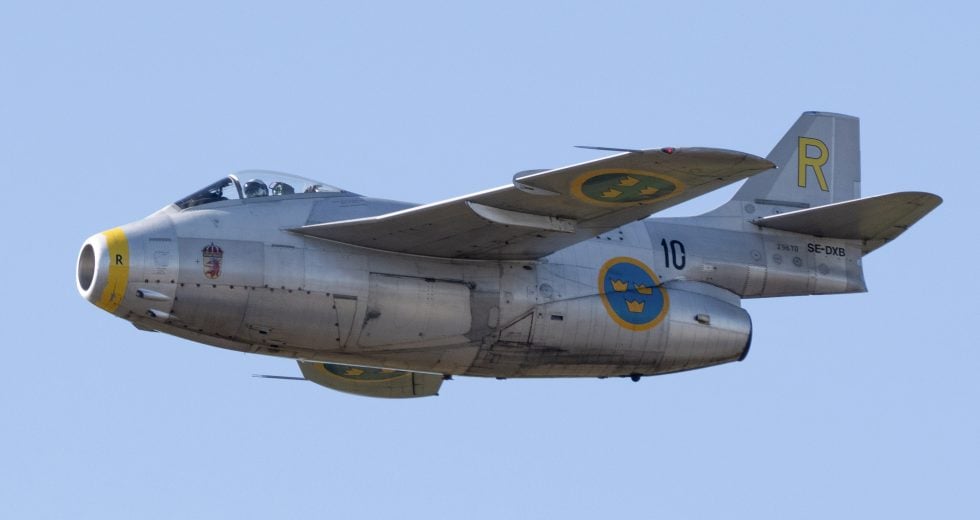
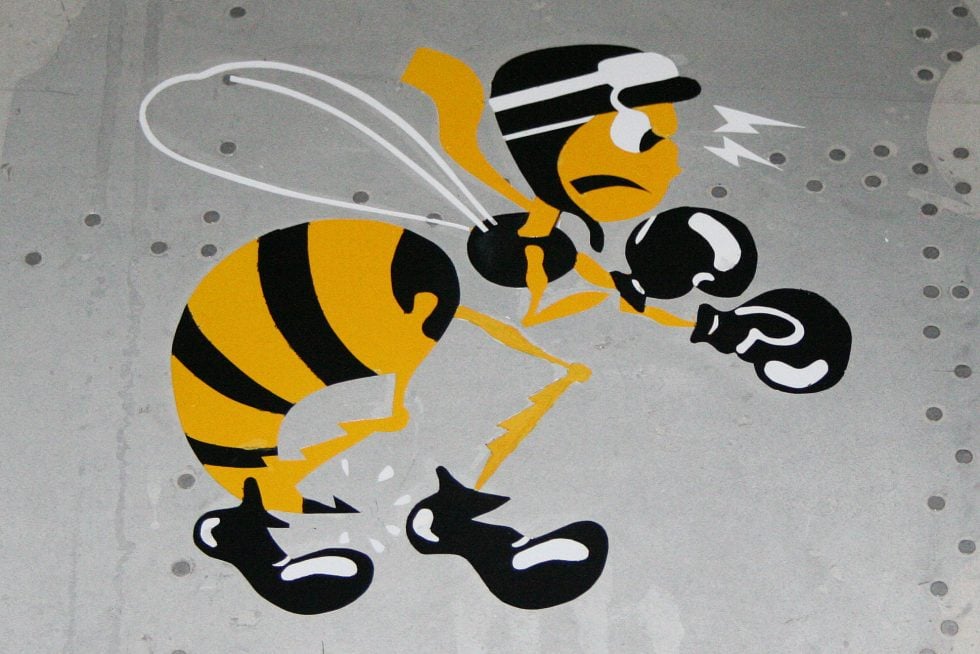
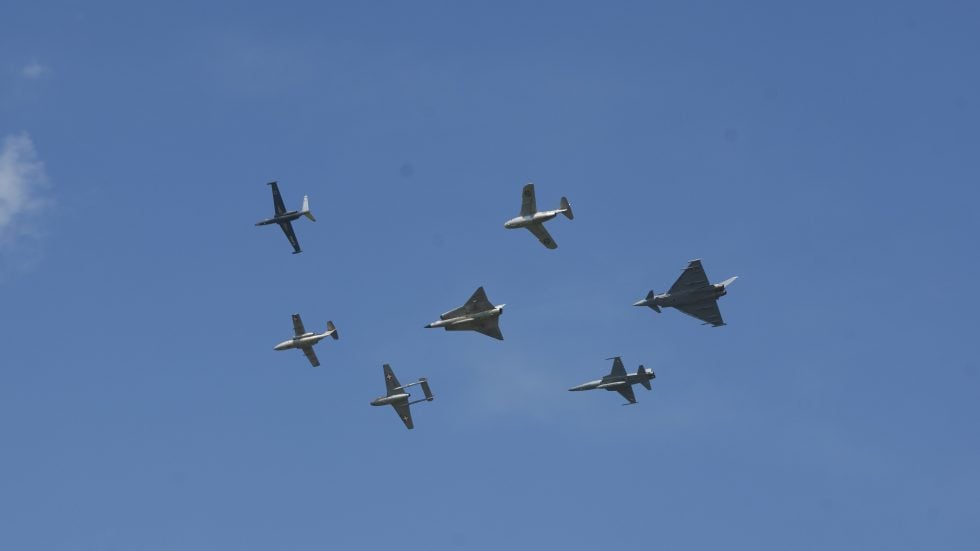
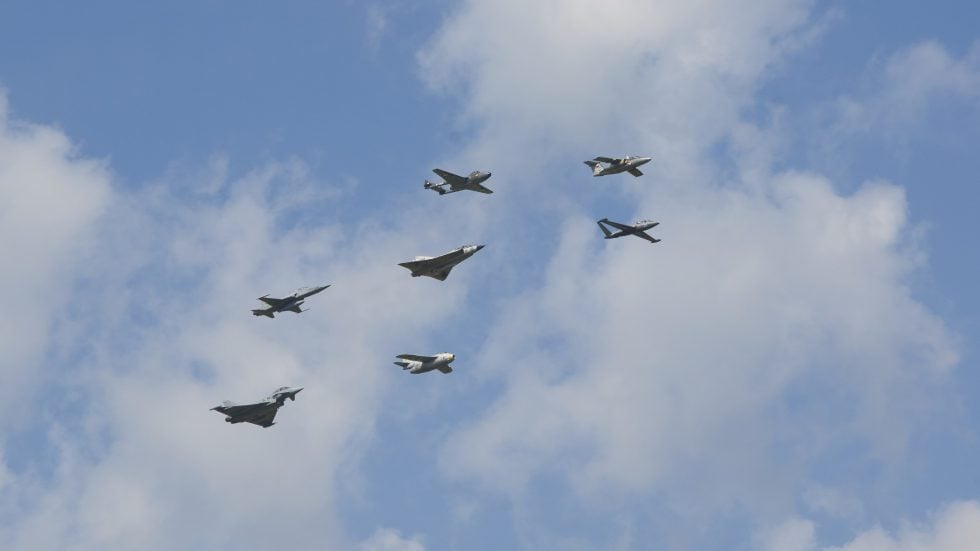
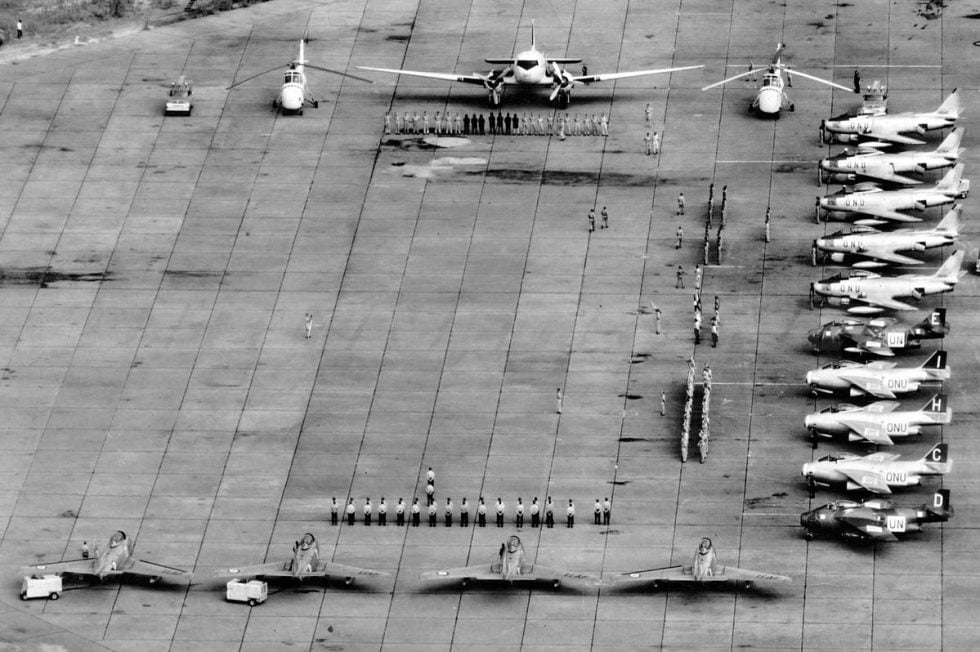
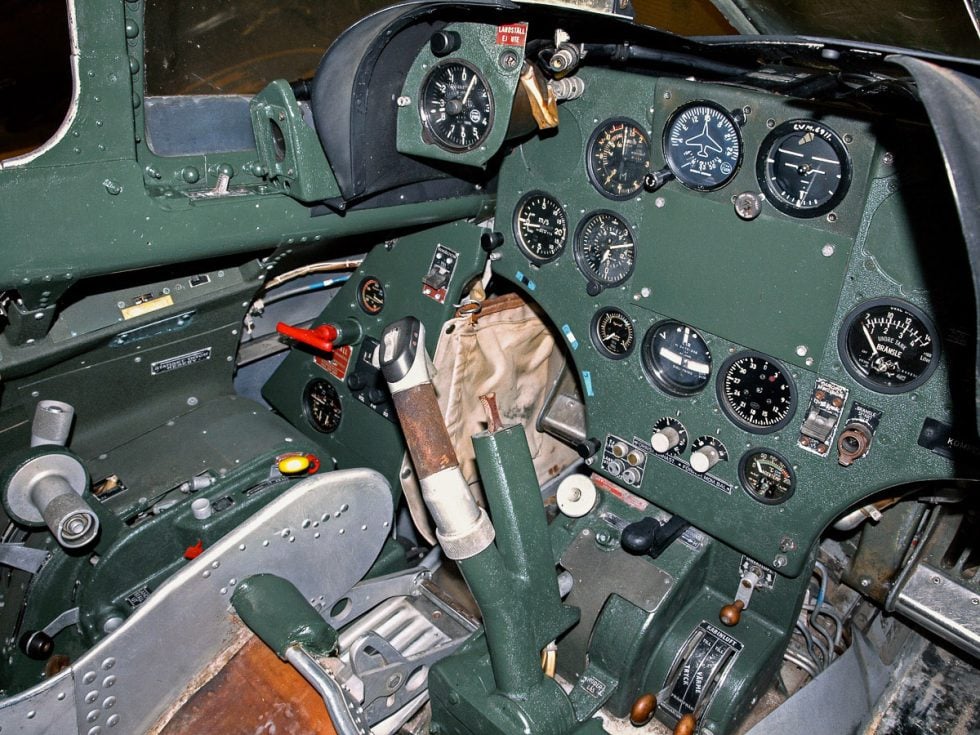
The Saab 29 Tunnan in motion
Video coming soon. We are still sourcing the right footage of the Flying Barrel — a rare flying survivor kept airworthy by the Swedish Air Force Historic Flight. Check back for a full video feature on the Tunnan.
The Tunnan in motion
Not A Pound For Air To Ground — one of the most-watched Tunnan films on YouTube.
Where the Tunnan flew
The score that defines it
The Tunnan’s combat record is unique: it is the only jet the Swedish Air Force has ever taken to war. In 1961 Sweden deployed J 29Bs to the United Nations ONUC operation in the Congo as squadron F22. Flying under the UN flag — the aircraft remained Swedish and Swedish-crewed — they carried out ground-attack sorties against the breakaway State of Katanga, striking airfields at Kolwezi and Jadotville and supporting UN troops, alongside Indian Air Force Canberras. There was no air-to-air fighting; the Tunnan’s war was rockets, cannon and bombs against ground targets, and it came through without a combat loss.
Compare the combat record of every military aircraft. Figures as of July 2026.
Everything people ask about the Saab 29 Tunnan
Can I fly in a Saab 29 Tunnan?
Why is it called the “Flying Barrel”?
Was the Saab 29 the first swept-wing jet fighter?
Did the Saab 29 Tunnan ever see combat?
How fast was the Saab 29 Tunnan?
How many were built, and who flew them?
Is the Saab 29 Tunnan still flying?
Can a civilian fly the Saab 29 Tunnan?
You can’t fly the Saab 29 Tunnan.
These, you can.
Some legends only live in museums — others are fuelled and waiting. MiGFlug has put civilians in real military jet cockpits since 2004.
 Fly the L-39 AlbatrosThe world’s most-flown jet trainer — aerobatics included
 Fly the F-104 Starfighter“The missile with a man in it”
 Fly the MiG-21The Cold War’s most-produced jet
 Fly the T-33 Shooting StarAmerica’s first jet trainer
 Fly the DH VampireA piece of early jet history
 Fly the S.211Agile Italian jet trainer
 Fly the MB-326The classic Aermacchi jet
 Fly the MiG-15The Soviet legend of the Korean War
Continue the tour
Every fact, checked
- Aeroseum — Saab Tunnan: The Crisis in the CongoSwedish aviation museum account of the F22 UN deployment, dates and combat operations.
- Plane Encyclopedia — Saab 29 TunnanDevelopment, variants, full specifications and the Congo operation.
- GlobalSecurity.org — Saab J29 TunnanFirst flight and test pilot, the RM2 engine and dog-tooth wing, speed records and Austrian export.
- The National Interest — A Fighter Jet Work of ArtDesign, swept-wing origins and the barrel-shaped fuselage.
- Simple Flying — Saab’s Most Numerous FighterProduction totals, armament, service history and UN operations.
- War Thunder Wiki — Development and VariantsVariant breakdown from J 29A to J 29F and reconnaissance versions.
- Military Factory — Saab J29 TunnanDimensions, weights and performance reference figures.