

Sopwith Snipe
The Sopwith Camel’s successor: a tougher, kinder, higher-flying rotary fighter that reached the Western Front in the war’s last weeks — and then became the standard fighter of the peacetime Royal Air Force.
The Sopwith Snipe’s story: the fighter that outlived the war it was built for
The Sopwith Snipe was designed to do one job — to replace the Sopwith Camel, the most successful and most feared British fighter of the First World War. What is remarkable is not that it managed it in a few short weeks of front-line fighting in 1918, but that it did the job so well the Royal Air Force kept flying Snipes for the best part of a decade after the guns fell silent.
By 1917 the Camel had made its reputation. It was small, savagely manoeuvrable and lethal in the right hands — and treacherous in the wrong ones. Its concentrated mass and powerful rotary engine gave it a vicious swing that killed inexperienced pilots in training as readily as it killed Germans over the lines. Sopwith’s chief designer Herbert Smith was asked for something better: a fighter with the Camel’s fighting qualities but without its worst vices, able to climb higher and fight in the thin air where combat was increasingly taking place.
The answer was the Sopwith 7F.1 Snipe. On the surface it looked like a slightly larger, rounder Camel — a compact single-bay biplane with a rotary engine and twin Vickers guns. But the differences that mattered were in how it flew. The Snipe was more docile and forgiving than the Camel, sturdier in the air, and it gave the pilot a far better view over a wider, more sensible cockpit. Crucially, its new Bentley BR2 rotary engine of around 230 horsepower let it perform where the Camel struggled: at height.
It is important to be honest about what the Snipe was and was not. It was not a dramatically faster aeroplane than the best fighters of late 1918 — its top speed of roughly 195 km/h (about 121 mph) was respectable rather than startling, and on straight-line pace alone it did not eclipse types like the S.E.5a or the German Fokker D.VII. What set it apart was the whole package: a fighter that was easy and safe to fly, tough, well-armed, and comfortable at altitude, in the hands of a service that badly needed a single standard fighter it could train pilots on and rely upon. As an all-round combat aircraft it was a genuine improvement on the Camel, and pilots liked it.
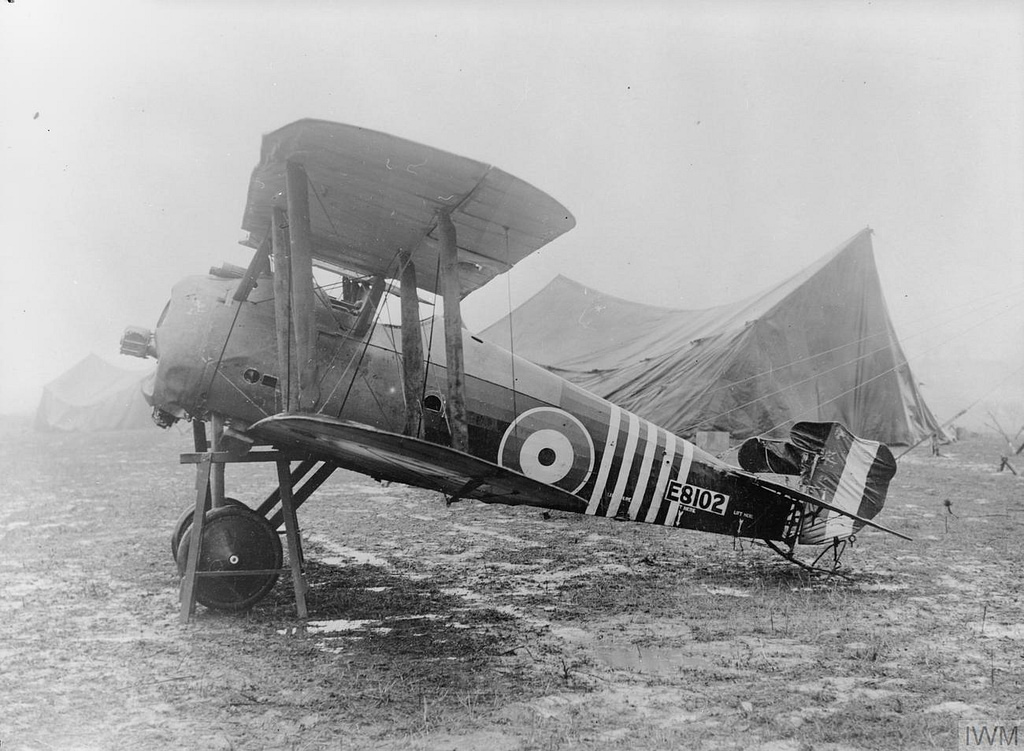
The catch was timing. The Snipe reached front-line squadrons only in the last weeks of the war. The first units re-equipped in the autumn of 1918, and by the Armistice on 11 November only a handful of squadrons — among them Nos. 43 and 208 of the RAF and No. 4 Squadron of the Australian Flying Corps — had taken the type into action. Roughly 500 Snipes had been delivered by the end of the war, a fraction of the thousands on order. Its wartime career was, by any measure, brief.
Yet into that brief window fell one of the most celebrated single combats in the history of air fighting. On 27 October 1918, Major William George “Billy” Barker, a Canadian already among the most decorated airmen of the war, took a Snipe up alone over the Foret de Mormal and ran into a large formation of German fighters. In the running battle that followed he was hit again and again — wounded in both thighs and with his left elbow shattered — fainting, recovering, and fighting on. He shot down several of his attackers before crash-landing inside Allied lines, and lived. For that fight he was awarded the Victoria Cross. It became the stuff of legend, and the Snipe was the aircraft that carried him through it.
The war ended before the Snipe could show what it might have done in a full campaigning season. In peacetime, though, it found its real career. As the vast wartime air force was cut back to a tiny fraction of its size, the RAF needed one dependable single-seat fighter to equip its surviving squadrons at home and across a far-flung empire. The Snipe was chosen. Through the early 1920s it was the standard RAF single-seat fighter, serving in Britain, in Iraq, in India and in the Middle East, and it was not fully replaced until the Gloster Grebe and Armstrong Whitworth Siskin arrived in the middle of the decade. Some Snipes lingered in training units until about 1927.
That post-war career is the truest measure of the design. Plenty of wartime aircraft were retired the moment the fighting stopped; the Snipe was trusted to soldier on as the backbone of a peacetime air force for years. A fighter that arrives too late to make a wartime name and then quietly becomes the standard by which a service equips itself has, in its own way, proved the point. The Snipe was the last of the great rotary-engined fighters, and it went out at the top of its class. It is a strange kind of distinction — to be the aircraft that a victorious air force chose to keep when it could have kept anything — but it is a real one, and it belongs to the Snipe alone among the fighters of 1918.
01
How the Sopwith Snipe improved on the Camel: docile handling, better height, a clearer view
+
The Snipe was born from a simple brief: keep everything that made the Sopwith Camel a deadly fighter, and fix everything that made it dangerous. The Camel’s fighting strength came from concentrating engine, guns, pilot and fuel in a very short fuselage, which gave it a lightning-fast turn — but that same concentration, combined with the gyroscopic pull of a powerful rotary, made it prone to a vicious, sometimes fatal, swing on take-off and in tight manoeuvres. It killed a great many of its own pilots in training.
Herbert Smith’s Snipe kept the twin-gun armament and the nimble, rotary-powered character but wrapped it in a larger, more stable airframe. The result was a fighter that was markedly more docile and forgiving to fly, and much safer for an average squadron pilot to master. It could still turn and fight, but it no longer demanded the exceptional hands the Camel did to stay out of trouble.
The Bentley BR2 rotary of around 230 horsepower was the other half of the story. More power, and power that held up better as the air thinned, gave the Snipe a genuinely useful performance at altitude, where the Camel had always struggled. As air combat drifted higher through 1918, that mattered enormously. A fighter that could climb well and still manoeuvre crisply above 15,000 feet was worth a great deal.
Finally, the Snipe gave its pilot a far better view. The cockpit sat where the wing cut-outs and the fuselage shape opened up the sky around him, and good visibility, then as now, was one of the most important qualities a fighter could have — the pilot who saw first usually shot first. Docile handling, better height and a clearer view: none of it was glamorous, but together it made the Snipe a better all-round combat aircraft than the famous Camel it replaced.
02
Major Barker’s Victoria Cross: the Sopwith Snipe’s most famous single combat, 27 October 1918
+
On the morning of 27 October 1918, Major William George Barker was flying a Sopwith Snipe, serial E8102, near the Foret de Mormal on the Western Front. Barker — a Canadian from Manitoba — was already one of the most decorated and experienced fighter pilots in the RAF, and he was, in effect, on an extended familiarisation posting when he went up alone that day.
He attacked a German two-seater and then found himself in the middle of a large formation of enemy fighters. What followed was a prolonged, desperate battle against heavy odds. Barker was wounded in the right thigh, then the left, and had his left elbow shattered; contemporary accounts describe him fainting from his wounds and loss of blood, recovering, and throwing the Snipe back into the fight more than once. He shot down several German aircraft in the course of the action before finally crash-landing his riddled Snipe inside Allied lines, gravely wounded but alive.
For this combat Barker was awarded the Victoria Cross, the highest British award for gallantry. The citation praised bravery “of the highest possible order”, and the fight became one of the most celebrated individual actions of the entire air war. It is worth telling honestly: the odds, the wounds and the sheer refusal to give in were extraordinary, and the story has understandably been retold many times.
The Snipe’s part in it is real but should be kept in proportion. The aircraft did not win the fight — Barker did — but the Snipe’s toughness and handling gave him a machine that could absorb punishment and keep fighting while its pilot was barely conscious. Barker survived, was carried from the wreck, and recovered. His aircraft E8102 survives too, in part: its fuselage is preserved by the Canadian War Museum, a direct relic of the most famous flight any Snipe ever made.
03
Too late for the war it was built for: the Sopwith Snipe’s brief front-line career
+
For all its qualities, the Snipe barely fought the war it was designed to win. Development and the switch to the new Bentley BR2 engine took time, and large production contracts were only placed in the spring of 1918. The first squadrons did not begin to re-equip with Snipes until the autumn, and by the Armistice on 11 November 1918 only a small number of front-line units were operating the type.
Among the first were No. 43 Squadron and No. 208 Squadron of the RAF and No. 4 Squadron of the Australian Flying Corps, which took Snipes into action over the Western Front in October and early November. They had time to prove that the aircraft worked and that pilots liked it, but not to build the kind of towering combat record the Camel had amassed over two years of fighting. Roughly 500 Snipes had been delivered by the end of the war, a small fraction of the thousands that had been ordered.
It is tempting, but wrong, to read this brief career as a failure. The Snipe did everything asked of it in the weeks it had: it flew well, fought effectively, and impressed the men who took it up. The problem was simply the calendar. Had the war run into 1919, as the Allies expected, the Snipe would have been the RAF’s principal single-seat fighter for the great offensives of that year, and its reputation would have been made in combat rather than in peacetime service.
Instead the Armistice came first, and the Snipe’s real story turned out to lie after the war rather than during it. That is an unusual shape for a fighter’s career, and it is one reason the Snipe is less famous than the Camel despite being, in most respects, the better aeroplane.
04
The last of the rotary fighters: where the Sopwith Snipe sits in aviation history
+
The Sopwith Snipe holds a particular place in the history of the fighter: it was the last rotary-engined fighter to serve as a front-line type with the Royal Air Force. The rotary engine — in which the whole cylinder block spins with the propeller around a fixed crankshaft — had powered the nimble scouts of the middle war years, including the Pup, the Triplane and the Camel. By 1918 it was reaching the end of its development.
Rotaries were smooth and light for their power, and their spinning mass helped a small fighter turn, but they had hard limits. They could not easily be throttled, they drank castor oil, and their power did not grow the way stationary in-line and V-type engines did. The Bentley BR2 in the Snipe was, in a sense, the rotary’s last and best word: about 230 horsepower, more than any earlier British rotary fighter, and enough to give the Snipe genuinely useful altitude performance.
After the Snipe, the future belonged to the stationary engine. The fighters that replaced it in the mid-1920s — the Gloster Grebe and the Armstrong Whitworth Siskin — used air-cooled radial engines that pointed the way forward. The Snipe therefore stands at a hinge in fighter design: the culmination of one line of development and the last of its kind, even as the technology that would supersede it was already arriving.
That makes the Snipe doubly interesting to modern eyes. It is not only a good aircraft in its own right but a marker in the story of the fighter — the point at which the whirling, oil-flinging rotary scout of the First World War gave way to something recognisably more modern.
05
Sopwith of Kingston: the company and the designer behind the Snipe
+
The Sopwith Aviation Company of Kingston upon Thames produced one of the most remarkable runs of fighters in aviation history. Founded by the pioneer aviator Thomas Sopwith, it gave the First World War the Pup, the Triplane, the Camel, the Dolphin and finally the Snipe — a family of scouts that between them shaped Allied air fighting from 1916 to the Armistice.
The designer of the Snipe, as of most of the line, was Herbert Smith, Sopwith’s gifted chief draughtsman. Smith had a consistent philosophy: build small, light, honest aeroplanes and give the pilot a machine he could trust. The Snipe was the mature expression of that thinking — a fighter that kept the agility of the earlier Sopwiths but added the strength, the altitude performance and the forgiving manners that hard experience had shown were needed.
The company itself did not long survive the peace. Post-war the collapse in military orders and a punitive tax bill forced Sopwith into voluntary liquidation, but Thomas Sopwith and his colleagues promptly reconstituted the business as the Hawker Engineering Company — named after the test pilot Harry Hawker — which would go on to build the Fury, the Hurricane and, eventually, the Harrier. In a real sense the Snipe was both the last Sopwith fighter and the seed of the Hawker line that followed.
So the Snipe is not an orphan. It stands at the end of the Sopwith story and at the start of the Hawker one, designed by the same hand that drew the Camel and built by the company that would become one of the greatest names in British aviation.
How the Sopwith Snipe was built: a Bentley rotary, two guns and a tougher airframe
Bentley BR2 rotary
A 9-cylinder Bentley BR2 rotary of around 230 hp — the most powerful British rotary fighter engine of the war and the type’s defining feature. It gave the Snipe the altitude performance the Camel lacked, and it was the last rotary to power a front-line RAF fighter.
Twin Vickers guns
Two synchronised .303 in Vickers machine guns firing through the propeller arc, mounted ahead of the cockpit. It was the standard heavy-hitting armament of a 1918 fighter, with provision on some aircraft to carry four small 25 lb bombs for ground attack.
A tougher, roomier airframe
A larger, sturdier two-bay biplane than the Camel, with a wider cockpit and a much better field of view. Built of wood, wire and fabric in the manner of its day, it traded a little of the Camel’s knife-edge agility for strength, stability and safety.
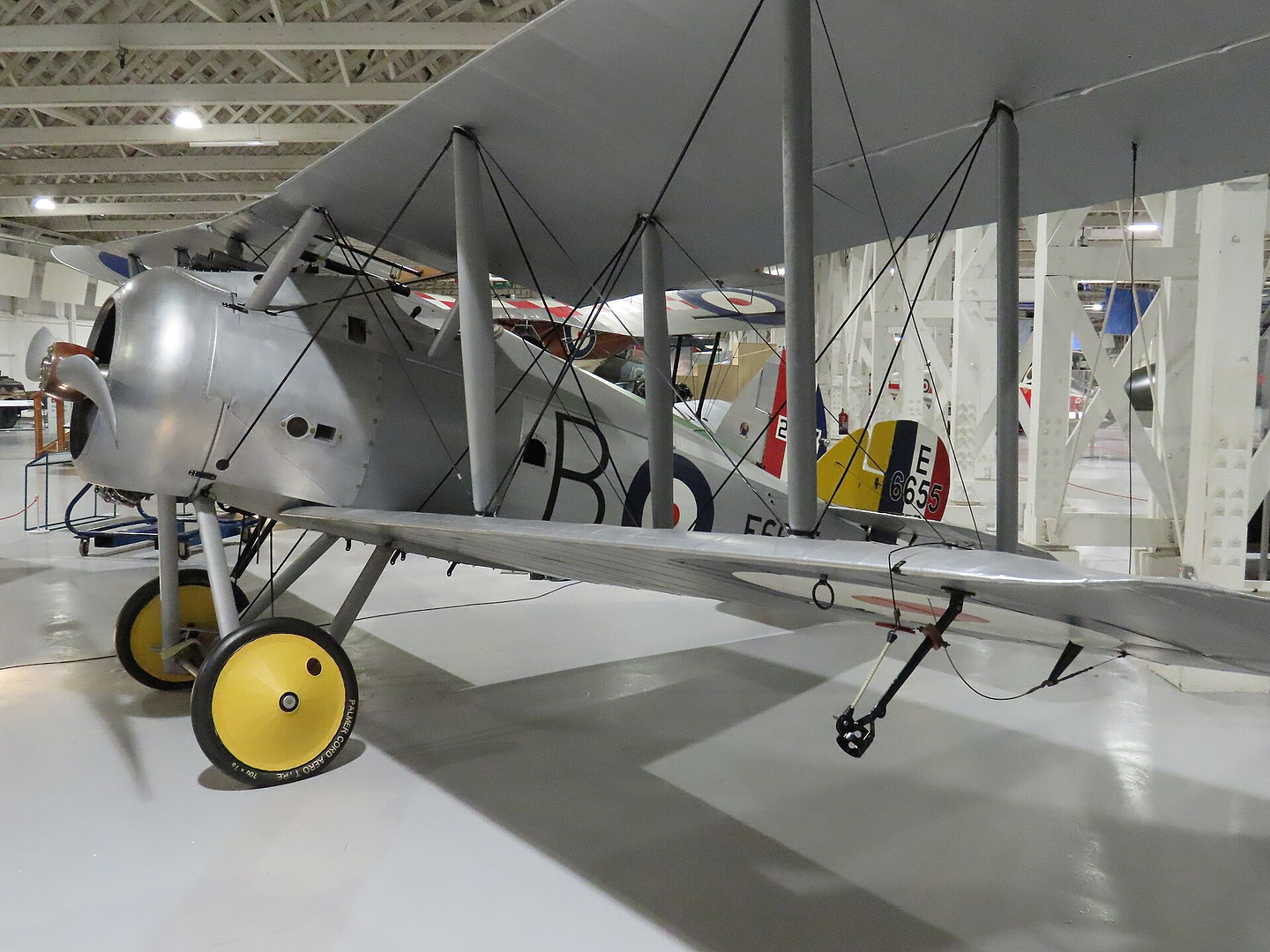
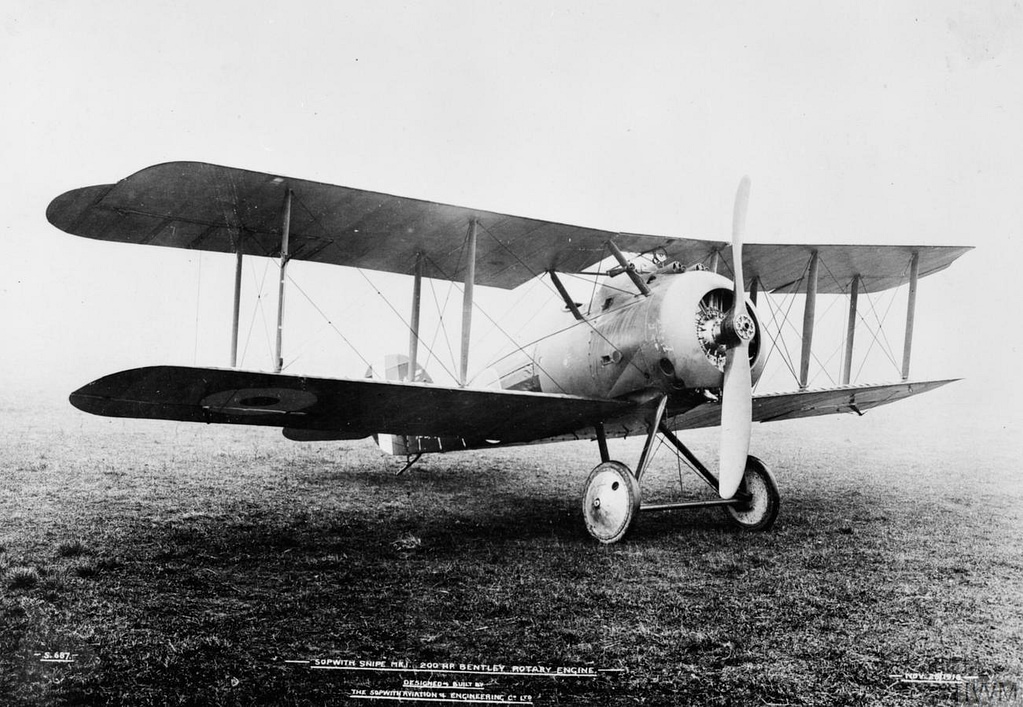
Structurally the Snipe was a conventional aircraft of its generation, built around a wire-braced wooden fuselage with a fabric covering over most of the airframe and metal panels around the engine. What distinguished it from the Camel was a matter of degree in every dimension: a little larger, a little stronger, a little more stable, with a wing arrangement and cockpit that gave the pilot room and a view. The prototypes went through single-bay and two-bay wing arrangements before the two-bay wing was settled on for production, and the definitive Snipe emerged as a balanced, practical fighter rather than a specialist’s tool.
06
The Sopwith Snipe’s Bentley BR2 engine: the rotary’s last and most powerful word
+
The heart of the Snipe was the Bentley BR2, a 9-cylinder rotary engine designed by W. O. Bentley — the same engineer who would later become famous for his luxury and racing cars. In a rotary engine the crankshaft is fixed to the airframe and the entire mass of cylinders spins with the propeller; the layout is smooth and self-cooling, which is why it powered so many agile First World War scouts.
The BR2 was the largest and most powerful British rotary of the war, commonly rated at around 230 horsepower, though some sources quote figures closer to 200 — period engine ratings varied with the standard used and the individual engine, and the honest answer is that the exact figure is best given as “about 230 hp”. Whatever the precise number, it was a decisive increase over the roughly 130 hp rotaries of the Pup and Triplane and the 130–150 hp class of many Camels.
That extra power did two things. It gave the Snipe a useful margin of performance at the higher altitudes where combat was increasingly taking place, and it let the aircraft carry a heavier, stronger airframe and full twin-gun armament without becoming sluggish. The BR2 was, in effect, what made the Snipe’s whole design possible.
It was also the end of the road. The rotary had been pushed about as far as it could go, and the BR2 was its finest expression. After the Snipe, the RAF’s fighters would move to stationary radial and in-line engines, and the great spinning rotaries of the First World War passed into history. The Snipe carried the rotary out on a high note.
07
Flying the Sopwith Snipe: the handling that made it a better service fighter than the Camel
+
Pilots’ verdicts on the Snipe are consistent and telling: it was a genuinely pleasant, effective fighter that did most things well and punished mistakes far less severely than the Camel. Where the Camel demanded constant respect — its swing on take-off and its readiness to flick into a spin caught out the unwary — the Snipe was stable, predictable and forgiving.
That did not mean it was dull. The Snipe kept a lively rotary-powered agility and could hold its own in a turning fight, and its better performance at altitude actually expanded the kinds of combat it could take on compared with the low-and-medium-level Camel. But it flew like an aircraft that wanted its pilot to succeed, which is exactly what a hard-pressed wartime training system and a peacetime air force full of ordinary squadron pilots needed.
Visibility was a particular strength. The cockpit and wing arrangement gave the pilot a much clearer view of the sky than the Camel allowed, and in air fighting the ability to see and be aware was worth as much as raw performance. Combine good visibility, honest handling, real firepower and useful altitude performance, and you have the recipe for a sound all-round fighter rather than a brilliant but dangerous specialist.
Modern display pilots who fly the airworthy Snipe reproduction built by The Vintage Aviator describe much the same character — a strong, honest, capable machine, and a notably nicer aeroplane to handle than a Camel. Nearly a century of hindsight has only confirmed the contemporary judgement: as a fighter to equip and fight a whole service with, the Snipe was the better choice.
08
Guns, bombs and the two-bay wing: the Sopwith Snipe’s armament and structure
+
The Snipe carried the standard heavy armament of a 1918 single-seat fighter: two belt-fed .303 in Vickers machine guns mounted on top of the fuselage ahead of the pilot, firing forward through the propeller arc by means of synchronising gear that timed the bursts to miss the blades. Two guns had become the norm by the last year of the war, and the Snipe’s ability to carry them without sacrificing performance was one of the advantages its more powerful engine bought.
Some Snipes were also fitted to carry four 25 lb bombs on underwing racks for ground-attack work, a reflection of how much low-level strafing and bombing fighters were being asked to do by 1918. The type was conceived first and foremost as an air-fighting scout, but like most fighters of its day it could be pressed into the ground-attack role when needed.
The airframe that carried all this was a two-bay biplane — that is, with two sets of interplane struts on each side rather than the single bay of the smaller Sopwiths — giving a strong, well-braced wing cell able to take the loads of hard manoeuvring and the weight of guns, ammunition and a heavier engine. Construction was the usual wood, wire and fabric of the period: a wooden box-girder fuselage, fabric covering, and metal panels around the engine bay.
A long-range development, the Sopwith Snipe (Long Range) or “Dragon”, replaced the rotary with a stationary ABC Dragonfly radial in an attempt to extend the type’s reach, but the troubled Dragonfly engine doomed that variant. The mainstream Snipe remained a rotary-engined two-gun fighter, and that is the aircraft that made the type’s name.
09
Wood, wire and fabric: how a 1918 fighter like the Sopwith Snipe was actually put together
+
Like every fighter of its generation, the Snipe was built from materials that would seem astonishingly simple today: spruce and plywood, piano wire and doped linen, with steel fittings and aluminium panels only where they were strictly needed. The fuselage was a wire-braced wooden box girder, faired to a rounded shape and covered mostly in fabric; the wings were wooden spars and ribs, again fabric-covered, braced into a rigid cell by struts and flying wires.
This kind of construction had real virtues. It was light, it could be repaired in the field with basic tools and skills, and it used materials and labour that were widely available. A squadron could patch battle damage, replace a wing panel, or rig a wing back to true without an industrial workshop. For a mass-produced wartime fighter that had to be built in thousands and maintained in the mud of front-line airfields, that mattered.
It also had limits. Wood and fabric age, absorb moisture and can rot or warp; a century-old original airframe is a fragile thing, which is why the surviving genuine Snipes are static museum exhibits rather than flying aircraft. The machines that fly today are faithful reproductions, built to the original drawings and methods precisely because that is what keeps their weight, strength and behaviour authentic.
Understanding the construction helps explain both the Snipe’s strengths and its preservation story. It was a practical, repairable, mass-producible fighter in its day; and it is a delicate historical artefact now, kept alive by museums that conserve the originals and by workshops that rebuild the type from scratch.
Sopwith Snipe specifications: dimensions, performance and cost
| צוות | 1 (single seat) |
|---|---|
| מֶשֶׁך | ~5.87 m (19 ft 3 in) |
| Wingspan (upper) | ~9.14–9.47 m (30–31 ft) |
| גוֹבַה | ~2.90 m (9 ft 6 in) |
| Wing configuration | Two-bay biplane |
| משקל ריק | ~595 kg (~1,310 lb) |
| Loaded weight | ~916 kg (~2,020 lb) |
| Number built | ~500 by the Armistice; total figures vary (see notes) |
| מָנוֹעַ | Bentley BR2 9-cyl rotary, ~230 hp (some sources ~200 hp) |
|---|---|
| מהירות מקסימלית | ~195 km/h (~121 mph) at 3,000 m (10,000 ft) |
| תקרת השירות | ~5,900 m (~19,500 ft) |
| Endurance | ~3 hours |
| הְתחַמְשׁוּת | 2 × synchronised .303 in Vickers (provision for 4 × 25 lb bombs) |
| First flight | 1917 (prototype); front-line service autumn 1918 |
| Unit cost (1918) | Not reliably recorded (WWI) |
| Cost per flight hour | Not applicable / not recorded (period aircraft) |
Figures for First World War aircraft vary between sources and between individual airframes and engine fits; the values above are representative and rounded, and contested figures are flagged. The Bentley BR2 is most often quoted at about 230 hp but sometimes at around 200 hp. Production totals are especially uncertain: roughly 500 Snipes had been delivered by the Armistice, and while thousands more were on order (contracts and plans have been cited from around 1,700 up to some 4,500 aircraft), the great bulk of those orders were cancelled after the war. Totals for aircraft actually completed are quoted anywhere from about 500 to well over 1,500 depending on how post-war production is counted, so any single “number built” should be treated as an estimate.
10
Sopwith Snipe variants: the two-gun fighter, the long-range Dragon and the trainer
+
The mainstream Snipe was the single-seat 7F.1 fighter powered by the Bentley BR2 rotary and armed with two Vickers guns — the aircraft that equipped the front-line squadrons of 1918 and the post-war RAF. Within that basic type there was the usual minor variation between production batches and sub-contractors, but the fighter was essentially one aircraft.
The most significant variant was the Sopwith Dragon, sometimes called the Snipe (Long Range). This replaced the reliable rotary with a stationary ABC Dragonfly radial engine in the hope of greater power and range. On paper the Dragonfly promised a great deal; in practice it was one of the most notorious engine failures of the era, plagued by overheating and vibration, and the Dragon never became a useful service aircraft as a result. It is a reminder that the Snipe’s success rested squarely on the sound, if old-fashioned, BR2 rotary.
There were also two-seat trainer conversions of the Snipe, used to help pilots transition onto the type, and various experimental and development airframes fitted with different engines and equipment. Production was spread across Sopwith and a number of sub-contractors, which introduced small differences in detail between batches.
None of these variants changes the basic picture. The Snipe that matters historically is the standard BR2-powered, two-gun single-seat fighter — the wartime scout that became the peacetime RAF’s standard, with the ill-starred Dragon standing as an instructive footnote about the limits of the engines available in 1918.
11
The Sopwith Snipe’s cost: why a 1918 price is not recorded — and what a replica costs today
+
The honest answer to “what did a Sopwith Snipe cost?” is that no reliable unit price survives in a form worth quoting. Wartime aircraft procurement mixed government-furnished engines, guns and instruments with airframe contracts spread across several manufacturers, and cancelled orders and inflation make the surviving figures inconsistent and hard to translate into modern money. Anyone quoting a precise 1918 price for a Snipe is guessing, and we would rather flag the gap than invent a number.
For context, a single-seat fighter of this class was a serious but not extravagant investment by the standards of 1918, and the engine was often the single most valuable component — which is one reason engines were carefully salvaged and reused. But turning that into a defensible unit price, let alone a modern-style “cost per flight hour” for a rotary fighter that burned castor oil at a prodigious rate, is simply not something the surviving records support.
What can be said, and clearly flagged as a modern estimate rather than a historical figure, is that building a faithful airworthy Sopwith Snipe reproduction today is an expensive undertaking. A hand-built wooden airframe, a rebuilt or reproduction rotary engine, and the skilled labour of a specialist workshop run comfortably into the high hundreds of thousands of pounds, and a museum-quality machine with an original-pattern engine can approach seven figures.
So the meaningful “cost” of a Snipe in the twenty-first century is the cost of recreating one, not any 1918 invoice. That figure — large, and driven above all by the engine and the hand craftsmanship — is the honest answer to what it takes to put a Snipe in the air today.
12
Sopwith Snipe versus the Fokker D.VII: how the RAF’s new fighter measured up in 1918
+
The benchmark for any Allied fighter in the second half of 1918 was the German Fokker D.VII, widely regarded as the finest German fighter of the war and singled out by name in the Armistice terms for surrender. Any honest assessment of the Snipe has to measure it against that yardstick rather than against the fighters of a year or two earlier.
On straight-line speed the two were broadly comparable, and neither the Snipe nor the D.VII was dramatically faster than the best of its contemporaries. The D.VII’s great virtues were its stable gun platform, its excellent handling at altitude and its famous ability to “hang on its propeller” and fight at low speed. The Snipe answered with its own strong altitude performance from the powerful BR2, lively rotary agility, good visibility and forgiving handling.
The fairest verdict is that the Snipe was a genuinely competitive front-line fighter that could meet the D.VII on reasonable terms — not a war-winning leap ahead, but a sound, modern, well-armed aircraft that gave RAF pilots a fighting chance against Germany’s best. Given how little time it had in action, it never got the chance to prove the point across a full campaign.
What tips the balance in the Snipe’s favour historically is not a single combat quality but the whole package plus longevity. It was easy and safe enough to train a whole air force on, tough, well-armed and comfortable at height — qualities that made it not just a match for the D.VII in 1918 but the aircraft the RAF was content to keep as its standard fighter for years afterwards.
The Sopwith Snipe’s timeline: from Kingston prototype to post-war standard
1917
Herbert Smith’s Sopwith 7F.1 Snipe prototypes take shape at Kingston upon Thames as a successor to the Camel, going through single- and two-bay wing arrangements and, decisively, adopting the powerful Bentley BR2 rotary.
Early 1918
The Snipe is evaluated in France and selected for large-scale production. Big contracts are placed in the spring, with plans for thousands of aircraft in anticipation of the fighting continuing into 1919.
Autumn 1918
The first squadrons re-equip with Snipes. Nos. 43 and 208 Squadrons RAF and No. 4 Squadron of the Australian Flying Corps take the type into action over the Western Front in the war’s final weeks.
27 October 1918
Major William Barker, flying Snipe E8102, fights a large formation of German aircraft single-handed, is gravely wounded, and is awarded the Victoria Cross — the most famous combat in the type’s history.
11 November 1918
The Armistice ends the fighting. Roughly 500 Snipes have been delivered; the vast wartime orders for thousands more are cut back sharply in the months that follow.
Early 1920s
The Snipe becomes the standard single-seat fighter of the peacetime RAF, equipping squadrons at home and across the empire — in Iraq, India and the Middle East as well as in Britain.
1924–1926
The Gloster Grebe and Armstrong Whitworth Siskin, with modern radial engines, begin to replace the Snipe in front-line RAF fighter squadrons.
c. 1927
The last Snipes are retired from RAF training units, ending the front-line career of the last rotary-engined fighter in British service.
Today
Genuine originals are preserved — notably E6938 at the Canada Aviation and Space Museum and examples at the RAF Museum and the Smithsonian — while airworthy reproductions, including one with an original BR2 rotary, keep the type flying.
The Sopwith Snipe in service: aces, engines and the fight for 1918
Barker’s Victoria Cross
Major William Barker took Snipe E8102 into a lone battle against a large German formation, was wounded in both legs and his left arm, fainted and fought on, and shot down several enemy machines before crash-landing alive. It became one of the most celebrated air combats of the war.
A better Camel
The Snipe was designed to replace the deadly but dangerous Camel. It kept the twin guns and rotary agility but was more docile, sturdier, higher-flying and gave a far clearer view — a better all-round fighter, if a less famous one.
Bentley’s rotary
Its Bentley BR2, of around 230 hp, was the most powerful British rotary of the war and the last to power a front-line RAF fighter. W. O. Bentley, its designer, would later give his name to the famous cars.
First into action
No. 43 Squadron RAF was among the first to re-equip with Snipes, taking the type into combat over the Western Front in the closing weeks of the war before the Armistice cut short its wartime career.
The Australian Snipes
No. 4 Squadron of the Australian Flying Corps re-equipped with Snipes in the war’s final weeks and flew them on the Western Front, one of the very few units to take the new fighter into action in 1918.
A career interrupted
Only about 500 Snipes had been delivered by the Armistice, and just a handful of squadrons flew them in anger. Had the war run into 1919, the Snipe would have been the RAF’s principal fighter for the great offensives planned that year.
Made the standard
After the war the Snipe became the standard single-seat fighter of the shrunken peacetime RAF — a mark of how sound the design was — serving at home and across the empire into the mid-1920s.
Empire policing
RAF Snipes served far from home in the early 1920s, equipping squadrons in Iraq, India and the Middle East as the aircraft that carried Britain’s air power across a vast post-war empire.
End of an era
The Snipe was the last rotary-engined fighter in front-line RAF service. Its successors, the Grebe and Siskin, used modern radial engines, and the whirling rotary scout passed into history with it.
A dead end
A long-range version, the Sopwith Dragon, swapped the reliable rotary for the ABC Dragonfly radial. The Dragonfly proved a notorious failure, and the Dragon never entered useful service — a reminder of how much the Snipe owed to its sound BR2.
A seed of the future
Sopwith did not survive the post-war slump, but its people reformed as Hawker — the company that would build the Fury, the Hurricane and the Harrier. The Snipe was the last Sopwith fighter and, in a sense, the first Hawker.
Kept alive
The genuine original E6938 is preserved in Canada, Barker’s E8102 fuselage in the Canadian War Museum, and airworthy reproductions — one with an original BR2 rotary — keep the sight and sound of a flying Snipe alive today.
Why “Snipe”?
Sopwith fighters carried bird and animal names — Pup, Camel, Dolphin, Snipe. The snipe is a small, fast, erratically flying game bird, an apt namesake for a compact and agile scout. The factory designation 7F.1 marked it as a single-seat fighter design.
The designer’s last Sopwith
Herbert Smith drew nearly all the great Sopwith scouts, and the Snipe was his final one for the firm. Soon after, he left to design fighters in Japan, carrying the Sopwith philosophy of the light, honest fighter across the world.
Sopwith Snipe photographs: period images and preserved aircraft
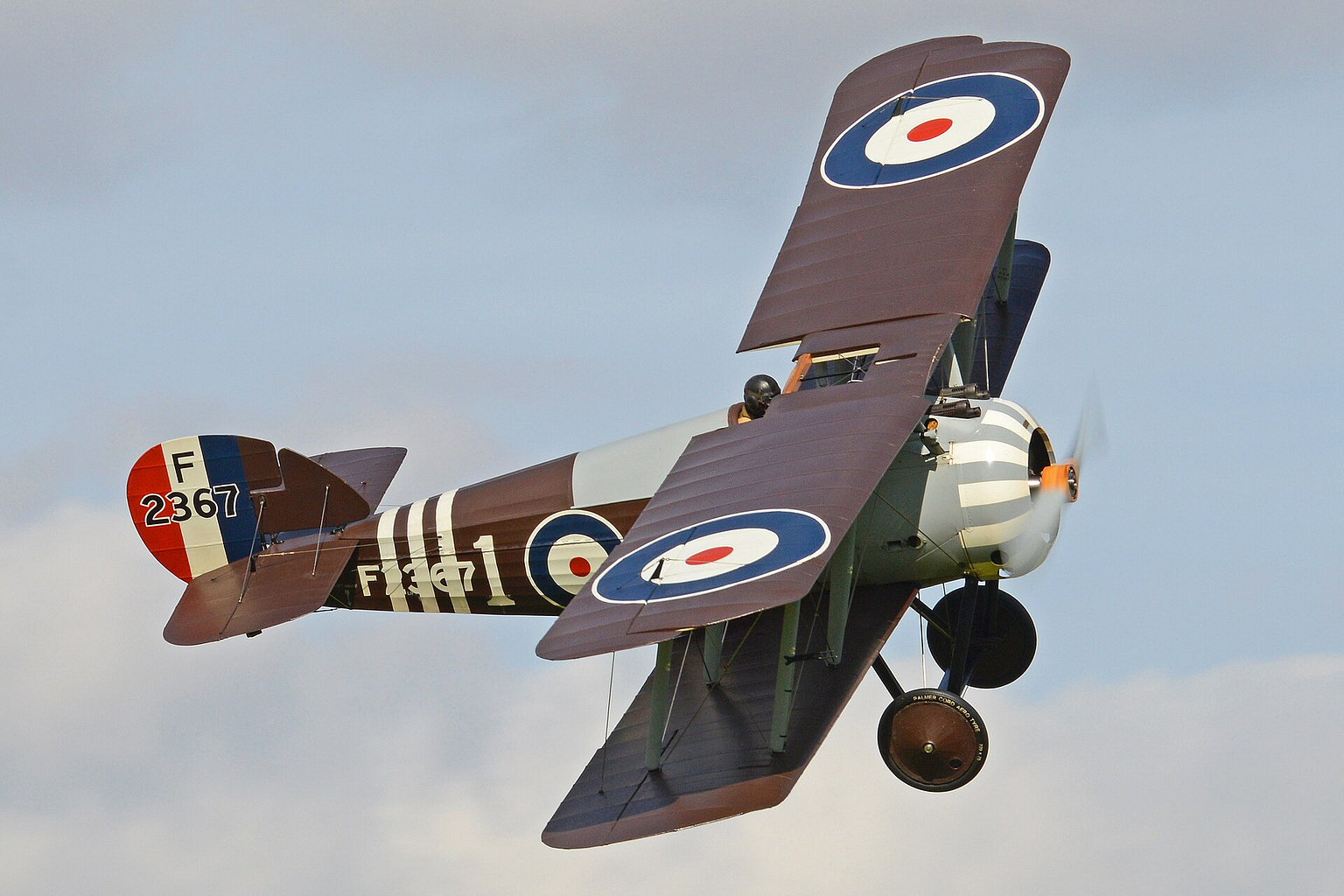
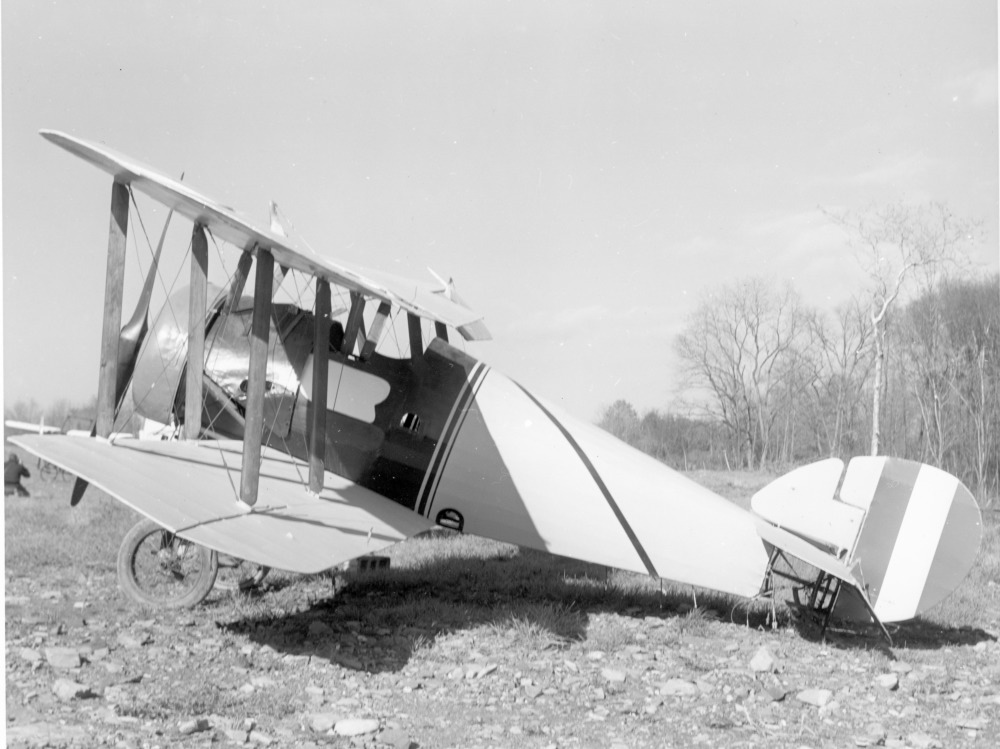
The Sopwith Snipe in the air: the only one flying with an original rotary
The best way to understand the Snipe is to watch one fly. The footage below shows the airworthy Sopwith 7F.1 Snipe reproduction built by The Vintage Aviator in New Zealand — the only Snipe flying anywhere in the world with an original 230 hp Bentley BR2 rotary engine. The stutter of the blipped rotary, the easy climb and the clean lines of the last great rotary fighter are all on show.
“Sopwith Snipe 1918 British fighter” — The Vintage Aviator’s airworthy Snipe with an original Bentley BR2 rotary. Video by the Historical Aviation Film Unit on YouTube (approx. 30,000 views at time of writing). Shown here for reference; all rights remain with the creator.
Sopwith Snipe operations map: origin, wartime and post-war service, and survivors
The Sopwith Snipe was a thoroughly British fighter with a story that spread outward from Kingston upon Thames: designed and built in England, flown briefly over the Western Front in 1918, kept on as the standard fighter of the peacetime RAF across a global empire, exported and operated by a few other nations, and preserved today in a handful of countries. The map colours Britain as origin and manufacturer, marks the wartime and post-war RAF service theatres, shows the export and other operators, and highlights where original and reproduction airframes survive. Toggle the categories and hover a country for detail.
The Sopwith Snipe by the numbers: service, standing and survival
The numbers capture the Snipe’s peculiar shape of a career. Only a few hundred reached the front before the war ended, and its wartime fame rests largely on a single extraordinary combat. Yet the same aircraft went on to be the standard fighter of the peacetime RAF for years — the real proof of a sound design. Few fighters have done so little in wartime and so much afterwards.
The Sopwith Snipe today: the originals that survive and the reproductions that fly
The Sopwith Snipe is a genuinely rare aircraft. Of the several hundred built, only a small number of originals survive, and none of them flies — the airworthy Snipes seen at airshows today are faithful reproductions. But between the museum originals and the modern reproductions, the last great rotary fighter can still be seen both on the ground and in the air.
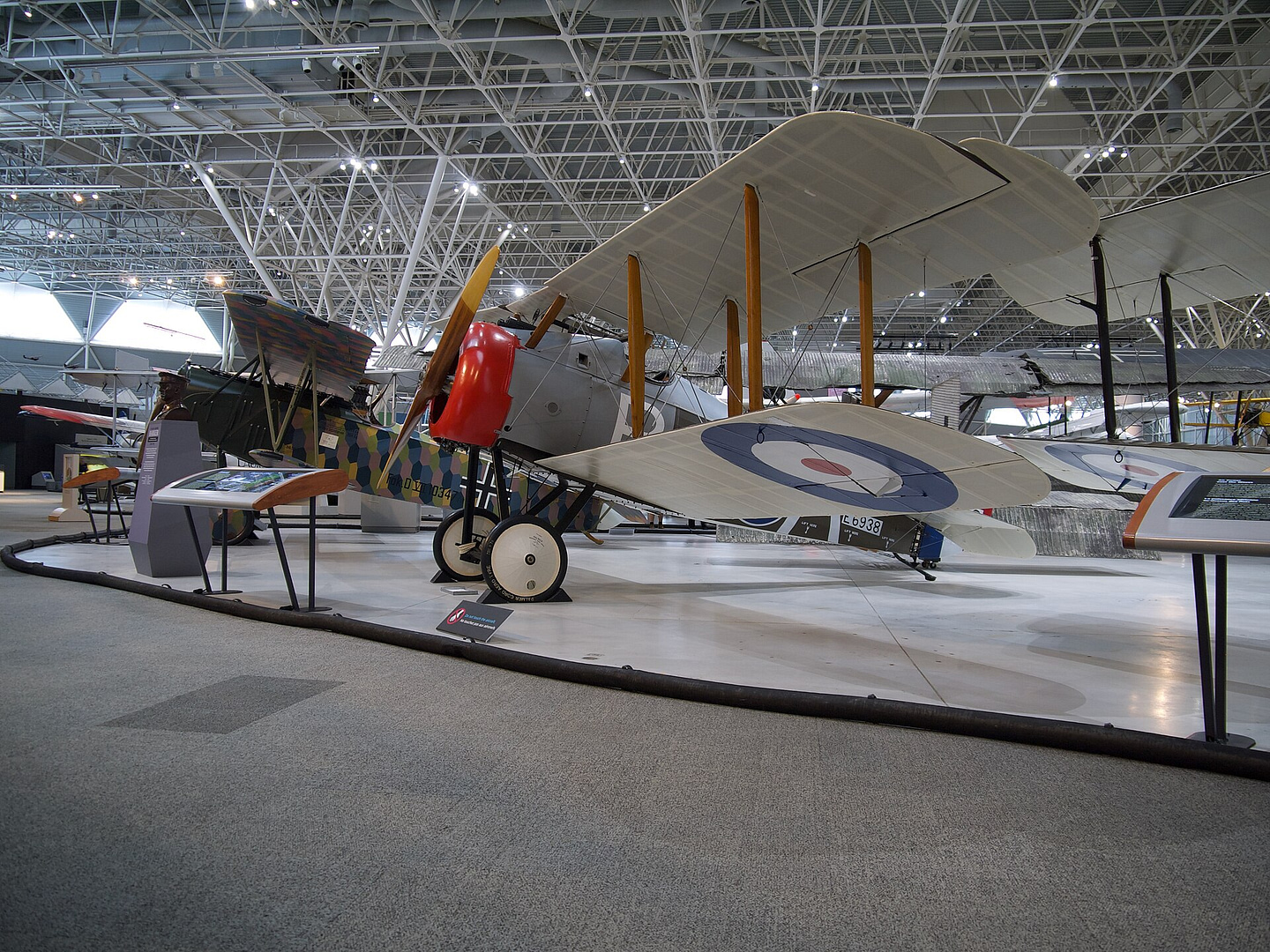
The most complete genuine original is E6938, preserved at the Canada Aviation and Space Museum in Ottawa — an actual 1918 airframe rather than a later reconstruction, and the reference point against which the type is understood. The Royal Air Force Museum in London holds a Snipe, and the Smithsonian National Air and Space Museum in Washington has one as well, so originals of the type can be seen on both sides of the Atlantic.
There is also a uniquely poignant survivor: the fuselage of E8102, the very Snipe in which Major William Barker won his Victoria Cross on 27 October 1918, is preserved by the Canadian War Museum. Few aircraft relics are so directly tied to a single famous action, and it is a fitting thing that Barker’s aircraft, like the man, came home to Canada.
Beyond the originals, the Snipe lives on through reproduction. The best known flying example was built by The Vintage Aviator in New Zealand and is notable for flying with an original 230 hp Bentley BR2 rotary engine — the only Snipe in the world doing so — while other airworthy and static reproductions have been built in Britain and the United States. These are not toys: recreating a Snipe means building a wood-and-fabric airframe to original drawings and sourcing or manufacturing a suitable rotary, a serious feat of craftsmanship.
13
The genuine Sopwith Snipes: E6938 in Canada, and the originals at Hendon and the Smithsonian
+
The survival of any genuine Sopwith Snipe is a small miracle. The type was built in the last months of the war and the years just after, and like almost all wooden fighters of its generation the great majority were scrapped once they left service. That so few originals remain makes each one historically precious.
The flagship survivor is E6938 at the Canada Aviation and Space Museum in Ottawa, generally regarded as the most complete genuine Snipe in existence. It is a real 1918-pattern airframe, conserved as a museum exhibit, and it is the aircraft historians and reproduction-builders turn to when they need to check a detail against the real thing.
The Royal Air Force Museum in London and the Smithsonian National Air and Space Museum in Washington also hold Snipes, so the type is represented in the national collections of Britain and the United States as well as Canada. Between them these museums ensure that anyone who wants to stand beneath a real Snipe and read its design at a glance can do so.
Standing in front of one, the Snipe’s character is plain: a compact but sturdy two-bay biplane, twin guns ahead of a roomy cockpit, and the broad cowling of the big Bentley rotary. It is visibly a more grown-up, more practical machine than the little Camel — exactly as its designers intended.
14
Building a flying Sopwith Snipe today: an original rotary and a lot of craftsmanship
+
Because no original Snipe is airworthy, every flying Snipe is a reproduction — and building one is a formidable undertaking. The airframe must be recreated in wood, wire and fabric to original drawings, because that is what keeps the weight, strength and handling authentic. Getting the two-bay wing cell rigged true is as skilled a job now as it was in 1918.
The engine is the hardest part of all. A working Bentley BR2 rotary is a rare and precious thing, and the reproduction built by The Vintage Aviator in New Zealand is celebrated precisely because it flies with an original 230 hp BR2 — the only Snipe in the world to do so. Other builders have had to rely on overhauled period engines or reproduction rotaries, each of which demands its own specialist knowledge to run and maintain.
A running rotary is a discipline in itself: the total-loss oil system, the blip-switch handling in place of a throttle, and the gyroscopic effects on take-off and landing are all part of the deal, and display pilots train specifically to manage them. Flying a Snipe reproduction is as close as anyone will ever get to the experience of a 1918 RAF fighter pilot.
The reward is that the sight and sound of a Snipe in the air — the blipping rotary, the easy climb, the clean two-gun nose — are not lost to history. The museums conserve the originals; the workshops and display pilots keep the type flying. Between them, the last great rotary fighter remains a living aircraft.
The Sopwith Snipe in context: the end of one era and the start of another
The Sopwith Snipe sits at a genuine turning point. It was the last of the great Sopwith fighters and the last rotary-engined fighter in RAF service, the culmination of a line that ran from the Pup through the Triplane and Camel — and, through the company that succeeded Sopwith, a direct ancestor of the Hurricane and everything that followed.
Look backward from the Snipe and you see the whole Sopwith story. The Pup established the philosophy of the small, honest, beautifully balanced scout. The Triplane pushed climb and agility to an extreme with three narrow wings. The Camel concentrated mass and firepower into the war’s deadliest and most demanding dogfighter. The Snipe gathered up the lessons of all of them: keep the agility and the guns, but add strength, altitude performance, a clear view and, above all, handling an ordinary pilot could master.
Look forward and you see the future arriving. The Snipe was the last rotary fighter the RAF flew; its successors used modern radial engines, and the aircraft that replaced it in the mid-1920s pointed the way to the monoplane fighters of the 1930s. And the company that built it, reconstituted as Hawker, would go on to create the Fury, the Hurricane and the Harrier. The Snipe is the hinge between the Sopwith era and the Hawker era.
There is a neat honesty to its place in history. The Snipe was not the most famous fighter of the war — it arrived too late for that, and the Camel will always overshadow it in popular memory. But it was, in most respects, the better aeroplane, and the peacetime RAF’s decision to make it the standard says more about its real quality than any wartime legend could. It is the fighter that outlived the war it was built for, and did so on merit.
15
Pup, Triplane, Camel, Snipe: where the Sopwith Snipe sits in the Sopwith fighter line
+
The Sopwith Aviation Company produced a run of fighters in the First World War that few manufacturers have ever matched. The Pup came first — light, docile and much loved — and set the template of the small, agile Sopwith scout. The Triplane followed, trading two wings for three in pursuit of climb and visibility and briefly outperforming everything around it.
The Camel came next and became the most famous of all: two guns and a concentrated mass of engine, guns, pilot and fuel that made it viciously manoeuvrable and lethally effective, at the cost of handling that killed many of its own pilots. The Dolphin, with its unusual back-staggered wings and a stationary engine, explored a different path. And the Snipe closed the line.
In that company the Snipe is the mature synthesis — the aircraft that took everything the earlier Sopwiths had taught and produced a rounded, practical, forgiving fighter fit to equip a whole air force. It is less extreme than the Triplane, less famous than the Camel, and better, all round, than either as a service fighter.
Understanding the Snipe means seeing it as the last and most complete step in a designer’s long argument, not as an isolated late-war type. It is the point at which the Sopwith philosophy of the honest, pilot-friendly scout reached its full expression — just as the rotary engine that had powered the whole line reached the end of its road.
16
From Sopwith to Hawker: how the Snipe’s maker became a giant of British aviation
+
The Sopwith Aviation Company did not survive the peace it had helped to win. With military orders collapsing and a heavy post-war tax bill for wartime profits, the firm went into voluntary liquidation in 1920. It would have been easy for the Sopwith story to end there, as one more casualty of the brutal contraction of the aircraft industry after 1918.
Instead, Thomas Sopwith, Harry Hawker and their key colleagues promptly reconstituted the business as the H. G. Hawker Engineering Company, named after the famous test pilot. The new firm inherited Sopwith’s people, its expertise and its Kingston base, and carried the same design philosophy forward under a new name.
What followed is one of the great runs in aviation history. Hawker built the Fury biplane fighter, then the Hurricane that bore the brunt of the Battle of Britain, and eventually, as Hawker Siddeley, the Harrier jump-jet. The thread of pilot-friendly, well-engineered fighters runs unbroken from the Sopwith scouts through to some of the most important aircraft Britain ever built.
This is why the Snipe deserves to be seen as more than a footnote. It was the last fighter to bear the Sopwith name, and it stands at the head of the Hawker line that followed. The company that built the Snipe became one of the pillars of British aviation, and the Snipe is the aircraft that carried its philosophy across the divide from war to peace. That the same design office should draw both the rotary-engined Snipe of 1918 and, within twenty years, the eight-gun Hurricane monoplane, is one of the more striking continuities in the whole story of the fighter.
Sopwith Snipe: frequently asked questions
Can I fly in a Sopwith Snipe?
Not as a passenger — and not with MiGFlug. The Sopwith Snipe was a single-seat fighter, so there is no second seat to carry you, and the genuine originals (such as E6938 at the Canada Aviation and Space Museum) are static museum exhibits. Airworthy Snipe reproductions do fly at airshows — most famously the one built by The Vintage Aviator with an original Bentley BR2 rotary — but they are single-seaters flown by specialist display pilots and are not available as rides. MiGFlug does not offer Sopwith Snipe flights.
What you can do is fly in a real, genuine fighter today. MiGFlug arranges flights in aircraft such as the MiG-29 to the edge of space and the L-39 Albatros jet in Europe and the USA. See migflug.com/flights-prices for the current line-up.
Was the Sopwith Snipe better than the Sopwith Camel?
In most respects, yes — as an all-round combat aircraft. The Snipe was designed specifically to replace the Camel and to keep its strengths while curing its worst faults. It was more docile and forgiving to fly, sturdier, had better performance at altitude thanks to its powerful Bentley BR2 rotary, and gave the pilot a much clearer view. It was not dramatically faster, and the Camel’s knife-edge agility in a low-level dogfight was hard to match, but the Snipe was the better and safer service fighter, which is exactly why it was chosen to succeed the Camel and why the RAF kept it for years after the war.
What happened in Major Barker’s Victoria Cross combat?
On 27 October 1918 Major William George Barker, flying Snipe E8102, fought a large formation of German aircraft alone over the Western Front. He was wounded in both thighs and had his left elbow shattered, fainting from his wounds and recovering to fight on, and shot down several enemy machines before crash-landing inside Allied lines, gravely wounded but alive. For this action he was awarded the Victoria Cross, and it became one of the most celebrated single combats of the entire air war.
What engine and guns did the Sopwith Snipe use?
The Snipe was powered by a Bentley BR2 9-cylinder rotary engine of around 230 horsepower (some sources quote closer to 200 hp) — the most powerful British rotary of the war and the last to power a front-line RAF fighter. Its standard armament was two synchronised .303 in Vickers machine guns firing through the propeller, with provision on some aircraft to carry four 25 lb bombs for ground attack.
How fast was the Sopwith Snipe?
Roughly 195 km/h (about 121 mph) at 3,000 m (10,000 ft), with a service ceiling around 5,900 m (19,500 ft). Raw speed was never the Snipe’s headline, though — it was not dramatically faster than the best late-war fighters. Its advantages lay in its altitude performance, its handling and its all-round soundness.
How many Sopwith Snipes were built?
Roughly 500 had been delivered by the Armistice in November 1918, out of thousands ordered in anticipation of the war continuing into 1919. Most of those orders were cancelled after the war. Totals for the number actually completed vary widely between sources — from around 500 up to well over 1,500 depending on how post-war production is counted — so any single figure should be treated as an estimate.
Did the Sopwith Snipe serve after the First World War?
Yes — this is the heart of its story. After the war the Snipe became the standard single-seat fighter of the peacetime Royal Air Force, equipping squadrons in Britain and across the empire, including in Iraq, India and the Middle East. It served through the early 1920s and was not fully replaced by the Gloster Grebe and Armstrong Whitworth Siskin until the middle of the decade, with some aircraft lingering in training units until about 1927. That long post-war career is the clearest proof of how sound the design was.
Why is the Sopwith Snipe less famous than the Camel?
Mainly because of timing. The Camel served for two years and ran up the highest aerial victory tally of any British fighter of the war, becoming a legend in the process. The Snipe reached the front only in the war’s last few weeks, so it never had the chance to build a comparable combat record, and the Armistice cut its wartime career short. Its real career was in peacetime, which is less romantic than a wartime legend — but as an aeroplane it was, in most respects, the better of the two.
Are there any original Sopwith Snipes left?
Yes, a small number. The most complete genuine original is E6938 at the Canada Aviation and Space Museum in Ottawa, and originals are also held by the Royal Air Force Museum in London and the Smithsonian National Air and Space Museum in Washington. The fuselage of E8102, the Snipe in which Barker won his Victoria Cross, is preserved by the Canadian War Museum. None of the originals is airworthy; the Snipes that fly today are faithful reproductions.
Can you see a Sopwith Snipe flying today?
Yes — but only reproductions. The best-known airworthy Snipe was built by The Vintage Aviator in New Zealand and is unique in flying with an original 230 hp Bentley BR2 rotary engine. Other airworthy and static reproductions exist in Britain and the United States. Because the genuine originals are fragile century-old museum pieces, every flying Snipe is a faithful modern reproduction rather than an original airframe.
Who designed and built the Sopwith Snipe?
The Snipe was designed by Herbert Smith, chief designer of the Sopwith Aviation Company, and built at Sopwith’s works in Kingston upon Thames along with sub-contractors. Smith designed most of the famous Sopwith fighters, and the Snipe was the mature expression of his philosophy. When Sopwith went into liquidation after the war, its people reformed as the Hawker company, which would go on to build the Fury, Hurricane and Harrier.
What was the Bentley BR2 engine?
The Bentley BR2 was a 9-cylinder rotary engine of around 230 horsepower, designed by W. O. Bentley — later famous for his cars — and the most powerful British rotary of the First World War. In a rotary the whole cylinder block spins with the propeller. The BR2 gave the Snipe its useful altitude performance and was, in effect, the rotary engine’s last and finest word before stationary radial and in-line engines took over.
Where can I see a Sopwith Snipe today?
The most complete original, E6938, is at the Canada Aviation and Space Museum in Ottawa, and Barker’s E8102 is at the Canadian War Museum nearby. The Royal Air Force Museum in London and the Smithsonian National Air and Space Museum in Washington also display Snipes. To see one fly you would look for airworthy reproductions at airshows, most notably the example built by The Vintage Aviator in New Zealand.
What does the designation “7F.1” mean?
“7F.1” was the Sopwith factory design number for the Snipe. In the company’s system the “F” indicated a single-seat fighter type, and the numbers identified the specific design; the name “Snipe” was the service name by which the RAF knew it. So “Sopwith 7F.1 Snipe” simply pairs the manufacturer’s design number with the aircraft’s name.
Did the Sopwith Snipe fight the Fokker D.VII?
Yes, in the war’s final weeks. The Fokker D.VII was the best German fighter of 1918 and the benchmark against which the Snipe has to be judged. On speed the two were broadly comparable; the D.VII excelled as a stable gun platform that fought well at altitude, while the Snipe answered with strong altitude performance, lively agility, good visibility and forgiving handling. The Snipe was a genuinely competitive front-line fighter that could meet the D.VII on reasonable terms, though it never had the time in action to prove the point across a full campaign.
What replaced the Sopwith Snipe in RAF service?
The Gloster Grebe and the Armstrong Whitworth Siskin, both fighters with modern air-cooled radial engines, began to replace the Snipe in front-line RAF squadrons from about 1924. The Snipe had been the standard single-seat fighter of the peacetime RAF through the early 1920s, and its replacement marked the end of the rotary-engined fighter in British service. Some Snipes lingered in training units until around 1927.
Fly a real fighter yourself
The Sopwith Snipe is a museum piece and a single-seater, so no one can take you up in one. But MiGFlug can put you in the cockpit of a genuine fighter today — from a Cold War jet trainer to a Mach-2 interceptor at the edge of space.
Explore more First World War fighters
Sopwith Snipe sources & further reading
- Royal Air Force MuseumCollection material and blog features on the Sopwith Snipe, the Dragon and the type’s post-war RAF service.
- Canada Aviation and Space MuseumCollection record for the surviving original Sopwith 7F.1 Snipe E6938, Ottawa.
- Canadian War MuseumRecord of the fuselage of E8102, the Snipe in which Major William Barker won the Victoria Cross.
- Smithsonian National Air and Space MuseumObject record for the museum’s Sopwith 7F.1 Snipe and background on late-war fighter development.
- Imperial War MuseumsPhotographs and records of RAF and Australian Flying Corps fighter operations, 1918.
- The Vintage Aviator (New Zealand)Project material on the airworthy Sopwith Snipe reproduction flying with an original Bentley BR2 rotary.
- The Museum of Flight, SeattleAircraft profile for its Sopwith 7F.1 Snipe reproduction and the type’s history.
- J. M. Bruce, British Aeroplanes 1914–1918The standard technical reference on Sopwith Snipe design, variants and production numbers.
- Accounts of William Barker VCBiographical references on Barker and his 27 October 1918 combat, and the RAF Museum’s “For Valour” feature.
- MiGFlug Afterburner magazineArticles on flyable warbirds and the fighters of the First World War.
- Historical Aviation Film UnitFlying footage of The Vintage Aviator’s airworthy Snipe with an original Bentley BR2 rotary.
- Fleet Air Arm Museum & RAF squadron historiesRecords of Nos. 43 and 208 Squadrons RAF and No. 4 Squadron AFC operating the Snipe in 1918.