
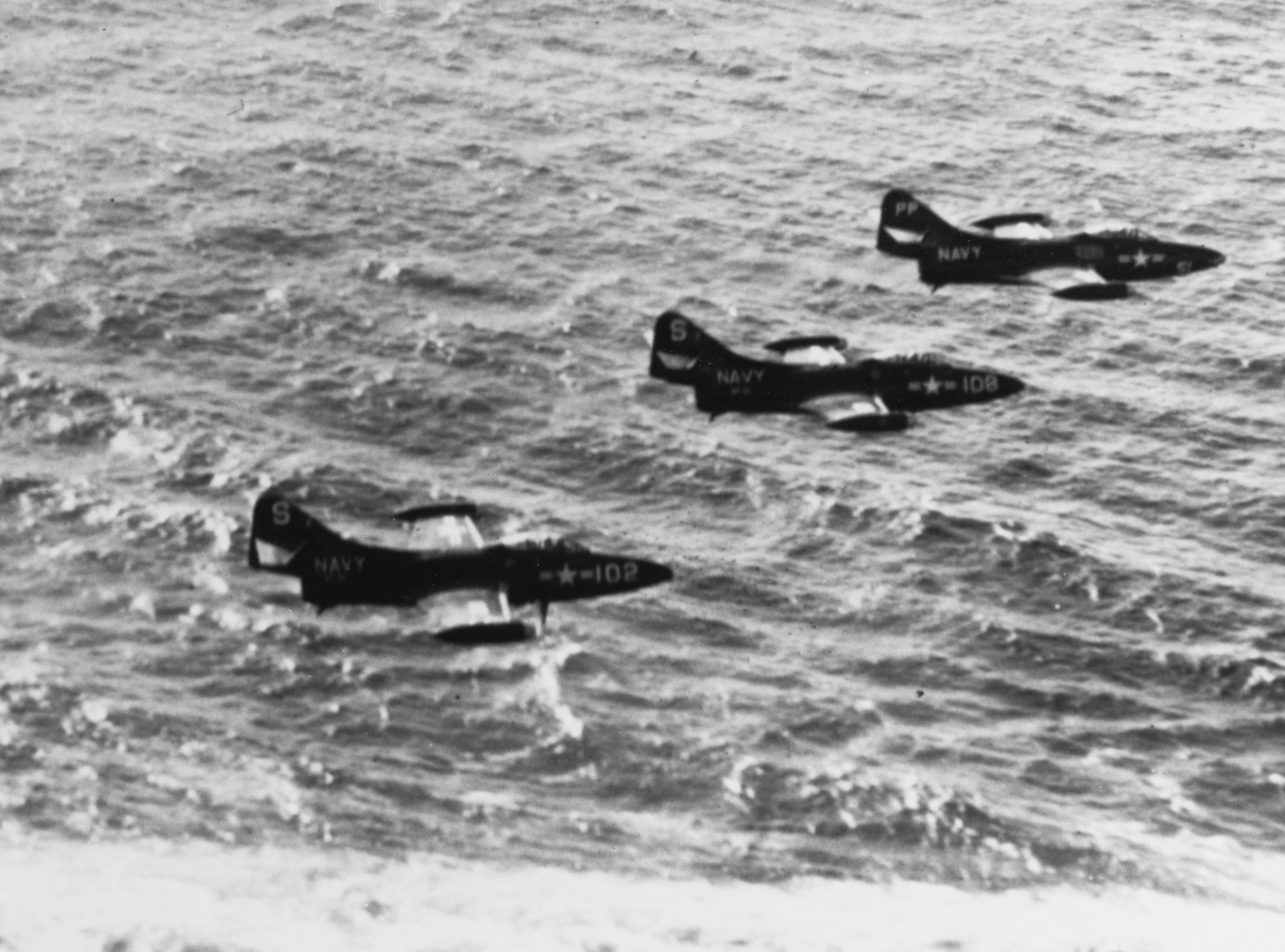
Grumman F9F Panther
The Navy’s first jet goes to war
A rugged, straight-wing carrier fighter that carried US Navy and Marine aviation through the Korean War — and scored the first jet-versus-jet kill in aviation history.
The straight-wing fighter that carried the Navy through Korea
The Grumman F9F Panther was the US Navy’s first successful carrier-based jet fighter — and one of its most important. When the programme began in 1946, Grumman first sketched an ungainly four-engine night fighter; the company wisely abandoned it for a clean, single-engine day fighter, the XF9F-2, which first flew on 21 November 1947 with test pilot Corwin “Corky” Meyer at the controls. Production Panthers reached the fleet in 1949, first equipping squadron VF-51.
The Panther was deliberately conservative: a straight wing, a conventional tail and the famously tough all-aluminium structure that earned Grumman the nickname “the Iron Works.” It was reliable, easy to fly and could soak up battle damage and still bring its pilot home. Those qualities made it the mainstay of US Navy and Marine carrier aviation over Korea, where Panthers flew the bulk of the Navy’s jet combat sorties — strafing, bombing and rocketing targets as often as they fought in the air.
On 9 November 1950, Lieutenant Commander William Amen of VF-111 out-turned and shot down a Soviet-flown MiG-15 over the Yalu River — the first confirmed jet-versus-jet victory in history, won by a straight-wing Navy fighter over a “superior” swept-wing jet. The MiG-15 was faster and climbed better, so Grumman answered with a swept-wing derivative, the F9F-6 Cougar, which flew in 1951 and reused the Panther’s fuselage and “F9F” designation. But it was the straight-wing Panther that fought Korea, that the Blue Angels first flew, and that carried future legends — astronauts Neil Armstrong そして John Glenn, and baseball’s Ted Williams — into combat.
01The Grumman F9F Panther versus the F9F Cougar: straight wing, then swept
It is easy to confuse the two aircraft, because Grumman gave them the same designation. The Panther is the straight-wing family — F9F-2, -3, -4 and -5, the jet that fought the Korean War. When the swept-wing Soviet MiG-15 appeared, Grumman grafted a 35-degree swept wing and tail onto essentially the same fuselage to create the F9F-6 Cougar (first flight 1951, in service from 1952–53). The Cougar was a genuinely different, transonic aircraft, but the Navy kept the “F9F” number to speed it through the budget process.
So when people say “the Panther,” they mean the straight-wing jet of Korea; “the Cougar” is its swept-wing successor. This page is about the Panther — though the Cougar earns a mention because the two are so closely related.
What makes the F9F Panther special
A rugged straight wing and permanent tip tanks
Built to Grumman’s famously tough carrier standards, the Panther’s most recognisable feature is the pair of permanently fixed wingtip fuel tanks. They stretched the jet’s range for long over-water missions and cleaned up the wingtip aerodynamically without the drag or handling penalties of a jettisonable store. The straight wing also gave the Panther a tighter turn radius than the swept-wing MiG-15 — its single greatest dogfighting asset.
A reliable turbojet with a Rolls-Royce lineage
The prototype flew on a British Rolls-Royce Nene; production F9F-2s used the Pratt & Whitney J42, a US licence-built Nene of about 5,000 lbf. The heavier, faster F9F-5 used the more powerful Pratt & Whitney J48, a licence-built development of the Rolls-Royce Tay rated around 6,250 lbf — roughly 7,000 lbf with water injection on later marks. Pilots prized these engines for their reliability.
Fighter and ground-attack in one airframe
Four 20 mm cannon in the nose made the Panther a hard-hitting gun platform, while underwing hardpoints carried up to about 900 kg (2,000 lb) of bombs or six 5-inch rockets. That versatility made it the Navy and Marines’ workhorse for close air support and interdiction in Korea as much as an air-superiority fighter — a genuine multi-role carrier jet before the term existed.
02The F9F Panther’s engine: how a British Rolls-Royce became an American turbojet
When Grumman needed a reliable jet engine in the late 1940s, the most promising design was British: the Rolls-Royce Nene centrifugal-flow turbojet. Pratt & Whitney acquired a licence and built it as the J42, powering the F9F-2. As the Panther grew heavier, Pratt & Whitney turned to a larger Rolls-Royce design, the Tay, and built it as the J48 for the F9F-5. Both were centrifugal-flow engines — simpler and more rugged than the axial-flow engines that would follow — and their dependability was a big part of why the Panther earned such trust in the fleet. Ironically, the same Nene design, sold to the Soviet Union, also powered the MiG-15 the Panther fought over Korea.
03The F9F Panther in a dogfight: how a straight wing beat the MiG-15
On paper the MiG-15 outclassed the Panther — it was faster, climbed harder and could fight higher. But the straight-wing Panther could out-turn the swept-wing MiG, and Navy pilots fought accordingly: in disciplined divisions, using teamwork and the tighter turn to force MiGs into their gunsights rather than trying to win a climbing or high-speed contest. It was enough to score at least nine air-to-air victories, including the first jet-versus-jet kill in history — a reminder that pilot skill and tactics can beat raw performance.
Full F9F Panther specifications
Figures are for the late-production F9F-5. Sources vary — especially on length and empty weight, which differed between the F9F-2 and the stretched F9F-5 — so contested values are hedged.
Airframe & Performance
- クルー
- 1
- 長さ
- ~11.8 m (38 ft 10 in)
- 翼幅
- 11.6 m (38 ft 0 in), tip tanks fitted
- 身長
- ~3.7 m (12 ft 3 in)
- 空虚重量
- ~4,600 kg (10,150 lb)
- Max takeoff weight
- ~8,840 kg (19,500 lb)
- Max speed
- ~932 km/h (579 mph) at sea level
- サービス天井
- ~13,600 m (44,600 ft)
- 範囲
- ~2,100 km (1,300 mi)
- 上昇率
- ~26 m/s (5,090 ft/min)
Propulsion, Armament & Cost
- エンジン
- 1 × Pratt & Whitney J48-P-6A turbojet (licence Rolls-Royce Tay)
- Thrust
- ~27 kN (6,250 lbf); ~31 kN with water injection
- Guns
- 4 × 20 mm cannon in the nose
- Ordnance
- up to ~900 kg (2,000 lb) bombs or 6 × 5-in rockets
- First flight
- XF9F-2, 21 November 1947
- Entered service
- 1949 (VF-51)
- Built
- ~1,380 straight-wing Panthers (all marks)
- Unit cost
- ~US$240,000 (early 1950s, approximate)
- Cost per flight hour
- Not reliably documented (1950s-era jet)
04The F9F Panther’s cost: what a first-generation Navy jet was worth
Firm cost figures for the Panther are hard to pin down in authoritative sources. Commonly repeated secondary figures put an early-1950s F9F at roughly US$240,000–250,000 per aircraft in the dollars of the day — a fraction of a modern fighter, but a serious sum in 1950. No dependable cost-per-flight-hour figure survives from the era, as such accounting was not kept the way it is for today’s jets. Treat any single dollar figure here as an order-of-magnitude estimate rather than an audited number; the Panther’s real value to the Navy was measured in carrier decks kept in the fight, not in a price tag.
From Grumman drawing board to Korea and beyond
Navy contract to Grumman
The US Navy orders a jet fighter from Grumman; an early four-engine night-fighter concept is dropped for the clean single-engine XF9F-2.
XF9F-2 first flight
Grumman test pilot Corky Meyer takes the prototype Panther aloft for the first time on 21 November 1947.
Enters fleet service
Production F9F-2 Panthers reach the fleet, first equipping VF-51 — the Navy’s first operational carrier jet fighter.
The Blue Angels’ first jet
The Navy flight-demonstration team debuts the F9F-2 Panther in August 1949, beginning the Panther’s Blue Angels era.
First combat — and first Navy jet kills
On 3 July 1950 VF-51 Panthers fly the first US Navy jet combat sorties over Korea and down two Yak-9 propeller fighters.
First jet-vs-jet kill in history
On 9 November 1950 Lt Cmdr William Amen (VF-111) shoots down a Soviet-flown MiG-15 — the first jet-versus-jet victory ever.
The swept-wing Cougar appears
Grumman flies the F9F-6 Cougar, a swept-wing development of the Panther built to counter the MiG-15’s speed.
Famous pilots over Korea
Neil Armstrong, John Glenn and Ted Williams all fly Panthers in Korea; Williams belly-lands his burning jet in February 1953.
Off the front line at home
The Blue Angels move to the swept-wing Cougar, and the Panther begins phasing out of front-line US service through the mid-1950s.
An Argentine afterlife
Argentina’s Naval Aviation buys ex-US Panthers, flying them land-based until their final flight on 3 March 1970.
Twelve F9F Panther stories
The first jet-vs-jet kill in history
On 9 November 1950 a straight-wing Panther downed a swept-wing MiG-15 over the Yalu.
Read the full story
Royce Williams and the secret dogfight
In 1952 one Panther pilot fought roughly seven MiG-15s alone — and it was classified for fifty years.
Read the full story
The Splendid Splinter’s burning belly-landing
Baseball legend Ted Williams rode a flaming Panther down and walked away.
Read the full story
John Glenn led Ted Williams into battle
A future astronaut flew as wingman leader for a baseball Hall of Famer.
Read the full story
Neil Armstrong’s six-foot haircut
A cable strung across a valley sheared feet off the wing of the future Moon-walker’s Panther.
Read the full story
A hole big enough to climb through
John Glenn once flew home with a hole in the tail he could put his shoulders through.
Read the full story
The Blue Angels’ first jet
The Panther launched the Navy demonstration team into the jet age.
Read the full story
Panthers on the silver screen
Hollywood made the Panther the face of Korean-War carrier aviation.
Read the full story
The signature silhouette
Permanent wingtip tanks gave the Panther its unmistakable outline.
Read the full story
Bombs, rockets and cannon
The Panther spent much of Korea working as a fighter-bomber.
Read the full story
First Navy jet victories
Before the MiG kill, Panthers scored the Navy’s first jet air-to-air wins.
Read the full story
The Panther’s Argentine second life
Retired US Panthers flew on from Argentine soil into 1970.
Read the full story
The Panther in pictures
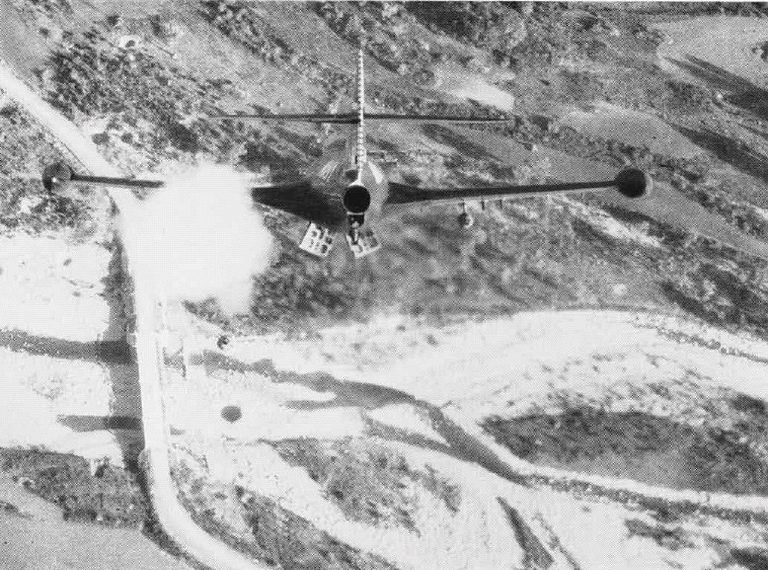
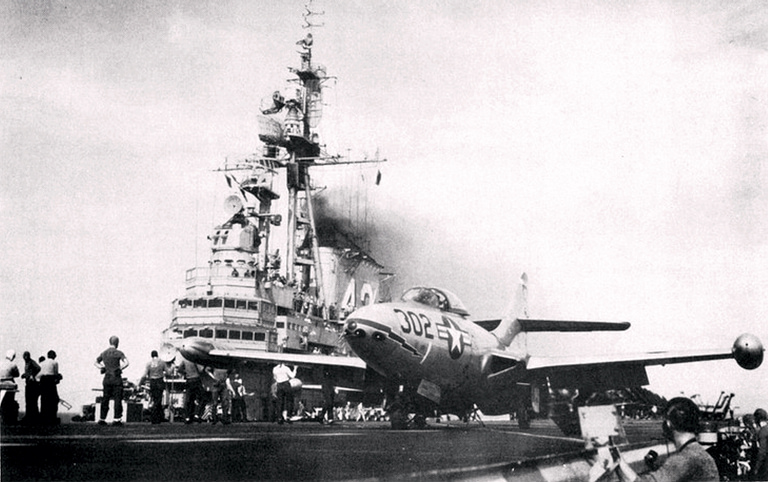
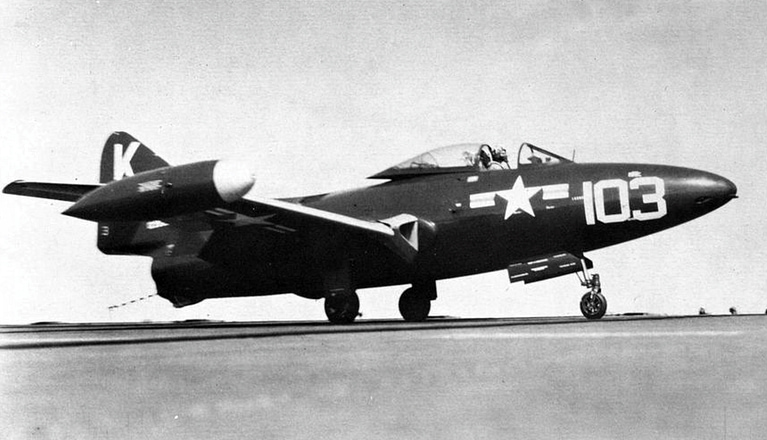
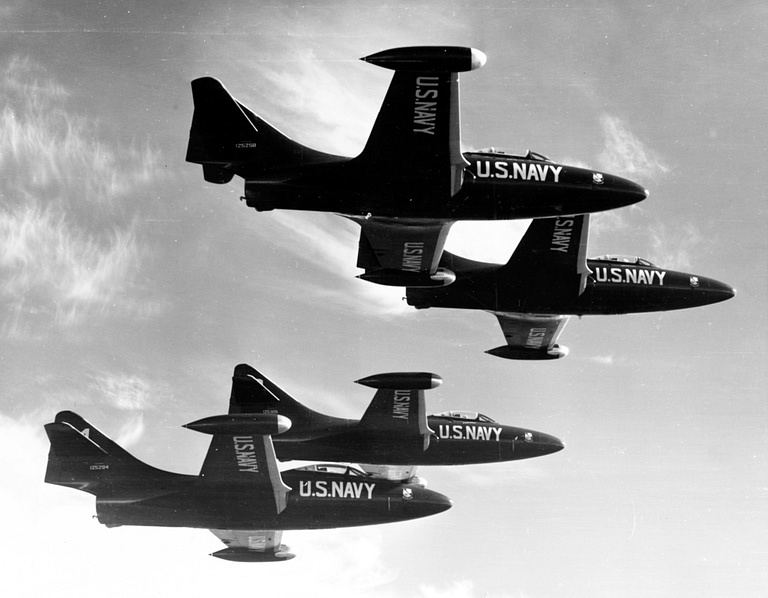
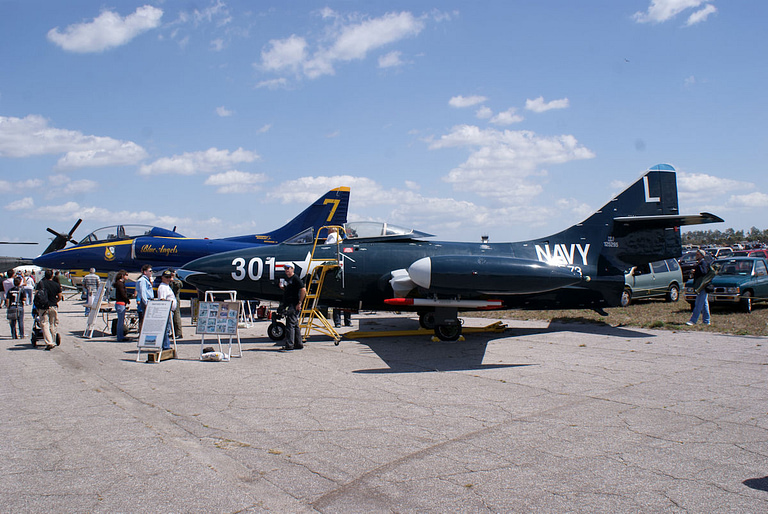
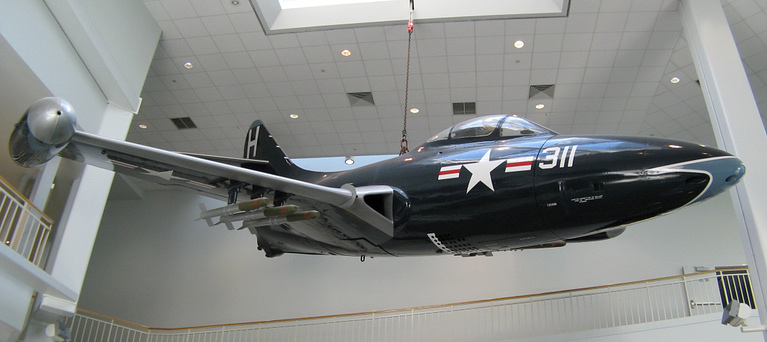
The F9F Panther in motion
A curated video feature for the F9F Panther is coming soon. In the meantime, explore the photo gallery above and the operations map below.
Where the F9F Panther flew
The record that defines the Panther
The F9F Panther was the US Navy and Marine Corps’ principal carrier jet of the Korean War. It opened the Navy’s jet combat account on 3 July 1950, downing two Yak-9 propeller fighters, and on 9 November 1950 scored the first jet-versus-jet kill in aviation history when Lt Cmdr William Amen destroyed a Soviet-flown MiG-15. Panthers are credited with at least nine air-to-air victories — a tally long understated because some, such as Royce Williams’ four MiGs, stayed classified for decades. But the Panther’s greatest contribution was as a fighter-bomber, flying tens of thousands of ground-attack sorties against bridges, supply lines and troops.
Compare the combat record of every military aircraft. Figures as of July 2026.
Everything people ask about the F9F Panther
Can I fly in an F9F Panther?
Was the F9F Panther straight-winged or swept-winged?
Did the F9F Panther really score the first jet-vs-jet kill?
Which famous people flew the F9F Panther?
What engine did the F9F Panther use?
Could the Panther beat the MiG-15?
Who else flew the F9F Panther besides the US?
You can’t fly the Panther.
These, you can.
Some legends only live in museums — others are fuelled and waiting. MiGFlug has put civilians in real military jet cockpits since 2004.
 Fly the L-39 AlbatrosThe world’s most-flown jet trainer — aerobatics included
 Fly the F-104 Starfighter“The missile with a man in it”
 Fly the MiG-21The Cold War’s most-produced jet
 T-33シューティングスターを操縦しようAmerica’s first jet trainer
 Fly the DH VampireA piece of early jet history
 Fly the S.211Agile Italian jet trainer
 Fly the MB-326The classic Aermacchi jet
 Fly the MiG-15The Soviet legend of the Korean War
Continue the tour
Every fact, checked
- National Naval Aviation Museum — F9F-2 PantherDevelopment, service entry with VF-51 and airframe data.
- Smithsonian Air & Space — “Panthers at Sea”The Panther’s Korean-War career and reputation for toughness.
- U.S. Naval Institute — Naval Aviators vs. the MiG-15The 9 November 1950 first jet-vs-jet kill and Panther air combat.
- U.S. Naval Institute — The Navy’s Aerial OscarHow Panthers came to star in “The Bridges at Toko-Ri.”
- U.S. Navy Blue Angels — team historyThe Panther as the Blue Angels’ first jet, 1949–1954.
- Baseball Hall of Fame — Ted Williams crash-lands in KoreaTed Williams’ burning belly-landing in a VMF-311 Panther.
- HistoryNet — Neil Armstrong in KoreaArmstrong’s cable strike and ejection flying VF-51 Panthers.
- Military Factory — Grumman F9F PantherSpecifications, engines, armament and production figures.