
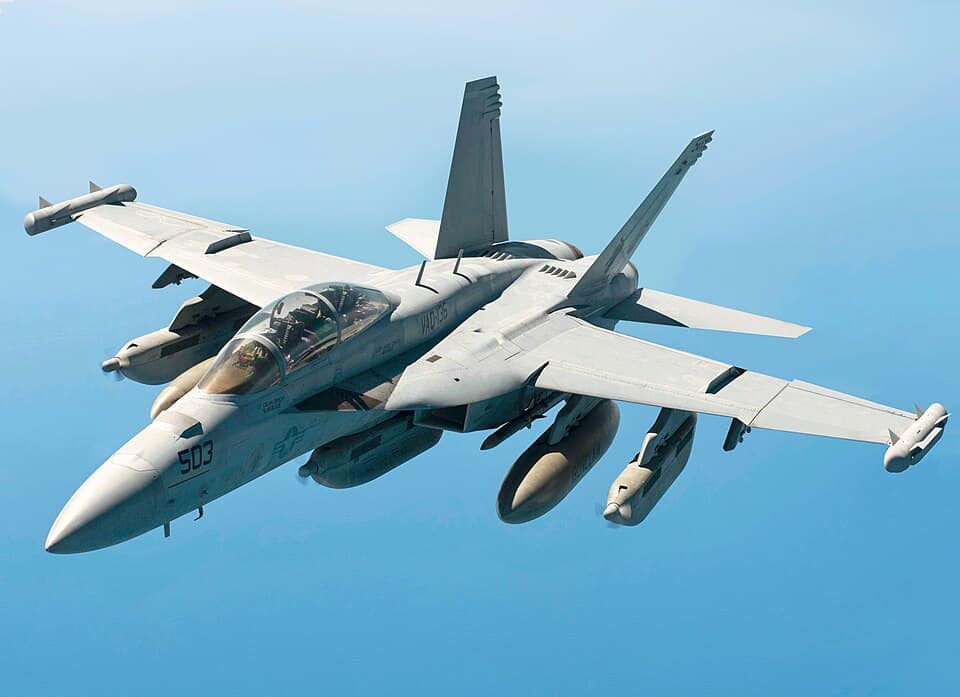
On May 17, 2026, two U.S. Navy EA-18G Growler electronic warfare jets collided midair during the Gunfighter Skies Air Show at Mountain Home Air Force Base, Idaho. The collision happened in front of thousands of spectators. Both aircraft were destroyed.
All four crew members survived.
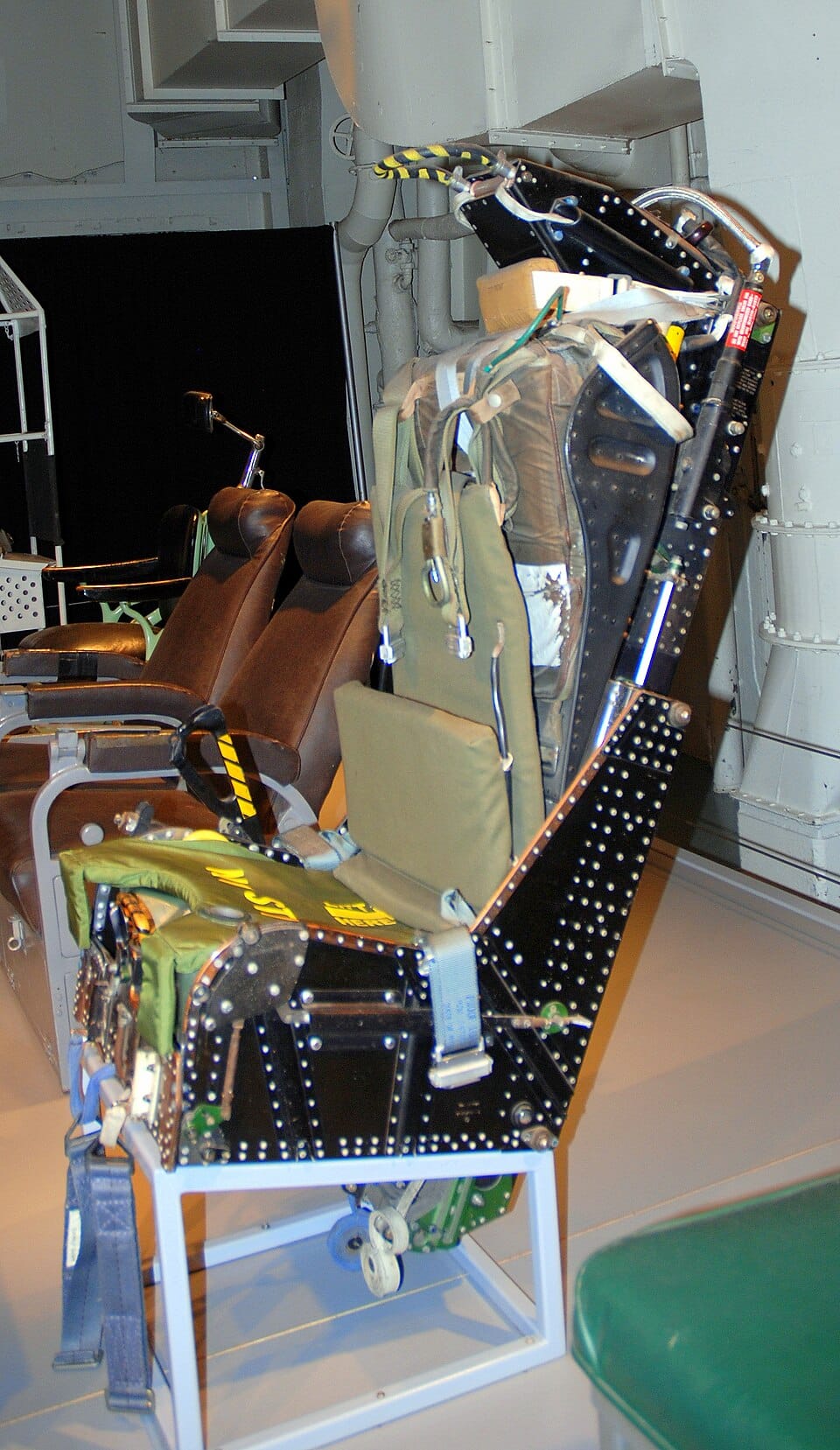
They survived because they were sitting on what a former test pilot called a “truly remarkable” piece of engineering: the ejection seat. In the fraction of a second between recognizing that their aircraft was no longer flyable and hitting the ground, four human beings were rocketed clear of disintegrating airframes by systems designed to convert a catastrophic situation into a survivable one. The physics involved are violent, the engineering is extraordinary, and the margin for error is measured in milliseconds.
💥 Idaho collision: 2 EA-18G Growlers, 4 crew — all survived via ejection
⚡ Ejection acceleration: 14-20G in a fraction of a second
🚀 Seat velocity: 0 to 200+ feet per second almost instantly
🎯 Zero-zero capability: eject at zero altitude and zero airspeed
🏆 Martin-Baker has saved 7,700+ lives since the first ejection in 1945
👔 The “Ejection Tie Club” — exclusive membership for survivors
What Happened Over Idaho
The two Growlers, assigned to Electronic Attack Squadron 129 from Naval Air Station Whidbey Island, Washington, were performing a formation demonstration when they came together. Witnesses reported seeing the aircraft make contact, followed by debris and two parachutes deploying almost immediately.
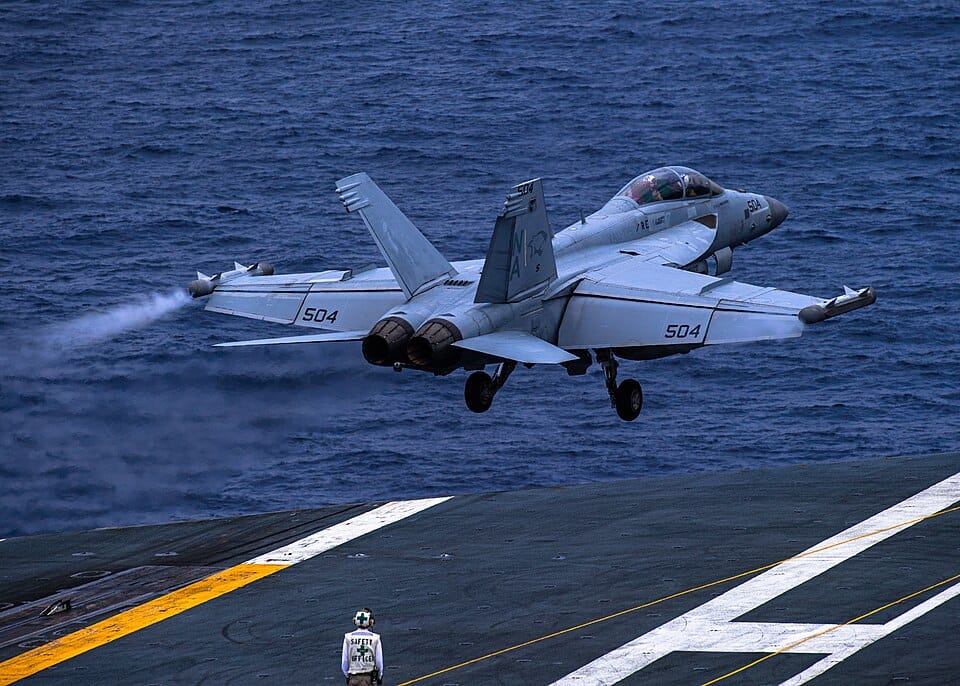
What made the outcome remarkable was not just that all four crew members ejected successfully, but the circumstances under which they did it. Midair collisions typically damage aircraft so severely and so quickly that ejection becomes impossible—control surfaces are destroyed, the fuselage breaks apart, or the ejection system itself is compromised by the impact. In this case, the relatively slow closure rate of the formation allowed just enough time and structural integrity for the seats to fire.
Every one of those four ejections represented an entire engineering discipline performing exactly as designed, under exactly the kind of conditions it was built for.
The Physics of Controlled Violence
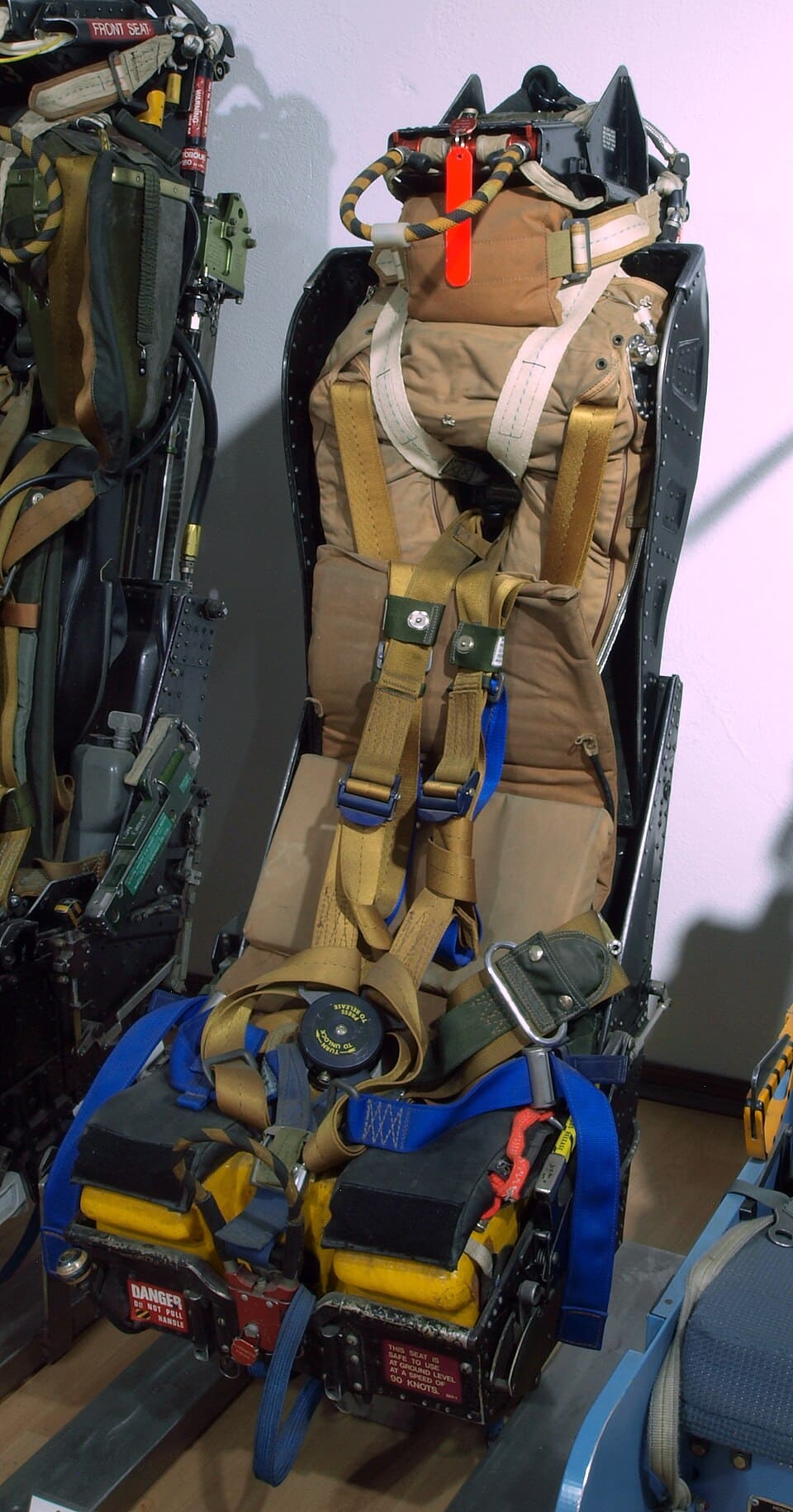
An ejection seat is, at its core, a small rocket strapped to a chair. Its job is to accelerate a human body from zero to over 200 feet per second in a fraction of a second, clear a disintegrating aircraft, stabilize the occupant in the airstream, and deploy a parachute—all in a sequence that takes less than three seconds from initiation to chute deployment.
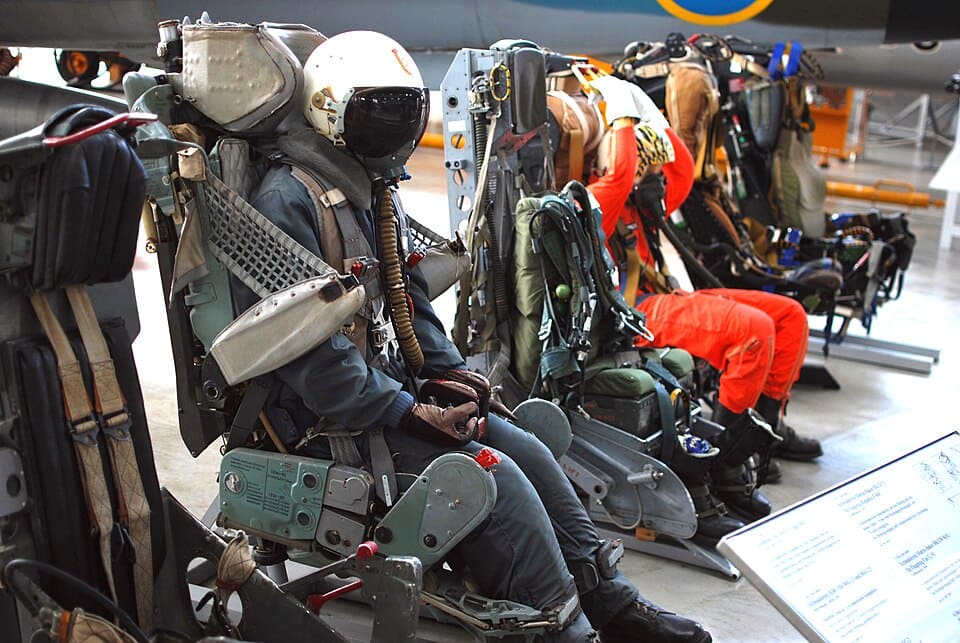
The forces involved are severe. The initial catapult fires the seat up guide rails and out of the cockpit at 14 to 20G—meaning the occupant’s body momentarily weighs 14 to 20 times its normal weight. For a 180-pound pilot, that’s an instantaneous force of over 3,000 pounds compressing the spine. This is why ejections frequently cause compression fractures, herniated discs, and other spinal injuries. Surviving an ejection is not the same as walking away unharmed.
Immediately after the catapult fires, the Under Seat Rocket Motor ignites. This secondary propulsion extends the trajectory, carrying the seat and occupant to a safe altitude for parachute deployment. The rocket burn typically lasts about half a second but generates enough thrust to loft the seat 200 to 300 feet above the aircraft—even from a standing start on the ground.
Zero-Zero: The Engineering Breakthrough
The most critical capability of modern ejection seats is what the industry calls “zero-zero” ejection: the ability to save a pilot at zero altitude and zero airspeed. This means the seat can fire, clear the aircraft, and deploy a parachute even when the aircraft is stationary on the ground.
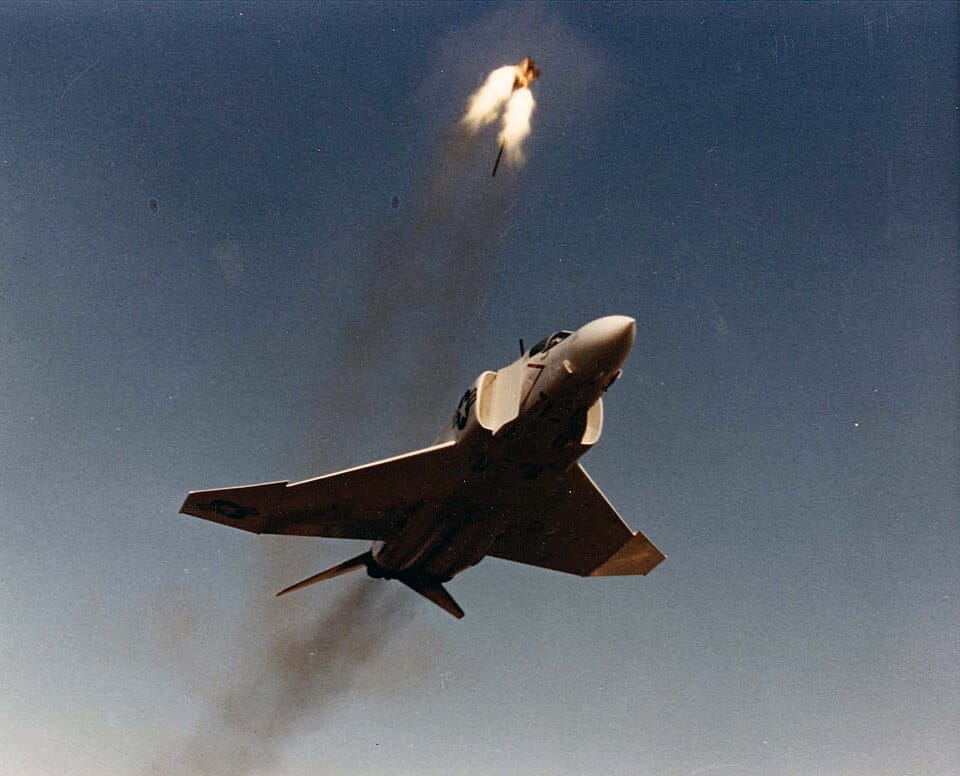
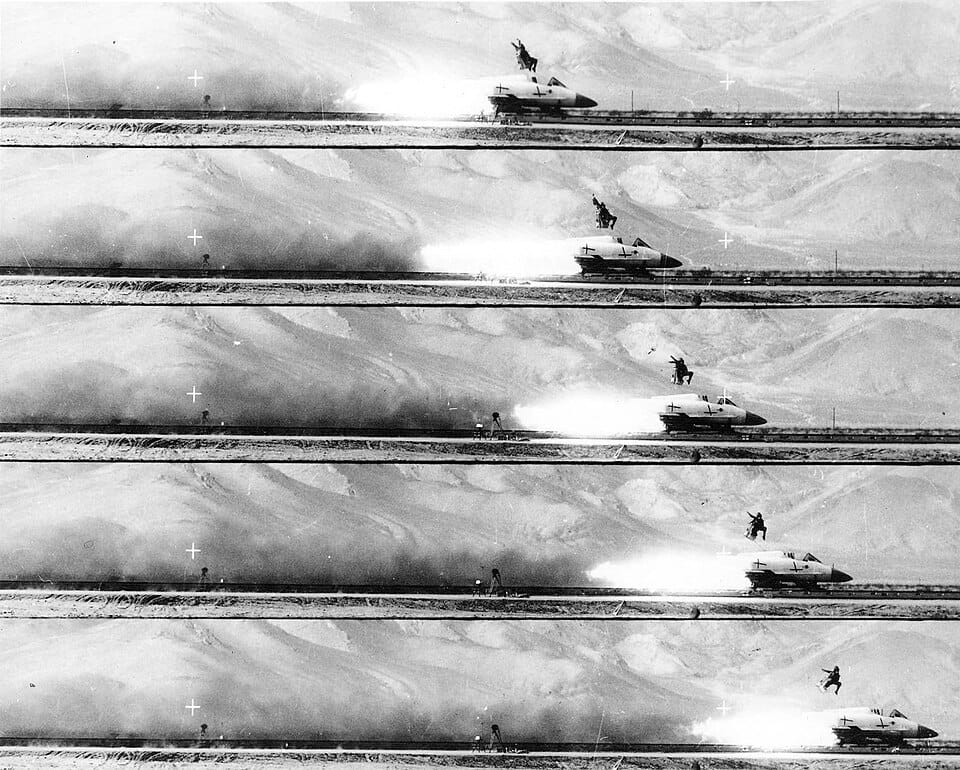
Early ejection seats required the aircraft to be moving and at altitude. If you were too low or too slow, the seat couldn’t generate enough energy to achieve a safe trajectory for parachute deployment. The development of rocket-assisted seats in the 1960s changed this fundamentally. The underseat rocket motor provided enough impulse to loft the seat 200 to 300 feet from a dead stop, giving the parachute enough altitude to deploy and decelerate the occupant before ground impact.
This capability is what made the Idaho ejections possible. At air show altitudes and relatively low speeds, early-generation seats might not have saved all four crew members. Modern seats, with their zero-zero capability, gave them a survivable exit even under challenging conditions.
The Envelope: Where Ejection Works
Every ejection seat has what engineers call an “envelope”—the range of speed and altitude combinations within which ejection is survivable. Outside the envelope, the seat either can’t generate enough altitude for the parachute or the aerodynamic forces at extreme speeds would injure or kill the occupant.
At the low end, modern seats handle zero-zero scenarios. At the high end, they must contend with aerodynamic forces that increase with the square of velocity. Ejecting at 600 knots subjects the body to windblast forces that can break limbs, tear off helmets, and cause fatal injuries. Above roughly Mach 1, most ejection becomes extremely dangerous regardless of seat design.
The sweet spot—where ejection is most likely to result in survival with minimal injury—is at moderate speeds and altitudes: roughly 100 to 400 knots and above 500 feet. Air show demonstrations typically occur within this range, which is one reason the Idaho ejections were survivable.
Martin-Baker and the Tie Club
The company most synonymous with ejection seats is Martin-Baker, the British firm that has manufactured seats for militaries worldwide since 1945. Their seats equip the F-35, the Eurofighter Typhoon, the Rafale, and dozens of other aircraft types. They also equipped the EA-18G Growlers that collided in Idaho.
Martin-Baker maintains a database of every life saved by their seats—currently over 7,700 and counting. The company recently conducted a review of historical records and discovered 35 previously unrecorded ejections, adding new members to their registry.
The Ejection Tie Club is perhaps aviation’s most exclusive fraternity. Membership is limited to those who have survived an ejection using a Martin-Baker seat. Each member receives a certificate, membership card, a distinctive tie, and a lapel pin. The club was founded by Sir James Martin himself and is now run by his grandson, Andrew Martin.
The four crew members from the Idaho collision are now eligible for membership. Their ties will join a collection representing seven decades of engineering that turned a controlled explosion into a lifesaving device.
Watch: One of the most dramatic ejections ever filmed — a MiG-29 pilot ejects just two seconds before his aircraft hits the ground at the 1989 Paris Air Show.
The MiG-29 at Paris: Two and a Half Seconds to Live
On June 8, 1989, at the 38th Paris Air Show at Le Bourget, Soviet test pilot Anatoly Kvochur was demonstrating the MiG-29 “303 Blue” when disaster struck. During a high-alpha, low-speed pass at just 160 meters altitude, the left engine suffered a bird strike and surged. The aircraft began an unrecoverable roll.
What Kvochur did next became one of the most studied ejections in aviation history. Rather than ejecting immediately, he steered the stricken MiG-29 away from the crowd line. Only when the aircraft was pointed at open ground did he pull the handle — just 2.5 seconds before impact. He landed approximately 30 meters from the fireball, was released from hospital the same day with only bruises and a small cut above his eyebrow.
The entire sequence was captured on film from multiple angles, making it one of the most famous ejections ever recorded. It demonstrated both the extraordinary courage of a test pilot and the life-saving capability of a K-36 ejection seat operating at the very edge of its envelope.
Watch: The full MiG-29 crash sequence at the 1989 Paris Air Show — Kvochur’s ejection is visible at the last possible moment before impact.
More Ejections Caught on Camera
Watch: A Canadian CF-18 pilot ejects from his aircraft in a Martin-Baker seat moments before the jet crashes — a textbook demonstration of zero-zero ejection capability.
Watch: A USAF Thunderbirds F-16 crashes during a performance, and the pilot ejects safely at the last second. The footage shows just how close the margins are at air show altitudes.
Every ejection seat in service today carries the accumulated knowledge of thousands of tests, hundreds of real-world ejections, and decades of engineering refinement. The seats that fired over Idaho in May 2026 were not lucky. They were the product of a design philosophy that treats failure as unacceptable and tests every component to destruction.
Four people are alive today because of that philosophy. As air shows continue and military aircraft continue to fly in formation at low altitude, the ejection seat remains the last line of defense—a machine built for the moment when everything else goes wrong.
Sources: PBS News, The War Zone (TWZ), USNI News, Task & Purpose, Martin-Baker (martin-baker.com), Military.com, KREM, MiGFlug ejection seat history.


 English
0 Comments