
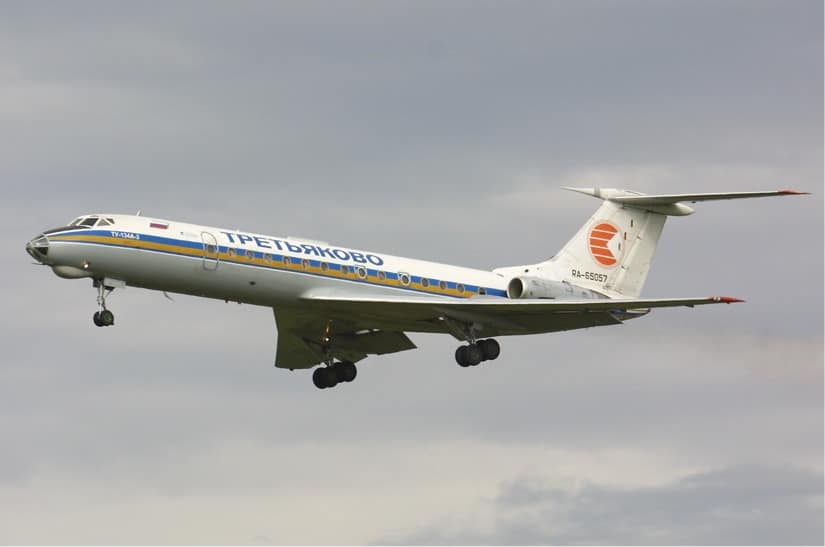
The photograph looks fake. A short-fuselage Soviet-era twin-engine airliner — a Tupolev Tu-134, the workhorse of Aeroflot domestic routes for thirty years — is hanging in midair beneath a single helicopter. The Tu-134 weighs about 28 tonnes empty. It is some thirty-seven metres — over 120 feet — long. It has its own engines, wings, and landing gear. And a helicopter is just flying with it slung underneath like a delivery package.
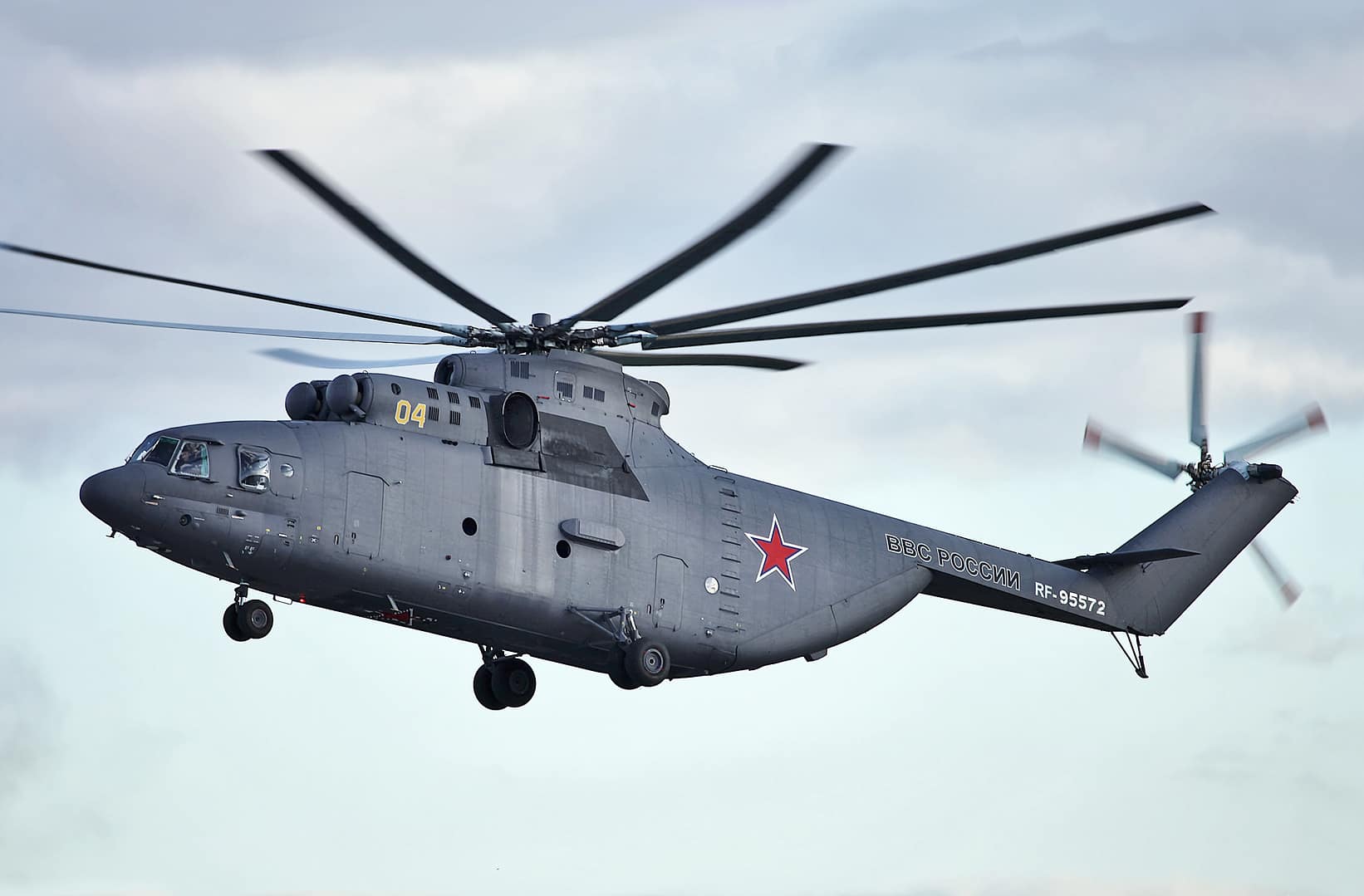
The photograph is not fake. The helicopter is a Mil Mi-26 — the largest and most powerful production helicopter ever built, the only rotorcraft in the world capable of routinely sling-lifting weights of 20-plus tonnes — and the photo is from a documented 2009 operation in which an Mi-26T carried a stripped Tu-134 fuselage — engines removed, wings cut down — between Russian airfields. Russian aviation, doing Russian aviation things.
Quick Facts
Helicopter: Mil Mi-26 "Halo" — NATO reporting name
Length: 40.0 m (131 ft) — rotor disc diameter 32 m (105 ft)
Empty weight: 28.2 tonnes
Maximum takeoff weight: 56 tonnes
Maximum sling load: 20 tonnes (44,000 lb)
Power: Two Lotarev D-136 turboshafts, 11,400 shp each — over 22,800 shp total
Rotor blades: Eight main rotor blades; five tail rotor blades
Crew: Five (two pilots, navigator, flight engineer, loadmaster)
First flight: 14 December 1977
Number built: About 320 as of 2026; still in production (limited)
Sling load demonstrated: Multiple aircraft fuselages over the years (the Tu-134 in 2009, downed-helicopter recoveries, and Boeing CH-47 Chinook fuselages recovered in Afghanistan in 2002 and 2009)
Why the Mi-26 exists
The Mi-26 was a Soviet answer to a uniquely Soviet logistical problem. The USSR covered nine time zones, much of it inaccessible by road or rail. Industrial development of Siberia, the Soviet Far East, and the Arctic required the ability to deliver heavy machinery — generators, drilling rigs, prefabricated buildings — to sites where no infrastructure existed. The American answer to the same problem (use small numbers of medium-lift helicopters in formation) did not scale. The Soviet answer was to build a single helicopter that could carry roughly twice the sling load of any Western heavy-lift helicopter.
The Mi-26 first flew in December 1977 and entered service in 1983. It is still in production today — Russian Helicopters builds a small number per year, including a new Mi-26T2V variant with modern avionics. Operators include the Russian Air Force, the Russian Ministry of Emergency Situations (MChS), the Indian Air Force (heavy-lift Himalayan operations), Kazakhstan, China (medium-lift fire-fighting), and several civilian heavy-lift operators in Russia, Ukraine, and the Middle East.
The aircraft-as-cargo story
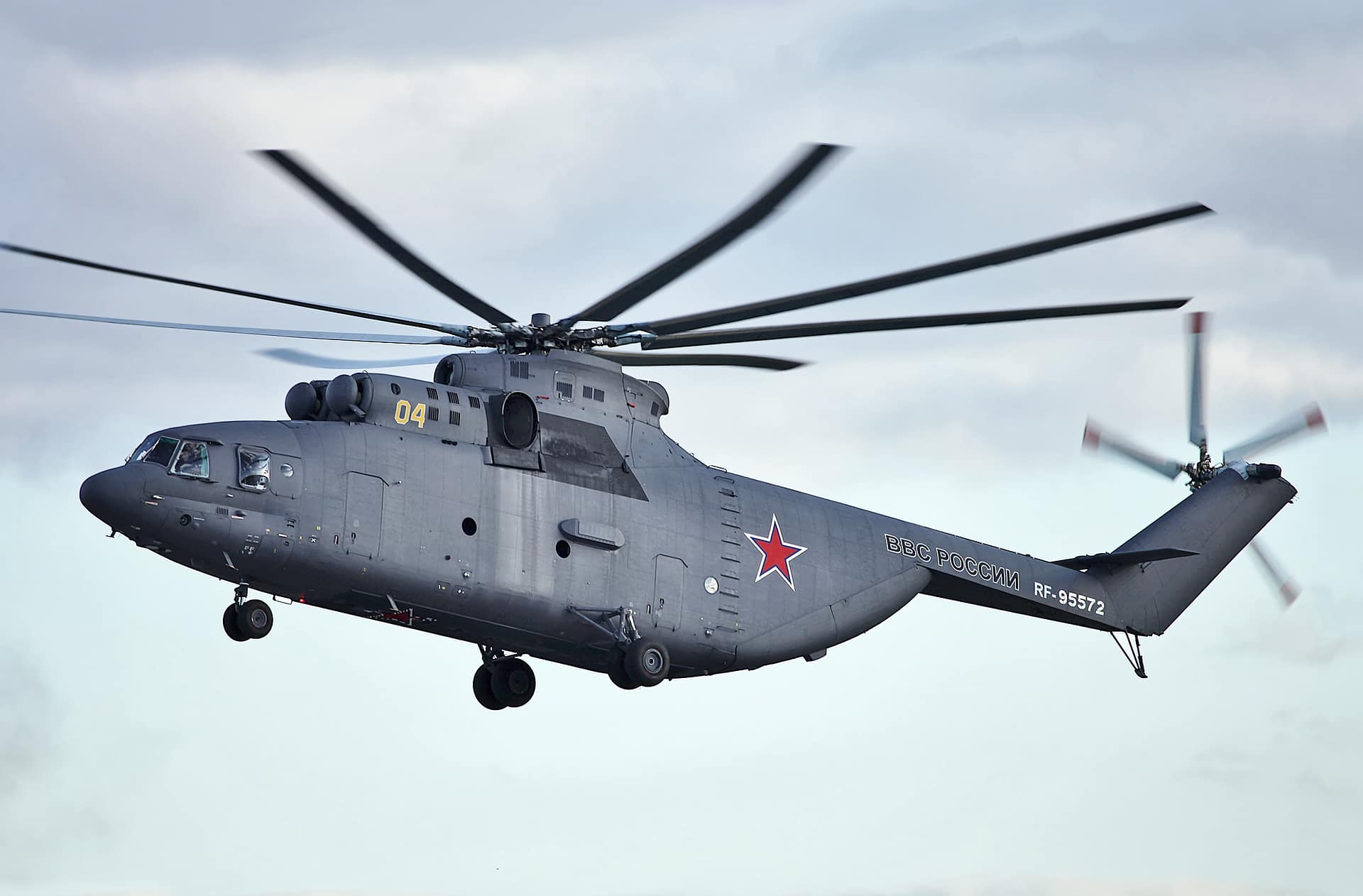
The Mi-26 has lifted entire fixed-wing aircraft on multiple occasions. The reel that prompted this article shows one of the most famous examples: a Tu-134 commercial airliner fuselage being sling-flown by an Mi-26 between Russian airfields in 2009 — a lift documented by Russian Helicopters itself. Other notable Mi-26 lifts include downed helicopters recovered from remote terrain, a 14-tonne Mi-26 fuselage flown across Russia for repair in 2015, and — in 2002 and again in 2009 — the recovery of 11-tonne Boeing CH-47 Chinook fuselages from crash sites in Afghanistan.
Each of these lifts is a serious operation. The Mi-26 cannot just pick up any aircraft and fly off with it. Sling-loads at the upper end of the helicopter’s capacity require careful weight-and-balance calculation, precise positioning of the lift points on the cargo, calm-air weather, and detailed mission planning. The pilots fly low and slow. Forward speed with a heavy sling load is typically capped at around 100 knots, and altitude is kept well below the helicopter’s service ceiling to preserve power margin. The flight engineer monitors engine output continuously. The loadmaster watches the cargo via the lower-hatch camera and the chase aircraft.
What it costs
The Mi-26 is, in commercial heavy-lift terms, the only game in town for many missions. Western competitors — the Sikorsky CH-53K (15-tonne sling), the Boeing CH-47F Chinook (12-tonne sling) — top out below the Mi-26’s capacity. For lifts above 15 tonnes, a sling-load mission is either a Mi-26 contract or it does not happen. Operating costs are correspondingly high — commercial charter rates run to tens of thousands of dollars per flight hour, typically billed with minimum block-hours and substantial fuel and positioning surcharges.
That sounds expensive until you compare it to the alternative. A heavy-lift recovery mission for a downed Mi-8 in central Siberia might require building 100 kilometres of access road, mobilising a flatbed truck convoy, and a six-week project timeline. The Mi-26 can fly in, pick up the wreck, and have it on a flatbed at the nearest paved road in a day.
Why the West never built one
The interesting question is not why the Soviet Union built the Mi-26 — they had to. The interesting question is why no Western manufacturer ever built anything comparable. The answer is that Western military and civilian operators long ago made the strategic choice to do heavy lift with multiple smaller helicopters and fixed-wing transports rather than with one giant rotor.
The U.S. Army’s heavy-lift requirement maxes out at the CH-47F’s 12-tonne sling capacity. Anything heavier goes to a C-17 Globemaster III, which can land on a 3,500-foot semi-prepared strip and unload directly. The U.S. Marine Corps’ CH-53K is the largest Western helicopter currently in production and tops out at 15 tonnes. There simply has not been a sustained Western customer requirement for a 20-tonne rotorcraft, because Western logistics chains are built around airfields and surface transport in a way the Soviet system was not.
The closest Western project to a Mi-26 equivalent was the Sikorsky CH-54 Tarhe / S-64 Skycrane of the 1960s, which is still flying as the civilian Erickson Air-Crane in firefighting and timber-recovery roles. It tops out at about 9 tonnes. Above that, the Western market goes to fixed-wing aircraft.
The Mi-26 will probably be the last of its kind. There is no obvious successor in any current programme of record anywhere in the world. The U.S. Future Vertical Lift programme is producing tilt-rotors and compound helicopters in the 10-15 tonne class. The European NH90 family is medium-lift. The Chinese AVIC Z-20 is a Black Hawk equivalent. None of them are pushing the size envelope upward. The era of the truly massive helicopter — the era the Mi-26 has owned for fifty years — is quietly ending with it.
Watch: rare footage of a Mil Mi-26 sling-lifting a Tupolev Tu-134 airliner fuselage — the world’s largest production helicopter doing what only it can do.
Sources: Russian Helicopters JSC press materials; Mil Mi-26 type certificate data; Vertical Flight Society heavy-lift helicopter surveys.
Related Questions
What is the world's largest helicopter?
The Mil Mi-26 "Halo" is the largest and heaviest helicopter ever to enter production. With a 32-metre rotor disc and a 56-tonne maximum takeoff weight, the Soviet-designed heavy-lifter can carry loads no other helicopter can manage.
How much can the Mi-26 lift?
The Mi-26 can carry a sling load of up to 20 tonnes (44,000 lb) — enough to lift vehicles, downed aircraft and even small airliners. Its two turboshaft engines produce a combined 22,800 horsepower to haul such enormous weights.
Has a helicopter ever lifted an airliner?
Yes. The Mi-26 has sling-lifted aircraft, including airliner-sized loads, beneath it — feats that look almost impossible. Its 20-tonne lifting capacity lets it recover crashed aircraft and move outsized cargo that defeats every other helicopter.
How powerful is the Mi-26?
It is driven by two Lotarev D-136 turboshaft engines of 11,400 shp each — over 22,800 horsepower in total — turning an eight-blade main rotor. That power is what allows its 20-tonne lifting capacity and 56-tonne maximum weight.
When did the Mi-26 first fly?
The Mi-26 first flew on 14 December 1977. Decades later it remains the most capable production heavy-lift helicopter in the world, still used for tasks too big for any other rotorcraft.
Related Posts
Boeing Lands a Chinook Without Anyone at the Controls
0 Comments