
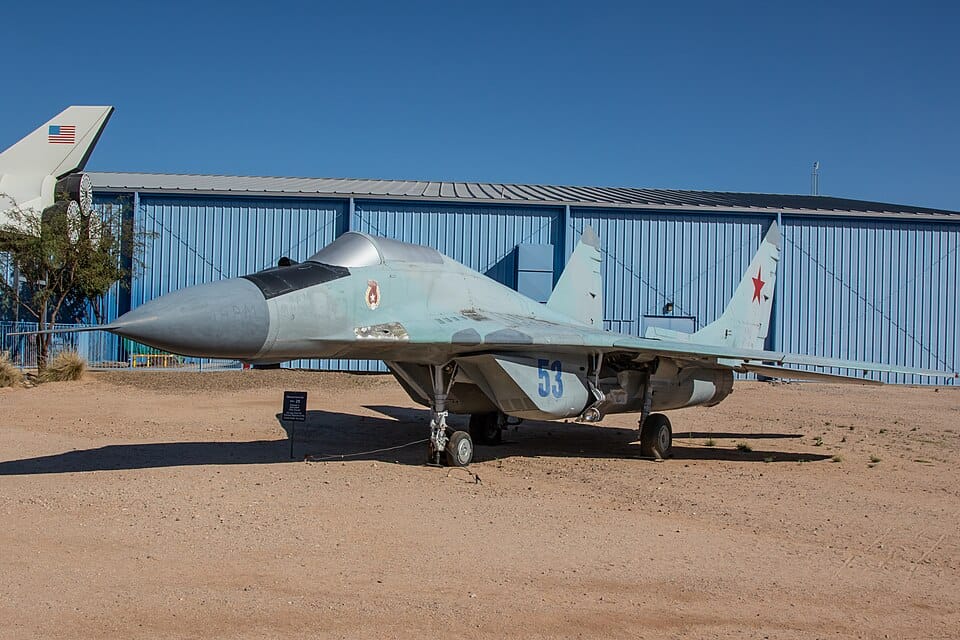
“How fast will I actually go?” It’s the question we hear most — from first-time L-39 passengers who’ve never been in a military aircraft, from aviation enthusiasts booking a MiG-29 Edge of Space flight, and from everyone in between. The short answer depends on which aircraft you fly. The longer answer involves physics, physiology, and the surprising fact that speed in a fighter jet feels almost nothing like speed in a car.
Here’s the deep dive into what speed, altitude, and G-forces actually feel like when you’re strapped into the back seat of a jet fighter — and why the numbers on the instruments tell only half the story.
- Fastest Available Flight: MiG-29 Edge of Space — up to Mach 1.8, altitude 20 km
- Most Popular First Flight: L-39 Albatros — up to Mach 0.7
- Maximum G-Force: Up to 9G in the MiG-29
- Supersonic Flights Available: MiG-29 only (all others are subsonic)
- Edge of Space Definition: Above 18 km (59,000 ft) — see the curvature of Earth
The Speed Table: What Each Aircraft Delivers
| Aircraft | Top Speed | Max Altitude | What You’ll Feel |
|---|---|---|---|
| L-39 Albatros | 750 km/h (466 mph / Mach 0.7) | 36,000 ft (11,000 m) | Fast enough to feel the G-forces in turns; subsonic but thrilling |
| L-159 ALCA | 936 km/h (581 mph / Mach 0.8) | 43,300 ft (13,200 m) | Transonic speeds; the jet buffets as it approaches the sound barrier |
| MiG-29 Fulcrum | 2,400 km/h (1,490 mph / Mach 2.25) | 60,000+ ft (18,000+ m) | Supersonic boom you can feel; the sky turns dark blue at altitude |
Every MiGFlug flight is different because every aircraft is different. The L-39 Albatros, our most-flown aircraft, reaches about 750 km/h — roughly Mach 0.7 at altitude. That’s faster than any commercial airliner in cruise, but it’s the G-forces during aerobatic maneuvers, not the straight-line speed, that make the L-39 experience memorable.
The MiG-29 is the only aircraft in our fleet that routinely breaks the sound barrier with passengers on board. During the Edge of Space flight, the Fulcrum accelerates to approximately Mach 1.8 and climbs to altitudes above 18 kilometers — nearly 60,000 feet — where the sky turns dark indigo and the curvature of the Earth becomes clearly visible.
Why Speed in a Jet Feels Different From Speed in a Car

Here’s something that surprises almost every first-time passenger: straight-line speed in a jet doesn’t feel fast at all. At 750 km/h in an L-39 at altitude, there’s no sensation of speed — no wind in your hair, no rushing scenery. The ground is far below and moves slowly across your field of view. The instrument panel says you’re going 400+ knots, but your body says you’re floating.
That changes the moment the pilot initiates a turn, a pull-up, or a roll. Speed in a fighter jet is felt through G-forces — the multiplication of your body weight caused by acceleration. A 4G turn means you weigh four times your normal weight. Your arms feel like lead. Your helmet pushes down on your head. The blood wants to drain from your brain, and you have to actively tense your lower body (the anti-G straining maneuver, or AGSM) to stay conscious.
In the L-39, passengers typically experience 3-5G during aerobatic maneuvers. In the MiG-29, the aircraft can pull up to 9G — the maximum a human body can tolerate with proper anti-G equipment. At 9G, a 80-kilogram person effectively weighs 720 kilograms. That’s the real speed experience: not how fast you’re going, but how hard the aircraft is turning.
Breaking the Sound Barrier: What Mach 1 Actually Feels Like

Going supersonic in the MiG-29 is both more and less dramatic than people expect. There’s no big bang inside the cockpit — the sonic boom radiates outward and behind the aircraft, so the crew never hears it. What you do feel is a subtle shudder as the aircraft passes through the transonic regime (roughly Mach 0.85 to Mach 1.05), followed by an eerie smoothness as the airflow goes fully supersonic.
The instruments tell the story: the Mach meter creeps past 1.0, and the altimeter climbs at a rate that would give a commercial pilot a heart attack. In the MiG-29’s full-afterburner climb, the aircraft gains altitude at up to 330 meters per second — essentially, you’re sitting in a flying cannonball pointed at the sky.
At Mach 1.5 and above, the sensation is almost zen-like. The buffeting stops. The engine noise is strangely muted because you’re outrunning your own sound. The sky darkens progressively as you climb through 50,000 feet, 55,000 feet, 60,000 feet. At maximum altitude, the view is otherworldly — a thin blue line of atmosphere separating the dark sky from the curved surface of the Earth below.
Altitude: The View Nobody Forgets
In the L-39 at 36,000 feet, you’re at commercial airliner altitude but with a 360-degree view through a fighter jet canopy instead of a window the size of a dinner plate. The visibility on a clear day can exceed 300 kilometers. Mountains, coastlines, and entire cities are visible simultaneously, and the sense of height is dramatic because there’s nothing between you and the ground but a thin Perspex canopy and 11 kilometers of empty air.
In the MiG-29 above 18 kilometers, the experience changes qualitatively. The atmosphere becomes visibly thin — you can see it as a glowing blue band on the horizon. Stars become faintly visible even during the day. The sky overhead is nearly black. And the curvature of the Earth, which you’ve seen in photographs your entire life, is suddenly right there in front of you, undeniable and breathtaking.
This is what pilots call “the overview effect in miniature” — a compressed version of what astronauts describe when they see Earth from orbit. You’re not in space, but you’re close enough to understand why people spend billions of dollars trying to get there.
Frequently Asked Questions
Will I pass out from the G-forces?
It’s possible but uncommon. Your pilot will build up G-forces gradually, and you’ll be briefed on the anti-G straining maneuver before the flight. Most passengers handle 4-5G without difficulty. If you start to feel lightheaded, tell the pilot and they’ll immediately reduce the load.
Can I fly the aircraft myself?
Yes — this is unique to MiGFlug. All our aircraft have dual controls, and during straight-and-level portions of the flight, your pilot will invite you to take the stick. You won’t be doing the aerobatics yourself, but you’ll experience the responsiveness of a military aircraft firsthand.
How long does the fast part last?
In the L-39, the aerobatic portion typically lasts 20-30 minutes. In the MiG-29 Edge of Space flight, the supersonic climb and high-altitude segment takes approximately 15-20 minutes, with additional aerobatics during the descent.
Is the speed dangerous?
The speed itself is not dangerous — commercial airliners cruise at similar or higher speeds than the L-39. What makes fighter jets different is the ability to change speed and direction rapidly, which creates G-forces. All flights are conducted by experienced military or former military pilots with thousands of hours in type.

 English
0 Comments