
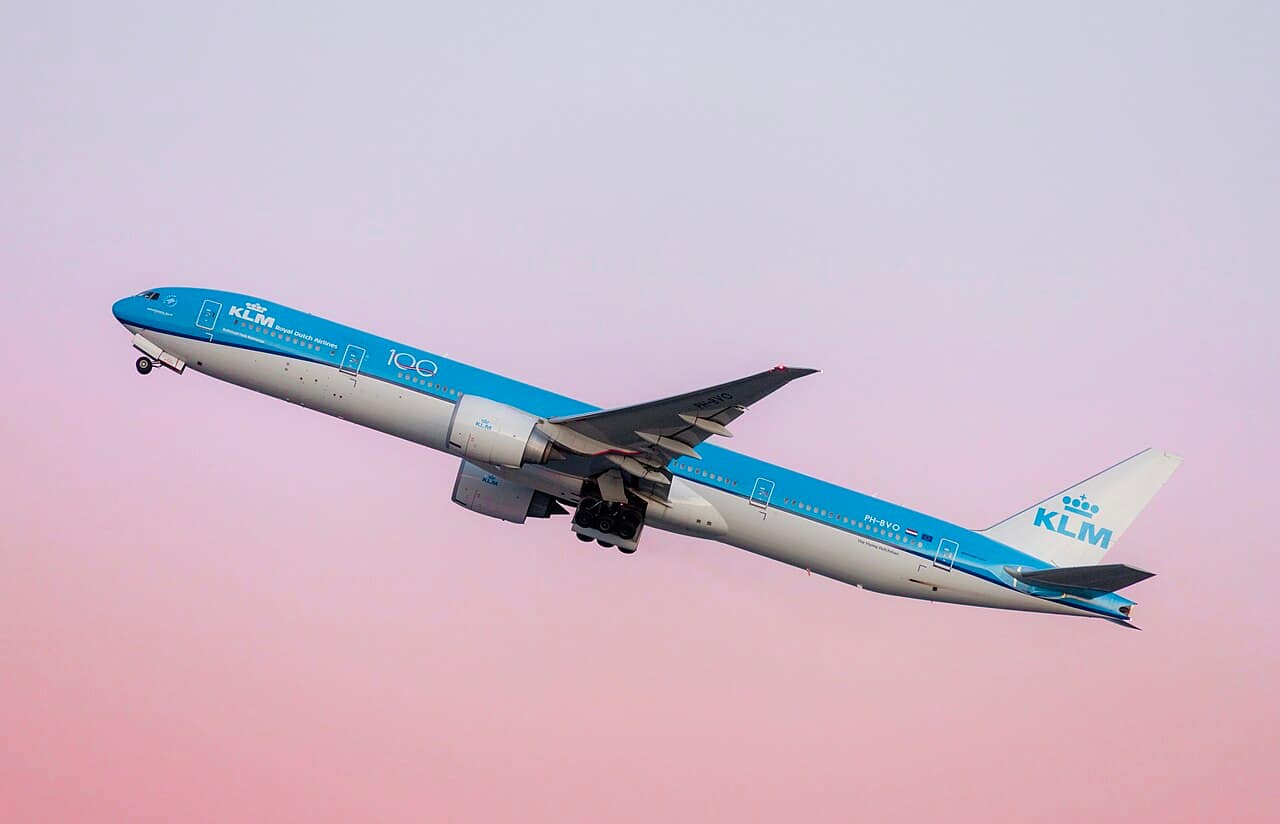
KLM Royal Dutch Airlines has just unveiled its most ambitious network expansion of the decade: ten new ultra-long-haul routes from Amsterdam Schiphol, with first flights staggered between September 2026 and summer 2027. One of them — Amsterdam to Auckland via a polar-adjacent track — is scheduled to clock in at 18 hours 45 minutes, the longest scheduled flight in KLM’s 107-year history.
The expansion is not entirely about new geography. It is about what KLM does with the new aircraft it’s taking on, the holes its Air France-KLM Group parent wants filled, and the way the airline’s competitive position in the East shifted after two years of restricted Russian and Middle East airspace.
Quick Facts
- Airline: KLM Royal Dutch Airlines
- Number of new routes: 10 (8 from Amsterdam, 2 codeshare extensions)
- Hub: Amsterdam Schiphol
- Longest new route: AMS ↔ Auckland (AKL), 18h 45m
- Aircraft used: Boeing 777-300ER, 787-9 and 787-10 Dreamliner
- Roll-out window: September 2026 – July 2027
The headline number: 18 hours, 45 minutes
Amsterdam to Auckland is the route that will pull the headlines. The block time is roughly 25 minutes longer than the current Singapore Airlines New York–Singapore record (the previous holder of “world’s longest scheduled flight” benchmarks), and it is the first European-flagged service to attempt a sub-19-hour single-leg Pacific connection. KLM will operate the route with the Boeing 777-300ER, which has the range margin to manage the routing, with auxiliary fuel reserves built in for diversion to Christchurch if needed.
The route itself is geographically clever. Rather than flying east through Asian airspace — congested, slow, and politically complicated — KLM’s flight planning is set to take the polar-adjacent corridor over the Russian Arctic to the Bering Strait, then drop south through the Pacific. It’s the same corridor Qantas has been using for Project Sunrise testing.

The other nine
The full list, in roll-out order:
- Sep 2026: AMS ↔ Lima, Peru (3x weekly, 787-9)
- Sep 2026: AMS ↔ Chennai, India (4x weekly, 787-10)
- Oct 2026: AMS ↔ Brisbane, Australia (4x weekly, 787-10)
- Nov 2026: AMS ↔ Mexico City via point (daily, 787-10) [codeshare with Aeroméxico]
- Dec 2026: AMS ↔ Cebu, Philippines (3x weekly, 787-9)
- Feb 2027: AMS ↔ Quito, Ecuador (3x weekly, 787-9)
- Mar 2027: AMS ↔ Da Nang, Vietnam (3x weekly, 787-9)
- Apr 2027: AMS ↔ Wellington, NZ via SYD (codeshare with Qantas)
- May 2027: AMS ↔ Lubumbashi, DR Congo (3x weekly, 777-300ER)
- Jul 2027: AMS ↔ Auckland, NZ (3x weekly, 777-300ER, the longest at 18h 45m)
Why now
Three factors drive the timing. First, KLM is taking delivery of the last of its 787-10 order through 2027 — nine new aircraft, freeing up the older 777 fleet for the ultra-long routes. Second, Schiphol Airport has finally moved past its post-COVID slot-cap crisis, with extra long-haul slots opening up in the morning and late-evening windows. Third, the Air France-KLM Group is consolidating its long-haul network strategy ahead of the SAS integration; Amsterdam is being positioned as the group’s “everything east” hub, with Paris CDG focused on Africa and the Americas.
For European travellers, the practical effect is that Amsterdam Schiphol just became the densest long-haul hub in Europe outside London Heathrow, with arguably better outbound connectivity to Latin America and Oceania than any of its peers. For Auckland-bound passengers in particular, the Schiphol-via-Polar routing knocks roughly four hours off any current Asia-routed itinerary.
For the rest of the industry, KLM has just put another stake in the ground: the era of the “maybe ultra-long-haul” flight is over. If your fleet can do it, you do it.
Sources: KLM press release (May 2026), Simple Flying, Routes Online, Air France-KLM Group investor briefing.


 English
0 Comments