
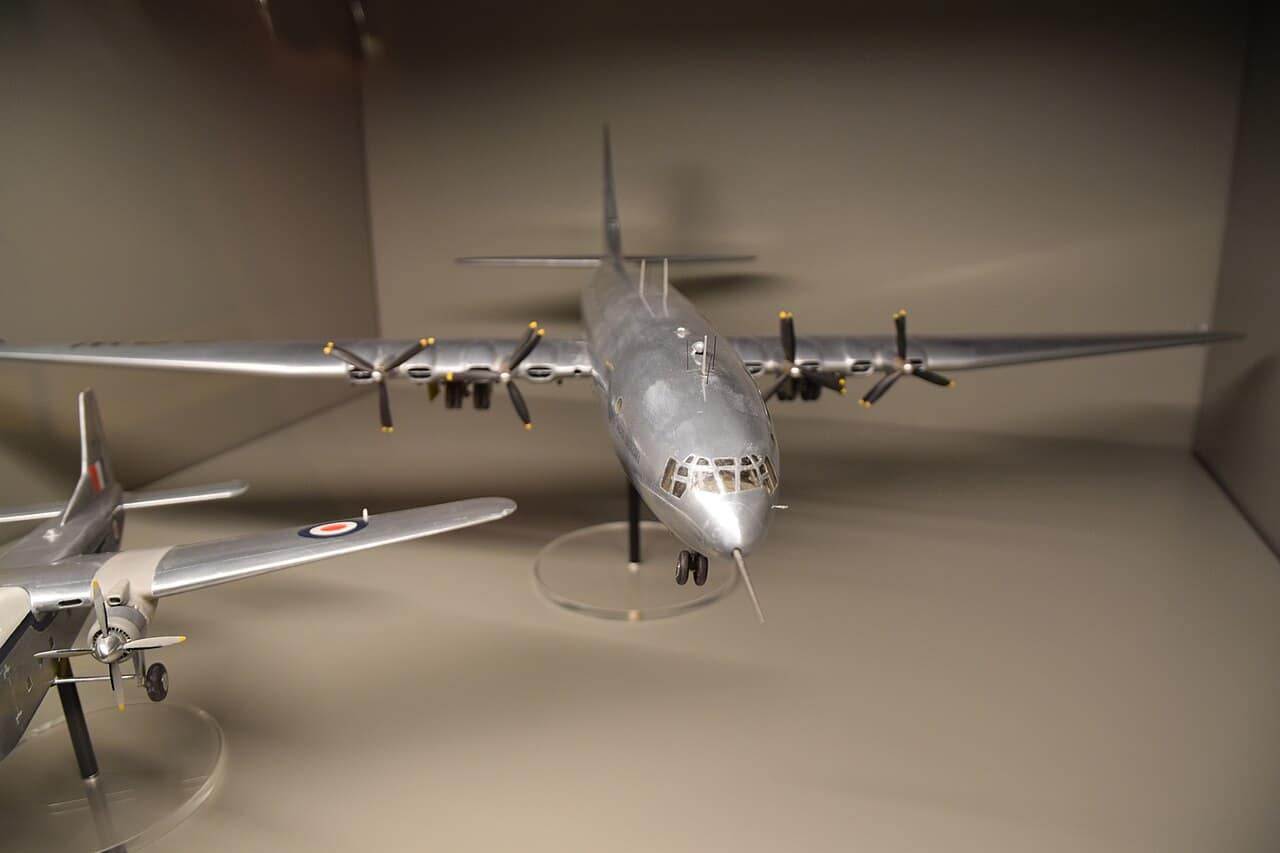
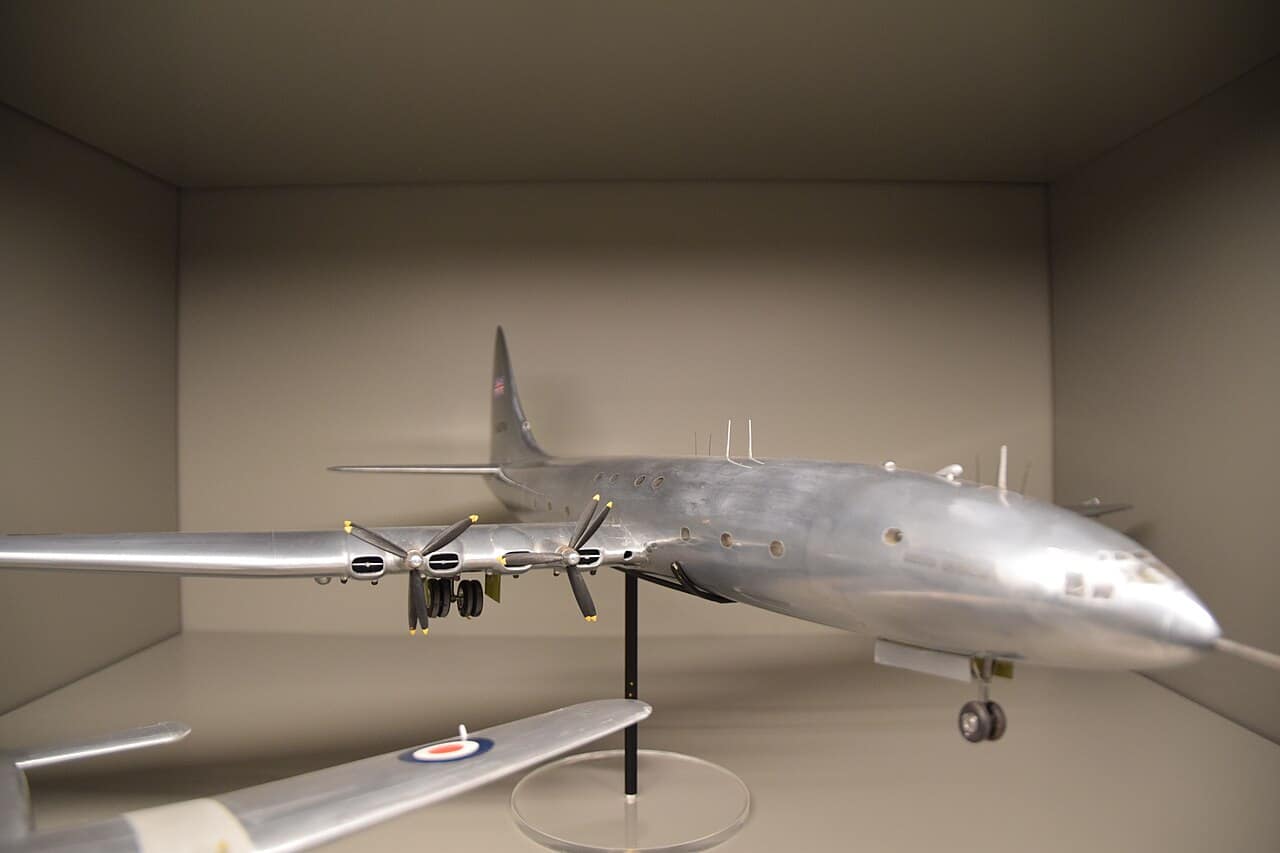
On 4 September 1949, the largest land-based aircraft ever built in Britain took off on its maiden flight from Filton, near Bristol. It had a wingspan of 70 metres — longer than a Boeing 747’s. Eight engines, buried in the wings in pairs, drove four sets of contra-rotating propellers. The fuselage interior, planned for 100 passengers, included sleeping cabins, a cocktail bar, and a cinema. The aircraft was named the Bristol Type 167 Brabazon, after Lord Brabazon of Tara — the man who had chaired the wartime committee that decided Britain should build it.
Four years later, the Brabazon was being cut up for scrap. Bristol had spent £3.4 million developing it (around £120 million today). Not a single paying passenger ever flew aboard. The runway extension required to operate it had been one of the most expensive concrete-pours in 1940s Britain. The full story of the Brabazon is what happens when a government commits to building the wrong aircraft for an industry that no longer exists.
Quick Facts
- Aircraft: Bristol Type 167 Brabazon Mk.I
- First flight: 4 September 1949
- Wingspan: 70 m (longer than the original Boeing 747)
- Length: 54 m
- Engines: 8 × Bristol Centaurus 18-cylinder radials, paired to drive 4 contra-rotating propellers
- Cruise speed: 402 km/h (250 mph)
- Range: Designed for 8,800 km London → New York non-stop
- Built: 1 (a second airframe, the turboprop Mk.II, was never completed)
A wartime committee with very wrong assumptions
The Brabazon began life in 1942. With the war still in doubt, the British government commissioned a committee under Lord Brabazon — the first man to be issued a pilot’s licence in the British Empire — to plan what kind of commercial aircraft British industry should build once the war ended. The committee’s recommendations were sensible for the world it expected: long-range first-class transatlantic travel for a tiny pre-war elite, served by aircraft with cocktail bars and overnight cabins, operating from Heathrow or Hurn to New York.
The committee did not predict the four things that would actually transform civil aviation in the late 1940s: the arrival of the pure jet engine, the dramatic fuel-efficiency gains of the Douglas DC-6 and Lockheed Constellation, mass-market tourism, and the rapid post-war decline of the British Empire’s long-haul demand. The Brabazon was designed for a world that did not exist by the time it flew.
The aircraft was, on its own engineering terms, magnificent. The 70-metre wing carried eight Bristol Centaurus radial engines mounted in pairs, each pair driving a single contra-rotating propeller via a complex reduction gearbox. The fuselage was a fully pressurised structure, designed to allow flight at 25,000 feet for above-weather cruise. The first prototype, G-AGPW, had a maximum take-off weight of 130 tonnes — comparable to a modern Airbus A300.
A runway that ate a village
The Brabazon required a runway around 2,440 metres (8,000 feet) long. The Filton airfield in 1945 had nothing remotely that big. So the British government extended the runway by demolishing the village of Charlton — population around 50 families — in 1946-47. The villagers were relocated, their homes torn down. The runway was completed in 1948, in time for the prototype’s first taxi runs.
The Brabazon never used that runway commercially. The cost-per-passenger-mile analysis was crushing. The aircraft could indeed fly the Atlantic with 100 passengers in luxury — but the cost worked out far higher than that of an equivalent Lockheed Constellation, an aircraft already in service with every American carrier. BOAC, the only realistic British customer, declined to order any.
The aircraft that no one ever flew
The single completed Brabazon prototype made 164 flights totalling 382 hours between 1949 and 1953. Bristol spent another four years trying to interest someone — BOAC, the RAF, foreign carriers — in either the existing piston-engined Mk.I or the proposed turboprop Mk.II. Nobody bit. In 1953, with development costs spiralling and an empty hangar full of Mk.II components that could never be commercially recovered, the government cancelled all funding. The prototype was broken up for scrap in October 1953.
The hangars at Filton that Bristol had purpose-built for the Brabazon — structures that were, for several years, among the largest enclosed buildings in Europe — were repurposed. Two decades later, those same hangars assembled the Anglo-French Concorde. There is a real sense in which the Brabazon’s greatest legacy was the runway and hangars that, fifteen years later, the country was actually ready to use. The aircraft itself was a magnificent commercial mistake. The factory that built it became Britain’s most successful supersonic project.
The Brabazon Committee’s other recommendations did, eventually, produce successes — the Vickers Viscount, the de Havilland Comet, the Bristol Britannia. But the headline aircraft, the Type 167, became the cautionary tale every aerospace executive in Britain learned by heart for the next thirty years: never build an aircraft for the world the committee thinks will exist. Build it for the world that does.
Sources: Bristol Aero Collection Archive, Flight International (October 1953 issue), Putnam Aeronautical, BBC Bristol.
Related Questions
What was the Bristol Brabazon?
The Bristol Brabazon was a giant British airliner of the late 1940s, designed for luxurious transatlantic travel. With a wingspan longer than the original Boeing 747's, it was enormous — but only one was ever built, and it never entered commercial service.
Why did the Bristol Brabazon fail?
It was based on wrong assumptions. A wartime committee imagined a small number of wealthy passengers needing vast personal space, so the Brabazon was huge, slow and hugely expensive, while the market actually wanted faster, higher-density airliners. No airline wanted it, and the project was abandoned.
How big was the Bristol Brabazon?
Its wingspan was about 70 metres — longer than that of the original Boeing 747 — with a 54-metre fuselage. It was one of the largest aircraft of its era, designed to fly London to New York non-stop in great comfort.
How many Bristol Brabazons were built?
Just one complete aircraft flew. A planned second airframe, the turboprop-powered Mk.II, was never finished, and the sole Brabazon was eventually scrapped after the programme was cancelled.
When did the Bristol Brabazon first fly?
The Brabazon Mk.I made its first flight on 4 September 1949. Despite flying successfully, it was already commercially obsolete, and no orders followed before the ambitious project was cancelled.
Related Posts
The Saunders-Roe SR.53: A Rocket Interceptor Britain Threw Away
0 Comments