
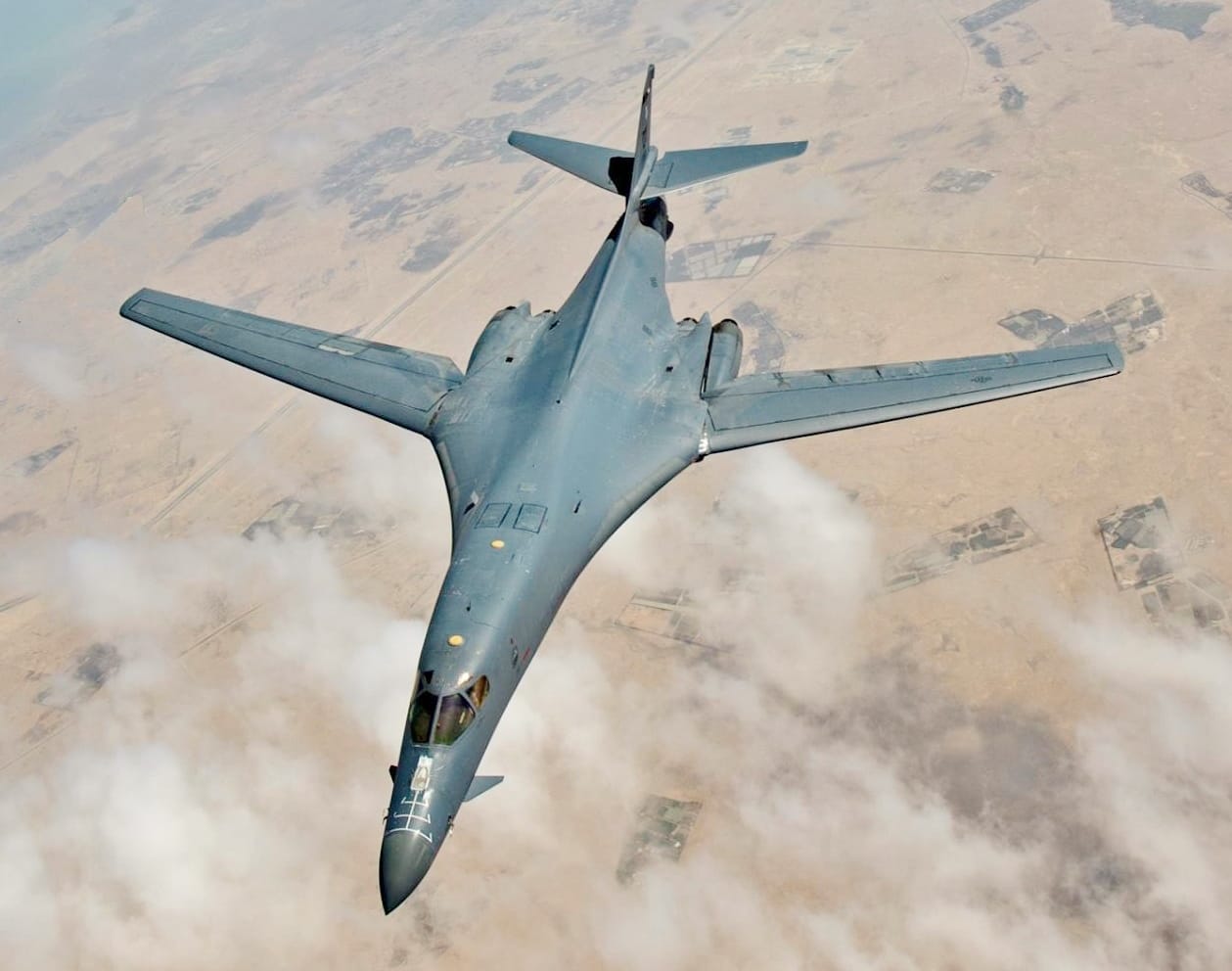
The Rockwell B-1B programme took to the air for the first time on 23 March 1983, in the shape of a modified B-1A testbed — and it should never have happened. Six years earlier, on 30 June 1977, President Jimmy Carter had stood before reporters in Washington and killed the programme that built it. "We should not continue with deployment of the B-1," Carter said, directing that production plans be discontinued. The Soviet penetration mission would be handled by cruise missiles and B-52s. The four Rockwell B-1A prototypes already flying would be parked in the desert. The 244 production aircraft would never exist.
Then Ronald Reagan walked into the White House. By 1981 the cancelled bomber was back, restructured, refitted, and aimed at a different mission entirely. On a clear March morning in Palmdale, California, two years later, B-1A airframe 74-0159 — now modified as the B-1B’s flying testbed — lifted its variable-sweep wings off the runway and turned the corner from cancelled programme to the bomber that would still be flying combat missions in 2026.
Quick Facts
Aircraft: Rockwell B-1B Lancer ("The Bone")
First B-1A flight: 23 December 1974
Cancelled by: President Jimmy Carter, 30 June 1977
Reinstated by: President Ronald Reagan, 2 October 1981
B-1B testbed first flight: 23 March 1983 — modified B-1A 74-0159
First production B-1B flight: 18 October 1984
Built: 100 production aircraft (1985–1988)
Still in service: 2026 (~45 jets active with USAF)
The bomber Carter killed
The B-1A was meant to be the Mach 2 penetration bomber that would replace the B-52. Four prototypes flew between 1974 and 1977. The later prototypes carried progressively more complete mission avionics. With variable-sweep wings, four GE F101 turbofans and a top speed of Mach 2.22 at high altitude, the B-1A was, on paper, the fastest combat aircraft Strategic Air Command had ever flown.
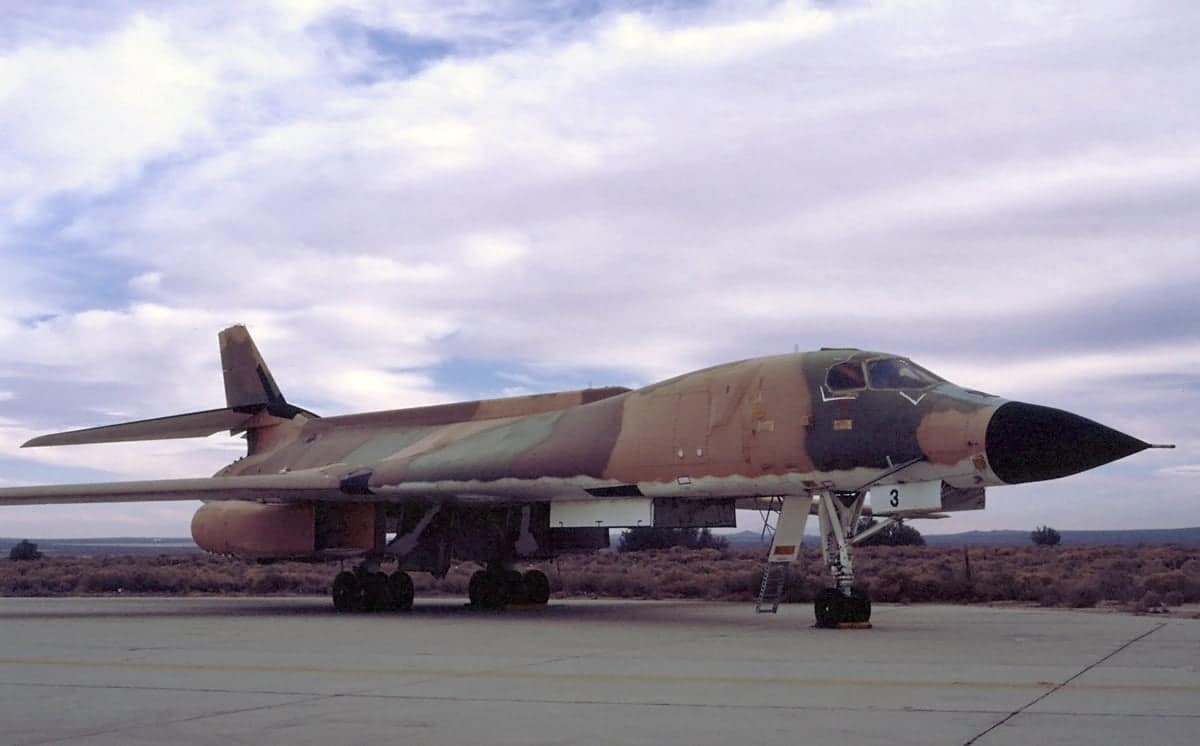
It was also expensive. Each B-1A was projected to cost roughly $100 million in 1977 dollars. The combined fleet of 244 was projected to cost $24 billion. Carter's senior advisers — including Defence Secretary Harold Brown — argued that the same penetration mission could be done more cheaply by sending older B-52s armed with the new AGM-86 air-launched cruise missile. The bomber would not need to penetrate Soviet airspace; the missile would.
On 30 June 1977, Carter announced the cancellation. The B-1A flight test programme was permitted to continue, partly as an aeronautical research effort and partly because Rockwell argued the data was valuable regardless of the production decision. Three B-1A prototypes kept flying through 1981, building up nearly 1,900 test hours.
Reagan brings the bomber back
Reagan made the B-1 a campaign issue in 1980. He criticised Carter's cancellation as evidence of strategic weakness against the Soviet Union. On 2 October 1981, eight months into his administration, Reagan formally reinstated the programme — but not as the original B-1A.
The new variant, designated B-1B, traded raw top speed for survivability and payload. Mach 2.2 at altitude became Mach 1.25. Low-altitude penetration speed — what would actually matter against modern Soviet SAMs — went up to Mach 0.92. The radar cross-section was reduced by roughly an order of magnitude. The avionics were rebuilt around the AN/APQ-164 multi-mode terrain-following radar. The internal weapons capacity was increased; cruise-missile carriage was added; the airframe was strengthened for sustained 200-foot AGL low-altitude flight.
23 March 1983 — Palmdale, California
The first flight of the B-1B programme was technically conducted by a B-1A airframe — 74-0159, the second B-1A prototype, retrofitted with the new electronic warfare suite, the larger fuel tanks and the new radar. Rockwell test pilots took the aircraft off from Plant 42 at Palmdale, flew an envelope-expansion sortie, and landed at Edwards Air Force Base. The B-1B production programme was officially under way.
The first new-build B-1B was rolled out at Palmdale on 4 September 1984 and made its first flight on 18 October 1984. Production accelerated rapidly. The 100th and final B-1B was delivered to the US Air Force on 2 May 1988. The fleet was, on paper, exactly what Reagan had promised: a 100-jet strategic bomber force capable of penetrating Soviet airspace at high subsonic speed at 200 feet AGL with nuclear and conventional payloads.
From nuclear penetrator to conventional workhorse
The Soviet Union dissolved in 1991. The B-1B's original mission disappeared with it. What happened next was extraordinary: the Air Force pulled the B-1B out of the nuclear stockpile, removed its nuclear capability under the START treaty in 1995, and converted the fleet to a pure conventional-strike platform. The Bone became the heaviest conventional bomber in the inventory — capable of carrying more bombs per sortie than any other aircraft except the B-52.
That mission has kept it busy for thirty years. The B-1B has flown combat missions over Iraq (1998, 2003, 2014–17), Afghanistan (2001–21), Libya (2011), Syria (2014–19) and Iran (2026). It carries the JASSM-ER cruise missile externally on new pylons. It has been pulled out of the boneyard at Davis-Monthan and put back into service at Dyess. And the fleet — now down to roughly 45 active airframes — is scheduled to fly until 2036, when the B-21 Raider finally takes over.
Forty-three years after the first flight at Palmdale, the B-1B is the rarest of American military aircraft — a strategic bomber whose own service decided it was worth keeping alive long after the war it was built for vanished. Carter cancelled the bomber that was supposed to penetrate Soviet airspace at Mach 2. Reagan brought it back as a slower, smarter, conventionally armed jet that has, since 1991, done more combat sorties than the B-2 and B-52 combined.
The B-1A testbed that took off from Palmdale on 23 March 1983 was lost in a crash near Edwards Air Force Base on 29 August 1984, killing Rockwell chief test pilot Doug Benefield. The 100 production B-1Bs that followed have flown roughly 1.6 million hours. The Bone may well be the only American combat aircraft that got cancelled, brought back, repurposed, and outlived almost every contemporary it once had.
Sources: Rockwell B-1 Lancer Wikipedia entry; key.aero (Jamie Hunter, "Flying the B-1B Lancer"); National Security Journal; The Aviationist; US Air Force fact sheet.
Related Questions
What is the B-1B Lancer?
The Rockwell B-1B Lancer, nicknamed "The Bone," is a long-range U.S. Air Force strategic bomber. A swing-wing aircraft built to penetrate enemy defences at low altitude, it entered service in the 1980s and around 45 remain active in 2026.
Why was the B-1 bomber cancelled and then revived?
President Jimmy Carter cancelled the original B-1A in 1977, judging it too costly and arguing missiles could do the job. President Ronald Reagan reinstated the programme in 1981 as the upgraded B-1B, which entered production and service later that decade.
When did the B-1 first fly?
The original B-1A first flew on 23 December 1974. After the programme was revived, a modified B-1A served as the B-1B testbed from 1983, and the first production B-1B flew on 18 October 1984.
How many B-1B Lancers were built?
Rockwell built 100 production B-1B Lancers between 1985 and 1988. About 45 remain in active U.S. Air Force service in 2026, decades after the type was nearly cancelled for good.
Why is the B-1B nicknamed 'The Bone'?
The nickname comes from B-One — written as B-1, it reads as Bone. Crews adopted the name, and the long, sleek swing-wing bomber has been known affectionately as The Bone throughout its service.
0 Comments