
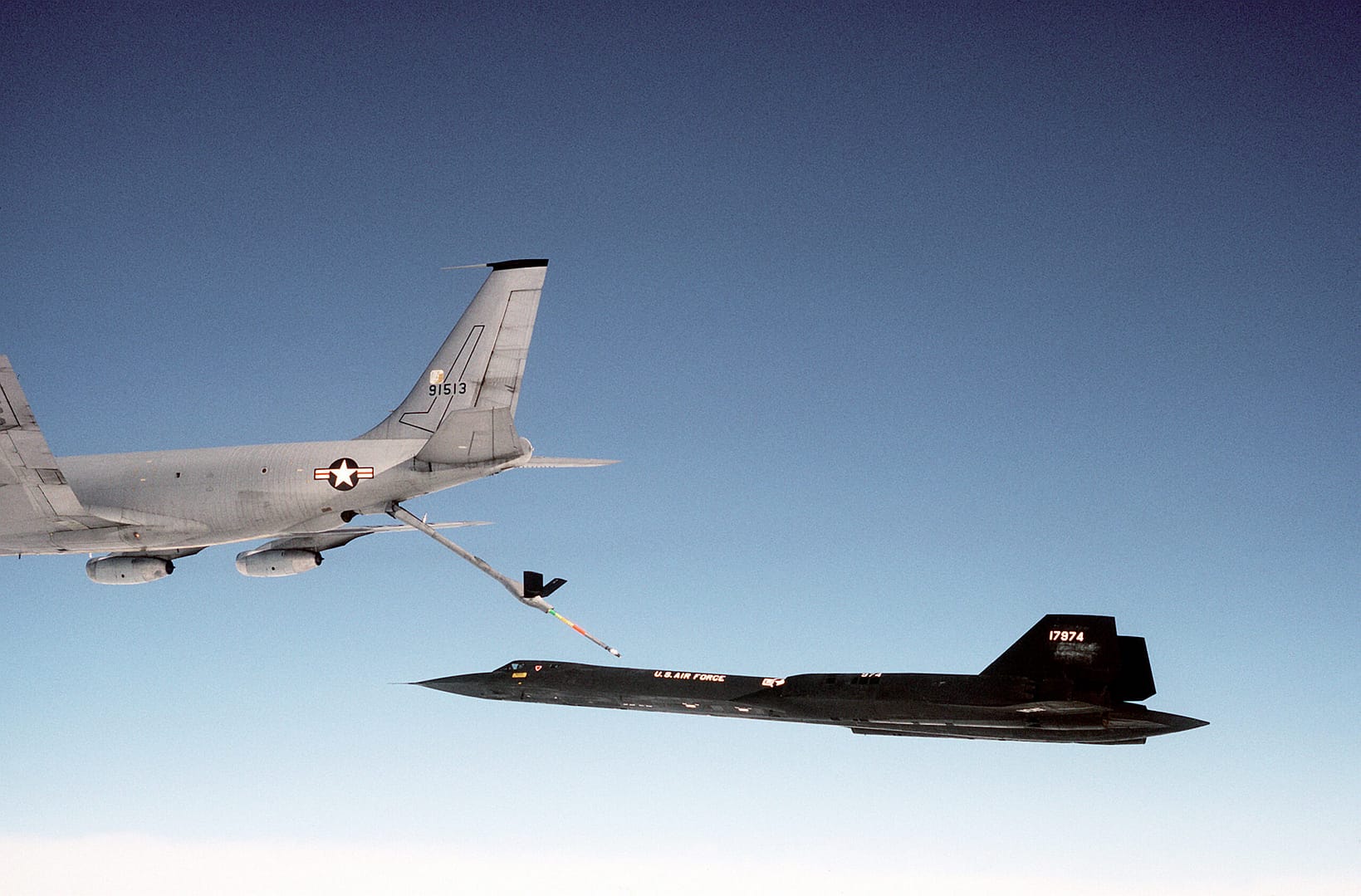
It's 2:00 AM over the North Atlantic. An F-15E Strike Eagle is running low on fuel 500 miles from the nearest divert airfield, cruising at 25,000 feet in total darkness. Ahead, barely visible against the black sky, a KC-135 Stratotanker trails a single red light from its belly. The fighter pilot inches forward, eyes locked on the dim row of director lights underneath the tanker. A boom operator, lying prone in a glass-walled station at the rear of the tanker, watches through night vision goggles as the fighter slides into position 50 feet below. Then, using a joystick that controls small winglets on a rigid telescoping tube, the boom operator "flies" the boom downward and plugs it into a receptacle on the fighter's spine. Contact. Fuel begins flowing at nearly 4,000 liters per minute. In under five minutes, the fighter will have a full tank -- and neither aircraft has deviated from its course by more than a few meters.
Quick Facts: Aerial Refueling
| First Aerial Refueling | 1923 (hand-held hose between biplanes) |
| Boom Flow Rate | ~4,000 liters/min (1,056 gallons/min) |
| Drogue Flow Rate | ~1,100-1,500 liters/min (290-400 gal/min) |
| USAF Primary Tanker | KC-135 Stratotanker / KC-46 Pegasus |
| Contact Speed | ~500-600 km/h (270-325 knots) |
| Boom System Users | USAF (primary) |
| Probe-Drogue Users | USN, NATO, most of the world |
| Refueling Altitude | Typically 20,000-30,000 feet |
The Flying Boom: The USAF Way
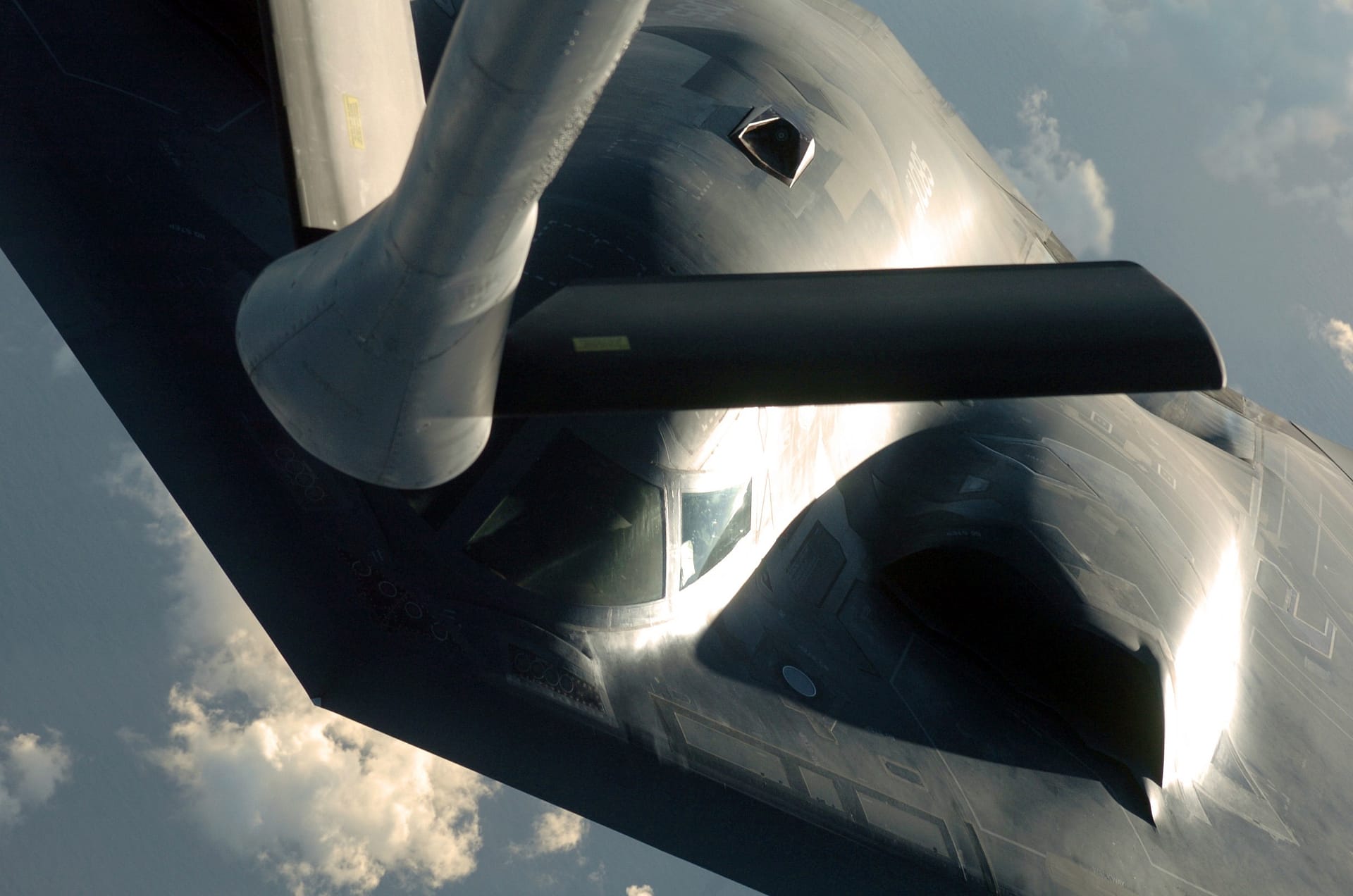
The flying boom is an elegant piece of engineering that looks, frankly, absurd. It's a rigid, telescoping pipe about 14 meters long that hangs from the rear fuselage of the tanker aircraft. Small aerodynamic surfaces called "ruddervators" -- essentially tiny wings -- allow the boom operator to maneuver it through the air. The receiver aircraft flies into a precise position behind and below the tanker, maintaining a speed of around 500 km/h, and the boom operator literally flies the boom down into a receptacle on the receiver's fuselage.
The genius of the boom system is its flow rate. Because the connection is rigid, fuel can be pumped at enormous pressures -- around 4,000 liters per minute, enough to fill a large strategic bomber like the B-52 in about 45 minutes. The KC-135 Stratotanker, which has been the backbone of USAF tanker operations since 1957, can carry over 90,000 kg of transferable fuel. Its replacement, the KC-46 Pegasus, uses the same boom principle but adds a remote vision system so the boom operator can work from a station inside the aircraft rather than the traditional belly window.
Probe and Drogue: The Rest of the World
The alternative system -- used by the U.S. Navy, NATO allies, and most other air forces worldwide -- works on a completely different principle. Instead of a rigid boom operated by the tanker, the tanker trails a flexible hose, typically about 22 meters long, with a basket-shaped drogue about 60 centimeters in diameter at the end. The drogue is stabilized by its own small parachute shape. The receiver aircraft is equipped with a fixed or retractable probe -- essentially a pipe sticking out from its nose or fuselage -- and the receiver pilot must physically fly the probe into the basket.
This means probe-and-drogue puts the workload on the receiver pilot rather than the tanker crew. It requires extraordinary precision: the pilot must maintain formation with the tanker while simultaneously steering a probe into a swaying basket, all at 500 km/h. The flow rate is lower -- typically 1,100 to 1,500 liters per minute -- because the flexible hose can't handle the pressures that a rigid boom can. But the system has one massive advantage: a single tanker can trail two or even three drogues simultaneously, refueling multiple aircraft at once.
Why America Can't Agree With Itself
The reason the United States operates two completely incompatible refueling systems is pure interservice rivalry. In the 1950s, the newly independent Air Force chose the boom system for its strategic bomber fleet because the higher flow rate was essential for refueling thirsty aircraft like the B-52. The Navy, meanwhile, stuck with probe-and-drogue because it worked better for the carrier environment -- you can fit a drogue pod under the wing of a tactical aircraft, turning any buddy aircraft into an impromptu tanker. Neither service has ever been willing to adopt the other's system.
The result is logistical absurdity. The KC-46 Pegasus tanker was designed with both a boom and wing-mounted drogue pods to serve both services. But Navy aircraft still can't use the boom, and Air Force aircraft mostly can't use the drogue. The F-35 added to the confusion: the Air Force version (F-35A) has a boom receptacle, while the Navy and Marine versions (F-35C and F-35B) have probes. Interoperability, decades later, remains an aspiration rather than a reality.
The Art of Not Dying at 500 MPH
What makes aerial refueling truly remarkable is how routine it has become despite remaining genuinely dangerous. The tanker and receiver are flying in close formation -- sometimes less than 20 meters apart -- at speeds approaching 500 mph, connected by a fuel line that's pumping thousands of liters of jet fuel per minute. Any loss of control, any sudden movement, any mechanical failure can result in a catastrophic mid-air collision.
Special operations take the danger to another level. Air Force Special Operations Command boom operators have mastered low-altitude refueling -- imagine the standard night refueling scenario, but at 4,000 feet with mountains nearby, wearing night vision goggles, with all external lights extinguished to avoid enemy fire. One account describes SOAR operators cutting all lights and diving to low altitude in the middle of a firefight to refuel an AC-130 Gunship that was running low while providing fire support. The marriage of precision flying, mechanical reliability, and raw courage that aerial refueling demands makes it one of the most impressive routine operations in all of military aviation.
Related Questions
How does aerial refueling work?
Aerial refueling transfers fuel from a tanker to a receiver aircraft in flight, letting combat aircraft fly far longer missions. There are two methods: the rigid "flying boom", flown by a boom operator into a receptacle on the receiver's spine, and the "probe-and-drogue", where the receiver pilot flies a probe into a trailing basket. Both happen at around 500 km/h.
What is the difference between boom and probe-and-drogue refueling?
The flying boom is a rigid telescoping pipe steered by a boom operator on the tanker, delivering fuel fast — about 4,000 litres per minute. Probe-and-drogue uses a flexible hose with a basket the receiver pilot must fly a probe into, transferring 1,100–1,500 litres per minute. The boom puts the workload on the tanker crew; the drogue puts it on the receiver pilot.
How fast does fuel transfer during aerial refueling?
A flying boom transfers roughly 4,000 litres (1,056 gallons) per minute — fast enough to fill a B-52 bomber in about 45 minutes. The probe-and-drogue system is slower, at 1,100–1,500 litres per minute, because the flexible hose cannot handle the pressure a rigid boom can. Refueling typically happens at 20,000–30,000 feet.
What is the flying boom on a tanker?
The flying boom is a rigid, telescoping pipe about 14 metres long that hangs from the rear of the tanker. Small aerodynamic surfaces called ruddervators let a boom operator "fly" it into a receptacle on the receiver. It delivers fuel quickly and is the primary US Air Force method, including for large aircraft like the B-2 Spirit stealth bomber.
Which air forces use boom versus probe-and-drogue?
The US Air Force uses the flying boom as its primary system. The US Navy, NATO partners, and most of the world use probe-and-drogue, which lets a single tanker trail two or three hoses and refuel multiple aircraft at once. Some tankers are fitted to do both, depending on the receiving aircraft.
What is the main US Air Force aerial tanker?
The KC-135 Stratotanker has been the backbone of US Air Force tanker operations since 1957, carrying over 90,000 kg of transferable fuel. Its replacement, the KC-46 Pegasus, uses the same boom principle but adds a remote vision system, letting the boom operator work from inside the aircraft rather than a belly window.
When was the first aerial refueling?
The first aerial refueling took place in 1923, using a hand-held hose passed between two biplanes — a crude but pioneering demonstration. The technique has since become essential to air power, a milestone in the broader history of military aviation from early biplanes to today's networked fleets.
Related Posts
- Boom or Basket: Why the World Can't Agree on Aerial Refueling


0 Comments