

The Junkers Ju 52 — affectionately known as Tante Ju (Auntie Ju) — is one of the most recognizable aircraft of World War II. Its corrugated duralumin skin, three engines, and fixed landing gear made it the workhorse of the Luftwaffe’s transport fleet. But there was one variant of this beloved transport that looked like nothing else in the sky: the Ju 52/3m MS, fitted with a massive aluminum ring beneath its fuselage, flying barely 20 meters above the waves to trigger magnetic naval mines.
It was, without question, one of the strangest — and most dangerous — aircraft conversions of the entire war.
Quick Facts: Ju 52/3m MS Minesweeper
- Designation: Ju 52/3m MS (Minensuche — mine search)
- Ring diameter: 14 m (46 ft) duralumin ring
- Ring material: Balsa wood frame containing aluminum coil, attached via plywood struts
- Power source: 150 kW diesel- or gasoline-engine-driven generator in cargo bay, producing 300 amps DC
- Operating altitude: 18–21 m (60–70 ft) above the water
- Mine detonation distance: ~300 m (980 ft) astern of the aircraft
- First operational flight: September 19, 1940 — Schelde estuary near Vlissingen
- Unit: Sonderkommando Mausi (later Minensuch Gruppe 1)
- Theaters: North Sea, Baltic, Atlantic coast, Mediterranean, Adriatic, Danube
The Magnetic Mine Problem
By 1939, the Royal Navy had introduced a devastating new weapon to the waters around Europe: the magnetic mine. Unlike traditional contact mines that required a ship to physically strike them, magnetic mines rested on the seabed and detonated when they detected the magnetic signature of a vessel’s steel hull passing overhead. They were nearly invisible, extraordinarily effective, and conventional minesweeping — dragging cables through the water — was useless against them.
The Kriegsmarine was desperate. Magnetic mines were choking vital shipping lanes along the coasts of occupied Europe, threatening Germany’s own maritime supply lines. Traditional minesweepers were too slow and too vulnerable. What was needed was something faster, something that could cover large areas of suspected minefields — something that could fly.
The Ring: Engineering the Impossible
The solution was brilliantly unorthodox. Engineers fitted the Ju 52 with a massive 14-meter (46-foot) diameter ring made of balsa wood framing containing an aluminum electromagnetic coil, attached beneath the wings and fuselage via plywood struts. Inside the cargo bay, a diesel- or gasoline-engine-driven generator produced 150 kilowatts of power, feeding 300 amps of direct current through the ring.
When the Ju 52/3m MS flew at low altitude — typically 18 to 21 meters (60 to 70 feet) above the water — the energized ring generated a powerful magnetic field below the aircraft. Any magnetic mine resting on the seabed within range would be triggered by this field. The mines had a roughly seven-second fuse delay, detonating approximately 300 meters behind the aircraft as it passed — close enough to feel the shockwave, but far enough to survive.
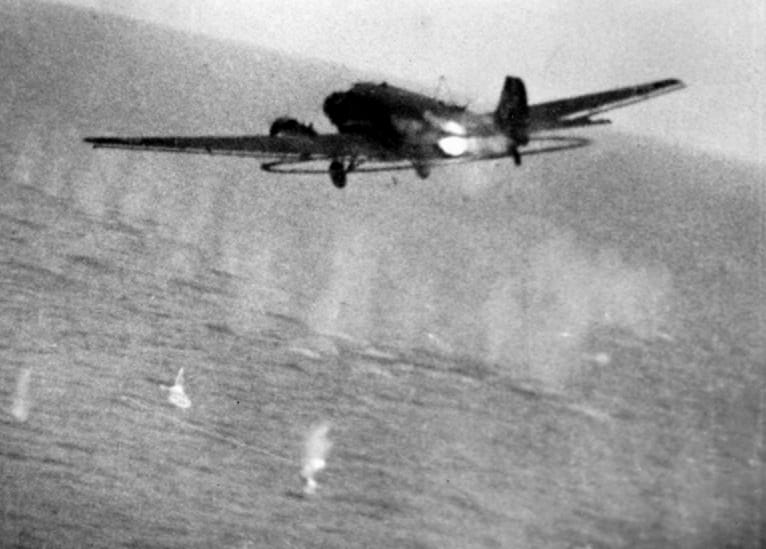
The concept was first tested in mid-October 1939, and the first successful operational test took place near the port of Vlissingen in the Netherlands, where the modified Ju 52 detonated several British mines. The first production Ju 52/3m MS was delivered in June 1940, and by September, the Luftwaffe had formed its first dedicated minesweeping unit: Sonderkommando Mausi — the “Mouse-Catcher” special command.
Sonderkommando Mausi: The Mouse-Catchers
The name “Mausi” — a diminutive of “mouse” — was a darkly humorous nod to the unit’s mission: finding and destroying hidden threats lurking beneath the surface. In October 1942, Sonderkommando Mausi was redesignated Minensuch Gruppe 1 (Mine Search Group 1) and expanded to become the administrative hub for six Minensuchstaffeln (mine search squadrons) that operated across nearly every maritime theater of the war.
The operational tactics were carefully choreographed. Two magnetic-coil equipped Ju 52/3m MS aircraft would fly in line abreast with 30 to 40 meters of lateral separation, sweeping a wide corridor. Behind them, trailing about 40 meters back, a third Ju 52 equipped with the Knallkörpergerät (KK-Gerät) — a device that dispensed 30 small explosive charges — would handle acoustic mines that the magnetic ring couldn’t trigger. It was aerial minesweeping as a coordinated ballet, performed at rooftop altitude over hostile waters.
Dangerous Skies, Deadly Waters
Flying at 20 meters above the sea was dangerous enough. But the Minensuchgruppe crews faced a far deadlier threat: enemy fighters. The northern French coast was the most critical — and most dangerous — area of operations. RAF and later American fighters routinely attacked the slow, low-flying Ju 52s as they tried to keep vital French coastal waters clear of Allied mines. The lumbering transports, burdened by their electromagnetic rings and flying at minimal altitude, were effectively defenseless. The Luftwaffe rarely provided fighter escorts.
Despite the losses, the Minensuchgruppe squadrons remained operational until the very end of the war. They swept mines from the Atlantic coast to the Danube River, where the RAF had begun dropping mines to block this critical inland waterway. Remarkably, after Germany’s surrender, the mine-sweeping Ju 52s continued their work — assisting Allied forces in clearing Baltic and North Sea minefields through 1946.
It remains one of the most bizarre aircraft conversions in aviation history: a civilian airliner turned military transport, turned airborne mine-hunter — with a giant aluminum ring and a prayer. The Ju 52 Minesweeper is a testament to wartime engineering ingenuity, born of desperate necessity and operated with extraordinary courage.
Sources
- Aerial Minesweeping: Ingenious Solution to a Hidden Undersea Menace — HistoryNet
- Junkers Ju 52 — Wikipedia
- Minensuchverbände Unit Histories — Luftwaffe Data Wiki
- Minensuchgruppe Mausi — Second Wiki
- Junkers Ju 52: The Saga of Iron Annie — PlaneHistoria
- Junkers JU-52/3mg6e MS Minesweeper — IPMS/USA Reviews

 English
0 Comments