
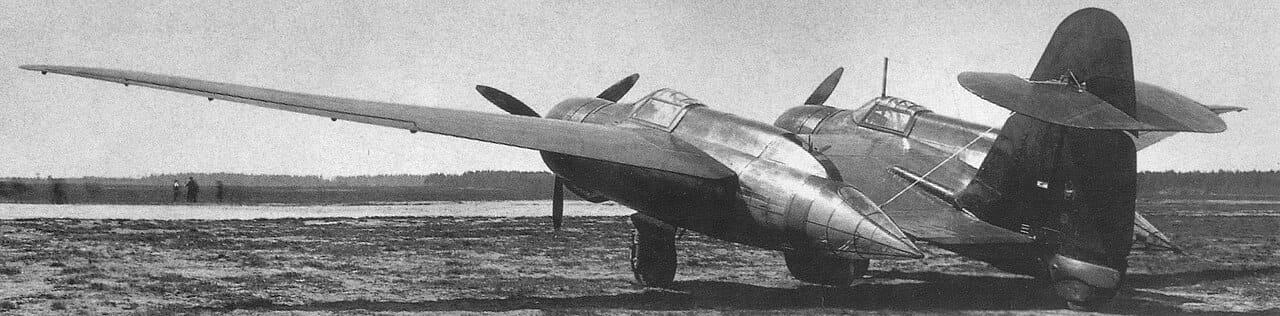
If you had asked a Soviet test pilot in 1940 to name the strangest aeroplane he had ever been ordered to fly, there is an excellent chance the answer would have come back as four syllables: Дэ-Бэ Эл-Ка. The Belyayev DB-LK. Two fuselages, no central cockpit, forward-swept outer wings, glazed bombardier stations grafted to the tail ends of each engine nacelle. It looked less like an aeroplane than like something a child had built from the spare parts of three other models.
The test pilots had a less polite name for it. They called it Курица. The Chicken. They did not mean it kindly.
Quick Facts
| Type | Twin-fuselage long-range bomber prototype |
| Designer | Viktor Nikolayevich Belyayev (TsKB) |
| First flight | Early 1940 |
| Wingspan | 21.6 m (70 ft 10 in) |
| Engines | Two M-87B 14-cylinder radials, 950 hp each |
| Max speed (achieved) | 488 km/h (303 mph) — well below the 547 km/h projected |
| Nickname | Курица ("Kuritsa" — "the Chicken") |
| Outcome | One prototype built. No production. Destroyed during WWII. |
A glider with ideas
Viktor Belyayev was not a fringe figure in Soviet aviation. He had worked under Andrei Tupolev throughout the 1930s on a series of large heavy bombers and had a deep engineering pedigree. What he also had was an obsession with the aerodynamic possibilities of the flying wing. His "batwing" glider, the BP-2, had been a successful test article in the mid-1930s, and Belyayev believed its short-fuselage, long-chord wing geometry could be scaled up to a combat bomber.
The DB-LK — Дальний Бомбардировщик-Летающее Крыло, "Long-Range Bomber — Flying Wing" — was the result. The design did away with the conventional fuselage entirely. The two M-87B engines sat at the front of two short fuselage pods, each ending in an extensively glazed tail cone that housed a radio operator/gunner station. The pilot and navigator sat in cockpits at the front of the pods, with the bomb load slung between them inside the wing centre section.
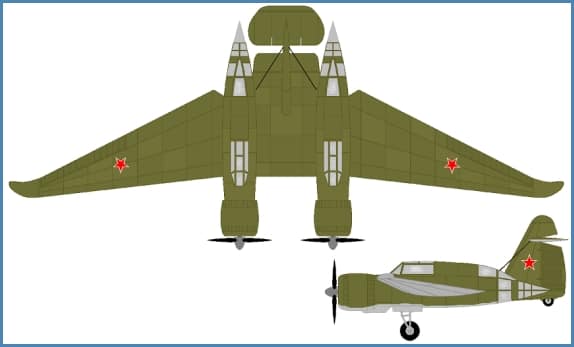
"The chicken"
Test pilots were reportedly unwilling to fly the DB-LK at all, citing the unconventional layout and the complete lack of flight envelope data for the configuration. It eventually fell to LII test pilot M.A. Nyukhtikov to take it up, after extensive fast-taxi trials — one of which ended with a collapsed undercarriage.
When the DB-LK finally flew, the performance was genuinely impressive on paper. The forward-swept outer wings — swept just 5 degrees 42 minutes, but swept forward, anticipating the much more famous experiments of the German Junkers Ju-287 and the American Grumman X-29 — produced excellent low-speed handling. The defensive armament had clear fields of fire that no conventional bomber could match.
What went wrong
The list of problems was not catastrophic individually — it was simply long. The take-off run was excessive because of high sensitivity to centre-of-gravity variations. The pilot cockpits had terrible visibility forward because they were tucked behind the propeller arcs and the wing leading edge. The crew complained that engine exhaust gases collected inside their compartments, forcing them onto oxygen masks. The crew could not see each other; the intercom was the only contact between cockpit and tail.
Most importantly, the design promised 547 km/h but delivered only 488. That offered no real advantage over the bombers already in service, and it was considerably slower than the next-generation Pe-2 entering service. The Soviet Air Force, the VVS, looked at the DB-LK, looked at its problems, looked at the production resources it would require, and said no.
A redesign as a dive bomber was discussed but abandoned. The single prototype's ultimate fate is unrecorded; it was most likely destroyed during the Second World War.
The Belyayev DB-LK story — a deep dive into one of the strangest Soviet bombers ever built, with rare period photographs and engineering diagrams.
Sources: Wikipedia; Plane-Encyclopedia; HandWiki; Military Matters / Forgotten Aircraft; Soviet engineering journals (1940 archives).
Related Questions
What was the Soviet bomber nicknamed 'the Chicken'?
It was the Belyayev DB-LK, an experimental Soviet twin-fuselage long-range bomber that first flew in 1940. Its odd, swept shape earned it the nickname Kuritsa — Russian for the Chicken. Only one prototype was built.
Why was the Soviet bomber called 'the Chicken'?
Because of its strange appearance. The twin-fuselage design with unusually shaped wings reminded observers of a chicken, giving it the Russian nickname Kuritsa. Its looks, not its performance, earned the name.
Did the 'Chicken' bomber ever enter service?
No. Only a single prototype was built. It flew in 1940 but fell short of its performance targets — reaching 488 km/h against a projected 547 km/h — and was later destroyed during World War II without entering production.
Who designed the Soviet 'Chicken' bomber?
It was designed by Viktor Nikolayevich Belyayev, a respected Soviet aircraft engineer, at the TsKB design bureau. His twin-fuselage DB-LK was an ambitious attempt at an efficient long-range bomber, even if it never went into production.
How fast was the 'Chicken' bomber?
The DB-LK reached about 488 km/h (303 mph) in testing — well short of the 547 km/h its designers had hoped for. The disappointing speed was one reason the unusual twin-fuselage bomber never advanced beyond a single prototype.
Related Posts
The Soviet Jet Train: When Engineers Bolted a Yak-40 Engine to a Railcar
The PZL M-15 Belphegor: A Jet-Powered Biplane Named After a Demon
0 Comments