

Somewhere over the Channel, in a slick of oil and cold grey swell, a fighter pilot is treading water and losing the argument with hypothermia. He hears it before he sees it: a slow, clattering drone, an aeroplane that looks less like it is flying and more like it is being carried aloft on stubborn faith. A biplane. A boat with wings. It circles once, then does the unthinkable — it lands on the sea, beside him, and a crewman leans out to haul him aboard.
That aeroplane was the Supermarine Walrus, and thousands of downed airmen owed it their lives. Ungainly to the point of comedy, it waddled on land like a duck and, in the words of one pilot, flapped about all over the sky. Nobody fell in love with the way it looked. Plenty of men fell to their knees thanking it.
Here is the twist worth savouring: this ugly duckling shared a father with one of the most beautiful aircraft ever built. The Walrus was designed by R.J. Mitchell — yes, the man who gave the world the Spitfire.
Quick Facts
| Type | Single-engine amphibious biplane — fleet spotter and air-sea rescue |
| First flight | 21 June 1933 (as the Seagull V), flown by “Mutt” Summers |
| Designer | R.J. Mitchell, Supermarine — designer of the Spitfire |
| Powerplant | One Bristol Pegasus radial (~680–750 hp), pusher propeller |
| Number built | More than 740 (Supermarine and Saunders-Roe, 1936–1944) |
| Nicknames | “Shagbat”; “Steam Pigeon” |
Mitchell’s other aeroplane
We remember Reginald Mitchell for elegance — the elliptical wing, the whisper of a fuselage that became the Spitfire. But a great designer solves the problem in front of him, and in the early 1930s the problem was not speed. It was survival at sea. Working at Supermarine, Mitchell led the team that answered a requirement for a spotter aircraft that could be flung off a warship, land on open water and be craned back aboard. First flown in June 1933 as the Seagull V, the result was pure function: a metal-hulled biplane you could beach, float or fly.
Almost nothing about it was conventional. The single Bristol Pegasus radial sat high between the wings in a pusher arrangement, propeller facing backwards, so that sea spray flung up on take-off flew past the blades rather than shattering them. It was the first British squadron aircraft with a fully retractable undercarriage — wheels that folded up so the machine could set down on water, then dropped again for a runway or a beach. It was noisy and cold and slow, and every one of those flaws bought it something better: it could go where sleeker aircraft could not, and come home.
Eyes of the fleet
Before radar shrank the world, a battleship’s vision ended at the horizon. The Walrus extended it. Catapulted off the decks of cruisers and battleships of the Royal Navy and the Royal Australian Navy, it climbed away to spot for the big guns, correcting the fall of shot that the gunners below could never see, and scouting for ships and submarines across thousands of square miles of empty ocean.

It was demanding, exposed work. The aircraft launched from a standing start down a short rail, then flew long patrols over hostile water. When the job was done the Walrus put down alongside its parent ship — no easy thing in a rolling sea — and was hoisted back aboard on a crane. By 1943 radar was doing much of the spotting from far less deck space, and the catapult flights began to fade. But the Walrus had already found its second, greater calling.
The Shagbat to the rescue
If the Walrus is remembered for one thing, it is this: pulling ditched airmen out of the sea. As the air war over the Channel and the Mediterranean intensified, the RAF’s air-sea rescue squadrons put the ugly amphibian to work doing what almost nothing else could — landing on open water, next to a man in a dinghy, and taking him home.
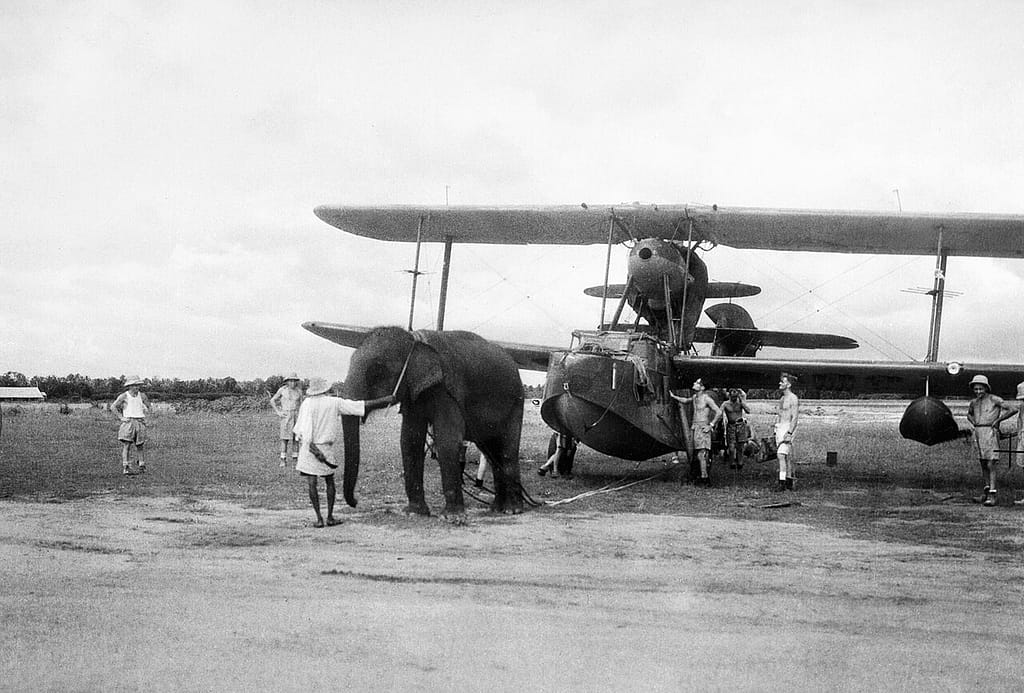
The crews flew low over grey seas hunting for a scrap of yellow, then risked a landing in swells that could smash a lesser hull. It is claimed the Walruses recovered well over a thousand airmen this way — British, Commonwealth and often enemy alike, because a man drowning is simply a man drowning. Only when the first practical helicopters arrived did the Walrus finally hand over the rescue watch. Not bad for a boat with wings — and further proof that Mitchell’s genius was not only skin-deep.
Sources: Wikipedia (Supermarine Walrus); Air Transport Auxiliary Museum; naval-encyclopedia.com; Wikimedia Commons.


0 Comments