
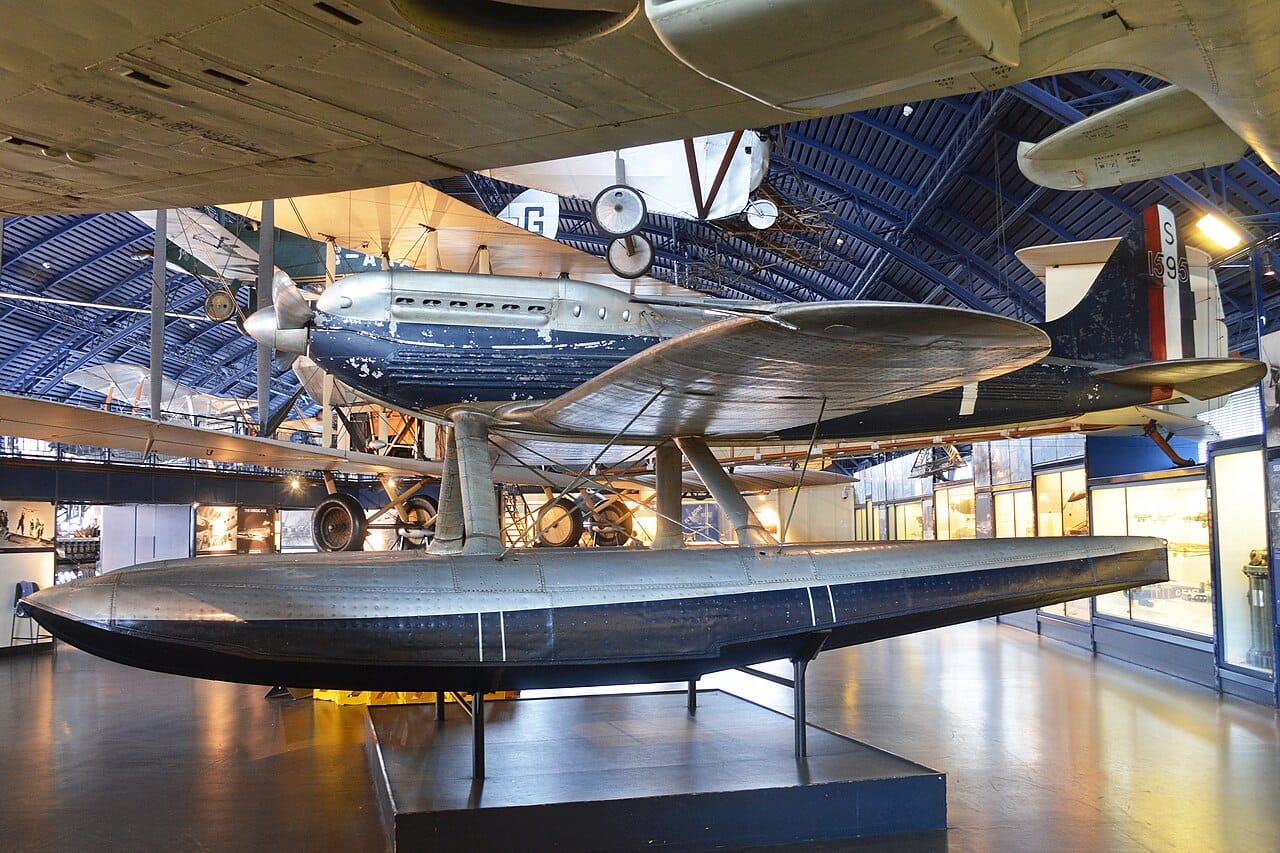
Before the Spitfire, before the Battle of Britain, there was a series of air races over water — gaudy, dangerous, and watched by hundreds of thousands. The Schneider Trophy looked like pure spectacle. In fact, it was quietly forging the engine and the designer that would help save Britain a decade later.
Between 1913 and 1931, the world’s fastest aircraft were seaplanes, and the Schneider Trophy was their arena. The rules were simple and ruthless: win it three times in a row, and you kept it forever. Britain did exactly that — and the technology it took to win fed directly into the Supermarine Spitfire.
QUICK FACTS
| Event | Schneider Trophy — international seaplane races, 1913–1931 |
| The rule | Three straight wins kept the trophy for good |
| British winner | Supermarine S.6B, designed by R. J. Mitchell |
| Engine | Rolls-Royce “R” — about 2,350 hp |
| 1931 win | 13 Sept — Flt Lt John Boothman flew the course |
| Speed record | 29 Sept — 407.5 mph, the first aircraft past 400 mph |
| Legacy | The R engine begat the Merlin; Mitchell begat the Spitfire |
The race that almost didn’t happen
By 1931, Britain had won the Schneider Trophy twice in a row, with Mitchell’s sleek Supermarine floatplanes. One more win would secure it permanently. Then, in the depths of the Depression, the government pulled the funding. The British entry was dead — until an eccentric, fiercely patriotic millionaire stepped in.
Lucy, Lady Houston, wrote a cheque for £100,000 — an enormous sum — to keep the team alive, backed by a press campaign that shamed the government. Her reasoning was pure defiance.

How a racing seaplane shaped Britain’s future.
Two flights that made history
On 13 September 1931, with the Italian and French teams unable to field an aircraft in time, Flight Lieutenant John Boothman flew the S.6B around the course at Calshot and won the trophy outright — Britain’s third straight victory. The Schneider Trophy was Britain’s to keep, and the contest was over forever.
Sixteen days later, on 29 September, Flight Lieutenant George Stainforth took another S.6B and pushed it to 407.5 mph — the first time any aircraft had exceeded 400 miles per hour. It was a staggering number for 1931, and it was made possible by the brutal, accelerated engineering the race demanded.

From racing floats to the Battle of Britain
Here is why the Schneider Trophy mattered far beyond sport. To win it, Rolls-Royce had to wring unheard-of power from its “R” engine, pioneering sodium-cooled valves and spark plugs that could survive enormous boost. Those hard-won lessons were poured straight into the company’s next design: the Merlin.
And the designer of those winning seaplanes was Reginald Mitchell, who took everything he had learned about speed, streamlining and cooling and applied it to a land-based fighter with elliptical wings. It is too simple to say the Schneider races “won the Battle of Britain” — the Spitfire and the Merlin both matured enormously in the years that followed. But without the crucible of the Schneider Trophy, neither would have started from such a commanding lead.
The races ended in 1931, their trophy retired to a display case. Their real legacy took to the air five years later, painted in RAF camouflage, and is still flying at airshows today. Sometimes the most important machines are the ones that teach us how to build the next one.
The Schneider Trophy air races, 1913–1931.
Period newsreel of the 1931 British triumph.
Sources: Science Museum Group; BAE Systems heritage; Rolls-Royce heritage; The History Press.
0 Comments